
Large Language Models (LLMs) sit at the heart of artificial intelligence, fueling solutions from chatbot services to enterprise systems. While power rests within the capabilities of these models, custom instructions depend on their output; hence, Custom LLM Prompt Engineering has become a serious area within AI development.
The prompt engineering market is exploding from $280 million in 2024 to an anticipated $2.5 billion by 2032, yet 74% of companies still struggle to achieve and scale AI value. The gap isn’t in the technology—it’s in how we communicate with it.
With the Structured LLM Prompt Engineering Strategies, an output can be improved, minimized from errors, and directed toward a certain goal. Unlike traditional inputs, finely crafted prompts provide businesses with accuracy, context, and consistency in functioning efficiently.
Consider this article to be your LLM Prompt Engineering Guide that highlights increasing worker productivity, workflows, and ensuring more reliable AI-driven solutions. The cultivation of working prompt applications, from technical things such as code generation through enterprise applications such as compliance reporting, has a direct influence on how well the LLMs are translated for real-world contexts.
What is Custom LLM Prompt Engineering?
Custom LLM Prompt Engineering is the term used when one is designing prompts that guide the large language models in producing outputs that are the most accurate and relevant. The general prompts generate a broad response, while custom prompts are defined with regard to specific applications, industries, or enterprise use cases.
The main difference is adaptability. General prompts work best with open-ended tasks but often lack consistency and depth. Large Language Model Prompt Engineering, on the other hand, involves customizing to meet specific needs, such as regulatory compliance, domain-specific vocabulary, or structured workflows.
Customization is needed most in professional contexts where accuracy and dependability cannot be compromised. For instance, in finance, law, or health-care settings, the language model would have to be subject to defined constraints. Following all the Prompt Engineering Best Practices would allow an organization to have consistency and limit the risk of hallucination and irrelevant responses.
So, it becomes highly crucial to opt for technical support from a highly experienced AI development company to embrace the benefits of LLM prompt engineering.
Such immense detail ensures that outputs are not merely right but also appropriate for the end user. It creates the ability for businesses to ensure that interaction across projects remains intact, enhances collaboration between various teams, and ultimately enables the output to integrate well with existing workflows. Over time, such engineering patterns will form deployment-ready models, capable of earning the trust of decision-makers.
Proven Strategies for Effective Custom LLM Prompt Engineering
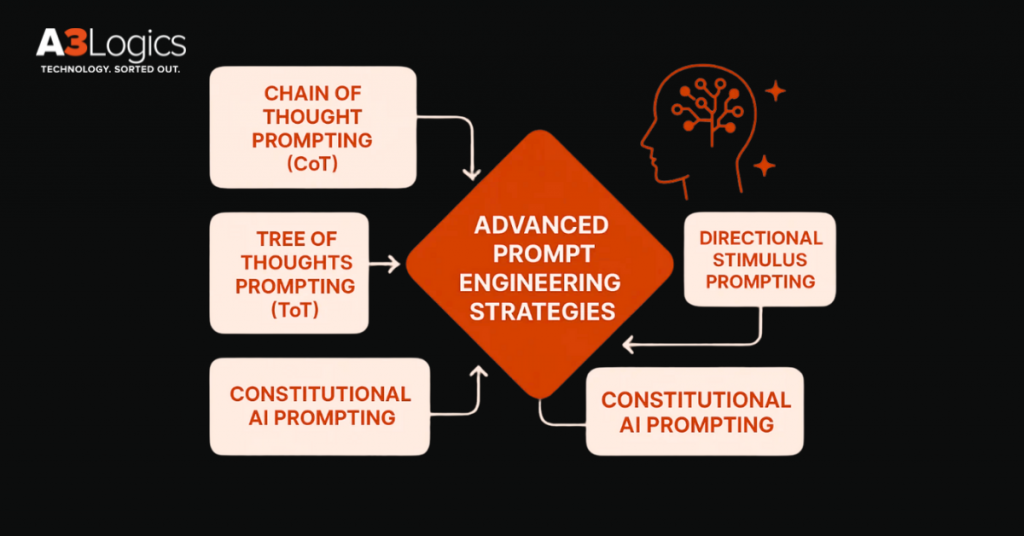
Whether you are opting for LLM product development from scratch or just choosing the custom LLM prompt engineering, here are the strategies that helps to elevate the overall capability of the software.
> Clarity and Specificity
Clarity is the most fundamental aspect considered while designing a prompt. Any kind of ambiguity will confuse the model, which will then mostly generate generalized, inadequate, or completely irrelevant outputs. In contrast, a clear prompt lays down the task at hand, the format expected, and the boundaries within which the response has to fit.
In Custom LLM Prompt Engineering, the existence of word count, tone, or formatting-related constraints may greatly enhance the quality of the end results. For example: “Explain blockchain technology in exactly five bullet points with short explanations,” which commands the LLM to be structured and concise.
This agrees with Prompt Engineering Best Practices, where clarity relieves the cognitive pressure for the model. Enterprises that consistently do this when issuing prompts report fewer errors and a faster time to market with LLM-powered systems. On the customer-service side, specific prompts allow agents to retrieve accurate, real-time answers and reduce average response time significantly.
> Contextual Framing
Without any context, LLMs act vaguely, often giving generic outputs. Accuracy improves when contextual framing offers domain knowledge, prior conversation details, or situational background. So, for healthcare, a simple question like “What is EDI?” would return a broad definition, but if the same question is framed as “In the context of U.S. healthcare compliance, explain how EDI reduces claim processing delays,” the model responds with something much more targeted and useful.
Using Custom LLM Prompt Engineering effectively ensures that prompts inherently include information to direct the model to the desired result. Context has an immense effect on the LLM Prompt Engineering Guide frameworks, where prompts are fine-tuned for specific industries. In retail, for example, contextual prompts help create customer engagement scripts weighted to product categories.
> Step-by-Step Guidance
LLMs often get overwhelmed when complex tasks reach them as a single instruction. Stepwise instructions factor the entire task into much smaller logical blocks so that models can churn out their outputs in an organized manner and with more certainty. For example, rather than asking, “Summarise this research paper and state some points,” it would be better to ask these questions:
- Summarise the key findings of the research paper.
- Highlight three insights relevant to business decision-making.
- Propose some practical applications in marketing or operations.
This decomposition enhances the quality of the outputs and ensures full coverage of all aspects that are requisite. In Custom LLM Prompt Engineering, stepwise instruction becomes very critical with workflows that need very high levels of precision, such as financial auditing or medical diagnostics.
> Incorporating Examples
Examples serve as templates for LLMs to guide them toward a desired structure, tone, or format. Similar to how humans learn through imitation, models generate much better results when they are shown what is expected. For example, when describing products, embedding a description as a sample within the prompt helps ensure that the output of hundreds of other descriptions is consistent with the same style.
In Custom LLM Prompt Engineering, using examples proves to be one of the most favored approaches for specialized domains. Legal offices will throw in sample case briefs when they instruct models to draft new ones. Likewise, technical teams provide example code snippets to steer LLM generation into the same language or structure.
The value of this approach is further reflected in AI prompt engineering tips, which point out that fewer repetitive iterations need to be constituted once examples are provided. When you effectively use AI prompts, you can guide the model more accurately from the start, reducing back-and-forth adjustments and improving overall efficiency. Their enterprises already benefit from a much more efficient and assured quality-based approach when output matches some precedent examples.
> Role Specification
The assignment of roles for the LLM helps set the outputs in the correct direction for the required domain expertise to some extent. For instance, instructing the model with “act as a financial advisor” will do so only to maintain the analysis tone required in investment-related contexts. Instructing the model to “respond as a customer support representative” will drive one toward more empathetic, solution-based responses.
Determining the role is critical in Custom LLM Prompt Engineering since it allows one to scale from generic outputs to the industry level. Role assignment is a very straightforward method in LLM Prompt Engineering Strategies, yet it is one of the strongest ways to ensure professional and consistent output.
Industries such as medicine, law, and education can benefit greatly from role-specific prompts. In a healthcare context, the model needs to be instructed to act as a compliance officer so that the output complies with regulations. In an educational setting, the tutor model helps adjust responses according to different learning levels.
Best Practices in Custom LLM Prompt Engineering
1 Iterative Testing and Refinement
LLM Prompt Engineering Guide frameworks underscore the importance of evaluation or feedback loops. Iterative tuning helps organizations develop an understanding of what instructions are most reliable for certain tasks. Otherwise, they fall into the trap of a one-size-fits-all approach for all their industries to hesitate before scaling with confidence.
From the perspective of enterprises, iterative testing goes hand-in-hand with Prompt Engineering Best Practices as it involves constant re-adaptation of the prompts to fit model improvements and newly arising needs. Consider it an ever-continuing process, in a way similar to maintaining software systems so they remain relevant.
2 Understanding Model Limitations
Even the most advanced LLMs have their limitations. A few such issues include token length constraints, factual inconsistencies, hallucinations, etc. If prompts are designed without any regard to these limitations, then outputs may lose their reliability. For instance, telling an LLM to summarize a 50,000-word legal document might be beyond the model’s token window, so it could not give a complete response.
Custom LLM prompt engineering counteracts this by making prompts that take those constraints into consideration. Breaking down bigger inputs into smaller chunks or instructing the model to summarize in steps helps greatly with token limitations. Likewise, fact-sensitive tasks like healthcare claims or compliance documentation can do well when models are grounded in domain-specific contexts, thereby reducing hallucination risks.
3 Avoiding Ambiguity
Ambiguity is a huge barrier to the application of LLMs across industries. Prompt Engineering Best Practices highly recommend precision to build in reliability and to reduce human rewrapping. Enterprises specify task, tone, format, and scope so that outputs conform to organizational standards.
Clear instructions, such as “Respond in a polite tone with step-by-step troubleshooting instructions,” yield better responses from customer service bots, whereas vague ones like “Help the customer” inhibit the quality of responses. Precision saves time, upholds professionalism, and keeps the brand identity intact.
4 Leveraging Advanced Prompt Techniques
Advanced prompting techniques push LLMs to deliver outputs that go beyond surface-level responses. These include:
- Chain-of-Thought Prompting: Splits the reasoning into steps, thereby helping the model be more accurate in logical or mathematical-type problems.
- Few-Shot Prompting: Gives a few examples in the prompt to nudge the model on the output format and tone.
- Zero-Shot Prompting: Instructs the model to undertake tasks without being given examples on how to do so, instead leaning on all its general understanding.
- Self-Ask Prompting: Prompting the model to ask itself clarifying questions before providing answers to curb mishaps.
Step-by-Step Guide to the Prompt Engineering Process
Having an understanding of “how to develop an LLM model” is a great idea to ensure that pre-defined KPIs are being achieved throughout the development lifecycle.
Step 1: Understand the Problem Statement
The first step in Custom LLM Prompt Engineering is to decompose the exact problem statement. Any sort of vagueness will cause problems in efficiency during the next stages of prompt development. This step would ensure that prompts are getting utilized for very specific ends, and not for a generalised request. The lack of any clear problem statement eventually renders any advanced set of LLM Prompt Engineering Strategies worthless; thus, problem clarity is a critical starting point.
Step 2: Craft the Initial Prompt
Following the problem definition comes the second step in Custom LLM Prompt Engineering. Keep it simple, specific, concrete, and structured. Instead of “Summarize this,” one could write, “Summarize this article into three points about financial results.” Defining formats for responses reduces irrelevant responses. The first version serves as a baseline for iteration. At this stage, using AI prompt engineering techniques helps ensure that prompts are clear enough to guide the model’s reasoning but still allow room for further refinement.
Step 3: Analyze and Evaluate Model Outputs
Evaluation starts the Custom LLM Prompt Engineering procedure. It must be assessed if the model response is accurate, incomplete, or ambiguous. The business can use its custom criteria, for example, factual correctness, tone, and logical flow. Hence, fraud-detection prompts should develop relevant and actionable insights. Consistency across runs is crucial. If randomness is in one outcome after another, tighter prompts should be designed. Supporting the evaluation with an LLM Prompt Engineering Guide will help structure the evaluations, rendering them much easier to evaluate prompt quality and reliability.
Step 4: Refine Based on Performance
There are multiple practices that help to refine custom LLM prompt engineering. For example, A/B testing helps to identify the best-performing version of the complete model. Feedback from the users assists in recognizing the areas for improvement and making the fixes.
In other words, iteration leads to consistency while also aligning responses with organizational goals. The iteration process is highly preferable when it is done according to Prompt Engineering Best Practices, as this reduces the chances of prompts becoming inconsistent, irrelevant, and ineffective through various applications.
Step 5: Test Prompts Across Multiple Models
In Custom LLM Prompt Engineering, platforms are being explored to recognise prompt effectiveness since different models process prompts differently. A prompt that serves well on GPT may act differently on Gemini or Claude; cross-model evaluation allows for small adaptability and not being reliant on one tool. Benchmarks would assess accuracy, latency, and stability across engines, making the larger system less vulnerable.
This component is incorporated into Large Language Model Prompt Engineering, where companies can realize value from flexibility across multiple tooling platforms.
Step 6: Scale or Automate Prompt Logic for Production
The last stage in Custom LLM Prompt Engineering is scaling the optimised prompts for production. This can be embedded into workflows, APIs, or applications for consumption by customers. In this step, automating them is important for high request volumes and quality. Optimised prompts could also power socially interactive chatbots, reporting tools, or data pipelines.
In this stage, businesses must test for stability, compliance, and security standards. Monitoring ensures reliability with evolving needs. Scaling becomes easier when the LLM Prompt Engineering guide shows the design process and helps maintain prompt effectiveness at the enterprise scale.
Real-World Applications of Prompt Engineering
1. Program-Aided Language Models (PAL)
The Program-Aided Language Models combine the reasoning capabilities of LLMs with the ability to use structured external computational and logic-based tools like Python and SQL. Program-Aided Language Models prompts indicate to the Language Model where to assign calculations and logic-based activities to a provided tool.
This allows for more reliable outputs. In the context of financial analytics or data science, outputs can now be improved in reliability and accuracy. Using Custom LLM Prompt Engineering techniques for business development, developers can enable prompts that cause the model to understand when to assign an external calculation to acquire outputs with speed and reliability.
2. Data Generation for Training and Testing
Organizations frequently encounter difficulties in sourcing clean, labeled datasets for machine learning. However, with prompt design, LLMs can produce synthetic but realistic datasets for AI projects and machine learning. For example, a healthcare startup could produce patient dialogues for chatbot training. These prompts have to include tone, type, content, and context in order to help the company ensure the output is aligned with the regulatory requirements. Organizations are faced with the challenge of ensuring that AI prompts describe the tone, type, and content of the data, and the context in which the data would be used.
While using AI prompt engineering tips, organizations focus less time on manually creating datasets, which can help generate diverse and relevant outputs of training scenarios.
3. Code Generation and Debugging
Custom LLM Prompt Engineering has one of the most impactful applications in software development. Developers can create prompts that direct LLMs to generate code, offer optimized algorithms, or indicate bugs in previously written code. By stating programming language, error boundaries, and efficiencies in a prompt, engineers can receive outputs that save tons of time. Corporations used the prompting technique to reduce their release cycle time and generally automate repetitive tasks. This use case illustrates a concrete application of Prompt Engineering Best Practices in a production setting.
4. Function Calling with LLMs
Modern-day models such as OpenAI’s GPT and Google’s Gemini are now capable of function calling. In this case, the prompts instruct the model to return structured outputs that cause external APIs or database queries. For example, a banking chatbot could have a prompt instructing the model to balance check without allowing the end-user to access sensitive logic. It is important to create this prompt so that the function call works properly, prevents errors, and protects any sensitive logic. The work done to integrate these systems is a leading use of Large Language Model Prompt Engineering.
5. Context Caching with Gemini 1.5 Flash
A known challenge with LLMs is tracking the context while interacting across many sessions without exceeding token limits. Gemini 1.5 Flash includes context caching capability, which allows the models longer session memory retention. Provided you have the right prompt design, businesses can signal to the model what context to emphasize and retain.
For example, a customer service assistant can hold user history throughout the entirety of the conversation, which should improve response quality. Here, custom LLM prompt engineering is very important for context size and efficiency.
6. Synthetic Dataset Creation for RAG Systems
Retrieval-Augmented Generation (RAG) systems couple LLMs with sources of external knowledge, such as document databases. To develop these systems, organisations often need synthetic datasets that mimic users’ queries and knowledge retrieval behaviour patterns.
Prompt engineering helps to generate synthetic datasets and ensure that datasets are relevant to the system’s domain. For example, a legal firm may generate a dataset of case-and-disposition-based queries to develop and train its RAG Assistant. LLM Prompt Engineering Guide enables datasets to incorporate the necessary edge cases and the more mainstream needs of users.
Why Choose A3Logics for Custom LLM Prompt Engineering?
At A3Logics, we recognize that AI effectiveness depends on the formulation of prompts just as much as the development of the model. Thus, our expertise in Custom LLM Prompt Engineering forms the very backbone of enterprise-ready system building.
We possess intricate knowledge of LLM Prompt Engineering Strategies acquired over time by implementing solutions across various things: healthcare, finance, logistics, and e-commerce.
A3Logics lays great emphasis on a refined LLM Prompt Engineering Guide for every project undertaken. We use a mix of iterations and refinements, cross-model testing, and evaluation frameworks to bring a final product that improves accuracy yet eliminates risks such as hallucinations, thus achieving stability in scaling AI systems to production environments.
When you partner with A3Logics, you don’t have to deal with puzzling prompts, hours wasted figuring out trial and error, and models getting you partial answers. Our aim is at the heart of your frustration. We make Custom LLM Prompt Engineering solutions to save you time, diminish errors, and direct your ideation to where you want it to be.