Banks divide their customer base into small groups consisting of similar features, in order to serve them in a more personalized way. It helps them to understand their clients’ needs and preferences by applying customer segmentation analytics in banking and gain deeper insights for targeted decisions.
The present dynamic environment of the financial industry demands better and quicker solutions to sustain customers and grow in the highly competitive market. Innovative AI and analytical tools enable finance businesses, including banks, to leverage advanced methods for enhanced CRM and marketing strategies.
According to stats, customer segmentation in fintech has helped to divide the market in five different segments: tech-savvy millennials ($60B+ market), busy professionals ($50B+), small businesses ($100B+), students ($20B+), and underserved populations ($70B+). This data has helped banks and fintech institutions to increase CAC, per-user revenue, and more.
This blog will cover the related concepts to banking customer segmentation analytics, and associated benefits along with key challenges. We will also explore why partnering with a technological expert such as A3Logic is essential to get progressive data analytics services.
What is Customer Segmentation Analytics in Banking?
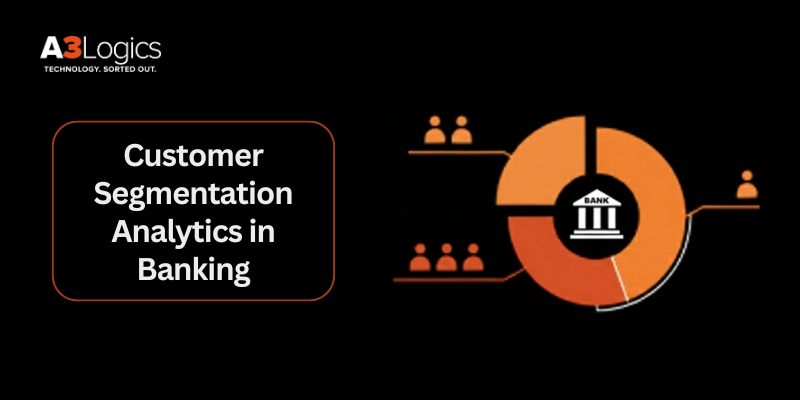
Customer segmentation analytics in banking is the practice of using data analytics techniques over each of the different divisions of customers sharing similar characteristics. The similarities can be demographic, geographic, psychographic, or behavioral.
This modern approach of AI-driven customer segmentation in banking leverages various advanced tools such as Machine Learning, data mining, predictive analytics, and CRM systems to derive real-time insights into changing customer habits and preferences. It is substituting the fixed and structured methods of traditional segmentation, which were based on manual analytics and were incapable of handling vast data.
Data analytical tools powered by AI and ML gather, arrange, and manage customers’ raw information from various sources, clean and analyse it to find useful details and identify similar patterns or attributes to categorise them for further actions.
Banking customer segmentation analytics is allowing different organizations, including retail banks, corporate banks, NBFCs, and fintechs, to offer more personalized products and services, considering their specific needs and preferences.
Why Customer Segmentation is Critical for Modern Banks
Banking customer segmentation analytics has become an essential practice to keep up with the changing landscape of the financial market by embracing fintech software development services.
- Customers want personalized solutions for their unique requirements, demanding an individualized study of their specific interests.
- Everyday new players from fintech and neobanks are entering into the market, laying countless options in front of customers, and making it crucial to implement customer segmentation models in banking.
- Modern banks are facing immense regulatory pressure to maintain 360-degree ethics in their analytical practices and manage risk with a proactive action plan, contributing to another major reason for adopting banking customer segmentation analytics.
- Implementing AI analytics for understanding clients’ needs and interests increases their satisfaction level, directly impacting lead generation, customer retention, loyalty, revenue growth, and operational efficiency.
Key Types of Customer Segmentation in Banking
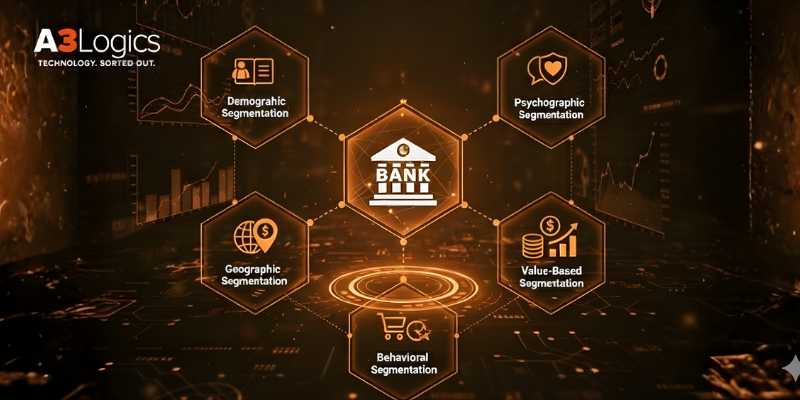
The following are the key ways banks can categorise their customer base into different segments:
1. Demographic Segmentation
This type of segmentation classifies customers on the basis of their age, gender, education, income level, and marital status. Demographic factors affect choices and preferences; for instance, young people like digital solutions, whereas older generations still trust only physical branches of banks.
2. Geographic Segmentation
Under this segmentation, groups are made according to the geographical location of the customers. It enables the banks to cater to local banking needs and avail region or city-related opportunities, such as area-wise housing market or opening community-based savings accounts.
3. Behavioral Segmentation
Banks can group their customers based on their buying and spending behavior to understand how particular customers engage with financial products and services, and develop customized marketing strategies using AI-driven customer segmentation in banking.
4. Psychographic Segmentation
Customers’ unique psychological attributes are the primary focus of this type of segmentation, and similar ones are assembled. Banks analyse their lifestyle, values, attitude, personality, and social status to offer products or services that match their specific interest.
5. Value-Based Segmentation
The value a certain customer brings to the banks falls under this type of segmentation strategy. High-value customers are rewarded with personalized services, whereas those with low value generation are served through automated channels to ensure optimum use of resources.
How Customer Segmentation Analytics Works
Customer segmentation models in banking follows an systematic process of collecting and employing a vast amount of data in different steps:
1. Data collection from multiple banking touchpoints
As banks classify their customers on the basis of their shared characteristics, gathering their relevant information is the primary task. For this, the client’s past and real-time data from various mediums, such as their transaction history, interaction through websites, ATMs, and mobile apps, their demographics, and the type of accounts they hold, are collected.
2. Data cleansing, enrichment, and unification
After fetching the data, it is cleaned to remove errors, copied or missing values, and prepare a unified view. Then, internal and external data is combined to enrich its quality and lastly integrated into one place for unified access and to build a coordinated database.
3. Analytics and modeling process
At this stage, similar patterns and features between the different customers’ data are identified to segment them into groups. This process is assisted by the use of the Machine Learning and Predictive modeling techniques, which help in summarising the databases.
4. Continuous refinement using real-time data
As customer data and market scenarios keep changing, it is important to refine the segmentation model continuously to keep AI customer segmentation for banks relevant and effective for marketing campaigns.
Technologies Powering Customer Segmentation Analytics
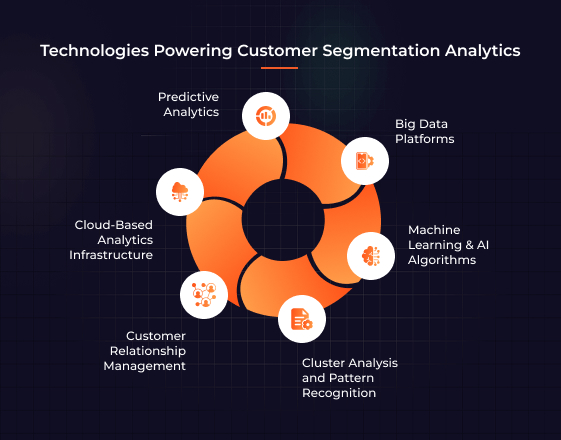
The following technologies accelerate AI customer segmentation for banks:
1. Big Data platforms
Data collected in different locations are processed on big data systems and useful information is extracted on them through the application of data mining procedures.
2. Predictive Analytics
These techniques enable the banks to anticipate future needs or behavior of customers in a particular segment, through historical data analysis, and adjust their marketing efforts accordingly.
3. Machine Learning & AI algorithms
ML and AI algorithms facilitate automatic segmentation of customers on the basis of their shared attributes, and also ensure the relevance of these groups over time by introducing updates frequently.
4. Cluster analysis and pattern recognition
It allows the banks to design targeted marketing strategies for different segments of customers with the same characteristics by identifying similar patterns in the databases.
5. CRM
Customer Relationship Management systems put customer data together in one place to provide a holistic view of every detail. Banks can easily track their customers’ behaviour, engagement with products/services, and transaction history.
6. Cloud-based analytics infrastructure
This modern solution eliminates the need for physical setup for storing and analysing vast amounts of data in a cost-effective way.
Key Use Cases of Customer Segmentation Analytics in Banking
The ability of the banks to capitalize on the banking customer segmentation analytics will enable the banks to tailor their products and services to the target groups and will boost their operational efficiency as well as revenue opportunities. The most important applications of AI customer segmentation for banks are:
1. Personalized Marketing & Campaign Optimization
Dividing customers with similar interests into small groups enables the banking organisation to deliver segment-specific messaging facilities, which are highly relevant and make conversations engaging.
2. Product Personalization & Innovation
Banks apply predictive analytics on a particular portion of customers to understand their preferred banking services and offer tailored loan, credit card, and investment products accordingly. It not only helps them to adapt as per customers’ expectations, but also facilitates new product opportunities such as green loans.
3. Cross-Selling & Upselling
Advanced AI tools can easily locate the potential need for certain products in a segment, providing tailored product recommendations and increasing revenue streams from cross-selling and upselling.
4. Customer Experience Enhancement
Customer segmentation models in banking produce deeper insights into the unique likes and tastes of customer segments. As a result, banks use these insights to engage clients via preferred omnichannel and align digital and branch responses.
5. Customer Retention & Churn Prevention
Early identification of churn-prone segments through customer segmentation analytics in banking facilitates proactive retention strategies such as personalized messages or other rewarding campaigns to keep them engaged.
6. Risk Management & Fraud Detection
Risk management and fraud prevention are the major concerns that financial institutions face. Application of AI-driven customer segmentation in banking simplifies the critical task of identifying deviations in behavioral patterns of a specific segment of customers and preparing risk-based customer profiles in time.
7. Regulatory Compliance & KYC/AML
Banking customer segmentation analytics not only assist risk-based classification but also monitor compliance fulfillment smartly, without giving up on revenue and profits.
Business Benefits of Customer Segmentation Analytics
Customer grouping is an important part of CRM strategies and generates indispensable benefits when paired with intelligent analytical tools. Let us have a look at some of the most hyped advantages of customer segmentation analytics in banking:
1. Improved customer satisfaction and loyalty
The goal of implementing predictive analytics in finance is always focused on improving customer satisfaction. Same in the case of the banking sector, customer segmentation allows banks to offer personalized product and service recommendations, providing them value for money and increasing loyalty.
2. Higher ROI on marketing spend
Consequently, segmentation-driven approaches improve efficiency, while simultaneously maximizing returns and minimizing marketing waste.
3. Increased revenue and profitability
Customer segmentation analytics in banking helps to identify high-value generating customers and create better cash inflow opportunities through cross-selling and upselling relevant products.
4. Data-driven strategic decision-making
Banks gain deeper insights into customers’ needs and preferences, develop tailored products for them, and create new income avenues with data-driven strategic decisions.
5. Better risk assessment and compliance readiness
Fraudulent transactions in smaller customer groups are relatively easy to find as opposed to being detected in a large database. Smart analytics monitors historical as well as real-time behavior of each segment and instantly signal risk prone groups for proactive action. Thus, segment analytics improves risk assessment and also helps in complying with data regulations.
6. Competitive differentiation in crowded banking markets
Custom products and services for each segment build a different image of the organization, providing competitive advantages of adopting customer segmentation analytics in banking.

Challenges in Implementing Customer Segmentation Analytics
The application of banking customer segmentation analytics is not a hassle free activity and is fraught with various issues. However, they can be navigated with proper knowledge of fintech software development services. Here are the major barriers and their effective solutions:
1. Data Silos Across Banking Systems
Every bank has its data scattered across the different departments and systems. It hinders the inclusive outlook of a segment’s insights and may create friction within the details from disparate sources.
To address the data silos problem, banks can use an integrated data management system and assemble all the relevant information at a central spot.
2. Poor Data Quality & Inconsistency
Inefficient data leads to misguided insights and inconsistencies, often creating confusion among different sections of the bank, lowering the segmentation analytics performance.
With continuous monitoring and multi-step verification practices, banks can ensure the high quality data deposits for analytical processes.
3. Legacy Core Banking Constraints
Transforming the traditional inherent working system into a modern one is a challenging process and faces many hurdles, like resistance from employees or outdated infrastructure.
However, banks can adopt a gradual change approach to replace their legacy operational structure through small steps instead of converting in one go. It will be easy on the pockets and give sufficient time to employees to adapt to change.
4. Privacy, Security & Regulatory Compliance
With the increasing amount and complexity of data, its security regulations are also becoming stricter. They complicate the banking customer segmentation analytics by pressuring for proper compliance with the law during data handling and transferring.
Regular audits, robust data usage measures, and a proper framework for regulatory compliance can help the banking sector navigate through the privacy and security challenges.
5. Skill Gaps and Analytics Maturity
Lack of sufficient skills to apply data analytics in customer segmentation also impedes deriving effective insights from customer data.
Inabilities and skill gaps can be addressed with proper training programs for the employees and assistance from an expert AI and Machine Learning development company.
6. Adapting to Rapidly Changing Customer Behavior
The expectation and behaviour of customers are shifting at a very fast rate due to the changing technologies and the sheer number of providers of banking services in the market. They have a tedious job to maintain their preference changes and revise segmentation analytics practices frequently.
With a scalable and flexible analytical framework, banks can confront the obsolescence issues in customer segmentation analytics in banking.
Best Practices for Successful Customer Segmentation in Banking
In order to run an ever-relevant and efficient banking customer segmentation analytics, it is important to follow the guidelines given below:
- Build a unified data repository to integrate solicited data and provide a comprehensive outlook of customer insights.
- Focus on real-time data collection and analysis, along with developing a dynamic segmentation strategy that can easily adjust to changes.
- Always align segmentation goals with broader business objectives to avoid clashes in different stakeholders’ interests.
- Ensure explainability and transparency in AI models to gain the trust of customers and get accurate analytical results for segment processes.
- Maintain strong data governance and compliance to ensure privacy and security of customer information, as well as prevent any legal obligation.
- Continuously test, measure, and refine segments to check for requirements of changes or improvement, and keep your marketing strategies productive and relevant.
How A3Logics Helps Banks with Customer Segmentation Analytics
Banking customer segmentation analytics provides best results only when you choose the efficient AI development services from a well-experienced provider like A3Logics. If you want to make a tangible impact through us, here is what you will get by our side
1. End-to-End Analytics Consulting
We provide a thorough roadmap for your customer data strategy and segmentation framework aligned with business goals. Our counselors make sure to guide you in the journey of transforming basic datasets into smart analytical insights.
2. AI & Machine Learning-Driven Segmentation Models
Our advanced clustering and predictive analytics solutions strengthen data analytics in banking, facilitating real-time, behavior-based customer segmentation.
3. Banking Data Engineering & Integration
Connected data is critical for effective customer segmentation analytics in banking, and A3Logics breaks data silos with unified platforms to integrate it seamlessly in your core banking, CRM, and digital channels.
4. Personalized Banking & Marketing Enablement
Our AI-powered personalization engines deeply analyse all customer segments’ behaviour and preferences to recommend relevant and optimum marketing campaigns that can interest them the most.
5. Risk-Aware & Compliant Segmentation
A3Logics offers robust security measures such as AML, KYC, and risk-based customer profiling to prevent your banking business from fraudulent transactions and behaviours. Our explainable AI ensures transparency in its generated segment recommendations, aligning with regulatory compliance needs.
Conclusion
Customer segmentation analytics in banking is transforming the way banks serve their clients and fulfill their expectations in profitable ways. Personalization, risk management, effective marketing strategies, and data-driven decisions are some of the key reasons banks are increasingly adopting customer segmentation analytics. However, tech developer support like A3Logics is a must to navigate through associated implementation challenges and enjoy positive impacts.