Today’s digital-first business world requires organizations to send thousands of documents every month to their partners, vendors, insurers, and retailers. Paper-based processing delays business processes, creates inaccuracies, and raises expenses. The strategy to address these challenges is to use EDI Outsourcing, in which the experts handle electronic data interchange on behalf of the business.
The global Electronic Data Interchange (EDI) software market was valued at USD 2.08 billion in 2024. It is expected to expand from USD 2.31 billion in 2025 to USD 5.30 billion by 2032, growing at a compound annual growth rate (CAGR) of 12.6% over the forecast period.
Knowing about what EDI outsourcing is, leaders understand how operations and business are being changed by outsourcing, how it becomes simpler, more accurate, and scalable.
What is EDI Outsourcing?
When researching a solution to the manual processes, many businesses start by inquiring what EDI Outsourcing is. In clear terms, EDI Outsourcing implies the outsourcing of all the EDI management functions, including mapping, data conversion, connectivity to partners, protocol configuration, and monitoring transactions, to dedicated external companies.
Organizational benefits are realized promptly by organizations that comprehend the meaning of what is EDI outsourcing when they eliminate the pressure associated with the maintenance of complex EDI systems or the in-sourcing of full-time professionals. EDI Outsourcing guarantees adherence, trusted communication, and complete integration services, which are essential to industries that require real-time information sharing.
What is EDI Outsourcing? In the wider scope of the word, it refers to a full-fledged ecosystem of services that ensures the management of the transaction end-to-end and lets it remain up and running, correct, and compliant with regulations. Under the EDI Outsourcing Services, firms relieve themselves of technical loads and enable internal staff to concentrate on the strategic initiatives. This definition of what is EDI outsourcing makes it one of the pillars of digital modernization.
What EDI Outsourcing Includes?
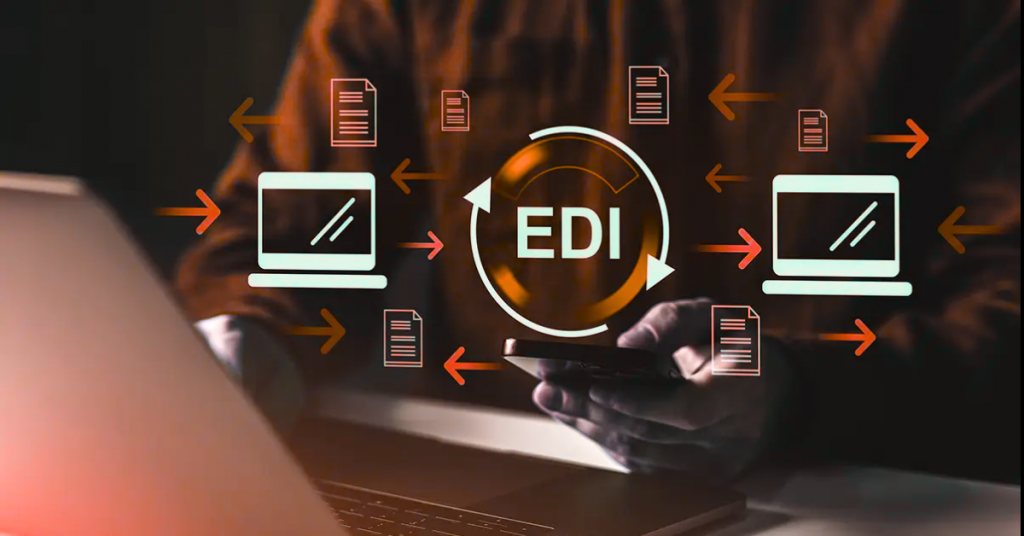
EDI Outsourcing Services is an investment that gives an organization a full package of managed solutions. All these elements are aimed at flawless and secure data exchange:
Mapping & Translation
Mapping and translation are the key issues since the trading partners have different formats and structures. Under EDI Outsourcing , all mapping and translation is done by professional teams, which make sure that each and every document is properly formatted, such as purchase orders, invoices, and so on. These experts constantly revise the mapping versions to take note of the partner changes to ensure the smooth flow of documents.
Communication Protocols
Various partners adopt different communication protocols such as AS2, SFTP, VAN, or API based transfers. The EDI Outsourcing services provide encryption, authentication, and acknowledgements to provide a secure and reliable transmission of documents. Outsourcing ensures that there are no chances of human error in transmission, and it also complies.
Partner Connectivity
It may be complicated to board on and maintain contact with various trading partners as they may have different needs and testing processes, as well as compliance regulations. EDI Outsourcing takes care of onboarding, certification, and continuous connectivity, with the aim of facilitating seamless collaboration between partner ecosystems.
Monitoring & Maintenance
EDI Outsourcing Services include constant monitoring. The providers identify the errors in time, monitor acknowledgments, and avoid document failure to minimize the disruptions to performance at a high cost. Any business organizing outsourcing is assured that transactions are handled by professional individuals and matters are addressed early enough.
System Integration
Automation is essential with integration with ERPs, WMS, EMRs, or other systems. Under EDI Outsourcing, the experts make sure that the system is integrated so that there is a flow of data that is automatic and not manual. This enhances precision, speed in handling orders, submitting claims, and real-time tracking.
Models of EDI Outsourcing
Full-Service EDI Outsourcing
This model offers end-to-end management, which deals with all aspects of EDI. Full-service EDI Outsourcing is best suited to those organizations that lack the technical knowledge or require a fully controlled environment. The providers take charge of mapping, integration, partner relations, monitoring, and updates on the system, which is fully automated.
EDI Service Bureau
An EDI Service Bureau is a lighter model of outsourcing the processing, mapping, and validations of transactions, which can, however, lack complete integrations. This is appropriate for a company that has available in-house IT personnel who are in need of support on regular processing, and a small level of internal control is desired.
Partner Onboarding Support
Other organizations handle EDI within, but need some help in bringing new partners on board. Providers facilitate testing, certification, and connection, facilitating the lessening of delays in creating new business relationships.
Why Businesses Need EDI Outsourcing?
The reason why businesses need EDI outsourcing is that it is important for companies that need to improve their operations. Such advantages are considerable as follows:
1. Speed & Efficiency
Automation significantly lowers the purchase order, invoices, claims, and shipping document turnaround times. EDI Outsourcing facilitates the process of document flow and helps make decisions much faster, which is why the tool is an inevitable part of the contemporary business world.
2. Accuracy & Error Reduction
Handwritten data entry may cause errors, conflicts, and compliance problems. The accuracy of professional mapping, automated validation, and clean data flow is guaranteed by EDI Outsourcing Services, which is why Businesses Need EDI Outsourcing and it cannot be ignored.
3. Cost Reduction
The major benefit of EDI Outsourcing is the reduction of labor and paperwork, as well as system maintenance. Outsourcing not only removes the expensive infrastructure but also the need to over-depend on the specialized in-house employees.
4. Improved Partner Relationships
Retailers, insurers, logistics companies, and partners require correct and timely exchanges. The utilization of EDI Outsourcing Services by businesses will help avoid delays and build relationships, which is an important reason why businesses need EDI outsourcing.
5. Real-Time Visibility
A reporting and monitoring system gives real-time information on all transactions. Constant monitoring makes sure that everything is in order, the conflict is minimized, and another factor that makes Businesses Need EDI Outsourcing essential is that planning is enhanced.
6. Scalability
Outsourced solutions are capable of managing the rise in transactions and new integration of partners with ease. Scalability has been cited by businesses looking at Why Businesses Need EDI Outsourcing as a major advantage of EDI Outsourcing.
Why Businesses Choose to Outsource EDI?
> Lower Cost vs In-House EDI
Outsourcing does not require the expenditure on costly software, servers, and elite personnel. EDI Outsourcing: provides consistent subscription fees, and thus, organizations can better spend resources.
> Reduced IT Workload
IT teams that are within the company are spending hours on mapping changes, updating partners, and troubleshooting. Outsourcing eliminates all these burdens, and IT can now concentrate on innovation, system upgrades, and cybersecurity efforts.
> Access to Certified EDI Experts
The providers are qualified experts who offer experience in the standards and mapping in the industry, and compliance. This ensures the high accuracy and fast problem solution which is a tremendous advantage of EDI Outsourcing vs in-house solutions.
> Simplified Trading Partner Onboarding
Vendors who are outsourced are involved in partner testing, certifications and connectivity. The EDI Outsourcing Services are also user-friendly because it enables businesses to conduct transactions in a quick and efficient manner.
> Scalability Without Infrastructure Upgrades
Outsourcing also enables it to expand without upgrading server or employing additional staff. Scalable software, which can be modified to the amount of transaction volume required, can be beneficial to businesses, which is also a feature of EDI Outsourcing.
> Risk Reduction with Professional Monitoring
On-going monitoring reduces transaction failures, transaction delays, and compliance violations. The professional control will ensure operations, which will eliminate operational risk to a considerable degree.
> Business Focus on Core Operations
Through the delegation of EDI activities, the internal teams concentrate on strategic, process, enhancement, and growth. The EDI Outsourcing Services enable firms to be focused on the major business purpose rather than technical administration.
Challenges or Risks of Outsourcing EDI
1. Lower Direct Control
Extrinsic management can be constraining since the change depends on the provider workflows. Before deciding on EDI Outsourcing businesses have to determine the extent of control they need.
2. Vendor Dependency
Organizations rely on the availability, quality of support, and cost of providers. It is important to choose a partner who is reliable to reduce risks.
3. Long-Term Cost Considerations
Subscription or transaction-based fees are incurred in the long run despite costs that are lower in the short term. The companies should make sure that EDI Outsourcing Services are cost-effective in the long term.
4. Security & Compliance Oversight
In outsourcing, there is the sharing of sensitive data. The providers should adhere to the rules and high data security standards, particularly in healthcare and finance.
5. Customization Limitations
Other providers have standard workflows that might not be applicable to unique business requirements. The companies ought to ensure their EDI Outsourcing partner is able to support complicated mappings or industry demands.
Key Factors to Consider When Choosing an EDI Outsourcing Provider
1. Integration Capabilities
The automatic flow of data through seamless integration with: ERP, WMS, EMR, and billing systems – eliminates a number of errors in manual entries and enables real-time visibility, which allows businesses to manage the flow of activities effectively.
2. Supported Standards & Protocols
Providers also implement ANSI X12, EDIFACT, HL7 formats, and AS2, SFTP, VAN, and API protocols, which allow the trading partners in any industry to exhibit secure, standardized, and compliant document exchange.
3. Transparent Pricing
Prices are clearly defined based on mapping, onboarding, support, and scalability without any hidden costs. It enables businesses to plan their budgets in a good way, prevent any unexpected expenses, and predict their operational expenses.
4. 24/7 Monitoring & Support
The 24/7 monitoring would make certain that EDI failures are identified and corrected instantly. The round-the-clock support will reduce downtime, avoid delays in transactions, and ensure constant communication with the trading partners.
5. Onboarding & Testing Assistance
Providers assist in getting partners on board fast, administering certifications, and testing. This not only minimizes the delays in implementation but also guarantees that the requirements of partners are met, as well as rapid operational preparedness.
6. Industry Experience
Healthcare, logistics, retail, and manufacturing standards knowledge would mean that the providers are aware of the required regulatory standards, transactions that are unique to the industry, and the expectations of the trading partners, which would allow the EDI processes to proceed smoothly and provide correct mappings.
7. Scalability Options
Scalable solutions will enable the business to expand transaction volumes and add new business partners easily. Providers have to handle the rising demands without any interruptions, which makes them run smoothly during the peak seasons or in case of sudden growth.
8. Security Certifications & Data Protection
The compliance with SOC 2, HIPAA, ISO 27001, and GDPR ensures high data protection standards. Providers alleviate sensitive business, financial, and healthcare information, besides ensuring regulatory compliance on all EDI transactions.
9. High Availability & Uptime
Backup systems, redundant infrastructure, and failover systems will maintain continuous EDI operations. High uptime will minimize operational interruptions, avoid wastage of time in supply chains, and ensure smooth business communication.
When Should a Business Outsource EDI?
> SMEs Without EDI Staff
Small and mid-sized businesses will also get access to skilled EDI professionals without the need to hire full-time employees. Outsourcing will provide a precise, valid, and effective exchange of data and a lower operational load.
> Companies Needing Rapid EDI Compliance
Ready-to-use templates, tools, and partner knowledge help to comply with the requirements of retailers, insurers, or distributors for EDI quickly. Necessary procedures can be easily avoided, allowing businesses to commence their operations in a short time.
> Low to Medium Document Volume Businesses
Outsourcing is less expensive than in-house systems in the case of businesses that have moderate EDI traffic. They do not require huge capital investment and redundant infrastructure to enjoy professional management.
> Fast-Growing Companies
Quickly growing organizations are able to grow transaction volumes and add new partners without installing new systems or training. Outsourcing promotes expansion effectively and still remains accurate and operational.
> Businesses Avoiding Large Upfront IT Expense
Outsourcing also removes the servers, software, and specialized IT personnel required to support the infrastructure, and the financial burden is minimized to organizations by converting EDI into predictable operational expenses.
> Teams Wanting to Focus on Operations
Through the outsourcing of EDI, internal staff can no longer be associated with the creation of maps, testing, and troubleshooting; instead, employees are able to invest in strategic projects, business operations, and enhance their business outcomes.
In-House EDI vs Outsourced EDI
| Category | In-House EDI | Outsourced EDI |
| Cost | High upfront costs for software, hardware, servers, and staff. | Predictable subscription pricing with no capital investment. |
| Deployment Speed | Slow, can take months due to setup and training. | Faster deployment using pre-built tools and provider expertise. |
| Flexibility & Control | Full internal control over systems and mapping. | Less direct control but flexible with provider-managed updates. |
| Maintenance Responsibility | IT team manages updates and troubleshooting. | Provider handles all monitoring and maintenance. |
| Expertise Requirements | Requires trained EDI specialists. | No internal expertise required; provider supplies certified professionals. |
| Team Size Needed | Larger teams needed for mapping, testing, and support. | Minimal staff; provider manages all operations. |
How A3Logics Helps Healthcare & Health Insurance Companies with EDI Outsourcing?
A3Logics provides provider, payer, TPA, and health systems with Healthcare EDI Outsourcing on a fully managed and HIPAA-compliant basis. They are provided services that allow the exchange of data in a safe, accurate, and real-time manner, which in turn ensures compliance and enhances patient care.
Key Ways A3Logics Supports Healthcare EDI
- End-to-End Managed Healthcare EDI
Processes claims of 837, remittances of 835, EDI 834 Services enrollments, and 820 premium payments. Has mapping, validation, submission and acknowledgements.
- HIPAA-Compliant & Secure
The EDI Consulting services reduce security threats to a minimum through advanced encryption, protocols and twenty four hour surveillance.
- Seamless System Integration
The workflows are automated by integrating EMR/EHR, billing, and practice management systems.
- Faster Claims & Reduced Administrative Work
Reduces refusals, handwritten corrections and increases reimbursements.
Why Choose A3Logics for EDI Outsourcing?
> Deep Domain Expertise Across Healthcare, Logistics, and Insurance
A3Logics as a leading EDI Services Provider has years of experience in various sectors, hence, they can execute complicated EDI transactions accurately. Their domain expertise guarantees adherence, seamless integrations, and industry-specific solutions that suit the needs of each organization in terms of its operations.
> Fast Deployment with Pre-Built Frameworks and Partner Templates
A3Logics is fast in implementing EDI due to its built-in frameworks and templates of partners, which allows saving much time in the implementation. One can start transactions faster without delays, and businesses can easily achieve EDI compliance without the need to undergo a lengthy internal development cycle to guarantee efficiency in operations.
> High-End Mapping and Translation Accuracy
The company guarantees the accuracy of mapping and translating all the EDI transactions and reduces the number of mistakes and the occurrence of data inconsistency. Such a level of precision ensures adherence, fewer transaction declines, and improvement of the relationship with trading partners and regulating authorities.
> Strong Reputation for EDI Development and Integration
A3Logics has gained a good reputation for the high-quality EDI solutions it offers. Their development, integration, and support skills enable businesses to believe that their data exchange operations are safe, lawful, and effectively controlled.
> Customizable Workflows Aligned with Business Processes
A3Logics customizes EDI processes to fit specific business processes that ensure automation perfectly fits within the pre-existing systems. The flexibility of workflows assists organizations in process optimization, lessening human intervention, and scaling processes without compromising accuracy and compliance.
Conclusion
So after knowing about What is EDI Outsourcing, you must be having clarity of this emerging trend. Firms in sectors are rapidly moving towards EDI Outsourcing in the name of complex minimization, enhanced precision, and cost-effective scale operations. Knowing what EDI outsourcing is can make leaders appreciate the fact that outsourcing modernizes communication, fastens processes, and minimizes administrative burdens.
Through EDI Outsourcing Services, companies are able to achieve efficiency, reliability, as well as long-term operations power. In the case of healthcare facilities, EDI Managed Services guarantees the absence of noncompliance, proper handling of claims, and smooth processes. With the growing pace of the digital transformation digital transformation is gaining momentum, Strategic EDI Outsourcing partnerships will be an essential part of the contemporary business environment.