
The insurance industry is challenged greatly with the need to resolve claims more quickly and accurately. Typical claims processes take a duration of weeks and sometimes stretch into months. The result is increased inefficiencies and lower retention.
The AI in insurance claims processing is a must for all insurance firms. The worldwide digital insurance industry will reach $681.2 billion in 2034 at a CAGR of 21.7%. Thus, insurers are to turn to automation, intelligent document manipulation, and predictive models which are the only way to stay on top.
This blog will provide an overview of how AI is cutting insurance claims cycle times, the technologies used, examples, and much more. Let’s get started!

The Significant Problems Arising from Claims Delays
Long claims cycle times are still a top challenge in the insurance industry. For instance, it now takes an average of 23.1 days for auto repair claims, which is more than double the pre-pandemic period. The delays incurred have a direct effect on the customer’s trust and so turn them into churners. The research shows that 30% of the customers change carriers after a bad claims experience.
Besides customer dissatisfaction, delays also extend the administration costs. Manual activities cause 5 to 12% of the errors in claim matters.
Fraud is another implication of inefficient handling of claims. The insurers of the U.S. are believed to suffer from a fraud-related cost of $80 billion every year through false claims.
To sum it up, the obsolete methods deliver a rise in costs, complications, and the loss of customers.
How AI Reduces Claim Cycle Time and Improves Customer Satisfaction?
First, AI-powered systems remove bottlenecks. Instead of waiting for days for human data validation or manual inspection, computer vision and NLP manage claim intake and documentation within a matter of minutes.
Secondly, predictive analytics make it possible to adjudicate in real-time. By looking into the past claims data, AI models are able to predict the severity of the claims, route the cases intelligently and pre-approve low-risk claims.
Thirdly, AI enhances customer experiences due to the fact that customers get instant and personalized interactions. And because of chatbots, customers are given 24/7 support, while automated notifications keep customers informed throughout the process.
Collectively, these enhancements cut insurance claim cycle times significantly.
Why AI-Powered Claims Processing Has Become a Competitive Advantage?
McKinsey research reflected that AI-led insurance had a 6x advantage in returns over other peer companies for the period of five years. Part of this is due to their operational excellence in core sectors such as claims.
Manual touch points can be reduced by incorporating intelligent automation; thereby, insurers can cut costs by 30 to 40% and simultaneously increase customer loyalty.

How AI Reduces Delays in the Insurance Claims Lifecycle?
1. AI for Automated Data Collection and Validation
AI in insurance claims processing is an important part of speeding up the intake accuracy. When policyholders request claims, the AI program automatically reads and validates entries like policy ID, loss date, and coverage limits. Therefore, only clean, validated, and structured data go through the processing pipeline.
2. Using OCR and NLP to Accelerate Claims Documentation
OCR changes the physical or digital text into a machine-readable format, and NLP identifies document types. This extracts key data like ICD codes, treatment dates, or damage narratives.
This functionality is inevitably relevant in Custom Health Insurance Software Development, where the need for precise and real-time handling of large volumes of clinical data is required.
3. Machine Learning Models for Real-Time Claims Triage
AI triage systems assign claims based on urgency and complexity using trained ML algorithms. These models score each submission by risk, coverage, past behavior, and potential fraud indicators. With this method, the expert resources are kept only for the complex cases which directly results in the improvement of claims cycle time and the quality of outcomes.
4. Predictive Analytics for Faster Claims Decision-Making
AI models are used to find the patterns and causes of different claims, which can be used to see what the expected settlement amounts will be, what reserves will be needed, and the chances of litigation. Thus, this predictive power opens up the way for the insurers to make automatic decisions or come up with data-backed recommendations to the adjusters.
How AI Enhances Customer Satisfaction Through Smooth Claims Experiences?
1. Chatbots and Virtual Assistants for Instant Support
AI chatbots and voice assistants now supervise FNOL intake to be handled along with responding to queries and guiding customers in real-time. These bots can be used any time, 24/7. By turning the first friction into instant service, insurers can lower the number of complaints during the insurance claims cycle times.
2. Personalized Customer Communication with AI
AI uses customer interactions that are dynamic based on their behaviors, choices of communication, and the type of claim. For example, a customer who is making a low-severity auto claim may prefer SMS notifications, while another dealing with the total home loss will avail of the voice support and real-time updates via app.
3. Transparent, Real-Time Claims Status Updates
The AI platforms now endeavor to provide immediate updates, thereby, customers get the entire milestone of their claims without any doubt. Whether through portals, chatbots, or emails, these updates help bring clarity and mitigate inquiries.
How AI Improves Adjuster Productivity and Reduces Workload?
AI mainly eliminates the mundane tasks related to administration and cuts down claims cycle time.
AI systems make sure that adjusters get suitable cases depending on their expertise. This prevents overload and provides faster delivery. AI fills claim data automatically and flags any anomalies, so the adjusters can focus on real work instead of working on manual, time-consuming paperwork.
The second part where AI significantly helps is the performance analytics. This basically helps in workflow alignment. AI tracks the claim cycle and suggests possible changes to the process. The feedback loop allows teams to improve and iterate faster for better outcomes.
How AI Reduces Claims Cycle Times by 90%?
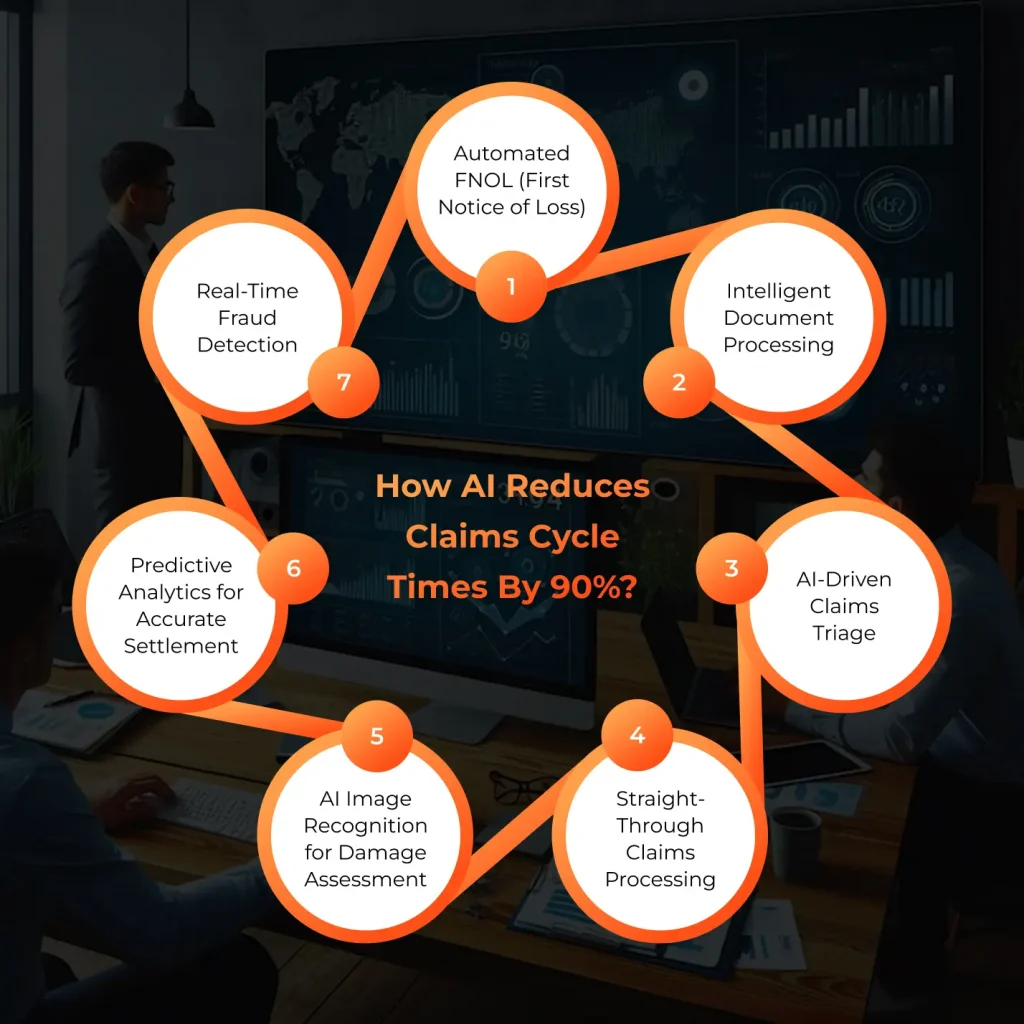
1. Automated FNOL (First Notice of Loss)
AI agents collect FNOL data on the spot. Also, it checks the validity of the policy and initiates workflow without a human operator. Instead of taking hours or even days to start a claim, clients directly receive further steps. In the Touchless Claims Insurance model, FNOL bots simply link with backend systems to schedule inspections.
2. Intelligent Document Processing
OCR and NLP tools analyze forms, PDFs, photos, and auto-fill claim data fields that have been scanned. These tools are first to classify files, then extract relevant data, and finally validate against policy rules in minutes.
3. AI-Driven Claims Triage
As soon as claims arrive at the platform, they are scored and routed immediately by AI models. The highest-risk or highest-value types come to the subject-matter experts, while the simple cases of processing go in the straight-through (STP) direction.
4. Straight-Through Claims Processing (STP)
STP relies on pre-set business rules and AI reasoning for full automation of claim adjudication and payment at this stage. As a result, insurers substantially lower claims cycle times by moving a large proportion of high-frequency, low-complexity claims into the STP pipelines without losing control.
5. AI Image Recognition for Damage Assessment
Computer vision allows for the quick observation of property or damage to the vehicle. After the insured person uploads images, the AI automatically spots the defective areas, forecasts the repair, and also checks previous records for similar issues.
6. Predictive Analytics for Accurate Settlement
AI predicts claim outcomes and costs early in the process. This allows accurate reserves and auto-settlement proposals. These models consider historical trends, loss type, and customer profile. For complex claims, predictive analytics suggest next-best actions and flag potential escalation paths.
7. Real-Time Fraud Detection
The fraud-detecting AI tools thoroughly examine each claim for any unusual patterns in advance. They manage to filter out the bad players as well, but they do not hold up the other claims. Such strategies help to catch fraud at the FNOL stage, which in turn leads to a reduction in manual investigations and a faster pace of clean claims.
8. Automated Communication & Workflow Orchestration
AI also manages status updates, escalations, and handoffs. When a document is approved, payment is issued, or a review is completed, the system automatically triggers the next steps, informing stakeholders and reducing lag time.
Challenges and Considerations in Implementing AI in Claims Processing
To begin with, the major obstacles are data quality and system integration. A large part of the problem is the old infrastructure, which does not have APIs or data standards for effective AI applications. The process of cleaning and unifying historical data sets can amount to as high as 50% of the total project time and cost.
Then there is the matter of model explainability and bias. It is imperative for insurers to confirm that the automatic decisions that are made are not only auditable but also free from any form of historical discrimination, especially in the case of AI used in adjudication.
In addition, regulatory control and privacy issues are significant. AI tools that deal with personal, financial, or health data are subject to HIPAA, CCPA, or GDPR regulations, which might depend on the jurisdiction.
The customer problem is also an additional one. AI can dramatically reduce treatment time; however, some clients feel uncomfortable, especially when it comes to their emotional part, and they would rather have a discussion with a real person. The appropriate mix of automation and human compassion remains the key to continuous development.

AI-Powered Claims Automation Use Cases
1. Health Insurance
Health insurers manage huge amounts of claims that contain complicated medical information. The utilization of AI-enabled OCR and NLP tools allows speedy extraction of ICD codes, validation of therapy details, and automatic matching of these to the policy coverage. The result is shorter manual processing review times and fewer errors.
2. Property and Casualty Insurance
Property and casualty insurers encounter high diversity in the types of claims they get and they have to provide solutions fast during periods of high volume. Computer vision and drones can examine the physical damage incurred in just a few hours’ time. When this is combined with predictive triage and STP for low-complexity claims, this ends up significantly reducing the insurance claims cycle time.
3. Auto Insurance
The auto insurance sector prominently relies on AI to handle claims within a short period. Telematics devices magically detect car accidents, AI previews the incident, confirms, and initiates FNOL. Finally, the system is able to cover all the subsequent procedures in just a matter of seconds.
4. Life Insurance
In life insurance, AI accelerates claim commencement and verification that could be done through linking the obituary notices to the death certificates, along with the beneficiary records. NLP clears and checks the documentation while the smart contract payouts are piloted through the blockchain.
Future Trends in AI-Powered Claims Processing
1. AI-Driven Automatic Settlements
The progress of parametric and rule-based insurance is moving towards fully automated claims settlements. For example, the policies automatically pay out when weather sensors have confirmed that a hail event has occurred; thus, customer submission is not required at all.
2. Drone-Powered Inspections
Drones that are integrated with AI image analysis will allow quick, scalable inspection without human deployment. The new FAA rule changes will allow more of these types of inspections, like BVLOS, especially during a disaster or in a rural area.
3. Hyper-Personalized Customer Journeys
AI will make it possible for each of the policyholder claims to be personalized, such as individualized interfaces, communication styles, and workflows. Some claimants might want to manage their claims themselves with the use of an app, while others would want a guided journey through a voice.
4. Blockchain-Backed Claim Validation
Blockchain-based validation systems will ensure a record of the insurance policies, the evidence, and the transactions that cannot be denied. The smart contract is the one that initiates the payment automatically based on the terms met, which in turn will deter the fraud and create shared visibility between the carriers, the reinsurers, and the policyholders.
5. Fully Autonomous Claims Systems
Basically, AI, RPA, and analytics would add themselves together into autonomous claims engines. These systems would manage the entire process, starting from FNOL to adjudication and payout, with just a small amount of human involvement for low to mid-complexity cases.

Why Choose A3Logics for Your AI-Powered Claims Transformation?
As insurers accelerate digital transformation, partnering with an expert Insurance Software Development Company is critical. A3Logics delivers comprehensive AI integration and automation solutions designed to reduce claims cycle time, eliminate inefficiencies, and boost customer satisfaction.
With expertise across machine learning, computer vision, RPA, and blockchain, A3Logics builds modular, scalable systems tailored to your business needs.
Backed by 20+ years in the industry, we’ve helped clients reduce claim handling time by up to 95%, improve workflow orchestration, and unlock new service models. Our robust engineering practices ensure regulatory adherence, data privacy, and seamless integration across core systems. From ideation to deployment, we provide end-to-end Software Development Services for AI-powered claims modernization.
Final Thoughts
AI is redefining how insurers manage claims. What once took weeks now takes minutes. From automated FNOL to intelligent triage, STP, and real-time fraud detection, each AI layer removes inefficiencies and accelerates resolution.
With the right roadmap and tools, insurers can streamline claims operations, improve loss ratios, and position themselves for sustained leadership in the digital insurance ecosystem.
At A3Logics, our team partners with you every step of the way to make transformation practical, secure, and sustainable. Let’s reimagine your claims process.
Contact us today!