The Internet of Things (IoT) is transforming how both patients and providers engage with medicine, enhancing connectivity and data-driven decision-making across all areas of patient care. This article will provide a comprehensive overview of how IoT impacts healthcare, its primary use cases, advantages, elements, actual use, and prospective outlook, as well as examples of how companies providing IOT Healthcare Solutions Development services contribute to that ecosystem.
The internet of things (IoT) in healthcare is happening very quickly; it is estimated that in the coming years more than 125 million patients will be monitored remotely by an IoT-based system by 2027 alone. It does not take much imagination to see that IoT based healthcare monitoring systems are creating opportunities in primary care, chronic disease management, emergency response, and personalized care through smart sensors, wireless connectivity, and analytics.
What is an IoT Based Healthcare Monitoring System?
An IOT healthcare monitoring system uses interconnected smart devices, sensors, and medical devices to collect, transmit, and analyze patient health data in real time. These smart devices and sensors are connected in a seamless way that allows remote interventions, alerts in time, and improved health outcomes. The care is delivered to patients in their daily lives rather than in a clinical or practice.
Unlike general consumer wearables, IoT healthcare monitoring systems offer medical-grade accuracy, regulatory compliance, and the ability to provide automated, actionable feedback to providers and patients.
Below are brief statistics regarding IoT based healthcare monitoring systems:
- Worldwide IoT healthcare market projected to be valued at $282 billion in 2025.
- The global IoT healthcare market is growing at 21.8% CAGR annually.
- 71 million Americans will utilize remote monitoring services in 2025.
- RPM programs reportedly reduce hospital admissions by 38%.
How Does an IOT Healthcare Monitoring System Work?
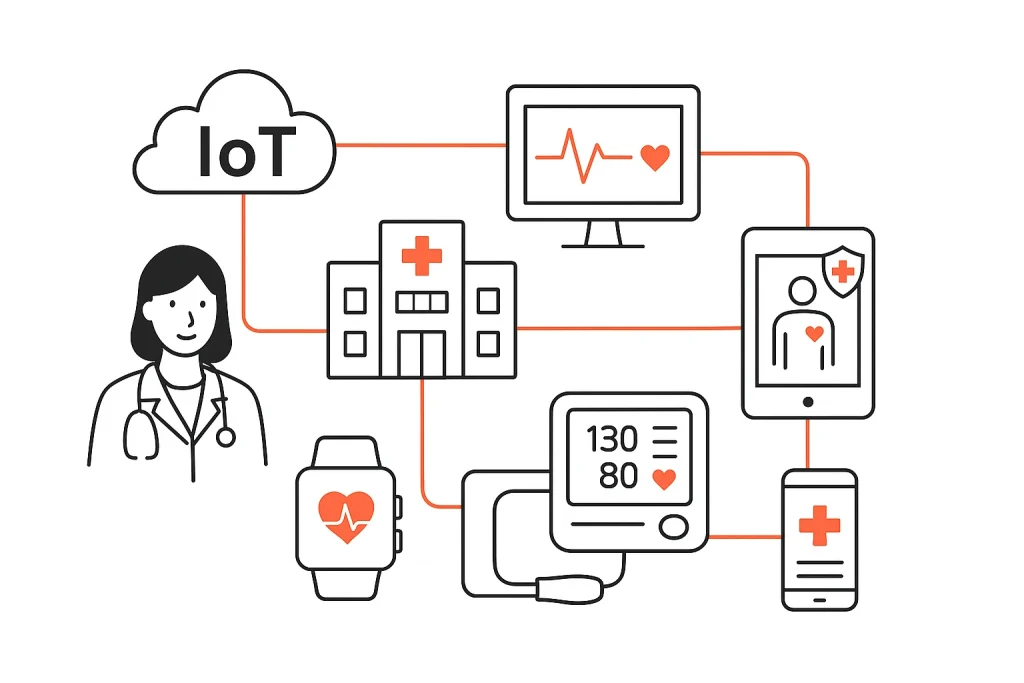
Step 1: Data Collection
Health data is captured using a variety of IoT-enabled devices, such as wearables, implanted sensors, or bedside monitors. These devices capture vital signs including heart rate, blood glucose, oxygen level, blood pressure, ECG, activity patterns and environmental factors.
Step 2: Data Transmission
Wireless networks like Bluetooth, Wi-Fi, or cellular services securely transmit data to gateways. Gateways receive, aggregate, and forward data to cloud systems for processing. The cloud system then analyzes the data to generate meaningful healthcare insights.
Step 3: Data Processing and Analysis
Within minutes, the cloud platform (with some support from edge computing) can analyse the patients data in real time. AI models and algorithms continually evaluate data to identify abnormal patterns, trends, or risks. They flag potential indicators of emerging health issues.
Step 4: Alerts and Insights
Based on the analysis, the system can send alerts. These range from simple reminders (like taking medication) to urgent warnings for healthcare providers if a patient’s health crosses dangerous limits. Doctors and patients can view detailed insights and health trends on dashboards or mobile apps.
Step 5: Patient Engagement
Patients stay actively involved in their care through connected apps or devices. They receive instant feedback, reminders, and personalized recommendations, which help them follow treatment plans and improve health outcomes.
Key Use Cases and Applications of IoT Based Healthcare Monitoring System
1. Remote Patient Monitoring (RPM)
IoT allows the monitoring of patients out of hospital and those needing supervision for a chronic disease, recovering from surgery, and other recent discharge from the hospital (acute or chronic). RPM has been shown to reduce readmissions by as much as 20%, while increasing compliance with the care plan and reducing costs.
2. Emergency Response and Fall Detection
Connected sensors detect falls and send SOS alerts for elderly or at-risk patients. They share real-time situational awareness and location. Rescue networks respond quickly to deliver immediate support.
3. Medication Management
Devices in IoT healthcare monitoring systems track medication compliance effectively. They notify patients and care teams about missed or incorrect dosages. RFID or NFC tagging confirms if medications are legitimate.
4. Hospital Asset and Staff Tracking
Smart sensors have been integrated on the drugs, equipment and staff, allowing for accurate tracking of assets and employees, while reducing waste and optimizing resource workflows.
5. Chronic Disease Management
Continuous monitoring of patients with diabetes, heart disease, or respiratory problems can facilitate better monitoring of patients along specific care pathways, and IoT allows for easy blood glucose checks, ECGs and respiratory monitoring.
6. IoT in senior Care
Smart monitoring devices track the vital signs, activities, and safety of the older adult population allowing for independent living, while proactively engaging caregivers and clinician assistance as needed.
7. In-Hospital Patient Monitoring
A Smart Health Monitoring System based on IoT enables continuous monitoring of acute care patients in hospitals. It transmits vital sign data directly to the care team. This reduces time, errors, and the need for manual check-ins.
8. Post-operative and Rehabilitation Care
IoT can effectively monitor recovering patients from an external site to identify complications early, optimize rehabilitation exercises, and keep the care team engaged without having to see the patient frequently.
9. Mental Health and Wellness Monitoring
Connected wearables and apps for monitoring sleep and activity and behavioral routines reveal important information to health care teams and alert them to potential relapses or crisis situations, especially vulnerable individuals.
Benefits of Healthcare Monitoring System Using IOT for Patients
Below are the essential benefits one get with healthcare monitoring system using IOT, check it out:
- Ongoing Monitoring: In instances where a patient is required to seek treatment we can provide 24 hours, 7 days a week observation of a patient outside of the clinical space, which reduces the likelihood of negative health experiences.
- Early Detection: Automated detection systems reduce the risk of hospitalization through the detection of either short and/or long severity changes outside of significant symptoms that would trigger a visit to a clinical space/trip to ED.
- Convenience: Patients can send vital signs without a trip to the clinic, saving time and money.
- Personalized Health: Through data and analytics, we can assist with disease management and provide proactive care as the health of the individual may dictate.
- Confidence and Security: Family and patient safety and security is at the fore when they can assure the detect/dispatch capabilities in the event of an emergency.
Benefits of Smart Healthcare Monitoring System Based On IOT for Healthcare Provider
- Improved Efficiency: Automating vitals collection and asset tracking helps ease the workload on medical personnel and expand service to more patients efficiently.
- Better Decision-Making: Real-time, longitudinal data can help clinicians make better clinical decisions.
- Cost Savings: Reducing hospital readmissions, and, reducing in-person monitoring, all lead to a cost-reduction approach to long-term patient monitoring.
- Better Patient Engagement: Patients are involved in their own health journey versus passive management that leads to longer costs, lower adherence, and poorer outcomes.
- Scalability: Cloud-based monitoring systems can do all of the above for many thousands of patients, all with the same infrastructure across multiple sites.
Essential Features of an IoT Healthcare-Monitoring System
- Biometric and Environmental Sensors: Monitors multiple vital signs and external factors
- Continuous Monitoring: No interruptions in patient data streams
- Wireless Communication: Facilitate entry in mobile (untethered) and remote modes.
- Gateways: Aggregate data from multiple sensors and secure it or possibly batch transmit it to the cloud
- Cloud Platform: Houses , processes, and visualizes a huge amount of health data.
- Data Aggregation and Standardization: Brings together many sources for one visualization, standardizing for comparisons across populations.
- Real Time Alerts: Indicates to relevant involved parties potential emergencies.
- Preventive Treatment: Systems combine advanced continuous monitoring of patients to support prevention and promptness in healthcare.
- AI Healthcare Testing: Ensures intelligent algorithms, predictive models, and automated workflows are validated for accuracy, reliability, compliance, and patient safety
- Mobile and Web Applications: Used by providers and patients to manage their health and health system engagement with locations.
- Data Visualization: Dashboards format raw data and provide information for patient education and actions for the clinical ward.
- Data Security: Encryption of sensitive medical information per regulatory requirements for travel and sharing.
Real-World Examples of IoT-Based Healthcare-Monitoring System Adoption
Below are some of the examples of IoT based healthcare monitoring system adoption, check it out.
1. Philips IntelliVue Guardian Solution
The Philips IntelliVue Guardian Solution is a hospital monitoring system that leverages Internet of Things (IoT). It combines automated early warning scoring (EWS) with wireless real-time monitoring. The system continuously tracks vitals like heart rate, respiration, and oxygen saturation. It alerts medical teams to early signs of deterioration before patients become critically ill.
The combination of wearable sensors and predictive analytics to prevent critical events such as cardiac arrest or sepsis. Early detection supports timely interventions, improves patient outcomes, and enhances the overall workflow of hospital staff by allowing care teams to prioritize patients who are at risk of critical illness.
2. Medtronic’s MiniMed™ 670G
The Medtronic MiniMed™ 670G is an IoT-powered innovation in diabetes management. It is the first hybrid closed-loop insulin pump with a continuous glucose monitoring (CGM) system. The MiniMed™ 670G and CGM use real-time glucose data to adjust basal insulin automatically. This helps maintain optimal blood glucose levels safely. Patients experience fewer hypoglycemia risks and improved glycemic control with minimal manual adjustment.
The system allows people to live more freely while alleviating restrictions associated with frequent surveillance of blood-glucose levels and insulin administration. By personalizing therapy using adaptive algorithms, the MiniMed™ 670G transforms diabetes management and improves patients’ health-related quality of life.
3. Propeller Health
Propeller Health offers a smart respiratory monitoring platform linking inhalers with IoT sensors and mobile apps. The platform tracks asthma and COPD management comprehensively. It monitors inhaler use patterns, missed doses, and patient adherence. It also detects external triggers like pollen, pollution, and indoor environmental factors.
Patient data will provide providers with an adherence picture and provide potential reasons for acute flare-ups. This preventative monitoring is assisting patients to reduce emergency episodes and hospital visits, and patient self-management.
4. Medtronic Guardian Connect
Medtronic’s Guardian Connect is an IoT-enabled continuous glucose monitoring (CGM) solution for diabetes management. It tracks glucose in real time using a wearable device. The system provides predictive analytics on highs and lows up to 60 minutes in advance. Personalized alerts are sent directly to patients’ smartphones. Patients can use this data to improve lifestyle and dosing decisions.
Guardian Connect sends early warnings of high or low glucose to patients. These alerts help prevent life-threatening complications like severe hypoglycemia. Patients gain the information they need to act quickly. The system reduces dependence on acute care facilities and hospitalization risks. It supports proactive diabetes management and leads to better overall outcomes.
5. GE Healthcare Real-Time Monitoring
GE Healthcare is leveraging IoT technologies to enhance both patient care and hospital resources. These solutions also provide continuous real-time monitoring of the health parameters of patients so that clinicians can quickly respond to serious events. GE not only develops patient monitoring solutions but also integrates asset tracking solutions that assess the whereabouts and state of medical equipment within hospitals.
Reducing lost equipment which also eliminates the time wasted in searching for devices, while ensuring the ability to track all available equipment as part of a conscious resource management plan. Combining data analytics with real-time monitoring allows hospitals to enhance workflow efficiency and to lower operating costs while improving care delivery. Ultimately, these solutions lead to a safer, smarter, and better healthcare environment.
The Role of AI and Big Data in IoT-Based Healthcare-Monitoring Systems
Below we highlight the role of AI and Big Data separately in IoT-based Healthcare monitoring systems. Check it out:
Role of AI
Artificial Intelligence (AI) serves a primary role in smart healthcare monitoring systems by converting large amounts of Internet of Things (IoT) data into actionable intelligence. Whereas human reviewers can conduct trend analyses for data aggregation, AI analytics platforms can quickly identify patterns, trends, and anomalies, while also providing clinical knowledge in real-time.
AI algorithms analyze continuous streams of data from wearable sensors, bedside monitors, and other medical devices. Similarly, predictive AI models can increase effectiveness of remote patient monitoring by streamlining hospital workflows; and allocating resources more effectively.
However, as AI becomes more commonplace in healthcare applications, it’s being increasingly acknowledged that greater governance is necessary to assess the new uses of AI. This is done in relation to patient data privacy and security concerns initiated by AI algorithms themselves while creating trust with patients.
Role of Big Data
Conversely, Big Data technologies are essential in storing and utilizing the vast data generated from healthcare IoT devices. Big Data technologies enable the aggregation, storage, and quick retrieval of multiple datasets that facilitate the creation of comprehensive patient profiles and support effective longitudinal care management.
With the growth of diverse real-time inputs (e.g., vital signs, environmental measures, and patient-reported outcomes), Big Data accommodates clinicians’ access to multiple structured and unstructured datasets.
By providing connectivity of information across devices and systems, Big Data allows for scale and functionality needed for predictive and personalized medicine when combined with AI. In this role, Big Data complements AI by providing a dynamic flow of vast, organized data that AI systems analyze to facilitate smarter decision-making and more proactive, personalized patient care.
Cost and ROI of IoT-Based Healthcare-Monitoring System Implementation
The initial expense of building the IOT for a Healthcare Monitoring System includes hardware devices, network integration, security, and training users. The burden of upfront costs is outweighed by long-term savings across established hospital networks for remote care programs. Across the hospitals that adopted the IOT model, the average reduction in emergency visits and readmissions from deployment to one year afterwards is 15-30%, and there are significant decreases to labor cost because the IOT saved staff from manually checking vital signs, medication counts, and asset tracking.
Organizations often see strong ROI from operational efficiencies like reduced paperwork, automated compliance reporting, and improved workflows. This return typically occurs within 2–4 years across the continuum of care. Because the cost per monitored patient is low, cloud-based IoT platforms improve financial sustainability at scale. As patient populations and monitoring needs grow, these platforms provide greater long-term value. Indirectly, higher patient satisfaction and improved clinical outcomes reduce legal liabilities and enhance brand reputation.
An important cost-saving aspect is IoT Healthcare Monitoring Systems guiding chronic and high-risk patients away from inpatient care. They achieve this through proactive interventions or early detection of health deterioration. Many providers use analytics to enhance population health management by identifying high-utilization or high-cost groups. These insights help improve care pathways and optimize resource allocation. When selecting systems, organizations should prioritize modular upgrades, standards-based interoperability, and strong security protocols. Such protocols ensure ongoing compliance with regulations like HIPAA and GDPR.
Future of IoT-Based Healthcare-Monitoring Systems
The future of the IOT Based Healthcare Monitoring System market will be characterized by deeper, seamless combinations with AI, ubiquitous next-generation connectivity (e.g., 5G and Wifi‐6), and a wide range of environmental and behavioral sensor types. Check it out how:
1. The Combined Force of AI and IOT
It will support fully autonomous decision support for acute care, chronic disease management, and mental wellness monitoring, delivering unlimited personalized, real-time intervention regardless of the physical location of the patient.
2. New and Advanced Predictive Models
This will assist in predicting emergent health needs and will automatically engage IOT connected devices in response to the emergent indicators, as learning is derived from all patients with similar features.
3. 5G Evolution
When it becomes widely available, more robust and scalable networks will change the landscape of reliability while significantly impacting the latency of sensor data transmission and high fidelity streaming of sensor data.
4. Continuous Monitoring
When this happens in both rural and urban environments, it will only be limited by the availability of next-generation environmental and overall ambient and functionality monitoring such as, but not limited to, air quality, noise, fall risk, and even indoor navigation, in next-generation Smart Healthcare Monitoring Systems based on IOT platform.
5. Privacy-preserving Artificial Intelligence (AI)
This technology with robust cybersecurity approaches will provide the underpinning elements which should drive system adoption and use while protecting patient data and allowing authorized providers to make better, more accurate, and more efficient treatment decisions.
6. Blockchain Technology
It can foster transparency and integrity for medical records shared between connected IoT devices and healthcare providers. Overall, advancements in Healthcare IoT Device Monitoring enable patient-centered “hospital at home” models, smarter in-hospital monitoring, and advanced telehealth ecosystems. These improvements expand access, lower costs, and promote global health equity.
Why Partner with A3Logics for IoT-Based Healthcare-Monitoring System Development?
As a reputable IOT Development Company, A3Logics, is distinguished for its specialization by providing custom solutions for digital healthcare transformation via end-to-end procurement of services.
Below are some of the reasons that makes us the right choice for your needs of IoT based healthcare monitoring system, check it out:
- The best part about partnering with A3Logics for IOT Healthcare Development is not only will you have a technology partner who understands the complexity of compliance , but also brings extensive expertise in architecting robust, scalable and interoperable IoT based platforms from remote patient monitoring to advanced in-hospital device management.
- A3Logics embraces a holistic approach to development: they begin with discovery, requirements gathering and workflow mapping, and seamlessly transition into agile software engineering and hardware integration.
- The solutions incorporate edge computing for low-latency analytics, AI-driven anomaly detection, and cybersecurity including end-to-end encryption, meaning they cover all aspects of patient safety and privacy from day one.
- A3Logics utilizes the best of the best biometric sensors, secure gateways, cloud data lakes, etc. to design platforms that allow organizations to scale and grow with confidence and innovate quickly.
- We are also adept at integrating IoT capabilities with legacy EHRs/HIS, developing user-friendly dashboards and mobile user interfaces, and providing enterprise-level post-launch support including device calibration, cloud migrations, compliance audits, and staff training.
- Their experience ranges from successful deployments in large multi-site health care systems to emerging telecare startup companies, and they have consistently improved quality of care, patient satisfaction, and operational efficiency.
- For visionary health organizations who require sustainable and future-proof digital monitoring platforms, A3Logics’ IOT healthcare development services ensure a rapid digital transformation, realized ROI, and synergies for a long-term partnership.
Final Thoughts
The IOT Based Healthcare Monitoring System landscape is changing the framework of healthcare from a reactive to a proactive sector, and it’s all about smart monitoring and timely interventions at an appropriate level of care. The emergence of smart sensors, secure cloud infrastructures, and real-time analytics of health information are creating a last frontier for patients, providers, and health organizations to enable safer, effective and patient-centered care for everyone involved.