Water is the lifeline of farming. Yet many farmers still struggle with water use. Traditional irrigation often wastes water and energy. Crops either get too much or too little. This hurts yields and profits.
Here comes the IoT-based automated irrigation system. It connects soil sensors, weather data, and smart pumps. Farmers can track and control water use from their phones. This system ensures crops get the right water at the right time.
IoT-Based Irrigation System Development helps reduce waste and improve farm output. It gives farmers control and peace of mind. With smart irrigation, farming becomes moreWater is a lifeline for agriculture.
However, many farmers have difficulty managing and utilizing their water resources. Most irrigation techniques are wasteful with both water and energy.
Water is applied either too often or not enough, ultimately hurting crop yields and profitability.
This is where the IoT-Powered Intelligent Irrigation System methods help. An IoT in agriculture helps irrigation system links soil sensors to weather data and smart pumps.
Farmers can monitor and control their water usage from their smartphones. This system assures consistent water applications while management reacts to changing environmental conditions.
Supporting the IoT-based Irrigation system development helps minimize waste and enhance agri-business output. Implementing smart irrigation management systems provides farmers with control and peace of mind during the irrigation process.
Most importantly, it enables farmers to maximize their more efficient and sustainable practices.
Stats and Facts about IoT in Agriculture
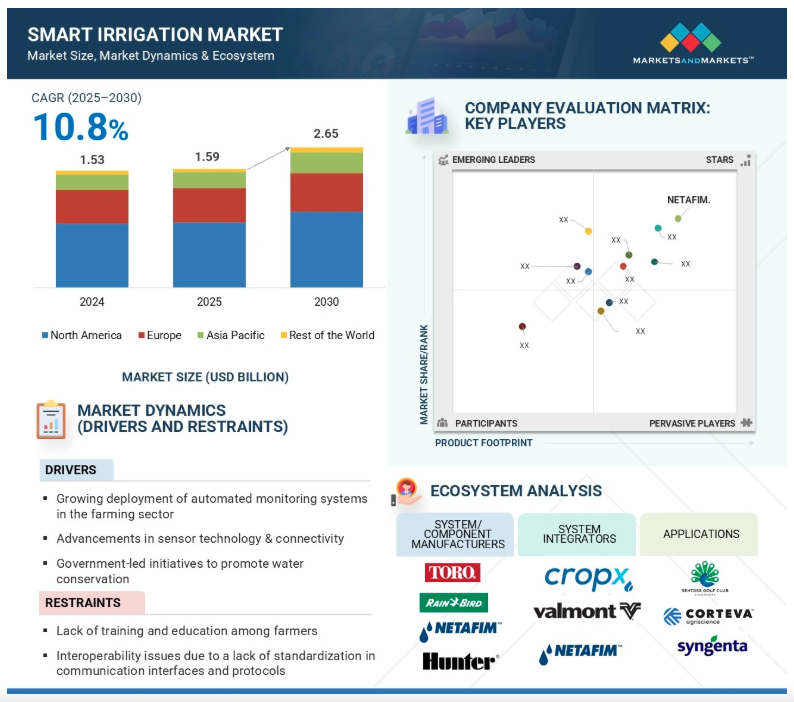
- The global smart irrigation market is growing fast. It is expected to reach USD 2.65 billion by 2030.
- Studies show smart irrigation can save 20% to 30% water per acre.
- In India, smart irrigation boosts crop yield by up to 15%.
- About 25% of farmers worldwide use IoT solutions in some form.
The UN states that by 2050, food demand will rise by 70%. IoT will help meet this demand.
These facts show why IoT-based irrigation management systems are becoming popular. They save water, cut costs, and support global food needs.
How Does an IoT-Based Automated Irrigation System Work?
The system combines devices, sensors and software in order to control water.
- Soil Sensors – measure moisture and temperature in the soil.
- Weather Data – records rain, humidity, and sunlight.
- Controller – makes decisions based on data.
- Smart Valves and Pumps – allow water to be released when it is needed.
- Mobile or Web App – allows farmers to check and control irrigation at any time.
When soil moisture declines, sensor alerts can be sent to the system, which will turn on pumps or valves. Once the soil moisture gets to the correct amount of moisture, the water shuts off.
This is an IoT-enabled smart irrigation system!
Types of Smart IoT-Enabled Irrigation Systems in Agriculture
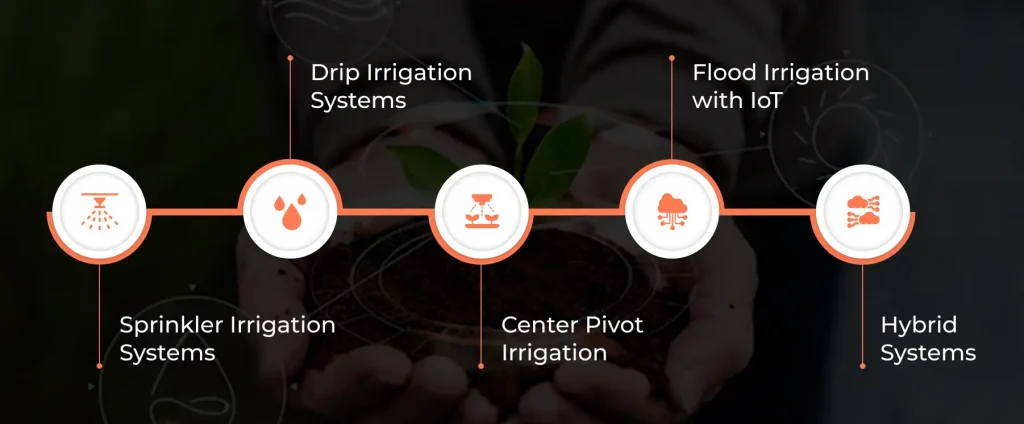
Here are different types of Smart IoT-Powered Intelligent Irrigation Systems that you should be aware of:
Drip Irrigation Systems
A tech that allows water to drip slowly close to the roots. Sensors control water flow according to the plant’s needs. Save several gallons of water.
Sprinkler Irrigation Systems
Simulates rainfall by cascading water. Sensors adjust pressure levels and timing. Centre for large farms.
Center Pivot Irrigation
Long pivots that go around a circle. IoT helps manage speed and water amount. Used for renting wheat, corn, or rice.
Flood Irrigation with IoT
The same, but with sensors to avoid waste and waterlogging negative impact of waterlog.
Hybrid Systems
A mix between drip and sprinkler systems. IoT allows for flexibility in management and control.
These systems can be adapted to fit different crops, soils and farm size. IoT-based irrigation system development can greatly enhance the experience in terms of control, management, usability.
Five Best Small, Smart IoT Irrigation Systems to Buy on the Market
- Netafim Smart Irrigation: Based on drip systems developed with sophisticated sensors. Farmers across several acres may be monitored with ease.
- CropX Smart Irrigation: It collects soil moisture and weather data. Per cent to conserve up to twenty-five per cent of water.
- HydroPoint WeatherTrakL: Leverages real-time climate data. Can fit better for farm and landscape use.
- Rain Bird Smart Systems: Provides sensors, controllers, and cloud platform that is easy to control for growers. Respected around the world by growers.
- Lindsay FieldNET: Used on a pivot irrigation.Enables mobile app control.
These brands illustrate IoT-based automated irrigation systems available in the world today.
Benefits of an IoT-Based Automated Irrigation System
An IoT-based irrigation system does more than simply irrigate crops – it saves money, conserves resources, and produces more yield.
With this type of setup, the end result is more intelligent, sustainable farming practices. Here is a summary of the unique things about irrigation systems that are powered through IoT:
- Water Savings: Sensors will indicate soils moisture content and we can also speak about the environmental conditions. Once the farmers receive spatial and temporal data, they can assess when and if they should irrigate. If all of the above is done properly to always make good decisions on irrigation, you could use up to 50% less water. It also prevents waste and helps to protect local water resources.
- Energy savings: Conventional pumps often run longer than necessary, wasting energy. With IoT in place, the pumps would only run when crops need water. This not only saves electricity but also reduces wear and tear on farming equipment and pays dividends in durability over time.
- More Yield: All plants grow better when they are supplied the right quantity of water, at the right time. IoT-based irrigation systems remove the guesswork on when to irrigate crops, and as a result, improve soil health and produce healthier, higher-quality crops in greater volumes.
- Lower Cost: Less water used and less electricity consumed – less cost. Less frequent over-irrigation and under-irrigation mean lower monthly utility costs to the farmer. In addition to lowering their cost, IoT enhances the farming system’s overall costs and eliminates water and crop losses caused by over- or under-watering.
- Improved Planning: IoT technology enables farmers to collect and interpret data regarding water consumption, crop needs, etc. Effectively, farmers will use this data to create more elaborate irrigation plans, anticipate future seasonal shifts, and distribute resources in a more logical manner.
- Remote Monitoring: Farmers will no longer have to physically monitor irrigation in a field or growth operation. With the help of mobile applications, farmers are able to conduct monitoring and management of water flow remotely from anywhere in the world, and this saves them time, guesswork, and unnecessary transportation.
- Sustainable: Automated irrigation supplies an environmentally friendly means by which farmers can reduce waste and protect land and water resources. World concern about food shortages translates to the fact that farmers are now being asked to farm sustainably.
Finally, for investors and stakeholders, these systems will provide serious returns, both socially and financially. The future for smarter farming solutions is looking even better now than it did a decade ago.
For investors and stakeholders to benefit from significant returns on their investments. The demand for food will greatly increase, and smart irrigation is the answer.
Sensor & Hardware Components Required to Build an IoT Irrigation System
Water is the lifeblood of agriculture, yet most farms waste water just guessing when to irrigate.
An IoT-Based Automated Irrigation System changes this. It utilizes smart sensors along with hardware and software to irrigate accurately.
Farmers can save water, save money and harvest better yields.
Let’s discuss the sensors and hardware recommendations and the process involved in bettering an IoT-based irrigation System.
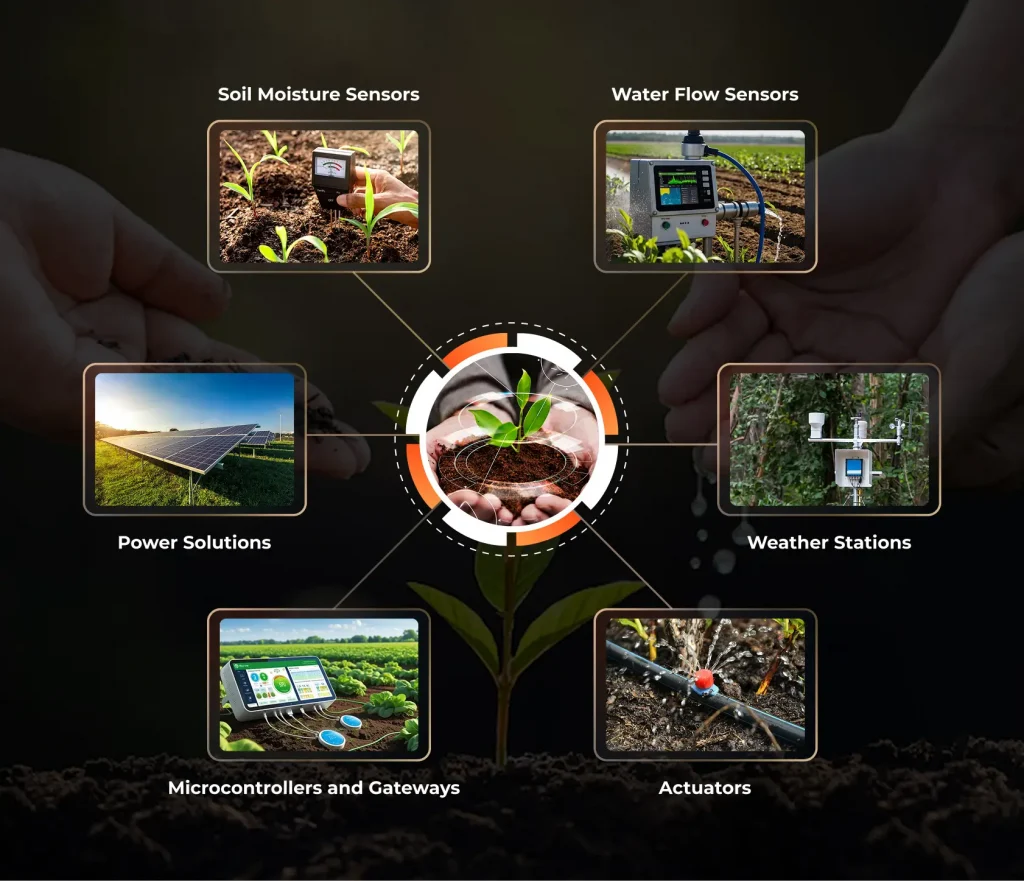
Soil Moisture Sensors (Capacitive and Resistive)
Soil moisture sensors are key components of an IoT-Enabled Smart Irrigation System.
Capacitive moisture sensors measure the presence of moisture by detecting variations in capacitance. They are more resilient to erosion; they are the most durable, longer-lasting sensors.
Resistive soil moisture sensors measure the amount of resistance in wet or dry soil. They are less durable than capacitance sensors, and they are less costly.
Therefore, they help farmers to irrigate with precision and have awareness of how much and when crops need water.
Temperature and Humidity Sensors (DHT, SHT Series)
Changing weather conditions have a powerful impact on crop water needs. Temperature and humidity sensors determine when to make changes.
DHT sensors are easy to use and inexpensive. Ideal for small-scale farms.
SHT sensors have better precision, and they work well with large-scale farms or precision agriculture.
Water Flow Sensors
Water flow sensors measure the amount of water moving through pipes. With these sensors, farms can avoid overusing water and monitor for leaks.
Furthermore, farmers get actual water consumption and can set limits on the amount used.
An IoT-based automated Irrigation system that incorporates flow sensors provides equitable water distribution to various parts of the farm.
Also, it enables farmers to track their fair usage of shared water systems.
Weather Stations (Rain Gauge, Light/UV sensors, Wind sensors)
Mini weather stations allow for better decision-making through the measurement of rainfall, light levels, and wind speeds.
A rain gauge stops irrigation when rainfall indicates that there has been enough rain.
Light sensors measure the sun’s energy, which is important when calculating evapotranspiration (ET).
Wind sensors stop irrigation in the presence of high winds.
When used together, these tools deliver field-level information to farmers to be able to make smarter irrigation decisions.
Actuators (Valves, Pumps, Sprinklers, Drip Systems)
Sensors only collect data. Actuators make action possible. They include pumps, valves, and sprinklers.
- Valves open and close based on soil and weather data.
- Pumps push water through pipes with the right pressure.]
- Sprinklers and drip systems distribute water evenly.
With actuators connected to a IoT-Enabled Smart Irrigation System, irrigation becomes fully automated.
Microcontrollers and Gateways (Arduino, ESP32, Raspberry Pi, STM32)
Sensor data must be transferred to a cloud. Microcontrollers and gateways control this process.
- Arduino – straightforward and inexpensive
- ESP32 – Pretty much the same as an Arduino, but with WiFi and Bluetooth.
- Raspberry Pi – More powerful than an Arduino or ESP32 and, unlike them, can run AI models.
- STM32 – Self-contained microcontroller for larger, industrial projects.
These devices safely connect field sensors with an IoT-Based Irrigation Management System. Farmers receive live data via mobile app or web dashboards.
Power Solutions (Solar Panels and Low-Power Batteries)
Around the world, many farms do not have a consistent power supply. Smart irrigation requires renewable power solutions.
- Solar panels allow self-sufficient systems to run without Power-efficient
- Low-power batteries store energy for overcast days.
Power efficient sensors use less power in their real-time reporting (if it is accepted as a given that you have a power-efficient design, this aspect is taken care of).
You can incorporate a low-power battery to back-up your system to deliver your IoT-Based Automated Irrigation System with non-stop power.
Combining Machine Learning and Artificial Intelligence in a Smart Irrigation System
One of the most significant advantages of developing an IoT-based irrigation system is its powerful use of real-time sensor data in tandem with AI and machine learning.
Replacing timers or farmer judgment as a measure of how much to irrigate (which typically leads to a notice of over-irrigation or under-irrigation) is a solution that provides dynamic, predictive, optimized water delivery.
For instance, if a machine learning algorithm can factor in soil moisture, temperature, crop growth patterns, etc., the system can forecast watering needs days in advance.
It can also learn from prior irrigation cycles and make its own changes without human input.
Machine learning models can even make predictions about drought stress, identify anomalies in water conveyance, and provide the best irrigation weekly schedule for each crop type.
When AI-maximized functionality occurs within an IoT-enabled smart irrigation system, not only do farmers conserve water, but there are yield improvements and increased energy savings.
Now, picture a farm where pumps only run automatically when soil moisture drops below a moisture threshold and the system suggests different levels of water needed for wheat, maize, or paddy, all without checking or monitoring manually.
Now that’s real power for AI in Agriculture!
What Are the Capabilities of IoT and AI Driven Irrigation system
1. Automated Irrigation Control
- Automatically controls water motors/pumps based on soil moisture, weather data, and crop requirements.
- Reduces manual intervention and ensures optimal watering cycles.
2. IOT Irrigation system Offers Real-Time Monitoring
- Tracks soil moisture, temperature, humidity, and other environmental parameters in real time.
- Provides live dashboards and mobile alerts for farmers.
3. Weather Forecast-Integrated Decision Making
- Collects weather forecasts and adjusts irrigation schedules accordingly.
- Prevents over-irrigation during rainy conditions and saves water.
4. Data-Driven Insights & Predictive Analytics
- Uses AI/ML models for soil moisture prediction and irrigation planning.
- Helps in predicting water needs for different crops and seasons.
5. Remote Access & Control
- Farmers can monitor and operate irrigation systems remotely via smartphones, tablets, or web apps.
- Enables Wi-Fi, ZigBee, or GSM-based control of pumps and valves.
6. Irrigation with Water & Energy Efficiency
- Reduces water wastage by supplying only the required amount.
- Optimizes motor usage, reducing electricity consumption.
7. IOT Irrigation System Offer Scalability & Flexibility
- Can be customized for small farms, large agricultural fields, or greenhouses.
- Integrates with different sensors, pumps, and communication technologies.
8. IOT Irrigation System Instant Alerts & Notifications
- Sends instant SMS, app, or email alerts for critical events (low moisture, motor failure, water leakage, etc.).
- Ensures proactive maintenance and timely interventions.
9. Integration with Farm Management Systems
- Connects with farm ERP or cloud-based systems for record-keeping.
- Provides actionable reports for crop yield improvement.
10. Provides Sustainability & Smart Resource Use
- Promotes sustainable farming by conserving water and energy.
- Helps in achieving higher crop yield with fewer resources.
Architecture of IOT Bases Irrigation System
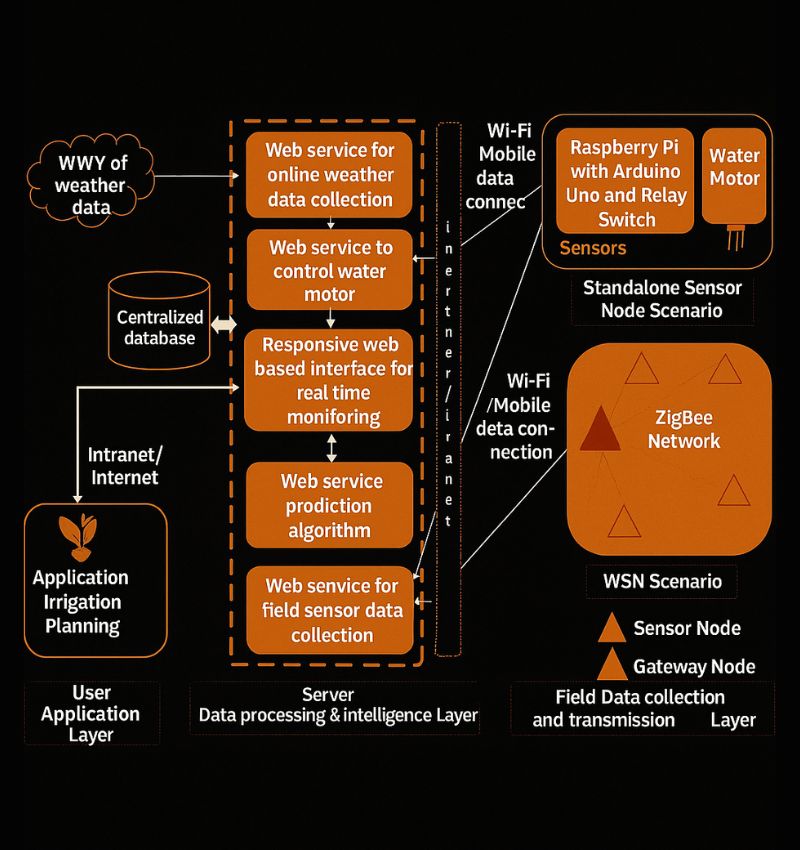
| Layer | Key Components | Functions |
| 1. Perception / Sensing Layer | – Soil moisture sensors – Temperature & humidity sensors – Light/UV sensors – Rain/precipitation sensors – Water flow & pressure sensors – pH/EC sensors – Actuators (pumps, valves, sprinklers, drip lines) | Collects real-time field data and controls irrigation devices. |
| 2. Network / Communication Layer | – Zigbee, BLE, Wi-Fi (short range) – LoRaWAN, NB-IoT, LTE-M, 4G/5G (long range) – Mesh networks – IoT Gateways | Transfers sensor data to gateways/cloud using wired or wireless protocols. |
| 3. Edge / Gateway Layer | – IoT Gateways – Microcontrollers (Arduino, ESP32) – Edge devices (Raspberry Pi, local servers) – Edge analytics software | Aggregates data, performs local processing, ensures offline operation, applies simple irrigation logic. |
| 4. Cloud / Data Management Layer | – Data ingestion (MQTT, CoAP, HTTP APIs) – Databases (time-series DB, NoSQL) – Analytics engines – Digital twin models | Stores large-scale sensor data, runs analytics, and provides central data management. |
| 5. Application & Service Layer | – Farmer dashboards (web & mobile apps) – Alerts/notifications (SMS, push alerts) – Manual overrides (remote irrigation ON/OFF) – Scheduling & automation tools | Provides user interface, monitoring, and control options for farmers and operators. |
| 6. Analytics, AI & Decision Layer | – Predictive analytics – Machine learning (crop-specific irrigation needs) – Weather API integration – Prescriptive irrigation recommendations | Optimizes irrigation schedules, forecasts water needs, integrates weather predictions for smart decisions. |
| 7. Security & Management Layer (Cross-cutting) | – Data encryption (TLS, AES) – Identity & access control – Device management (firmware updates, monitoring) – Compliance with regulations | Ensures secure, reliable, and compliant system operation across all layers. |
How to Develop the Correct IoT-Based Automated Irrigation System?
Creating an IoT-based automated irrigation system entails a systematic process integrating hardware, software, and connectivity. Here are the key steps:
1. Identify the Needs of the Farm
Not every farm needs the same degree of atomization.
For example, the vineyard may require specific drip irrigation, and the wheat field may use a wide spray sprinkler.
The selection of goals, such as maximizing yield or minimizing water loss (e.g., X% over X days), provides the developer with the basis of the irrigation system design.
2. Choose Proper Sensors and Hardware
After reviewing and developing the local agriculture climate network design, if applicable, the author selects appropriate sensors to utilize, which may include a combination of sensors (e.g., soil moisture probes, temperature and humidity, local weather station), based on the crop and soil type.
The device controller, which can be an Arduino, ESP32, or Raspberry Pi, acts as the pathway backbone, holding all these devices together on the network.
3. Set Up Communication and Gateways
Irrigation control based on the IoT requires assured communication. Developers will add gateways that forward sensor data to the server across Wi-Fi, LoRaWAN, or cellular networks, for example. This ensures that data is captured and sent in real time.
4. Connect to Cloud Platforms and Data Storage
All field data will be streamed to a cloud, where it will then be analyzed. Subject to selection and priority, there are numerous cloud IoT platforms (e.g., AWS IoT, Microsoft Azure IoT) or use dashboards (e.g., Tableau) to store and visualize irrigation data.
5. Implement AI and Automation Rules
Once connected, the developer will then be able to insert machine learning models that estimate crop water use and automate irrigation schedules. Farmers can set in criteria such as “only irrigate if the soil moisture is below 20%” etc.
6. Create Web and Mobile Applications for User-Friendliness
A web dashboard and mobile application make the system easier to utilize. Farmers can all see the data, set notifications based on data, and manage irrigation remotely.
7. Test and Improve
Finally, the field testing of the system is done. Any inconsistent water delivery and connectivity issues have been fixed before widespread use.
By adhering to these steps, developers will be able to make the IoT-enabled smart irrigation system efficient, scalable, and tailored to a farmer’s specific requirements.
How Much Does It Cost to Develop an IoT-Based Automated Irrigation System?
The cost to build an IoT-based automated irrigation system mostly depends on a few things.
The size of the project has the most influence, as a small farm and garden setup will require far fewer devices and sensors, than those needed for large agricultural fields.
In essence, the more sensors, smart valves, and connected controllers needed, translates into higher the costs.
The type of sensors also changes the price.
Basic soil moisture sensors are cheaper. But advanced ones that track nutrients, temperature, and water levels will increase the budget. The same goes for controllers. A basic small-scale system costs about $8,000 to $15,000 on average.
Many more mid-level systems with app control, improved sensors, and real-time tracking activities range from $20,000 to $40,000. For larger farms with advanced automation, AI-based water scheduling, and cloud integration, the price can go higher as $250,000 – $760,000.
Also Read: Agritech Software Development Company
Commercial Enterprise Level IOT Irrigation System Development Cost
Cost Estimates
1. Project-Scale Cost Ranges
- Full commercial startup (hardware, software, manufacturing, marketing, operations):
$250,000 – $760,000
2. Smart Irrigation Hardware Costs
- Soil moisture controller units (ET or sensor-based):
$250 – $900 for standard;
$900 – $2,500 for professional-grade
- Add-on soil moisture sensors (compatible with existing controllers):
$99 – $165 each
3. Complete System Installations (Residential Context)
- Average smart sprinkler system (installed):
$3,500 – $5,500
- Higher-end or more complex residential setups:
$8,000 – $18,000; large estates can reach $35,000 – $45,00
4. IoT-Focused Prototypes and Modules
- Pilot/commercial IoT modules (e.g., CropX, Teralytic, Libelium kit):
$1,000 – $5,000 depending on features.
- IoT-based Proof-of-Concept for Smart Farming:
$10,000 – $11,000 for sensor integration, backend, basic UI
You also need to factor in software development. Creating a custom mobile app or dashboard adds to the cost. Cloud storage, IoT gateways, and secure communication features add more. Hardware installation and ongoing maintenance should also be part of the budget.
The cost may seem high at first. But an automated irrigation system saves water and improves crop yield. It reduces manual effort and avoids overwatering or underwatering. For long-term use, it pays back through higher efficiency and lower resource waste.In summary, the cost depends on scale, features, and technology. Small farmers can have a low-cost setup. Larger farms can invest in all the technology to automate the process completely.
Whatever route is taken the new investment presents an opportunity to make better use of resources and increase productivity.
Barriers Preventing Smart Irrigation Systems from Being Adopted in Agriculture
Although the benefits that an IoT-enabled smart irrigation system offers are apparent, there still may be barriers preventing adoption:
High Price Point – Many smallholder farmers cannot afford the high costs to purchase an IoT device or subscribe to a cloud service.
Digital Literacy – Rural farmers typically may lack the foundational skills to effectively use the dashboards or apps.
Limited Connectivity – Some farms are too remote to adequately connect to Wi-Fi or mobile networks to support IoT communication between devices.
Calibration of devices – Farmers may not know how to calibrate, replace, or troubleshoot sensors and actuators.
Concerns about privacy – Some farmers may be concerned about sharing data, agriculture data, with third-party IoT platforms.
In order to overcome the barriers to acceptance, we will need to invest in cheap hardware, farmer-friendly apps, and research funding to facilitate widespread adoption of smart irrigation technology.
Future of IoT-Based Irrigation System Development
The future of developing IoT-based i, irrigation systems appears extremely promising with agriculture increasingly becoming a data-driven industry. Here are a few things that will set the next decade:
AI-Powered Crop Water Needs Forecasts
AI-based algorithms will continue to get better at forecasting specific needs for water, when considering crop type, soil condition, and weather conditions. This will allow for almost no water waste and maximum yield potential.
Integration with Drones & Satellite Data
Combining irrigation systems with drones and satellites enables the observation of plant health and water stress on large tracts of land in real-time. This enables large farms to attain precision irrigation.
Blockchain-enabled water usage tracking
Having blockchain-enabled water usage records will create a transparent system of record that will allow governments to assess fair distribution and support sustainable agricultural practices.
Integration with Smart Fertilizer Systems
The future smart irrigation system based on IoT will not only supply water but also nutrients. Fertigation systems along with IoT will supply crops with specific amounts of water and fertilizer together.
How A3Logics Can Assist in Developing an IoT-based Smart Irrigation System?
A3Logics IoT development services focuses on IoT-based irrigation system development, turning farms into smart ecosystems.
We design customizable end-to-end solutions with everything from sensors, gateways, cloud platforms, implication with existing AI, and enabling user engagement via mobile applications.
Whether you are a startup developing an IoT-based irrigation management system or an enterprise looking to deploy an IoT smart irrigation system on a larger scale, we can provide you with scalable solutions that satisfy your needs.
We can include soil monitoring systems, weather forecasting/monitoring systems, and AI-driven automation, which will continue efforts for agricultural producers to save water, costs, and crop production.
Dedicated to IoT, AI, and agriculture technology, we have perfected a true partnership of support to help you build next-generation irrigation management systems that are efficient, dependable and future-proof.
Conclusion
The transformation to IoT based smart irrigation systems is a considerable advancement in agricultural technology, from manual irrigation to advanced technologies using sensors, automated tillage, IoT and AI to utilize water efficiently, enhance profitability, and improve yields.
While costs for IoT and smart irrigation technology, as well as connectivity, could be obstacles, the advantages of smart irrigation turn the limitations into advantages.
As changes and future solutions incorporate drones, blockchain tools, and AI data forecast tools, IoT-based automated irrigation will become a large component of water sustainability plans in agriculture.
If businesses and farmers want to be on the forefront of technology trends, they are positioned to utilize smart irrigation technologies right now.