Introduction to IoT and its Relevance in Healthcare
Before IoT came to healthcare, patients mostly talked to doctors and nurses in person, over the phone, or through simple text messages. This old model made it hard to keep an eye on things all the time and get medical help quickly. Healthcare providers couldn’t keep an eye on patients’ health in real time, so they had to rely on occasional updates and old data.
The Internet of Things (IoT) has changed the way healthcare works in a big way. With networked devices that let doctors keep an eye on patients from afar, medical help is now more proactive, tailored to each patient, and easier to get. Patients may now talk to doctors online, which has made things much easier and more satisfying, especially for people who live in remote or disadvantaged locations.
IoT in healthcare is good for doctors, patients, and healthcare administrators all at the same time. Medical facilities may improve therapeutic outcomes and make their operations run more smoothly by using connected devices to securely share real-time data. One of the main goals of using IoT in healthcare is to lower expenses overall. This can be done by using resources more efficiently and streamlining treatment operations.
Custom IoT healthcare solutions also fill important gaps in care by allowing patients and clinicians to connect with each other in real time. Real-time information on a patient’s health not only makes diagnoses more accurate, but it also builds trust and dependability in the patient-provider relationship. IoT helps make clinical decisions more informed and increases the chances of successful treatment by using precise analytics and constantly checking data.
IoT also makes it easier to use resources more wisely in healthcare institutions, which improves operational efficiency and makes sure that patient demands are met quickly. IoT solutions help institutions keep the highest standards of care by adding advanced monitoring and data-sharing features. They also make institutions more responsive and improve the entire patient experience.
Must-Know IoT Statistics Shaping Healthcare
The global Internet of Things (IoT) in Healthcare Market was worth USD 139.74 billion in 2023. It is expected to rise from USD 175.61 billion in 2024 to USD 822.54 billion by 2032, with a CAGR of 21.3%.In 2023, the Asia Pacific region had the largest share of the internet of things in the healthcare market, with 40.32%.Moreover, the expenditure on IoT in medical facilities is expected to cross the benchmark of $134 billion in 2025. These stats emphasize the dynamics of connected healthcare technologies, showcasing its revenue growth and capacity to transform patient care while enhancing overall efficiency.
Top Use Cases of IoT in Healthcare
IoT has turned out to be one of the best things that could have happened to the healthcare industry. Listed below are the top use cases of IoT in Healthcare:
Remote Patient Monitoring
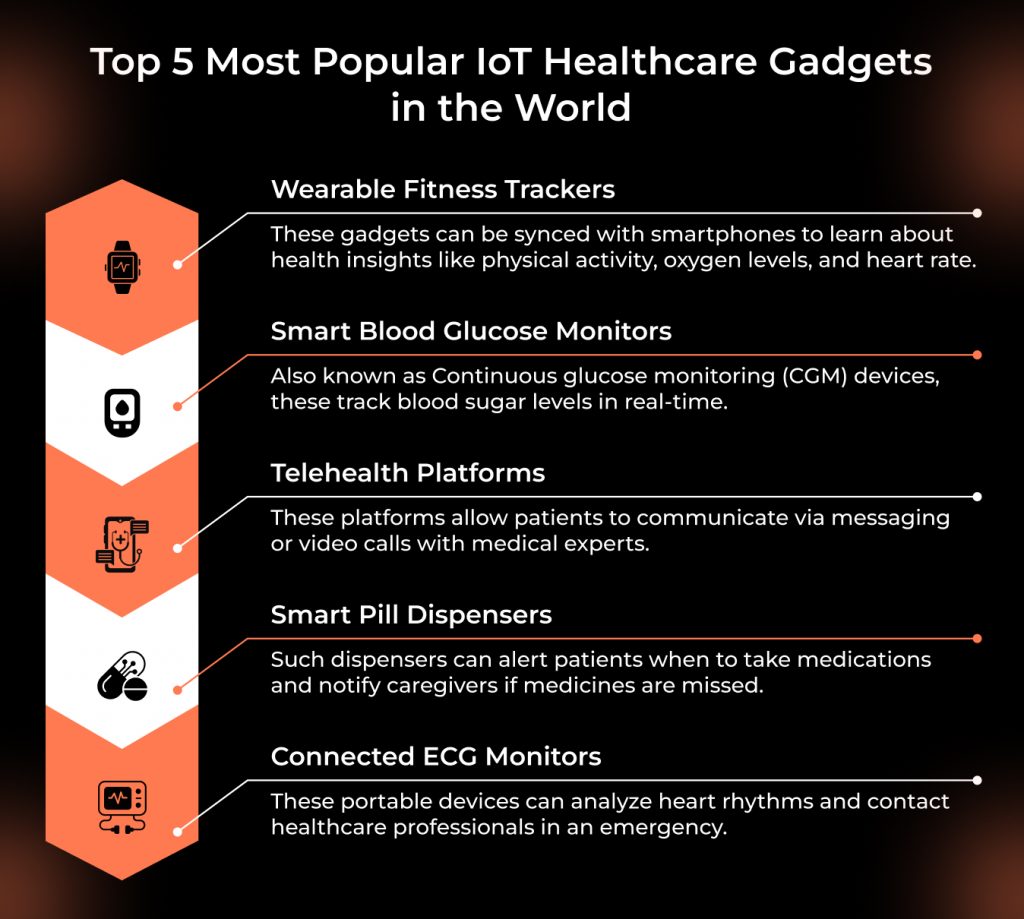
Listed among the top use cases of IoT in healthcare is RPM or Remote patient monitoring. It utilizes IoT gadgets to gather medical information from patients for predictive analysis. This process allows medical professionals to track and monitor chronic conditions, deliver timely interventions, and check vital signs, improving patient care and minimizing hospital visits.
Healthcare Facilities and Infrastructure
IoT also elevates medical facilities by optimizing patient safety and operational efficiency. Smart gadgets analyze environmental conditions, track equipment usage, and optimize resource allocation. This synchronization aids in better usage of infrastructure, ensuring smooth and effective operation of clinics and hospitals.
Smart Medical Devices IoT
Some of the IoT use cases in healthcare also include Smart medical devices that leverage innovative frameworks to share information. These enable real-time diagnostics and monitoring. Such devices, including smart inhalers and wearable health trackers, allow patients to monitor their health on a proactive basis while offering unique insights to healthcare providers for customized care.
IoT Smart Beds for Hospitals
IoT-enabled smart-beds are known for monitoring patient vitals, adjusting positioning on their own, and tracking usage. These beds improve patient safety and comfort while equipping healthcare professionals with critical information for making better decisions. IoT Smart Beds ultimately lead to elevated patient care and operational management.
Predictive Maintenance
Another of the most important use cases of IoT in healthcare is predictive maintenance. IoT aids in predictive maintenance via several sensors that monitor gadget performance and detect possible failures. Such proactive techniques reduce downtime, ensure operational efficiency, and minimize repair costs, enhancing service delivery and patient safety.
IoT Medication Management
IoT medication management frameworks are effective in enforcing adherence to prescribed medication. Reminder mobile apps and smart pill dispensers track the intake of medicines, provide real-time information to medical professionals, and alert patients. Thus, minimizing errors and elevating medical outcomes via consistent compliance with medication.
Electronic Medical Records (EMR) / Electronic Health Records (EHR)
IoT integration into EMR/EHR frameworks is one of the top IoT use cases in healthcare. It streamlines information via connected gadgets that update patient records, enhancing accessibility and accuracy. Such an integration fosters better communication within the provider network, making room for enhanced patient experiences and coordinated care.
Tracking Patients, Staff & Medical Assets
IoT-powered devices also enable real-time monitoring of medical staff, assets, and patients located within medical facilities. Sensors and RFID tags help in reducing wait times, enhancing inventory management, and streamlining workflows, ensuring a smooth availability of resources as and when required.
Advancing Surgical Procedures
Innovative surgical procedures are among the recent use cases of IoT in healthcare. It is achieved via connected gadgets that offer real-time analytics and information. Robotic systems and smart surgical tools improve outcomes and precision, while RPM aids specialists in overseeing surgeries remotely, promoting patient safety and collaboration.
Emergency care
In the cases of emergency care, IoT-powered gadgets expedite patient treatment and assessment. Connected devices provide first responders with vital medical data before the patient reaches the hospital, enabling quicker, informed decisions and improving survival rates.
IoT Enabled Smart Implants
Among the most unique IoT use cases in healthcare, is the growing demand for smart implants. With the help of real-time health monitoring, these connected gadgets offer real-time information to medical professionals. They help in facilitating proactive interventions and customized treatment plans, leading to improved patient outcomes and overall quality of life.
IoT-Driven Predictive Analytics for Mental Health
Predictive analytics that are IoT-powered, help in the assessment of mental health patterns and risks among patients. By analyzing physiological responses and patient behaviors, medical professionals can customize interventions, and enhance support through early detection and customized care.
Virtual Consultations and Telemedicine
Among the diverse use cases of IoT in healthcare are Telemedicine and Virtual Consultations. IoT-enabled medical frameworks enable end-to-end communication between providers and patients. Connected gadgets via real-time monitoring allow medical experts to diagnose patients remotely, increasing access to care and improving patient engagement.
Medical Equipment Tracking
IoT technology is also used to track medical equipment with the help of RFID tags and sensors. It can be leveraged to figure out asset usage and location. This ensures aids in loss reduction, optimal inventory management, and enhanced resource allocation in healthcare institutes, allowing medical staff to focus more on patients.
Ingestible Sensors
When speaking of IoT use cases in healthcare, Ingestible sensors are considered to be a major breakthrough. They help with RPM, by fetching real-time information on physiological conditions and medication adherence. Such smart capsules transfer data to medical professionals, enabling timely interventions and customized treatments, thus enhancing health outcomes and patient engagement.
Depression and Mood Monitoring
There are several IoT-powered gadgets for mood monitoring and depression, that track emotional stress via wearables and mobile apps. These devices gather information on sleep patterns and physical activity, offering unique insights to medical professionals. Thus, helping patients manage their mental health in a better way through personalized interventions.
IoT-Powered Epidemic Tracking
Some of the use cases of IoT in healthcare also cover the tracking of epidemics by gathering and processing information from several sources. Connected devices and sensors monitor health trends on a real-time basis, enabling awareness among public health agents to take immediate and relevant actions.
Intelligent Medical Imaging
Intelligent medical imaging leverages IoT frameworks to improve the interpretation and analysis of diagnostic pictures. Synchronized imaging machines improve collaboration and data sharing and among medical staff, leading to precise diagnoses, better patient outcomes, and faster decision-making.
Smart Wound Care
The list of the top IoT use cases in healthcare won’t be complete without mentioning Smart Wound Care. IoT-powered smart wound care frameworks analyze healing progress via sensors that monitor moisture, infection indicators, and temperature. This allows medical experts to engage in timely intervention and improve patient outcomes.
Smart Pill Dispensers
Smart pill dispensers are devices that use IoT technology to enhance medication adherence. These devices are known to offer reminders, send alerts for missed doses, and track usage, to ensure that patients are taking their medications on time. The smart dispensers help in minimizing the risk of complications arising from non-adherence to prescriptions.

The Significant Benefits of IoT in Healthcare
> Improved Patient Care
One of the most highlighted benefits of IoT in healthcare is enhanced patient care. Remote monitoring powered by IoT ensures a more effective and efficient patient care system by syncing them with medical professionals in real time. For example, wearable technology that can monitor vitals such as blood pressure, heart rate, and insulin levels allows patients to keep a tab on their health.
> Cost Reduction
By introducing IoT in medical institutions and frameworks, significant cost savings can be easily achieved. IoT-fueled devices help reduce manual tasks, optimize resource utilization, and streamline operations. For example, IoT-powered gadgets can help in the prevention of unpredictable breakdowns, avoid expensive downtime, and save on repair costs.
> Better research
IoT in healthcare allows for better research by offering huge volumes of real-time insights from connected gadgets. Researchers can interpret this information to identify trends, develop innovative therapies, and assess treatment outcomes. This data supports evidence-based medical practices, and accelerates clinical trials, improving healthcare and promoting a deeper understanding of patient needs.
> Improved communication between healthcare provider and patient
IoT aids in building improved relationships among medical experts and patients via mobile apps and connected devices. These technologies work together to enable data sharing, pave the path for professionals to analyze patient progress, and offer proactive feedback. It leads to improved patient engagement and encourages patient awareness related to treatment plans.
> Reducing Errors
The usage of IoT in healthcare considerably minimizes errors related to data entry, patient monitoring, and medication administration. Connected devices enable precision tracking of medication dosages and schedules, while automated information gathering reduces human error. IoT contributes to making healthcare environments safer for all and provides quality care.
Challenges faced in Integrating IoT into healthcare
Compatibility with the Existing System
Integrating IoT in healthcare faces many compatibility issues with the existing infrastructure. Several medical facilities use legacy systems that are not easy to pair with innovative IoT solutions. This may lead to data inefficiencies, thus causing issues in smooth communication among healthcare platforms and devices. Ensuring interoperability needs a significant amount of investment in infrastructure and can postpone implementation, complicating overall efforts.
Connectivity and Infrastructure
Infrastructure and connectivity challenges are some of the trickiest ones when implementing IoT in medical facilities. Dependable internet access is essential for real-time data transfer, many healthcare facilities, particularly in rural areas, suffer from a poor network connection. Moreover, obsolete infrastructure may struggle to support the data flow from IoT gadgets. Overcoming such challenges requires heavy investments in technology to ensure efficient deployment.
Legal and Ethical Issues
While integrating IoT in healthcare, a variety of legal and ethical concerns may arise. Problems related to patient information privacy, consent, and data security, are on top priority, as sensitive information is stored and transmitted digitally. Complying with regulations is important but may prove to be resource-intensive and complex. Addressing legal challenges needs comprehensive practices and policies that protect patient rights and ensure the ethical leverage of technology.
Short Device Lifespan and Obsolescence
Another challenge faced during the integration of IoT-powered frameworks is the rapid obsolescence and short lifespan of gadgets. Technological advancements may sometimes make devices outdated on a mass scale, asking for replacements or frequent upgrades. This may put a burden on the budgets and complicate long-term objectives for medical institutes. Managing these issues requires a proactive team that looks after investments in technology, ensuring that systems remain relevant.
Resistance to Change
Resistance to change is known to be among the most notable issues in adopting IoT in healthcare. Healthcare experts may show hesitance towards embracing the latest technologies because of concerns related to workflow disruptions, and skepticism regarding effectiveness, and training. Such reluctance may hinder implementation and minimize the benefits of IoT frameworks. Overcoming such issues involves promoting a culture of innovation, and demonstrating the emergence of new technologies.

Future Outlook of IoT in Healthcare
AI and ML in IoT
The integration of AI and ML with IoT technology in medical facilities is set to transform patient care. These technologies working together can analyze huge datasets from connected gadgets, providing predictive analytics, customized treatment plans, and more effective resource allocation, enhancing overall healthcare outcomes.
Blockchain-Enabled IoT Devices
Blockchain-enabled IoT devices assist with enhancing data security and integrity in healthcare. By offering tamper-proof, decentralized ledgers for patient data, blockchain guarantees safe data sharing across stakeholders. This helps build transparency and trust, facilitating enhanced collaboration while protecting sensitive health data.
Data-Driven Decision Making
The future of healthcare will depend on data-driven decision-making powered by IoT technology. Real-time information from connected gadgets will allow medical practitioners to customize treatments, identify trends, and optimize operations. Thus, elevating patient outcomes and promoting efficient health management across a diverse patient base.
Enhanced Data Security and Privacy Measures
As IoT adoption gains more popularity, improved privacy measures and data security will become essential. Future developments in the domain will concentrate on secure access controls, advanced encryption, and regulations that protect patient information. Such an approach will help in establishing trust among medical professionals and guarantee secure IoT deployment.
IoT-Enabled Robotic Surgeries
Robotic surgeries powered by IoT technology are the next big deal in the surgical practices segment. The advanced and precise systems of IoT will enhance and minimize recovery times and surgical outcomes. As technology evolves, the partnership between robotics and IoT will further enhance surgical efficiency and patient safety.
How A3Logics can be your IoT partner for making your healthcare industry efficient?
A3Logics can be your partner in implementing IoT technology in healthcare, improving patient care and operational efficiency. As an experienced IoT development company, we offer real-time monitoring systems and seamless integration with existing healthcare frameworks. Our focus on data security guarantees compliance with regulations while providing data-driven insights. Through our collaborations with many reputed medical organizations, we’ve developed solutions for unique challenges, ultimately improving patient outcomes and driving innovation across the industry. By choosing top IoT app development companies as your partner, your organization can leverage IoT technology effectively, creating a better and more responsive healthcare system.