Today all the industries are turning to IoT to optimize and streamline their business processes. One of the leading industries that is leveraging the benefits of IoT is the Manufacturing industry. A rapidly evolving industry with the Internet of Things being at the core of this transformation.
Ranging from predictive maintenance to getting real-time visibility into the supply chain, IoT is quickly becoming a crucial part of manufacturing. The global IoT manufacturing market size is valued at USD 97.03 billion in 2023. The market is expected to grow from USD 116.52 billion in 2024 to USD 673.95 billion in 2032 with a CAGR of 24.5% during the forecast period.
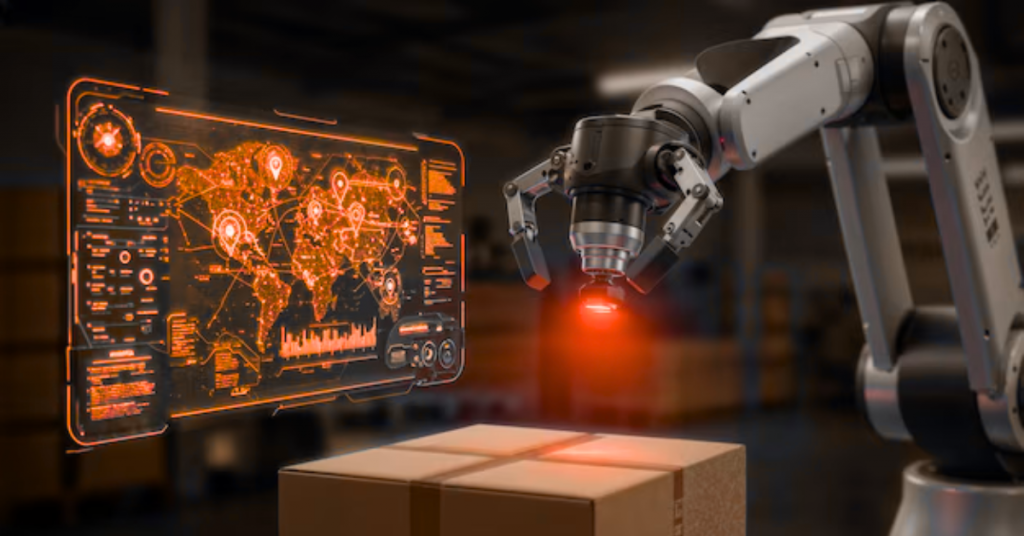
IoT-based solutions are empowering manufacturers to reach unprecedented levels of innovation, cost savings, and efficiency. Through the IoT, IoT interconnects machines, systems, and people, transforming conventional factories into smart factories that are more agile, intelligent, and competitive. To understand the extent of influence that IoT has on manufacturing is yet to be defined.
In this blog we have taken an in-depth look at the benefits of IoT in manufacturing, what is IoT in manufacturing and what are the IoT use cases in manufacturing.
What is IoT in Manufacturing?
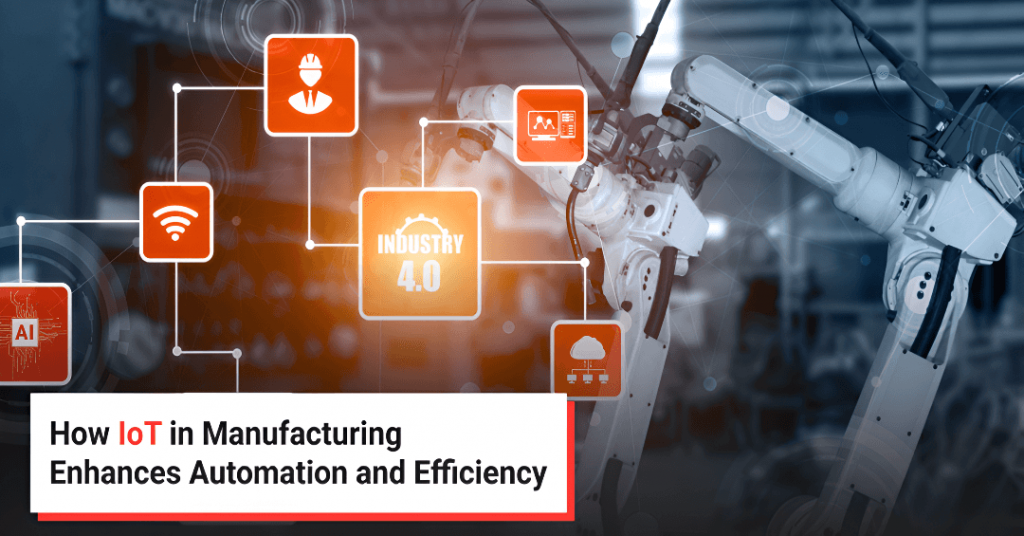
IoT in manufacturing refers to the use of internet of things technology, consisting of various connected devices, sensors and machines. This is used to collect, analyze and exchange data in real-time within the manufacturing operations.
In simple terms, IoT helps in turning the regular traditional factories into smarter and more optimized factories. Where all the devices, sensors, machines and humans can communicate with each other with the help of the internet. This highly connected network of devices and machines enable the manufacturing operations to drive operational efficiency, safety, productivity and decision-making.
Now how this works,
- Machines and devices are fitted with sensors that help in collecting and tracking data like temperature, productivity, energy use, etc. especially in connected equipment such as XTJ CNC machines on the factory floor.
- This is connected with the help of Wi-fi’s, bluetooth, Network connectivity or other Industrial IoT connections.
- This data that is collected is then uploaded to the cloud or a central system for analysis.
- This data is then used by manufactures to optimize processes, prevent breakdowns, monitor assets, and improve output. Sometimes this process is automated through AI and machine learning.
Why IoT is Needed in Manufacturing?
The international market has seen tremendous growth over the past few years with growth fueled by the growing demand for real-time data analysis, automation, and optimization of production processes. IoT technologies such as sensors, networked devices, and cloud platforms have helped manufacturers optimize operational efficiency, minimize downtime, and enhance decision-making.
Manufacturing industries like – automotive, electronics, and heavy machinery have adopted IoT solutions in a very short period to make production smooth, improve predictive maintenance, and introduce an agile supply chain. Also, the incremental movement toward Industry 4.0 has established IoT as a cornerstone within smart manufacturing environments with advantages like improved product quality and resource management.
The following are the driving reasons that propel the growth of IoT in manufacturing.
Industry 4.0 & AI Convergence – Increased automation, digital twins, intelligent sensors, and analytics powered by AI are leading to IoT adoption across manufacturing activities
Operational Efficiency & Quality Requirements – Predictive maintenance, asset monitoring, and supply chain optimization requirements are driving IoT platform implementation
Asset Management Growth in APAC Region – Industrialization in China, India, and Southeast Asia is increasing investment and IoT system deployment
In addition, the international market is also on the verge of strong growth driven by technologies for 5G connectivity, artificial intelligence, and edge computing. These technologies will facilitate quicker, more secure data transmission and processing, making way for more advanced IoT applications among manufacturers.
Green initiatives and the need for digital transformation in industries – are likely to speed up the market growth. Yet, adoption rates could be bogged down by challenges like cybersecurity threats and integration complexities. Nevertheless, the outlook for the market is extremely positive, with forecasts suggesting that IoT will be a key driver in redefining the global manufacturing sector in the next decade.
Best Use Cases of IoT in Manufacturing
1. Predictive Maintenance
Predictive maintenance is one of the strong IoT manufacturing use cases. By employing IoT sensors, manufacturers can monitor equipment health and predict failures before those events occur. This proactive approach minimizes unplanned downtime, thus streamlining overall productivity.
2. Asset Tracking and Management
Manufacturing in IoT tracks assets. GPS and RFID technologies can track supply chain inventory levels and critical equipment. Visibility enables resource allocation optimization and limits losses from missing or misplaced items.
3. Quality Control and Assurance
Quality control is the very base of a manufacturing process. In that respect, IoT technologies significantly enhance quality control. A production line can be monitored through IoT devices, and defects can automatically be detected. This helps in immediate corrections so that the products are always up to the quality standards.
4. Digital Twin Technology
Digital twin technology creates a virtual replica of physical assets so that monitoring and analysis can be carried out easily. This inimitable use case of IoT in manufacturing enables the simulation and analysis of performance within a virtual environment that, at its core, leads to better design and operational strategies.
In this regard, organizations can predict changes within the processes or material that might affect the outcome because they approximate conditions. Such capability helps solve problems that might come later and assists innovation as it can continually develop product development and smooth-running operations above the marketplace.
5. Worker Safety and Monitoring
Safety is one of the most important aspects of the manufacturing sector. IoT devices monitor environmental conditions, track workers’ movement, and insist on adhering to safety norms. The above helps create a safe working environment and eliminates the chances of accidents.
For instance, wearable IoT devices warn employees once hazardous exposures occur, such as high concentrations of poisonous gases or hot temperatures. At the same time, location tracking ensures speedy response in an emergency, thus carrying out proper evacuation procedures and optimum use of emergency management. Promoting a safe culture within the organization improves employees’ productivity and well-being, showcasing ioT in the manufacturing industry.
6. Energy Management
Energy is one of the major cost drivers in manufacturing, and IoT presents ways to track energy consumption, hence identifying inefficiencies and making appropriate energy-saving suggestions. Advanced analytics helps determine what wastes energy, whether machinery or lighting. It makes preliminary adjustments in energy consumption and saves significant utility costs.
Of course, lessened energy use also means a smaller carbon footprint for the manufacturing business, keeping it in line with sustainability initiatives and enhancing efforts at corporate social responsibility.
7. Smart Factory Automation
The smart factory is leading the way in IoT in manufacturing. Unmanned processes, through IoT, increase efficiency in industrial operations and diminish human input dependence. Productivity is further enhanced, and workers may be freed for more strategic pursuits.
Smart factories also use data analytics to make better decisions and respond to market fluctuations. These environments can always optimize operations to save on costs and improve product quality while ensuring the workplace is safer with the integration of robotics, AI, and machine learning.
8. Process Optimization
The information from the IoT devices gives us the necessary background to analyze and optimize the manufacturing process. We will gain insights from this analysis, which will help us notice any inefficiencies and bottlenecks in the process. We can then make any relevant adjustments to improve general operations.
This data helps in the constant monitoring and quick responses to the anomalies that arise, if possible, in production workflows. Manufacturing IoT use cases illustrate how predictive analytics can also foretell possible disruptions, allowing manufacturers to take preemptive action in advance. Integrating IoT improves operational efficiency and creates a culture of continuous improvement in manufacturing environments.
9. Automated Material Handling
Automated material handling systems coupled with IoT sensors can facilitate efficient logistics handling at manufacturing facilities. Such systems can carry materials independently, reducing labor and the likelihood of humans committing errors while handling the parts. They further enhance productivity in workflow since materials arrive at the production line just in time.
This data allows for accurate inventory monitoring, and the manufacturers adjust their operations. This enhances the optimal use of space and reduces operational costs, which add substantially to productivity and ensure the smooth running of smart factories.
10. Intelligent Packaging
Intelligent packaging employs IoT technologies to monitor the product’s condition in motion. It can include sensors within the vehicles that track temperature, humidity, and other environmental factors, ensuring the product is delivered to the customer in the optimum conditions.
This increases the quality of products but also gives useful data to optimize logistics. For instance, alerts will raise a red flag for manufacturers and shippers if any deviations from desired conditions occur, thus allowing proactive actions that can prevent spoilage or possible damage. Moreover, smart packaging may add traceability to improve responsibility in the supply chain.
11. Additive Manufacturing (3D Printing)
Adding IoT to additive manufacturing can enhance the potential of monitoring and controlling the 3D printing process. This use case improves print quality and resource consumption so that the manufacturer can produce shorter cycles.
Manufacturers can use data from IoT sensors to show temperature, humidity, and material flow metrics during printing. This information will allow the detection of a problem in its early stages and online change so that the final product is delivered with high accuracy, less waste, and less time for production. Ultimately, this integration encourages innovation and low-cost production in competitive markets.
12. Waste Reduction and Sustainability
IoT technologies are essential to waste reduction, monitoring processes, and identifying areas for improvement. Manufacturing firms save money on costs while satisfying the pursuit of sustainability. An IoT solution helps track materials and energy usage, thus enabling tracking where production needs improvement.
By working through such a data-driven approach, manufacturers can develop lean practices, better utilize resources, and reduce carbon footprints. Besides, sustainable manufacturing processes greatly improve reputation. Brands attract environmentally motivated consumers, making them more competitive in the markets.
13. Monitoring Production Flow
IoT technologies greatly reduce waste by monitoring processes and finding areas that need improvement. By minimizing wasteful practices, manufacturers may decrease costs and participate in sustainability. IoT allows tracking material and energy utilization, providing insight into what aspects are wasted in each production process.
Through data gathering, manufacturers can adopt lean practices and improve resource use, reducing their carbon footprint. Furthermore, sustainable manufacturing processes often enhance brand reputation, thus attracting eco-friendly customers while maintaining market competitiveness.
14. Smart Robotics and Cobots
Cobots are collaborative robots with IoT capability. This enables them to share their workload with human workers, improving productivity. The robots can communicate with other robots and devices to enhance task execution. When cobots share data, it will be quite easy to adjust things according to workload and environmental conditions, which makes working together relatively smooth.
This integration reduces the strain on human workers’ bodies and reduces potential errors and downtime in manufacturing processes, hence more flexible and adaptive. In this regard, cobots will play a significant role in overall operational efficiency and innovation in the manufacturing sector.
15. Condition-Based Monitoring
Condition-based monitoring entails continuously monitoring the state of machinery and equipment through IoT sensors, capturing data on performance metrics such as temperature, vibration, and pressure. Such data analysis helps identify possible upcoming failures beforehand.
Proactive maintenance reduces unplanned downtime and optimizes overall maintenance schedules for efficient resource use. It also extends asset life and improves operational efficiency, making it an important source of cost savings tempered with time. Finally, condition-based monitoring ensures reliable performance of manufacturing operations.
16. Remote Monitoring and Management
IoT in Manufacturing supports the remote monitoring of equipment and processes, significantly improving operational efficiency. This enables manufacturers to easily manage operations from afar, more effectively handle multiple locations, and be more responsive to problems. This capability decreases the need for on-site personnel but allows quicker interventions in troubleshooting and maintenance.
Furthermore, remote monitoring makes data analysis and reporting possible, thus helping manufacturers identify trends and optimize their performance. IoT technology ensures that companies get visibility, make decisions simply, and build responsiveness in dynamic market environments.
17. Smart Inventory Management
IoT solutions can automate inventory management, allowing manufacturers to enjoy optimal stock levels. This capability reduces holding costs and avoids lost hours, as the production cycle will not be interrupted by stock.
Data from the IoT sensors allows manufacturers to easily track inventory movement, clearly identify requirements, and be alerted to approaching full or empty stock conditions. This enables a pre-emptive stock buildup, thus avoiding overstocking and stockouts and improving operational effectiveness. Manufacturers will respond faster to shifting markets and consumer demand.
18. Environmental Monitoring
IoT technologies, therefore, ensure compliance with regulations by the manufacturing company and reduce its ecological footprint through environmental monitoring. It is possible to track air quality, emissions, and other environmental factors with sensors that enable proactive actions.
Manufacturers can identify environmental risks through continuous data collection, and corrective actions can be implemented; this capability is beyond the regulatory standards of certain organizations and helps develop sustainability initiatives. Apart from this, knowledge gained from environmental monitoring can enable the strategizing of more effective decisions, which contribute to optimizing resource usage and enhancing comprehensive efficiency improvement in manufacturing processes.
19. Supply Chain Optimization
The Internet of Things in manufacturing also covers supply chain optimization. Ensuring that data from IoT devices is used enables the optimization of supplier relationships and logistics, leading to greater efficiency and cost savings. Manufacturers can, for instance, use sensors and connected devices to report on inventory levels, track shipments, and follow production schedules.
For that reason, increased visibility allows for better proactive choices, such as adjusting orders according to fluctuating demand or combating delay. Lastly, streamlining the supply chain leads to increased efficiency and higher customer satisfaction regarding the timely delivery of the product.
20. Advanced Analytics in Demand Forecasting
Advanced analytics using IoT data allows manufacturers to predict product demand better. This creates a better probability in production planning and supply inventory since supply is aligned with market demands. Manufacturers can thus use data on how consumers behave, current trends, and historical sales in tracking patterns and predicting when demand will change. It significantly minimizes the risk of overproduction or lack of stocks and creates optimal resource utilization.
In addition, improved demand forecasting allows for enhanced cooperation with suppliers, the simplification of the whole supply process, and improved operational efficiency in general.

Benefits of IoT in Manufacturing
There are various benefits of IoT in manufacturing. These systems leverage cutting-edge technologies such as – robotics, artificial intelligence, and smart edge devices. This is especially important to optimize every part of the production cycle. The following are some of the key benefits of IoT in manufacturing.
1. Predictive Maintenance
Predictive maintenance is one of the strong IoT manufacturing use cases. By employing IoT sensors, manufacturers can monitor equipment health and predict failures before those events occur. This proactive approach minimizes unplanned downtime, thus streamlining overall productivity. IoT sensors track equipment condition in real time, sensing anomalies in vibration, temperature, and energy consumption. This enables manufacturers to forecast failures before they happen, lowering unplanned downtime and saving millions in maintenance.
2. Operational Efficiency
Growing need for automation and operational effectiveness is the key driver for the uptake of IoT among the manufacturing sector. As competition globally continues to heat up, manufacturers find themselves pressured to streamline their production processes, cut costs, and enhance the quality of their output. IoT technologies make automation possible for routine tasks, reduce the likelihood of human error, and enable improved real-time monitoring and management of equipment, resulting in increased efficiency in operations.
IoT solutions provide manufacturers with – real-time data and insights, which allows them to identify inefficiencies, track production metrics, and enhance decision-making. This helps reduce downtime, prevent equipment failures through predictive maintenance, and maximize resource utilization.
3. Risk & Error Reduction
One of the biggest concerns of any industry is the chances of risk and error. However with IoT in place it becomes easy to monitor any errors that may occur due to manual work. With continuous monitoring it becomes so much easier to monitor the errors and even if they occur it can be changed before it makes any real damage. Managing risks also become so much simpler and quicker with the help of IoT that analyses any event as and when it happens.
4. Quality Improvement
Digital change and intelligent manufacturing operations can significantly influence quality enhancement. With cameras, sensors, machine learning, and AI, robotic systems can track product quality quicker and more precisely than the human eye, detect flaws and react quickly.
As per a McKinsey report, automation and digitization have led to a reduction of more than 65 percent in total deviations in manufacturing. By responding promptly, manufacturers are saved from recalls of faulty products, enhancing the satisfaction level of customers.
5. Workplace Safety
Manufacturing is a vast area, which includes managing the supply chain, warehouse and transportation. It has a pretty hazardous work-setting. There are chances for the heavy load machinery to malfunction and often cause damage to life. Now with IoT sensors being involved at every stage, manufacturers can ensure that the machinery is not being overloaded and it can detect any malfunctions before it even happens. IoT can help in saving lives and preventing major accidents at work which is very important for employee safety.
It can detect any disturbance in the environment in case of any leaks or it can monitor the health of the employees through wearable devices that can monitor the temperature, heart-rate etc. it can also create virtual boundaries to prevent employees going near any device that may be malfunctioning. With IoT it can be so much easier to set in place the emergency response for enhancing workplace safety.
6. Cost Savings
Automation decreases human effort in repetitive or intensive work, not only keeping labour costs lower but also releasing human workers to perform higher-value work like problem-solving, innovation, and process improvement. Further, with maintenance of industrial equipment accounting for almost 70 percent of total expense, operational efficiency and preventive maintenance are imperative. Industrial IoT technology has valuable advantages, including enhancing remote troubleshooting and lowering the number of service calls in case of no maintenance.
And lastly, usage of connected devices and advanced management platforms enables operators to manage operations remotely such as remote out-of-band management.
7. Enhanced Customer Experience
One of the key benefits of IoT in manufacturing is enhancing the overall customer experience. This is achieved through better and streamlined processes that allows quicker deliveries, better functioning of the devices. With IoT it is easy to give updates and maintenance on a regular basis.
IoT Trends in Manufacturing
> Adoption of Edge Computing.
Edge computing processes data as close to the point of origin as possible, thus reducing latency and making applications based on IoT for the production setup more efficient. Since edge computing processes data locally, it automatically reduces the system’s reliance on data traveling upwards to cloud-based servers, which often causes delays.
A decentralized architecture speeds up live decision-making but, more importantly, improves bandwidth efficiency to ensure that manufacturers optimize processes and react rapidly to changing factory floor conditions.
> AI & machine learning integration for advanced analytics.
IoT allows for adding AI and machine learning to predict analytics and decision-making, making the manufacturing process much more intelligent. Data applies to finding many patterns and trends that human analysts might never have noticed. This gives them a much better forecasting system for their inventories and proactive maintenance, culminating in better efficiency and cost savings within the manufacturing landscape.
> Role of 5G for real-time IoT communication.
5G technology will eventually ensure faster data exchange and efficient connectivity of IoT devices for enhanced monitoring and automation. Because 5G affords low latency, high bandwidth, and the ability to fast-forward data exchange between numerous devices with little delay, manufacturers can develop and implement more complex automation controls. Advanced connectivity will enable advanced applications such as remote machinery control, analytics, responsive supply chain management, and numerous others, all geared toward smarter manufacturing processes.
> AR/VR with IoT for guided operations and training.
Blending IoT data with VR and AR has economic benefits, such as improved earnings, lower expenses, and new prospects for product innovation. IoT trends in manufacturing are especially relevant, improving AR/VR applications in a variety of ways.
IoT sensors provide real-time data that can be viewed in VR to aid in the detection of malfunctions. AR improves manufacturing layouts by establishing efficient routes and inventory locations. Additionally, VR can be utilized to simulate equipment functioning, providing useful employee training based on real IoT data.
Future Scope of IoT in Manufacturing
The manufacturing industry is quickly racing towards a radical future which is driven by IoT. One sector that was completely reliant on human intelligence is now seeing a whole new ecosystem that consists of connected devices, machines and sensors.
The future of IoT manufacturing solutions is going to be full of smart technologies that will redefine the way factories operate.
> Evolution towards Smart Factories.
As we are going towards the future of manufacturing, many factories are rapidly pacing towards smart factories. With the smart factories becoming the new standard where IoT manufacturing solutions are enabling manufacturers to have real-time monitoring, autonomous decision making and interconnected operations. There will be constant communication between the devices and sensors that will allow for continuous quality and efficiency improvement.
> Full automation & predictive operations.
Another thing that we can see in the future of IoT manufacturing solutions – predictive and prescriptive operations. With AI-powered IoT systems, factories will transition from scheduled maintenance to predictive and even autonomous maintenance.
> Deeper integration with blockchain, digital twins, and robotics.
We can see a complete transformation of IoT manufacturing with the help of blockchain. digital twins and robotics. With blockchain offering unmatched trust and transparency in the supply chain we can ensure for more efficient process for fraud prevention and compliance. With Digital twins coming into play manufacturers will be able to build virtual machine models, systems and complete factories.
That will be linked with IoT for real-time monitoring, simulation, and optimization enabling improvements without interrupting actual production.
At the same time, the confluence of IoT and robotics (IoRT) will enable intelligent robots to assume precision-based manufacturing, automated quality checks, and dangerous tasks, learning and adapting in real-time while working in tandem with human laborers.
Collectively, this technology triumvirate will redefine operational precision, transparency, and responsiveness, laying the groundwork for the next generation of smart factories that are truly intelligent and resilient.
Conclusion
These smart solutions enable manufacturers to remotely monitor, manage, and control all areas of their operations, such as inventory, manufacturing, maintenance, and repair. They can also reduce downtime and improve operational efficiency.
However, in order for manufacturers to realize the full potential of the Internet of Things – they must have confidence that their data is secure and under their control. Furthermore, your IoT ecosystem must be interoperable, allowing diverse devices and systems to interact together. As your IoT ecosystem evolves, you will gain additional value.
For forward-thinking manufacturers – investing in the correct IoT devices is a simple approach to stay ahead of the competition and boost your bottom line.
Why Choose A3Logics for IoT Development Services?
The industry is being transformed by the widespread adoption of the Internet of Things in manufacturing environments. It enables factories to optimize – production processes, maximize asset use, increase uptime, and anticipate problems.
A3Logics expertise in IoT development services and data analytics enables factories to confidently embrace the Industry 4.0 revolution. Our team will develop a customized solution to ensure that your manufacturing is prepared for an era of unparalleled transformation. Contact us today to begin your digital transformation journey.
We offer.
- We have 22+ years of proven expertise in IoT development services.
- Our experts create customized IoT manufacturing solutions.
- We build solutions that offer seamless integration with existing systems.
- Our IoT manufacturing solutions focus on security & compliance.
- We create personalized solutions that are AI & Analytics Driven.
- Get scalable architecture that is future ready.