As companies try to automate processes that are ever more complicated, the number of ways that machine learning may be used in RPA is growing quickly in fields including finance, healthcare, manufacturing, retail, and more.
An RPA bot might handle an invoice, but what if the person who sent it in makes a mistake on the form? How does that correct itself? By implementing ML in RPA whenever there is a mistake, ML can learn from it and fix it the next time it happens, which will lead to better results in the future.
RPA can move the chess pieces, but ML can figure out how to win the game. Add a little artificial intelligence (AI), and you have a chess master who can come up with new ways to play.
Here we will discuss all about the use of machine learning in RPA, as well as the best ways to accomplish it. It gives you a plan for how to successfully adapt and innovate.
Machine Learning in RPA: Market Statistics
It’s crucial to grasp what RPA and ML are, how they are different, and how you can use them to your advantage as they become more and more connected. Robotic Process Automation (RPA) was a new technology in the early 2000s that used already-existing technologies like screen scraping and workflow automation. RPA has been the most popular automation tool across all industries throughout the years. The RPA market is worth roughly $4 billion right now, and it’s expected to grow to more than $13 billion by 2030.
The market for machine learning in RPA is growing very quickly as more and more firms see how useful smart automation can be. Recent reports say:
- The global RPA market was worth $22.79 billion in 2024, and it is expected to grow at a rate of 43.9% per year from 2025 to 2030.
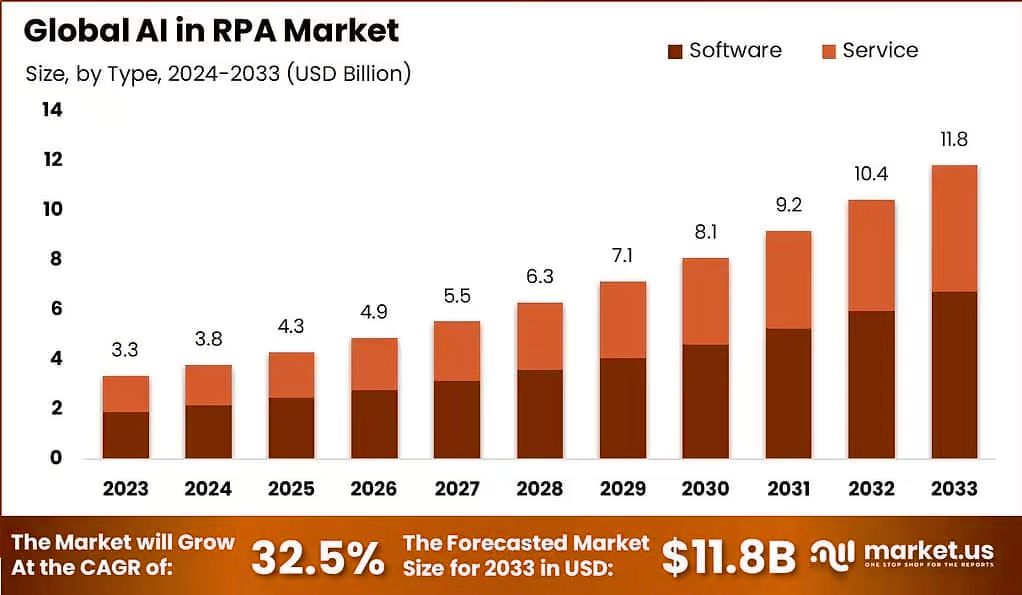
- AI in RPA is predicted to expand at a CAGR of 32.5% and be worth $11.8 billion by 2033.
- Deloitte found that more than 78% of the organisations they questioned had already used or plan to use RPA, and most of them are already working on intelligent automation initiatives.
How Machine Learning Enhances Traditional RPA Workflows
Traditional RPA is great at automating processes that are organised and happen over and over again. But when you have to deal with unstructured data, make complicated decisions, or change processes, its limits become clear. This is how machine learning in RPA fills this gap:
- Handling Unstructured input: ML lets RPA bots handle emails, photos, PDFs, and speech input, which opens up new areas for automation.
- Predictive Analytics: ML models can guess what will happen, find problems, and tell bots what to do to stop them from happening.
- Continuous Learning: ML-powered bots get better over time by learning from fresh data and outcomes, unlike static rule-based bots.
- Natural Language Processing (NLP): ML makes it possible to simplify to understand and respond to human language, which makes chatbots and document processing smart.
- Better Decision-Making: By using ML in RPA, bots may make judgements that take into account the situation, which means that humans don’t have to become involved as much in complicated workflows.
Companies may get scalable, adaptable, and high-impact automation by using RPA and machine learning together.
Key Differences Between RPA and Machine Learning
RPA and ML both help with automation, but they do so in very different ways. To integrate well, below are the key difference between RPA vs. ML. Check it out:
| Aspect | RPA (Robotic Process Automation) | ML (Machine Learning) |
| Approach | Rule-based, deterministic | Data-driven, probabilistic |
| Data Type | Structured (spreadsheets, databases) | Structured & unstructured (text, images, audio) |
| Learning | No learning, follows pre-set rules | Learns and adapts from data |
| Task Suitability | Repetitive, predictable tasks | Complex, variable, judgment-based tasks |
| Adaptability | Low | High |
| Human Intervention | Needed for changes in rules | Needed for model training, less for inference |
| Example | Invoice processing, data entry | Fraud detection, sentiment analysis |
Top Use Cases of Machine Learning in RPA Across Industries
The combination of RPA and machine learning is opening up new, game-changing uses in many fields. Here are the most useful use cases of Machine Learning in RPA:
1. Machine Learning in RPA for Financial Services and Banking
Banks use RPA with machine learning for things like processing loans, stopping money laundering (AML), and finding fraud in real time. ML models look at transaction patterns, find unusual ones, and RPA bots take prompt steps like putting a hold on an account or reporting compliance issues. This combination makes it easier to control risk, cuts down on manual work, and makes sure that all rules are followed.
2. Use of Machine Learning in RPA for Healthcare and Medical Claims
Healthcare providers use ML in RPA to accelerate claims processing, manage patient records, and predict diagnoses. ML models extract and verify unstructured data from medical documents. Meanwhile, RPA bots handle data entry, billing, and claims decisions. As a result, this integration speeds up payments, reduces errors, and improves patient care.
3. Enhancing Supply Chain and Logistics with ML-Powered RPA
Machine learning applications in RPA help supply chains by predicting demand, optimising inventories, and keeping track of shipments. ML forecasts how many orders will come in and what problems might happen, whereas RPA handles the logistics and processing of those orders. The end result is lower costs, better accuracy, and more flexibility in responding to changes in the market.
4. Machine Learning Applications in RPA for Retail and eCommerce
Retailers use ML in RPA to do things like personalised marketing, dynamic pricing, and keeping track of their stock. ML looks at how customers act and makes predictions about future patterns. RPA keeps product listings up to date, handles orders, and automates returns. This synergy makes things easier for customers, increases sales, and makes operations run more smoothly.
5. Intelligent Document Processing in Insurance Using RPA + ML
Insurance businesses utilise RPA and machine learning to speed up the process of taking claims, managing policies, and assessing risks. ML models sort and pull data from different types of documents, while RPA bots check, process, and send them where they need to go. This speeds up processing, lowers the number of mistakes, and makes customers happier.
6. Fraud Detection with Machine Learning-Driven RPA
Detecting fraud is a common use of machine learning in RPA. ML models look for strange trends in transactions, and RPA bots act right away by barring accounts, sending notifications, or moving cases up for review. This response in real time lowers losses and increases safety.
7. ML in RPA for Human Resources and Recruitment Automation
HR departments use ML applications in RPA to scan resumes, narrow down candidates, and onboard new employees. ML models use NLP and past data to see if an applicant is a good fit, while RPA handles organising interviews, sending offer letters, and checking for compliance. This speeds up hiring and makes sure that everything is the same.
8. Predictive Maintenance in Manufacturing with ML and RPA
Machine learning applications in RPA help manufacturers forecast when equipment will go down and plan maintenance. ML looks at sensor data to predict when something will break down, and RPA bots send out maintenance requests or order new components. This proactive strategy cuts down on downtime and makes assets last longer.
9. Leveraging RPA with Machine Learning in Telecom for Customer Service
Telecom firms use RPA and machine learning to sort customer support tickets, predict network problems, and fix them automatically. ML models figure out what problems customers are having, and RPA bots fix simple ones or send more complicated ones to the next level. This speeds up response times and improves the quality of service.
10. ML-Powered RPA Chatbots: Enhancing Customer Engagement
Chatbots that use machine learning are one of the best examples of machine learning in RPA. These bots employ natural language processing (NLP) to understand what customers are asking, respond right away, and handle common requests. RPA bots change records or start activities based on what chatbots say, giving customers service around the clock.

What Are the Key Benefits of Combining ML and RPA?
Integrating machine learning into RPA has huge benefits, such as:
Enhanced Process Intelligence
Machine learning in RPA lets bots do more than just simple tasks by making decisions based on data. By looking at big datasets and finding patterns, ML-equipped bots may learn how to handle new situations, make smart decisions, and improve workflows. This makes automation across business processes smarter and more responsive.
Ability to Handle Unstructured Data
Traditional RPA has trouble handling unstructured data like emails, pictures, and PDFs. By adding ML to RPA, it can process, extract, and understand information from a wide range of unstructured sources. This greatly expands the spectrum of jobs that can be automated, including those that used to need human help.
Improved Accuracy and Reduced Errors
ML-powered RPA learns from fresh data and results all the time, which reduces mistakes over time. This ability to adapt makes sure that bots get better at their jobs as they handle more situations. This cuts down on expensive mistakes and rework and improves the overall quality and dependability of automated processes.
Scalable and Adaptive Automation
RPA systems can change how they work based on new business needs and data trends thanks to machine learning. This scalability lets businesses automate increasingly complicated tasks as they get bigger. Adaptive bots make sure that automation still works when workflows, rules, or data inputs change.
Enhanced Decision-Making Capabilities
With predictive analytics and real-time insights, ML-driven RPA can guess what will happen, figure out what the best course of action is, and advise it. This gives businesses the power to make decisions more quickly and with more information, which is especially important in areas like fraud detection, customer service, and supply chain management, where quick reactions are crucial.
Significant Time and Cost Savings
ML-powered RPA cuts down on manual work, speeds up job completion, and lowers operating expenses by automating complicated and repetitive procedures. Bots can work around the clock without becoming tired, giving you consistent results and letting human workers focus on more important, strategic tasks.
Better Customer Experience
When RPA uses ML to learn about consumer needs and wants, it can offer faster, more personalised service. This means faster reaction times, fewer mistakes, and solutions that are made just for you, which makes customers happier, more loyal, and more likely to stay in very competitive marketplaces.
End-to-End Process Automation
RPA in machine learning lets you automate whole business processes instead of simply one activity at a time. With ML, businesses can automate multi-step workflows that include making decisions, extracting data, and resolving exceptions. This makes it possible for all departments to work together smoothly.
Competitive Advantage and Innovation
Early adopters of ML-powered RPA get a strategic edge by running their businesses more intelligently and efficiently. Therefore, companies that quickly innovate, adapt to market shifts, and improve services often stay ahead of the competition. This creates a culture of constant improvement and technological leadership.
Continuous Learning and Improvement
RPA in Machine Learning changes every time new data is added, which lets bots get better over time. As a result, this ongoing learning ensures automation stays useful, current, and aligned with evolving goals and external factors.
Challenges in Implementing Machine Learning in RPA Projects
Even if it has a lot of potential, adding RPA in machine learning comes with a lot of problems:
Data Availability and Quality Issues
To work well, machine learning models need a lot of high-quality data that is correctly labelled. However, in many companies, useful data is often fragmented, missing, or inconsistent, making model training difficult. Poor data quality makes models less accurate, which means that RPA processes can’t automate things correctly and make wrong conclusions.
Integration Complexity
To add machine learning models to current RPA operations, you need an infrastructure that is strong and adaptable. It needs well-designed APIs to make sure that ML components and RPA bots may talk to one another without any problems. Integration problems include making sure that everything works together, dealing with latency issues, and making sure that data flows smoothly. These can make deployment harder and take longer and cost more to construct.
Lack of Skilled Talent
As RPA and machine learning come together, professionals who are good at both are needed. But there aren’t many people who are good at all three areas: RPA development, data science, and ML engineering. This lack of skilled workers makes it hard to design, build, and keep intelligent automation solutions running smoothly.
Model Training and Maintenance
Machine learning models aren’t set in stone; they need to be retrained with new data all the time to stay accurate and useful. Monitoring model performance, finding drift, and upgrading models are all ongoing processes that need committed resources. If you don’t take care of them, ML models in RPA can get worse, which makes automation less effective.
High Initial Investment and ROI Concerns
Implementing RPA solutions with machine learning (ML) requires a lot of money up front, such as for software licenses, gear, data preparation, and qualified workers. Even if the long-term benefits usually make the investment worth it, companies may not have enough money and may not know when they will see a favourable return on investment.
Security and Data Privacy Risks
Adding machine learning (ML) to robotic process automation services means handling private and sensitive data, which raises privacy and security issues. Companies need to take strong steps to protect their data, follow rules like GDPR, and protect themselves from cyber threats. Not protecting data can lead to breaches, fines, and losing customers’ trust.
Best Practices to Successfully Integrate Machine Learning in RPA
Businesses should do the following to get the most out of machine learning in RPA:
- Find good ways to use ML in RPA: Focus on processes that have unstructured data, make hard judgements, or have a lot of mistakes.
- Make sure the data is high-quality and useful: Put money into collecting, cleaning, and labelling data to make strong ML models.
- Make teams that work across departments: Use your knowledge of RPA, ML, business, and IT to come up with complete solutions.
- Pick the Right Tools and Platforms: Choose platforms that can grow and work with both RPA and ML.
- Make, train, and test ML models In steps: Start with tiny tests, check the outcomes, and then grow successful pilots.
- Keep an eye on and take care of ML models After Deployment: Keep an eye on performance and retrain when necessary.
- Put Explainability and Transparency at the top of your list: For compliance, use models that can be understood and write down how decisions are made.
- Put in place strong security and governance: Keep data safe, follow the rules, and control who can access it.
- Keep an eye on ROI and business impact: Evaluate results and improve plans to get the most value.

A3Logics’ Expertise in Delivering ML-Driven RPA Solutions
A3Logics is the best machine learning development company since it offers end-to-end solutions that integrate RPA with powerful ML models. We are experts in:
- Process Assessment and Strategy: Finding the most important ML application in RPA use cases.
- Custom Model Development: Making, teaching, and improving ML models to meet the demands of a certain business.
- Seamless Integration: Adding ML models to RPA bots and workflows for smart automation.
- AI Development: Using natural language processing, computer vision, and predictive analytics to make automation better.
- Robotic Process Automation: Providing RPA solutions that can grow, are safe, and follow the rules in all industries.
- Ongoing Support: Keeping an eye on, retraining, and improving models to make sure they keep adding value and new ideas.
A3Logics has a proven track record of helping businesses get the most out of machine learning in RPA, which leads to digital transformation and a competitive edge. So, you can always trust us for AI development services and get all the assistance you need.
Final Takeaway
The use of machine learning in RPA is changing the way automation works, giving businesses the ability to handle complicated, data-driven tasks with more intelligence and speed than ever before.
Machine learning in RPA is making things more efficient, accurate, and innovative on a large scale in a wide range of fields, from finance and healthcare to manufacturing and retail. Businesses may stay ahead in the digital age by learning about the pros and cons of ML use in RPA and working with skilled providers.
Do you want to use RPA, ML, or both together? All of these options have their pros and cons, but the optimal one for your business will rely on its particular operations, goals, personnel, and other characteristics.
You don’t have to make this choice alone, which is a good thing. We at A3Logics are delighted to share our knowledge of automation and aid our clients with new ideas. Contact us to talk about all the choices and get a free proof of concept to see how automation can change your business.