A digital revolution is undergoing in the industrial sector with the implementation of advanced machine learning, artificial intelligence, and real-time analytics. Firms are turning from traditional analytics to AI-driven business intelligence. Predictive analytics is at the core of the manufacturing analytics market, and its estimated value by 2026 is $2.5 billion. The future-oriented methods of analysis have overpowered the old school analytical mechanism, where every data point was handled personally and included extensive labour associated with scribbling papers, hand-written maintenance records, and manual intervention.
Data science and AI analytics have grounded predictive analytics as one of the profound solutions for unrealised bad calls in the manufacturing industry. Intelligent prediction models help the factories to anticipate demand, line up periodic maintenance, regulate the production process, and manage inventory levels. Predictive analytics in manufacturing facilitates data-driven decisions, optimizes operations, and enhances efficiency. It also builds an adaptable supply chain, minimizing the chances of material waste or shortage, and eliminating the risk of production downtime.
The forecasting formula protects businesses from disruptions before they occur by identifying risks early through accurate data insights.
Latest technologies like ML, AI, and industrial IoT improve manufacturing analytics and transform ETL processes to predict future production outcomes.
This enables production teams to stay competitive, adapt faster, and make smarter decisions in an increasingly dynamic manufacturing landscape.
What is Predictive Analytics in Manufacturing?
Predictive analytics is simply looking at the historic trends, conducting analysis in the present, and forecasting the future. It refers to applying data to anticipate upcoming trends and events. Here, the future can be close to the present, for instance, on the same day after some hours, or in distant years. Predictive analytics in manufacturing is used for projecting product demand, machinery failure, and tracking quality issues before processing them further. Modeling techniques and historical statistics are key elements of data-driven forecasting, as they offer past and current insights into a particular topic or segment to foresee succeeding outcomes.
Traditional analytics, including descriptive and diagnostic emphasis, only on the past events or their related causes, whereas predictive analytics solutions focus on the prospective occurrence. Both the old analytical approaches were not able to establish a proactive environment, and often kept the manufacturer stuck in a reactive behaviour to attempt to address the problem after it appeared clearly. It could lead to manufacturing disturbance, wasting significant resources. However, forecasting methodology helps the business to derive proactive actions instead of reacting immediately after a mishap. It uses multiple advanced tools to tell us what could happen shortly and enables the supervisor/leaders to fix the problem in advance.
Data, algorithms, and machine learning are key to predictive analytics, helping identify patterns in historical statistics and trends. ML uses neural networks mimicking the human brain, along with methods like linear regression and decision trees. These tools create formulas based on relationships between past inputs and outputs to generate precise future estimates. Predictive analytics not only forecasts outcomes but also enables better control and planning of future business events.
Key Use Cases of Predictive Analytics in Manufacturing
The AI boom in digital technologies has advanced manufacturing, replacing stockpiling with smarter, more efficient production techniques. Predictive analytics offers manufacturers strong insights that lead to better decisions and improved operational efficiency. The way a business implements forecasting tools ultimately determines how much value it gains from them. To understand predictive analytics in manufacturing better, let’s explore its key applications and the impact they create across operations.
1. Predictive Maintenance
Manufacturers do not need to wait until the equipment taps out due to malfunction or failure. Instead, they can fix the issue even before it comes out visually and run a proactive maintenance routine by anticipating potential breakdowns. Predictive maintenance in manufacturing eliminates guesswork and enables the factory owner to detect faults in time and reduce repair costs.
Under the forecasting analytical mechanisms, machines are powered with IoT sensors that act as health trackers for them. These sensors continuously monitor equipment temperature, pressure, and vibration, sending alerts on finding any unusual or faulty operation that may indicate potential failure of the gadget. The manufacturing analytics provides a round view of production equipment and estimates its lifespan, offering a repair or replacement guide.
2. Quality Control
Predictive analytics in manufacturing studies its core functionalities like supply chain process, maintenance requirements, demand forecasting, and studying customer behaviours. These insights serve to establish a quality control mechanism on the factory site by setting quality standards and pointing out any possible defects in the production or final product.
Plant operators do not work blindly anymore, but can check for the desired parameters of KPIs, increasing the quality of goods as well as factory operations through ERP software. Early adjustments in the processes reduce material wastage, production of scraps, and eliminate the need for rework.
3. Supply Chain Optimization
Managing a global supply chain is complex, where any misstep can cause major delays and dissatisfied customers. Predictive analytics in logistics helps build resilience by analyzing historical data on customer demand and inventory needs. It uses machine learning and AI to develop accurate forecasting models for smarter, proactive decision-making. These insights support better inventory planning, reduce disruptions, and strengthen supply chain efficiency across global networks.
For instance, Amazon uses AI-driven analytics to evaluate order volume, inventory levels, traffic flow, and weather conditions. These tools help create a dedicated supply chain optimization system for real-time, data-backed decisions. As a result, Amazon gains accurate insights into delivery timelines and inventory needs in various scenarios. This significantly improves order fulfillment speed and enhances stock management efficiency across their vast logistics network.
4. Energy Consumption Management
Energy use in production plants is a major cost and environmental concern for manufacturers worldwide. Predictive maintenance ensures machines run efficiently, avoiding energy waste from faults or slow performance. Machine learning and statistical algorithms analyze energy usage records and detect waste patterns. These proactive insights help manufacturers adopt efficient practices, including integrating renewable energy sources to reduce environmental impact and operational costs.
5. Production Planning
Predictive analytics in manufacturing source data from multiple domains like customer preferences, demands, and feedback databases. These insights help the product developer to produce goods smartly and reduce the chances of failure in the market. The advanced forecasting tells the manufacturer what will work in the current as well as in upcoming times, and what value/features are most desired by consumers. It guides the developers throughout the product development lifecycle from idea to launch stage.
Predictive modeling offers collection and analysis of historical data, risk assessment, continuous improvement, and decision support to generate products that can deliver satisfactory value to customers, ensuring their success.
Benefits of Predictive Analytics in Manufacturing
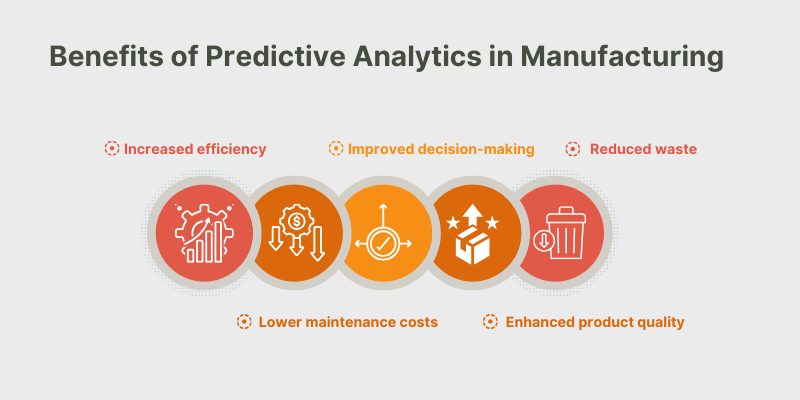
Predictive analytics solution implants numerous benefits in a manufacturing firm, ranging from lowering downtime, better quality control, reducing cost, and increasing efficiency of operations. Forecasting helps the business to timely anticipate potential issues and take corrective and informed decisions. Here are some of the key advantages of predictive analytics use cases in the manufacturing industry:
1. Increased efficiency and productivity.
Statistical estimates boost various production processes, including sales, marketing, and inventory management operations. Predictive maintenance eliminates unplanned downtime significantly, ensuring higher productivity of equipment by increasing its life span through timely repairing and servicing. Additionally, supply chain optimization by Prediction models reduces the manufacturer to market, increasing the return from production and sales. Moreover, real-time insights gained from past data help the manufacturer to make faster and smarter decisions, contributing to overall productivity.
2. Lower operational and maintenance costs.
Timely detection of potential machinery failure with the help of predictive analytics in manufacturing saves the production unit from big blunders. Small defects are easy to fix and less expensive in comparison to messy faults in the equipment that occurred due to negligence in carrying on timely maintenance.
Additionally, device wear and tear, resulting in a complete breakdown, brings a sudden stop in the manufacturing process, causing huge operational and maintenance costs. Past performance data, sensor metrics, and AI-powered models help in identifying key preventive measures and hardware upkeep requirements, dodging disruptions and minimizing random outages.
3. Improved decision-making and strategic planning.
Intelligent prediction models empower leaders and supervisors with a 360-degree view of manufacturing processes. It provides foresight into inventory levels, market trends, supply chain dynamics, and changing customer demands. These insights help the decision makers to make strategic choices in their business and optimize their production workflows.
Algorithms armed planning eliminates the dependence on mere institutions and outdated data and facilitates future-looking resource allocation, capacity planning, product launch, and machinery maintenance routines. Optimized production schedules through demand forecasting also bring proper workforce management, reducing idle time and distributing workloads.
4. Enhanced product quality and customer satisfaction.
Predictive analytic solutions featuring demand forecasting and market trends evaluation improve the supply chain process along with production and inventory management. It enables the manufacturing company to deliver better customer service and on-time delivery without delays. Not only this, producers can use AI and ML-charged tools to monitor and control the quality scales of products simultaneously without losing performance and speed of workflow.
Defective items are detected during production by analyzing material consistency, temperature discrepancy, and process alteration. Timely product delivery with promised quality elevates customer satisfaction and builds a loyal customer base for the business.
5. Reduced waste and optimized resource utilization
Predictive maintenance and balanced workflow sustained from manufacturing analytics solutions deprive businesses of any kind of resource wastage or redundant workflows. Producers can overview the entire production process and identify patterns indicating material overuse or energy inefficiency, channeling the improvements to the required parts.
Predictive software delivers actionable solutions by spotting inefficiencies, strengthening product development strategy, and optimally employing available resources. Targeted refinements of the manufacturing processes remove scrap building, power misuse, and chances of rework, resulting in cost savings as well as fulfilling environmental responsibility.
Challenges in Adopting Predictive Analytics
Even though predictive analytics in manufacturing serves as a progressive transformation kit, its several attached challenges can hinder the effective implementation of the solution.
1. Poor data quality or incomplete data sources.
Poor data quality will surely generate low results that are not usable, evaporating the core purpose of the forecasting mechanism. The predictive analytics use cases highly rely on large, heterogeneous historical data, but combining it in a comprehensive format to simplify it is a tedious task, making accurate predictive analytics challenging.
Inaccurate anticipation about the future leads to flawed decisions, hindering the growth and success of the business. To prevent this issue, manufacturers must ensure robust data collection methods and quality assurance. Here choice of reliable data sources is crucial, and gathering as much information as possible increases the scope of analytics.
2. High setup costs and uncertain ROI.
The initial investment is significantly high for setting a sturdy framework of predictive analytics in manufacturing. The total execution price involves IoT sensor infrastructure, advanced software, personal training programs for acquiring skills, and cloud storage platforms. Even after the implementation process, its continuous adaptation is primarily essential to keep it in check with possible variables and make real forecasting.
The post-deployment expenses put an evident burden on the production organization, specifically on small and medium ones, without promising sufficient returns. Thus, funding in manufacturing analytics solutions contains considerable financial risks, discouraging the manufacturer from lookig forward to predictive analytics use cases in its business.
3. Shortage of skilled data science and analytics professionals.
Employing predictive analytics in manufacturing demands highly skilled professionals who possess a specialized command of AI and ML models, data science, and semantic manufacturing processes. Moreover, the need for data engineers to select and evaluate predictive models and statisticians to work on models and check the accuracy is more critical than ever.
Lack of analytical expertise, along with industrial and technical knowledge always creates a barrier in effective endorsement of data-driven forecasting. Internal staff may not be able to transcribe complex algorithm codes or generate expandable models, causing businesses to rely on external consultants, increasing dependency and costs.
4. Organizational resistance to adopting new technologies.
Manufacturing analytics solutions are still novel concepts in the technological world, and thus, the limited exposure makes it challenging for businesses to efficiently implement the models and leverage the benefits. The workforce in a production company might find it difficult to understand the outputs to appropriately forecast certain events. It hinders them from taking the required action and mitigating the risks timely.
Steps to Implement Predictive Analytics in Manufacturing
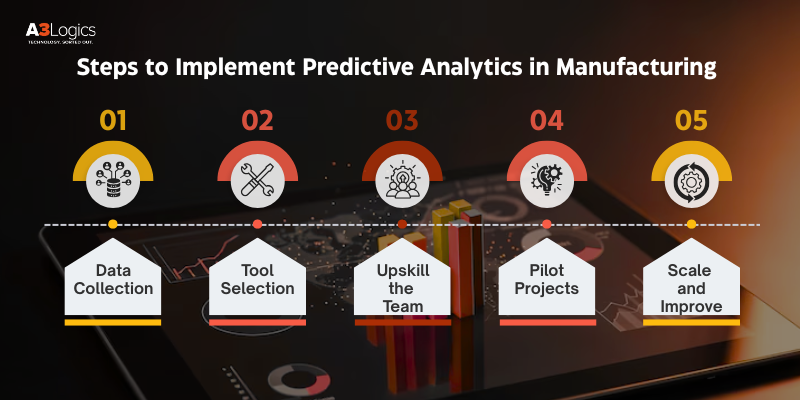
Predictive analytics in manufacturing brings a lot of benefits. However, the advantages can only be leveraged when the innovative solution is implemented with efficiency and quality control. While the development process might change according to the development team that you choose, the following are the ideal steps that you must ensure while implementing manufacturing analytics solutions-
1. Data Collection and Integration
The efficiency of the predictive maintenance model highly depends on the type, quantity, and quality of data that have been used to train the AI models. So, our process of building predictive maintenance in manufacturing begins with collecting high-quality data from internal and external sources. Once the data has been collected, the next approach is to fine-tune the information that helps to ensure that all the data is correct, true, updated, and doesn’t carry any impurities.
2. Choose the Right Tools and Platforms
The next step for implementing predictive analytics in manufacturing is dedicated to choosing the right tools and platforms that help to build an innovative and scalable solution. It is ensured that the overall technical infrastructure of the software aligns with real-time business needs and scope. At the same time, the third-party integrations, like data analytics services that can enhance the predictive analytics use cases in manufacturing, are also carried out.
3. Build or Upskill the Team
Now it is the team to choose or build the AI development team that can help you build scalable predictive analytics solutions according to your business needs. Make sure that you choose the right development team with relevant experience. There are multiple hiring models that you can choose from to hire AI and ML experts. Once the team is onboarded, a brainstorming session is carried out to exchange ideas and requirements.
4. Start Small – Pilot Projects
The project is first deployed with the Pilot phase to check the overall response, efficiency, and return on investment. At this step, the new solution is ready to use for the selected stakeholders, who can check the efficiency and provide feedback. Pilot project also helps to identify the quality issues and the scope of equipment failures.
5. Scale and Improve
This is an ongoing process where the development team provides maintenance and support to the solution. This process helps to continuously identify the scope of improvements in the system and implement the changes. Moreover, the new features are also added to the solution so that it can align with the changing business needs and stakeholders’ expectations.
Future Trends in Predictive Analytics for Manufacturing
Artificial intelligence, predictive analytics, and data science services have already transformed the manufacturing industry. However, it will not be wrong to say that all these changes are just the beginning, and there is a lot to witness with the use of predictive analytics in manufacturing in the future. While the vision has no limitation, here are the main future trends that we will witness with predictive analytics use cases in manufacturing-
1. Deeper integration with AI and Machine Learning
Artificial intelligence and machine learning have been playing a crucial role in the use of predictive analytics in the manufacturing industry. A deeper integration of both technologies is expected in the coming times that will make the predictive analytics system even smarter and autonomous. It will increase the decision-making capability of the solution, which will require the least human interference in understanding the environment and carrying out the right actions.
2. Widespread use of IoT devices for real-time data input.
There is no doubt that IoT brings convenience with control. The same might be the future of manufacturing, where the sensors and production machines will be continuously sharing the data like machine efficiency, temperature, fuel, and safety to a predictive analytics solution. It will help the innovative software to analyze the information and make informed decisions for better control and maintenance.
3. Rising importance of data security and privacy.
The increasing cases of data breaches and hacking have turned the attention of business owners toward data security and privacy. Predictive analytics is expected to be a part of this trend that helps businesses add an extra security layer. The new technology will implement advanced encryption, privacy-preserving machine learning techniques, and multi-layer computations to protect information related to inventory, business, or clients.
4. Adoption of cloud-native analytics solutions
Scalability, cost effectiveness, and flexibility are the new foundation stones for any business that aims to sustain in the competitive market. So, a big turn towards the cloud-native analytics solution is expected, which allows the centralization of data across systems and locations. The new system will allow multiple stakeholders to share information and receive updates in real time, fostering a seamless operational process.
Why Choose A3Logics for Predictive Analytics in Manufacturing?
As interpreted earlier in this blog, the efficiency and success of your predictive analytics system depend hugely on the AI development company that you choose. A3Logics is a leading predictive analytics system development company with over 21+ years of experience. We are a team of 350+ tech enthusiasts, dedicated to exploring and implementing the new use case of industry 4.0 technologies. Our core competencies have helped us achieve a significant client retention rate over the years.
1. Industry Expertise
A3Logics has partnered with several manufacturing companies from different regions around the world. The journey gives us exposure to the manufacturing industry, where we can closely understand our clients’ challenges and their real-time requirements. So, our team offers custom software solutions that align with these challenges and bring a significant ROI.
2. Custom Solutions
Our team builds every solution from scratch while ensuring the end-to-end transparency throughout the development process. At the same time, we make sure that each feature, element, technology, and design is incorporated into the predictive analytics software strictly according to the clients’ preferences.
3. Cutting-Edge Technologies: Integration of AI, ML, IoT, and cloud computing for advanced forecasting
Along with the traditional technologies like web development, app development, and software development, we excel in industry 4.0 technologies like artificial intelligence, cloud computing, machine learning, and IoT. Our expertise in advanced tech stack provides us with the horizon to build innovative solutions.
4. Proven Track Record
A3 Logics has delivered 500+ projects along with thousands of successful futuristic solutions for businesses globally. Our solutions have streamlined the business workflow, increased efficacy, and multiplied annual revenue for our clients. We have maintained a client retention rate of over 90% throughout our journey.
5. End-to-End Support
From ideation to deployment and maintenance, we offer end-to-end support to our clients, ensuring that they leverage a smooth digital transformation. Our predictive analytics software development services include consultation, brainstorming, designing, development, testing, deployment, maintenance, and even updates.
6. Scalable and Secure
Each of the software solutions that we develop is scalable and secure. We ensure the long-term usability of the software and thus integrate the strong and scalable technology stack during the development process. At the same time, we also prioritize security implementations in our solutions that promise the complete confidentiality of users’ and businesses’ information.
Conclusion
It can be concluded that predictive analytics in manufacturing has been playing an important role in minimizing inefficiencies and increasing revenue. From predicting the market demand to managing inventory levels and ensuring the timely maintenance of machines, the innovative technology has brought accuracy in every aspect of manufacturing operations.
Suppose you are also a manufacturing business owner and looking to digitize your operations. In that case, A3 Logics invites you to the free consultation session to brainstorm on your idea and steer a result-driven transformation.