
Machine learning algorithms are what make the artificial intelligence (AI) revolution happen. They are changing how organizations work and driving innovation in many fields. These algorithms are more important than ever in 2025. They run everything from personalized suggestions on streaming sites to real-time fraud detection in the financial services sector.
As more and more companies want to use data-driven insights, the need for strong, scalable, and understandable ML algorithms keeps growing. Improvements in automation, interpretability, and processing power will change the landscape of the best machine learning algorithms by 2025, allowing businesses to handle difficult issues with remarkable speed.
If you want to know how to use AI in the future, you need to know how these algorithms have changed and what they can do. This is true whether you are a data scientist, a company executive, or just someone who likes technology. Businesses can get the most out of machine learning (ML), make their operations more efficient, and stay ahead of the competition in a digital world that changes quickly with the help of a Machine Learning Development Company and specialist AI Development Services.
What are Machine Learning Algorithms?
Machine learning algorithms are ways for computers to learn from data and make predictions or judgments without having to be programmed for each activity. These algorithms work with big volumes of data, find connections between them, and get better at what they do as they get more data.
To comprehend the AI ecosystem, you need to know what machine learning algorithms are. They are the engines of intelligent automation, which powers apps like image recognition, natural language processing, and predictive analytics.
ML algorithms are different from traditional programming since they adapt and change over time. This makes them very useful for dealing with complicated, ever-changing situations. By 2025, machine learning algorithms have become much more advanced. For example, they can improve themselves, be open about how they work, and work with a wide range of business processes. More and more businesses are turning to AI Consulting Services to choose, set up, and improve these algorithms so that they support strategic goals and provide measurable value.
Understanding Machine Learning from Theory to Algorithms
Machine learning connects the dots between computer science theory and real-world use. The field uses statistics, arithmetic, and data science to make algorithms that can learn from what they do. The first steps are to define a problem, gather and prepare data, choose the right algorithm, and train a model. When the model processes input, it changes its internal settings to reduce errors. This is called optimization.
The greatest ML algorithms are those that generalize well to new, unknown data, avoiding overfitting and underfitting. In 2025, machine learning will be able to do things that were once thought to be impossible because of sophisticated computational approaches including neural networks, ensemble methods, and quantum computing.
Machine Learning Development Companies and corporations work together to make sure that these theoretical advances turn into real, scalable solutions that drive innovation in all fields.
Key Statistics about Machine Learning Algorithms
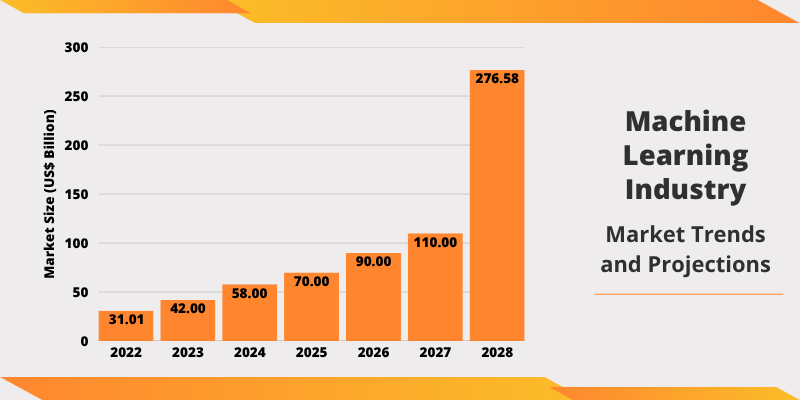
There are a lot of interesting statistics that show how machine learning algorithms are being used and what they can do.
- As of 2025, the worldwide AI market is worth about $391 billion.
- The AI sector is expected to increase five times over the next five years, with a compound annual growth rate (CAGR) of 35.9%.
- By the end of 2025, around 97 million individuals are predicted to have jobs in AI and machine learning.
- 83% of businesses say that AI is one of their top business goals.
- 48 percent of businesses utilize AI to make the most of big data, and thirty-eight percent of healthcare practitioners use AI to diagnose patients.
- Machine learning-powered tailored suggestions make Netflix $1 billion a year.
These Machine Learning Statistics show how powerful ML algorithms can be and how important it is to work with a Machine Learning Development expert or use AI Consulting Services to stay ahead of the competition.
Types of Machine Learning Algorithms
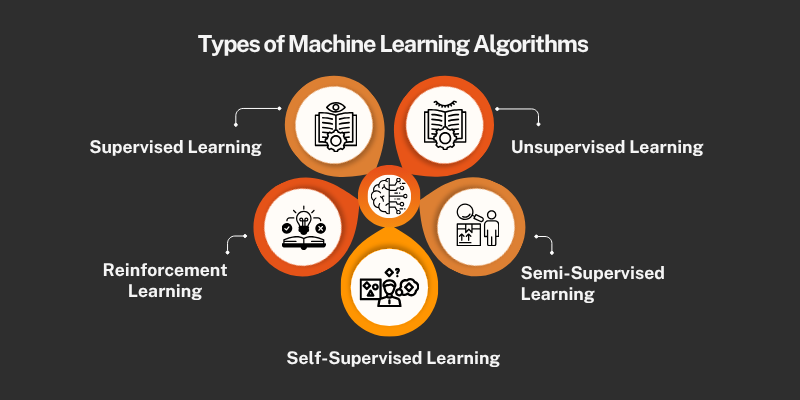
Machine learning algorithms can be categorized based on how they learn from data. Understanding the types of machine learning algorithms is crucial for selecting the right approach for a given problem.
1. Supervised Learning
Supervised learning is the most widely used type of machine learning algorithm, where the model trains on labeled data. It pairs each input with a known output and learns to map inputs to outputs by minimizing prediction errors.
Common applications include spam detection, credit scoring, and image classification. Supervised learning is foundational for tasks where historical data with clear outcomes is available, enabling accurate predictions for new, unseen data. The effectiveness of supervised learning relies on the quality and quantity of labeled data, and it forms the backbone of many AI Development Services offered by leading companies.
2. Unsupervised Learning
Unsupervised learning deals with unlabeled data, where the algorithm seeks to uncover hidden patterns, groupings, or structures within the dataset. This type of machine learning algorithm is essential for exploratory data analysis, customer segmentation, and anomaly detection. Techniques like clustering and dimensionality reduction fall under this category.
It is particularly valuable when the goal is to understand the underlying structure of data without predefined labels, making it a powerful tool for businesses looking to extract insights from raw information.
3. Reinforcement Learning
Reinforcement learning involves training algorithms to make a sequence of decisions by interacting with an environment. The model receives feedback in the form of rewards or penalties and learns to maximize cumulative rewards over time.
This approach is widely used in robotics, game playing, and autonomous systems. These Algorithms are capable of adapting to dynamic environments and optimizing long-term outcomes, making them a key component of advanced AI Consulting Services and real-time decision-making systems.
4. Semi-Supervised Learning
Semi-supervised learning combines elements of supervised and unsupervised learning, utilizing a small amount of labeled data alongside a larger pool of unlabeled data. This approach is particularly useful when labeling data is expensive or time-consuming. Semi-supervised algorithms can achieve high accuracy with less labeled data, making them cost-effective and scalable. They are increasingly adopted in domains like medical imaging and speech recognition, where labeled data is scarce but unlabeled data is abundant.
5. Self-Supervised Learning
Self-supervised learning is an emerging paradigm where algorithms generate their own supervisory signals from the data itself. This type of machine learning algorithm is gaining traction in natural language processing and computer vision, enabling models to learn representations without explicit labels. Self-supervised learning leverages large-scale datasets to pre-train models, which can then be fine-tuned for specific tasks. Its ability to utilize vast amounts of unlabeled data makes it a game-changer for industries seeking to maximize the value of their data assets.

Top Machine Learning Algorithms in 2025
The landscape of top machine learning algorithms 2025 is shaped by both time-tested methods and cutting-edge innovations. Here are the algorithms leading the way:
1. Linear Regression
Linear regression is a basic machine learning approach that uses input variables to predict continuous outcomes. By fitting a linear equation to real-world data, it shows how a dependent variable is related to one or more independent variables. In finance, economics, and healthcare, linear regression is often used to make predictions and look at trends. It is a must-have for any Machine Learning Development expert because it is simple, easy to understand, and works well.
2. Logistic Regression
Logistic regression is a way to classify things by guessing how likely it is that a certain result will happen, like yes/no or true/false. It employs a logistic function to show how the input features affect the chance of a certain class. Logistic regression is a common method for binary classification jobs like finding fraud, diagnosing medical conditions, and predicting when customers will leave. Its strength and ease of use mean that it will always be one of the best machine learning algorithms by 2025.
3. Decision Trees
Decision trees split data into branches based on feature values to make decisions and support classification and regression problems. They handle both numerical and categorical data and help model business rules, assess risk, and segment customers. Experts prefer them in regulated fields because they are easy to understand and interpret.
4. Random Forest
Random forest is a type of ensemble learning that builds several decision trees and aggregates their results to make them more accurate and less likely to overfit. This approach works very well with big datasets that have a lot of dimensions and is not affected by noise or outliers. Many people in finance, healthcare, and e-commerce use random forests for things like predicting diseases, rating credit, and suggesting products. It is one of the best ML algorithms for 2025 since it is reliable and can be used on a large scale.
5. Support Vector Machines (SVM)
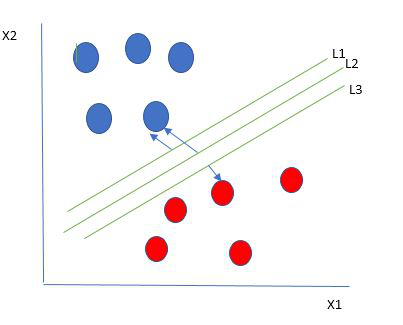
Support Vector Machines are strong algorithms for classifying data that determine the best hyperplane to separate data points of distinct classes. SVMs work well in environments with a lot of dimensions and are used for bioinformatics, image recognition, and text categorization. They will continue to be important in the world of machine learning algorithms since they can work with both linear and non-linear data and have a strong theoretical basis.
6. K-Nearest Neighbors (KNN)
K-nearby Neighbors is a simple learning method that uses instances to sort data points into groups based on the most common class of their nearby neighbors. Because KNN is non-parametric and doesn’t make any assumptions about how the data is spread out, it can be used for pattern identification, recommendation systems, and finding outliers. It is still one of the best machine learning algorithms in 2025 since it is simple and works well with small to medium-sized datasets.
7. Naive Bayes
K-nearby Neighbors is a simple learning method that uses instances to sort data points into groups based on the most common class of their nearby neighbors. Because KNN is non-parametric and doesn’t make any assumptions about how the data is spread out, it can be used for pattern identification, recommendation systems, and finding outliers. It is still one of the best machine learning algorithms in 2025 since it is simple and works well with small to medium-sized datasets.
8. Gradient Boosting Machines (GBM)
Gradient Boosting Machines are a type of ensemble method that builds models one after the other, with each new model fixing the mistakes of the ones that came before it. GBM is known for being quite accurate at predicting things, and it is used a lot in competitive data science, finance, and marketing analytics. It is a popular choice for difficult predictive modeling projects since it is flexible and can work with many different types of data.
9. XGBoost
XGBoost is a better version of gradient boosting that works faster and better. It uses regularization methods to avoid overfitting and can handle big datasets by processing them in parallel. XGBoost is the best choice for fraud detection, risk modeling, and consumer analytics since it is scalable and accurate. It also wins most machine learning competitions.
10. LightGBM
LightGBM is a framework for gradient boosting that is meant to be fast and easy to scale. It employs a new way of growing trees leaf by leaf, which speeds up training and requires less memory. LightGBM can easily handle massive datasets and features with many dimensions. This makes it perfect for big data applications and real-time prediction systems. It has solidified its place among the best machine learning algorithms of 2025 because of how well it works and how quickly it does so.
11. CatBoost
CatBoost is a gradient boosting algorithm that can work with categorical information without needing a lot of preprocessing. It is quite accurate, trains quickly, and works well, especially with datasets that have complicated category variables. CatBoost is becoming more and more popular in marketing, finance, and e-commerce analytics, where categorical data is common.
12. AdaBoost
AdaBoost, also called Adaptive Boosting, is an ensemble method that makes a powerful classifier by putting together weak learners. It changes the weights of instances that were wrongly classified such that next models focus on harder cases. AdaBoost works well for both classification and regression problems. People like it since it’s easy to use and can make simple models work better.
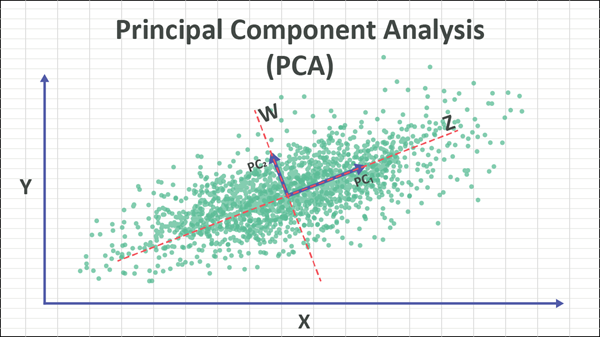
13. Principal Component Analysis (PCA)
Principal Component Analysis is a way to reduce the number of dimensions in data while keeping the variance. It does this by moving high-dimensional data into a lower-dimensional space. PCA is necessary for extracting features, reducing noise, and visualizing data. It makes ML systems work better and handle data faster, especially when it comes to genomics and image processing.
14. K-Means Clustering
K-Means Clustering is a type of unsupervised learning method that groups data into K different clusters based on how similar the features are. It is often used for segmenting customers, analyzing markets, and compressing images. People like K-Means because it is simple, fast, and good at finding natural groups in data.
15. Hierarchical Clustering
Hierarchical Clustering makes nested clusters by either merging or separating them one after the other. This program makes a dendrogram, which lets viewers see the structure of the data at different levels of detail. Researchers use hierarchical clustering in bioinformatics, document clustering, and social network analysis to show how the items in a dataset relate to each other in a hierarchy.
Why Machine Learning Algorithms Matter in 2025
In 2025, machine learning algorithms will be important for more than just new technology. These algorithms are what make digital transformation possible for businesses to:
- Get useful information from huge and complicated datasets that can help people make better decisions in all fields.
- Automate both simple and complicated operations to increase production and lower costs.
- Personalized recommendations, targeted marketing, and smart support systems can all help make customers’ experiences better.
- Finding patterns and outliers in real time might help you better manage risk and spot fraud.
- Speed up the discovery and innovation of new things in areas like healthcare, finance, and manufacturing.
Businesses may stay ahead of the curve, react to changing market conditions, and achieve long-term growth by strategically using the best machine learning algorithms in 2025. Companies may get the most out of ML algorithms by working with a Machine Learning Development expert or using AI Development Services. This can change how they do business and give them demonstrable value.
The Future of Machine Learning Algorithms in 2025 and Beyond
New trends and technological advances that promise to change the AI landscape are shaping the future of machine learning algorithms.
1. Explainable AI (XAI)
Explainable AI focuses on making machine learning algorithms clear and easy to understand, allowing people to see how the system produces decisions. XAI is very important for developing trust, making sure people are responsible, and following the rules in fields like healthcare and finance as AI systems get more complicated.
2. Federated Learning
Federated learning lets decentralized devices or organizations train models together without having to share raw data. This method improves privacy, security, and scalability, making it perfect for use in healthcare, banking, and the Internet of Things (IoT).
3. TinyML
TinyML enables resource-limited edge devices to perform machine learning and make real-time decisions using very little power. As a result, this trend actively drives the development of wearables, smart sensors, and autonomous systems. Moreover, it allows ML algorithms to operate efficiently outside the cloud.
4. Neuro-Symbolic AI
Neuro-symbolic AI creates stronger, more understandable, and more practical systems by combining neural networks and symbolic reasoning. Consequently, this hybrid approach tackles complex reasoning tasks and makes machine learning algorithms more reliable.
5. Generative AI
Generative AI uses models like GANs and transformers to make new things, like text, images, music, and code. AI Development Services are focusing on this technology since it is changing the way creative industries work, how content is made, and how people experience things.
6. Quantum Machine Learning
Quantum machine learning employs quantum computing to solve problems that regular computers can’t. In 2025, QML will revolutionize the game for optimization, modeling, and big data analytics. It could help researchers and businesses find crucial things faster.
7. AutoML Integration
Automated Machine Learning (AutoML) solutions are making ML more accessible by automating the process of choosing, training, and optimizing models. AutoML lets people who aren’t specialists build high-performance models, which cuts down on development time and makes ML methods more widely used in numerous industries.

How A3Logics can Accelerate Your Machine Learning Integration?
Machine learning algorithms are what make the AI revolution happen. They are changing industries and determining the future of technology. In 2025, the best machine learning algorithms are a mix of old and new ways that help businesses solve tough challenges, automate tasks, and find new opportunities.
Businesses need to keep up with new technologies like explainable AI, federated learning, and quantum machine learning if they want to stay competitive as ML algorithms become more popular.
To get the most out of data-driven insights and make the most of ML integration, you need to work with a Machine Learning Development Company or use AI Consulting Services. With the correct plan and knowledge, businesses can use machine learning to boost development, creativity, and success in a world powered by AI.
Final Takeaway
Machine learning algorithms are what make the AI revolution happen. They are changing industries and determining the future of technology. In 2025, the best machine learning algorithms are a mix of old and new ways that help businesses solve tough challenges, automate tasks, and find new opportunities.
Businesses need to keep up with new technologies like explainable AI, federated learning, and quantum machine learning if they want to stay competitive as ML algorithms become more popular. To get the most out of data-driven insights and make the most of ML integration, you need to work with a Machine Learning Development Company or use AI Consulting Services. With the correct plan and knowledge, businesses can use machine learning to boost development, creativity, and success in a world powered by AI.