
With greater focus on efficiency and sustainability, agriculture in the future will be smart. The pre-modern farming system has been struggling amid increasing food requirements and environmental threats. In this respect, Vertical Farming Automation has come up as a technology that aims to produce food with fewer resources in accordance with urban needs.
Automation in Vertical Farming Systems integrates various advanced technologies such as Artificial Intelligence, IoT, and robotics to form controlled environments for crop cultivation. By growing plants in vertical layers while automating their maintenance, the system cuts down on land usage and water consumption, allowing food production throughout the year, irrespective of any external rainfall or climate.
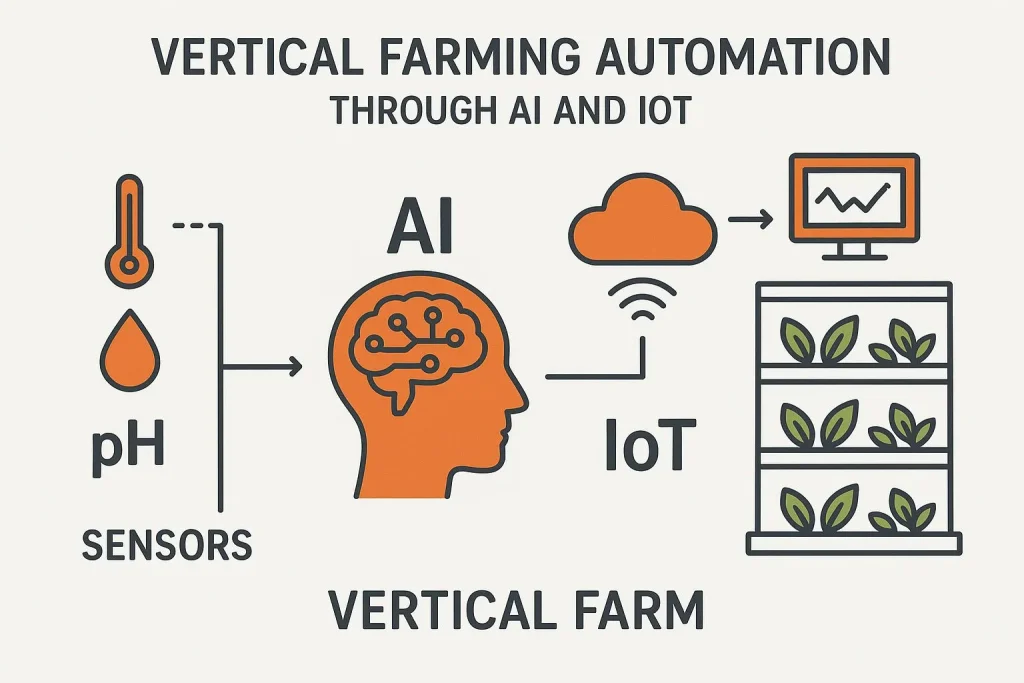
As the population swells and the need for sustainable food production grows stronger, vertical farming is fast establishing itself as a potential answer for feeding cities.
What is Vertical Farming and Why Does it Need AI and IoT?
Vertical farming develops crops inside controlled environment chambers in stacked layers. Hence, hydroponics or aeroponics are used on small layers through artificial lamps with monitored temperature and proper nourishment instead of using soil and open fields. It aims to maximise crop yields with the least consumption of land, water, air pollution, and pesticides.
Vertical farming can be scalable through automation. Schedules of light, irrigation, fungus nutrition, and climate control require plenty of manual manpower and resources in facilities of this kind. Vertical Farming Automation controls such factors in real time, instantly adjusting the settings of the environment, offering the best possible conditions for crop growth.
Vertical Farming Technology Market Statistics
The world population is expected to increase to 9.7 billion by 2050 and to 10.9 billion by 2100. This indicates that global food production needs to be increased by at least 50% by the year 2050. Agricultural land use has increased 42% between 1963 and 2009, while per-capita land availability in India has decreased by 48%. By the year 2050, arable land per person is expected to be less than 0.20 hectares, which is less than one-third of what it was in 1970.
The Role of Artificial Intelligence in Vertical Farming Automation
Artificial Intelligence (AI) is the backbone of an automated vertical farming system. Analysing real-time data with predictive modelling techniques enables vertical farms to become efficient ecosystems. While in traditional agriculture, farmers rely more on manual observation, in Vertical Farming, AI allows for the precise monitoring and control of every factor affecting plant growth.
AI also analyses the input from IoT sensors: temperature, humidity, CO2, soil moisture, and nutrient concentrations. In this way, an AI in vertical farming system reduces errors being made by humans, conserves resources, and ensures that crops are growing under ideal conditions.
How Automation Works in Vertical Farming
1. Climate Control Automation
Climate holds an important value for vertical farming. The Automated Vertical Farming System uses IoT sensors to capture live data about the crops and automatically adjusts to ideal climatic conditions. Stress is reduced on crops and results in consistent crop growth throughout the year, which a traditional farming process cannot promise.
2. Smart Lighting Systems
Light is one of the forces that create energy for photosynthesis. In vertical farms, light is related to automated control and management. Artificial intelligence systems and IoT systems modulate in spectral range, intensity, and duration based on the crop’s plant-growing stage: leafy greens prefer blue light and fruiting crops prefer red. The systems follow nature to minimise the stress on the crops and improve quality.
3. Automated Hydroponic/Aeroponic Irrigation
One of the strengths of an automated vertical farming system is water-use efficiency. The use of hydroponic/aeroponic irrigation makes accurate and timely water and nutrient delivery directly at the root zone. IoT sensors measure pH values and moisture contents, and AI systems determine when to deliver water/nutrients to the roots. This reduces waste, increases cost-effectiveness, and increases sustainability.
4. AI-Based Crop Monitoring
Fragmented crop monitoring is a complicated process. Automation in vertical farming utilises AI-powered cameras/sensors to check the growth, colour, and size of crops. AI spots any type of pest or deficiency in early stages before any losses can occur. Monitoring also facilitates predictive analytics to help in accurate harvest time estimation while reducing chemical applications.
5. Robotic Planting & Harvesting
Agriculture faces labour shortages. Automation in Vertical Farming helps cope with planting, transplanting, and harvesting through robotic systems. The robotic arms take care of planting. This allows the industry to avoid human error and operate 24 hours a day. It also optimises workflows and enables commercial farms to scale up.
6. Data-Driven Predictive Analytics
Predictive analytics lead to smart farming. Vertical Farming Automation System Development has made it possible to predict crop growth, expected yields, and the risk of diseases. For instance, these predictive tools prepare the harvest for production and how to use it, thus reducing waste. This intelligence makes efficiency possible, this demand up-supply farms, thus increasing the sustainability of farming.
7. Energy & Resource Optimisation
Energy is the largest expense in vertical farming. Vertical Farming Automation helps to mitigate waste by managing lighting, irrigation, and climate control. AI will dim lights based on sunlight and, if required, HVAC will also adjust. Irrigation loops are closed, which will reuse water and nutrients and therefore manage costs and carbon footprints, allowing for sustainable farming.
Key IoT Devices Powering Smart Vertical Farms
1. Environmental Sensors
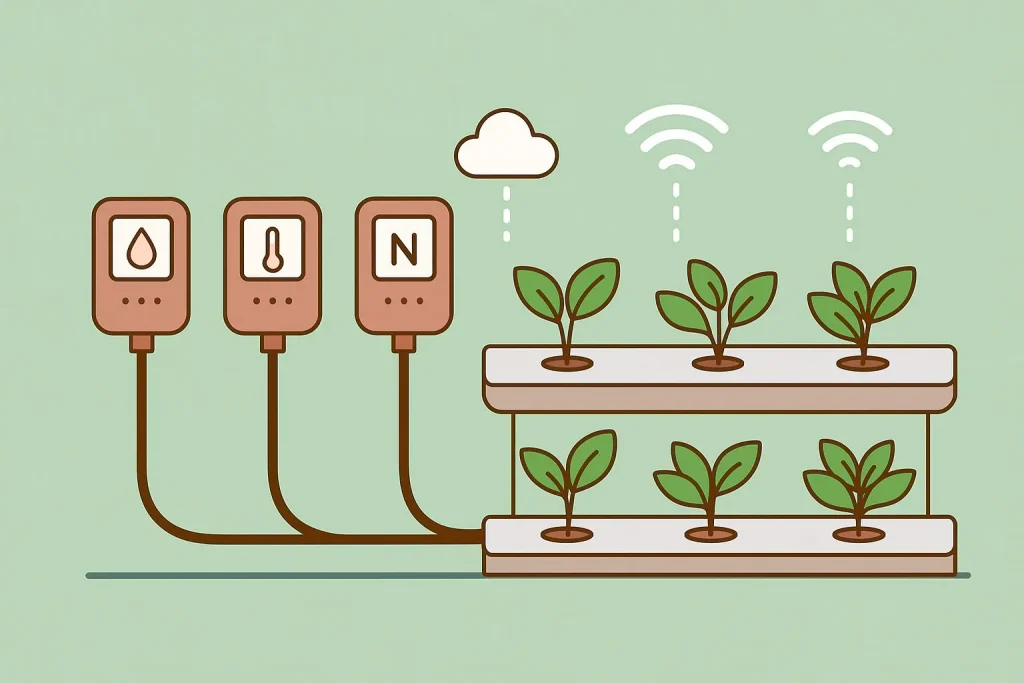
- Temperature & Humidity Sensors – Monitor and regulate climate conditions.
- CO₂ Sensors – Ensure optimal CO₂ levels for photosynthesis.
- Light Sensors (PAR Sensors) – Measure photosynthetically active radiation (PAR) to optimize LED lighting.
- Airflow Sensors – Track ventilation to prevent mold and ensure even climate distribution.
2. Soil & Hydroponic/Aeroponic Monitoring
- Soil Moisture Sensors – Detect water levels in soil-based systems.
- pH & EC (Electrical Conductivity) Sensors – Monitor nutrient solution balance in hydroponics/aeroponics.
- Water Level Sensors – Ensure proper irrigation and prevent over/under-watering.
3. Automated Irrigation & Nutrient Delivery
- Smart Valves & Drip Systems – Adjust water flow based on sensor data.
- Fertigation Controllers – Automatically mix and deliver nutrients.
4. Lighting Control Systems
- Smart LED Grow Lights – Adjust intensity and spectrum based on plant growth stages.
- Light Scheduling Controllers – Automate photoperiods for different crops.
5. Growth & Health Monitoring
- Camera Systems (Computer Vision) – Track plant growth, detect diseases, or pests using AI.
- Weight Sensors – Monitor plant biomass and growth rates.
6. Climate Control & Automation
- HVAC Systems – Regulate temperature and humidity automatically.
- Dehumidifiers & Foggers – Maintain ideal moisture levels.
- Automated Ventilation Fans – Ensure proper air circulation.
7. Data Integration & Control Systems
- Edge Computing Devices – Process sensor data locally for real-time adjustments.
- Cloud-Based Farm Management Software – Analyze data, predict yields, and optimize growing conditions.
- Remote Monitoring Dashboards – Allow farmers to control systems via smartphones or PCs.
8. Robotics & Automated Systems
- Autonomous Harvesting Robots – Pick mature crops using AI vision.
- Seed Planting Robots – Automate seeding in vertical trays.
How AI and IoT Work Together to Optimise Crop Production
1. Data Collection From IoT Sensors
The IoT in Vertical Farming allows for constant collection of temperature, humidity, CO2, nutrient levels, and light. The IoT is the “eyes” and “ears” of the plant and allows for no human error, without time delays. Numerical data is always measurable, allowing for optimal environmental conditions.
2. Artificial Intelligence Processing and Data Interpretations
AI in Vertical Farming uses machine learning to precisely interpret the live data transmitted by IoT devices. AI will only identify anomalies and think forward based on the learned trends. For instance, AI could show a possible nutrient deficiency before the plant displays any signs of stress. The combination of IoT with AI represents the potential for further automation in Vertical Farming.
3. Automatic Decisions Made by AI-powered IoT Actuators
AI in Agriculture delivers instructions to the IoT actuators (applicators, pumps, fans, LEDs) that instruct the IoT actuators based on their environmental readings to auto-adjust the system parameters, for example, a humidifier is turned on more under humid conditions. This system of automation builds towards an Automated Vertical Farming System, which is a fully self-regulated and efficiently managed self-sustainable ecosystem.
4. Predictive Analytics for Pro-active Farming
AI in the Vertical Farming sector has established Predictive Analytics practices, taking advantage of available data, to anticipate disease and nutrient issues. For instance, predicting readiness allows us to better align production to market demand, reducing potential waste.
5. Robotic Systems and Autonomous Farming
In vertical farming automation, robots perform planting, seeding, and harvesting activities. Robots have arms that only harvest ripe produce, creating less possibility of error and waste, and this could enable scaling of production with minimal human error.
6. Cloud & Edge Computing for Scalability
Vertical Farming Automation System Development requires the use of edge computing and cloud functionality. Edge devices provide a quick response to an event, while the cloud provides predictive AI functionality and online storage. When edge and cloud functions are linked together with IoT and AI, farms can achieve low latency, smarter insights, scalability, and efficiency.
Benefits of Empowering Vertical Farming Automation through AI and IoT
1. Increased Crop Yields through AI-Driven Optimisation
An Automated Vertical Farming System can deliver an exact amount of light, water, and nutrients to the crops. Using AI and IoT monitoring, the farm is optimised for the plants. Based on input from sensors, the algorithms determine the irrigation and climate control actions that improve growth rates. This type of accuracy increases yields per square meter as cities increase their food demands.
2. Water Savings from IoT-Smart Irrigation Systems
IoT in Vertical farming presents a positive solution to water shortages. It can recycle or reuse up to 95% of the water, whereas most agriculture would ideally recycle half. Automation in vertical farming ensures that these resources are saved for sustainability in agriculture.
3. Energy Savings from Automating Lighting and HVAC Systems
Farms save energy costs with lighting and climate control automation. The LED systems reduce light levels when levels of sunlight are adequate, and the HVAC controls airflow to adjust to optimal temperature.
These smart controls reduce energy costs and carbon footprints, making the Vertical Farming Automation System Development both cost-efficient and environmentally friendly.
4. Labour Cost Reduction via Robotic Automation
Automation in vertical farming will solve labour shortages via robotic automation. These robots efficiently seed, transplant, and harvest, as IoT guides acting in real time, while human labour does more high-value tasks that, in turn, reduce errors and cost.
5. Production all Year-Round
Vertical Farming Automation enables production to be continuous, regardless of what the weather outside is. The weather systems, powered by AI and IoT, shut down while protecting crops against any extremes of drought or floods. In areas where agricultural conditions are uncertain, food security is improved with reduced reliance on imports.
6. Improved Food Safety with Contamination-Free Growth
IoT promotes growth in contamination-free environments through vertical farming.
Farms maintain a pesticide-free status to ensure the production of safer food. Less human intervention also means less risk of pathogen intrusion. Through the Vertical Farming Automation System Development, high-quality crops are produced, giving high consumer confidence and supply reliability.
Real-World Examples of Smart Vertical Farming Systems
1. Plenty (USA) – AI-Optimised Indoor Farms

Many high-tech indoor farms use artificial intelligence in the management of the plant growth environment. Having the capacity to grow two to three times more in half the space of other vertical farms makes them the perfect setup for urban settings. Plenty prides itself on being able to conserve water and provide fresher produce to buyers within the city’s surrounding regions.
2. AeroFarms (USA) – IoT-Enabled Aeroponics
AeroFarms aeroponic growing systems have their root systems suspended in air, and nutrients are provided through direct misting rather than through soil. Connected sensors measure root health, moisture, and nutrient balance in real-time on their farms. The system optimises control and goes a long way in cutting down on resource wastage.
3. Infarm (Germany) – Modular IoT Farming
Infarm is a modular farming solution with vertical farms placed in supermarkets, warehouses, and restaurants. From their modular units, food miles can be reduced by growing crops closer to customers. Infarm’s system is based on sustainability factors under which millions of litres of water are saved, along with huge reductions in land use. Their approach is an example of how scalable local vertical farms can solve urban food supply problems.
4. Iron Ox (USA) – AI + Robotics Farming

Iron Ox has integrated robotics with artificial intelligence to provide for the automation of various steps of farming, such as seeding, harvesting, and plant monitoring. With plant-moving robots equipped with vision systems, each plant is given the optimal care it needs. Artificial intelligence leverages crop data to modify climatic conditions. This futuristic approach adds consistency while reducing labour costs.
5. Spread (Japan) – World’s Largest Automated Lettuce Farm

Spread, with operations specialising in lettuce production, boasts one of the largest vertical farms in existence. The farm uses automation for seeding, transplanting, and harvesting processes to lessen human intervention in these tasks. Standardising and scaling the operations allows Spread to operate high volumes of production while keeping its products safe and fresh. So their model demonstrates that automation-supported commercial farming.
6. Bowery Farming (USA) – AI-Powered Predictive Farming

Bowery Farming employs predictive analytics to maintain and sometimes even improve crop growth and quality. Their system collects huge volumes of environmental data for AI processing and plant needs forecasting. This way, recommendations about what needs to be fixed are presented before an actual problem drops down on yield reliability. Bowery supplies fresh produce for all major grocery chains.
Cost of AI and IoT-Based Smart Vertical Farming System Development
Cost estimation for an Automated Vertical Farming System enabled by an AI-IoT combo depends upon scale, complexity, and level of automation. A simple IoT-based system can cost anywhere between $10,000 and $11,000, and an implementation of a fully integrated Vertical Farming Automation System Development project involving robotics, AI-based analytics, plus IoT sensors is likely to be well above $20,000. Some of the influencing factors include climate control, hydroponics, and real-time monitoring devices.
For a business or startup considering long-term sustainability, these investments are critical for establishing the frameworks to make farming systems “future-ready”.
Challenges in Automated Vertical Farming
1. High Initial Investment and ROI Uncertainty
It cannot be ignored that a significant amount of initial capital is required to build a farm with an Automated Vertical Farming System. The systems, although capable of increasing yields and cutting down costs, may or may not yield an acceptable ROI, which depends on several factors such as the crops grown, energy costs, and sociological demand.
2. Data Integration and Interoperability Issues
Complexity arrives when multiple different devices, IoT platforms and AI models are all integrated into the Vertical Farming Automation System Development project. Unless the integration is smooth, a farm will remain incapable of using the predictive analytics fully.
3. Power Dependence and Energy Costs
Vertical farming relies heavily on lighting, HVAC, and automation, with costs tied to energy use. IoT in Vertical Farming is the easiest way to operate automation. This is especially where grid electricity costs are very high. The alternatives from renewable energy hold promise but come with an added investment cost.
4. Data Security and Privacy Threats
The data collected from IoT sensors and cloud-based platforms is the type that contains highly sensitive information. One should be quick to follow secure channel transportation methods to reduce the risk of cyberattacks.
5. Maintenance & Technical Skill
It’s easy to point out that emerging AI models, robotics, and IoT devices need some level of technical expertise. The farmers are often dependent on the IoT Development Company for the maintenance of these systems, thereby incurring more costs. Regular maintenance must be done to prevent any downtime and subsequent losses in productivity.
6. Limitations of AI Model Accuracy & Training Data
The enhancement of AI in Vertical Farming rests largely on the quality of training data. If these data sets are poor or limited, predictions will also be inaccurate, resulting in adverse consequences on yield and climate control.
The Future of Smart Agriculture: AI, IoT and Beyond Vertical Farming
The landscape of agriculture is beginning to change, thanks to AI and IoT in vertical farming. It is moving towards smart, resource-efficient food systems. Vertical farming has already highlighted ways that will be applied in open fields and greenhouses across the globe. Monitoring crops through AI, soil and water analytical devices used with IoT connectivity and forecasting analytics, highlight how farming is going smart.

Why Collaborate with A3Logics for AI & IoT-Driven Vertical Farming Automation?
A3Logics acts as the perfect connection between the solution set for Automation in Vertical Farming and enhanced Artificial Intelligence and IoT solutions. Our team understands the challenges a farmer faces: excessive operational costs and barriers to data integration.
With A3Logics, you’re not merely getting technology. You’re getting a company that is focused on food security, sustainability, and innovation. The fusion of technology with real-world farming experiences calibrates the Vertical Farming Automation System Development to solve the system challenges of modern farming easily.
Conclusion
Agriculture is set to advance in vertical farming automation through AI and IoT. The demand for food is increasing while the amount of land that can successfully grow crops is decreasing. These systems encourage the sustainability of agricultural resources, year-round production opportunities, and provide better quality food.
AI in Vertical Farming enables producers to track plant growth with the highest accuracy – predicting problems before they arise, optimising yield while failing to waste resources. With the complementary purchase of IoT in Vertical Farming, these automations will make for smarter irrigation, smarter energy purchase, and provide real-time climate control. This ensures that the global food crises are being worked on while reducing the costs of labour and environmental impacts.