As artificial intelligence evolves, it continues to dramatically impact our methods of creating, manipulating, and perceiving digital media. One of the most discussed, and controversial, applications of artificial intelligence is that of the AI Deepfake Generator. These products produced by deepfake generative AI can create hyper-realistic fake images, films, and sounds, often indistinguishable from real multimedia.
Deepfake technology provides immense creative possibility as well as potential peril, so deepfake generative AI is quickly becoming a significant concern that crosses into entertainment, business, security, and ethics. This exhaustive article seeks to discuss the particulars of deepfake technology, provide an overview of how modern AI deepfake video generator and AI deepfake photo generator products operate, introduce the real-world applications for the creators of deepfake content, and raise questions for society regarding responses to the challenges posed by this technology.
What is Deepfake Technology?
Deepfake technology considers complex algorithms to use artificial intelligence that focuses particularly on deep learning to create or manipulate multimedia that convincingly replicates a real person’s appearance, voice, or actions. The term deepfake comes from a combination of “deep learning” and “fake,” asserting that the purpose of AI was the creation of fake yet believable digital media.
It was introduced in 2017. Deepfake generative AI has since evolved rapidly. Early deepfake generative AI compared to modern versions utilized face swaps or lip sync, while current generation deepfake generative AI can regenerate parameters of speech, gestures of the face, and data paired with environments.
Growth Stat: In 2025, thousands of deepfake videos are being posted online each week, and it is expected to double each year as tools become more powerful and more accessible.
Deepfake technology‘s unique ability to obscure the line between real and synthetic provides opportunities for creativity and threats like misinformation and fraud.
What Is an AI Deepfake Generator?
An AI deepfake generator is a computer application that is based on deepfake generative AI models to synthetically create, edit or manipulate images, video or audio in a realistic way. These types of applications utilize trained and generative neural networks, large datasets, and complex generative methods, to create new media or modify existing media.
AI deepfake generators include a variety of products such as an AI deepfake video generator that reanimates actors or an AI deepfake photo generator that makes photorealistic edits to images. All of which enable the creation of complex media accessible to the general public and professionals.
Stat Insight: In 2025, over 75% of all deepfake videos found on the internet were generated by an automated deepfake generator platform. This represents the ubiquity of a technology that is affecting entertainment, marketing, and cybercrime.
The AI deepfake generator platforms are generally easy to use, and provide users an interface that allows them to upload a photo or video, select a desired template or style to switch to, and receive their final results in seconds or minutes without the need of a full coding background.
How Does an AI Deepfake Generator Work?
To understand how an AI Deepfake Generator works, we need to examine the inner workings of deep learning and the design of the modern neural network. We’ll examine the technology and the process of creating deepfake media step-by-step.
The Role of Deep Learning & Neural Networks
Deepfake technology relies upon deep learning, a form of machine learning that relies on deep, multi-layer neural networks to learn, generate, and modify high-dimensional data such as images, video, and audio. These networks learn to recognize patterns, characteristics, or expressions in the training content, which enables the model to synthesize or manipulate digital media with unprecedented accuracy.
Important Considerations to Understand Machine Learning
Pattern Recognition: Researchers train Deep Neural Networks to analyze facial features and vocal inflections. Moreover, they study gesture patterns while leveraging massive datasets to consistently improve accuracy and performance.
Generative Models: Once trained, these models are capable of generating new content (such as a face or a voice) that resembles reality closely.
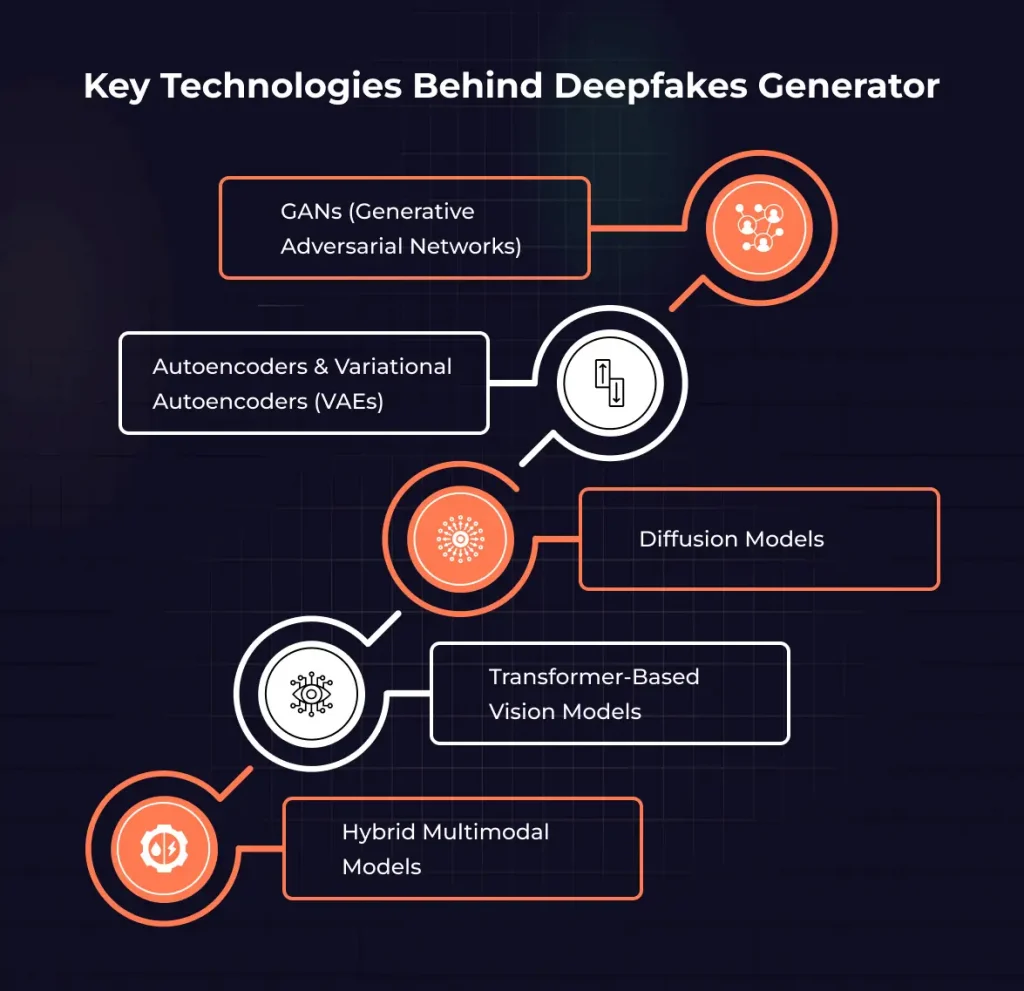
Key Technologies Behind Deepfakes Generator
What few deep learning architectures enable the deepfake generative AI that exists today are fundamentally important. Each of these architectures has important strengths which ultimately helps power deepfake technology.
i. GANs (Generative Adversarial Networks)
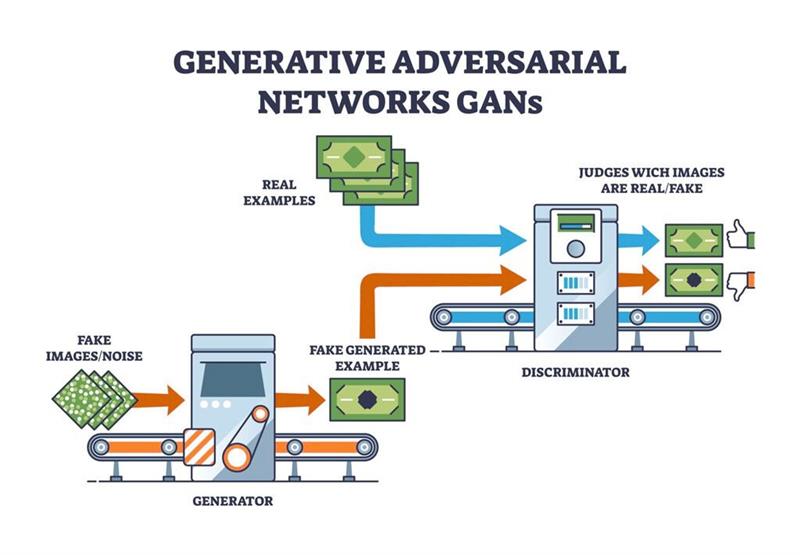
GANs are the fundamental architecture used by the vast majority of modern AI deepfake generators. A GAN essentially consists of two AI modules: the generator and the discriminator. The generator creates a fake piece of media, whilst the discriminator assesses its authenticity. The generator and discriminator are training against one another: throughout a given training cycle, both will improve until the generator produces a fake piece of media that is indistinguishable from genuine media (to the discriminator).
ii. Autoencoders & Variational Autoencoders (VAEs)
Autoencoders are made up of 2 deep networks: the encoder and decoder. The encoder compresses the input media (image or video) into a smaller latent space representation, then the decoder reconstructs this into the output media. Variational Autoencoders (VAEs) introduce statistical variability, enabling AI to interpolate between known data and unseen data, and produce a more plausible, diverse media synthesizer.
This is particularly useful when morphing faces or blending attributes in deepfake generative AI.
iii. Diffusion Models
Diffusion models basically take data and add “noise” to it and then just learn how to reverse the whole process to reconstruct the original content or generate new data samples from scratch. These models are a popular choice (with the likes of DALL-E and Stable Diffusion) because they can generate more complex/finer detail than other model types. They are being used similarly for deepfake generation, offering high detail and realistic images.
iv. Transformer-Based Vision Models
Although first developed for natural language processing, Transformers are gaining interest for diverse vision tasks. They process image data in parallel using sequential attention and block structures. Auto-regressive Transformers enable faithful synthesis of facial expressions, voice synchronization, and contextually accurate motion.
They are also very scalable, making them powerful tools for combating some of the advanced AI deepfake generator apps on the market.
v. Hybrid Models
Hybrid multimodal models involve combinations of neural architectures including combinations of GANs, VAEs, diffusion models and Transformer models. Combined these models offer hybrid AI deepfake video generator apps the ability to merge audio and visual content, as well as text prompted instruction, and emails typical capabilities of ground truth video, with synchronized lip movements and the ability to work with the re-dubbed voice of either a licensed or an unlicensed and adapted or mixed background.
Step-by-Step Deepfake Creation Process
The process of generating a deepfake using an AI Deepfake Generator has a workflow that consists of several formal steps driven by deepfake generative AI. Here is an outline of a general workflow:
1. Data Collection
The deepfake development process begins with the collection of large datasets from the target subject – images, audio, and videos of the target from as many angles as possible, multiple lighting conditions, and varying emotional states. The more data available, the better the AI’s model performance and the realism of the output.
2. Preprocessing the Data
The collected raw media goes through preprocessing steps. Preprocessing establishes the standardized resolution of the media, facilitates uniform lighting, identifies key landmarks (i.e. the eyes, nose, mouth), and aligns the features of the target subject across the frames of the dataset. Preprocessing reduces noise introduced through data collection steps, and promotes convergence during model training, which is a critical part of any AI development services pipeline.
3. Training the AI Model
The deepfake AI model is developed and trained using generative architectures like GANs, VAEs, transformers and diffusion. Training duration and processing is case dependent, it could take a few hours or a week of data processing time. Computers are trained using various models that can span from a few GPUs on a single desktop to a multi-node computer cluster.
4. Face Swapping and Blending
Once trained, deepfake AI video or photo generators swap faces, blend traits, or mimic voices with AI replicas. Advanced blending algorithms maintain alignment, lighting, and synchronization. They also prevent models from generating visible jumps or noticeable signs of manipulation.
5. Post-Processing
Post-processing resolves artifacts, fixes lighting, adds motion blur, and implements effects to make it more realistic. This can also include AI-powered editing tools or just the regular graphic post-effects, even borrowed from the AI Image Editor App Development.
6. Testing & Refinement
The final synthetic output is carefully examined for artifacts, realism, and sync. The AI deepfake generator completes the process again, editing or tweaking as necessary until it achieves the best possible quality–something a Generative AI Development service provider should take pride in.
Most Common Applications of AI Deepfake Generators
Below are the most commonly explored use cases:
1. Positive Uses
- Entertainment & Media: Filmmakers are using deepfake technologies to enhance visual effects, de-age characters, and swap actors. Studios can resurrect historical figures for films or documentaries.
- Business & Marketing: Organizations are using deepfake generative AI in customizable video messages, advertisements, and product demos. The use of an AI presenter can elevate brand interaction and engagement levels on social media sites.
- Education & E-Learning: Educators can use AI deepfake video generator tools to create historical recreations, virtual tutors, and immersive e-learning scenarios.
- Art & Creativity: Artists are utilizing AI deepfake photo generator tools to test new artistic boundaries and produce unique, AI-generated, masterworks.
2. Negative Implications AI Deepfake Generator
Although there are some beneficial applications, deepfake technology also presents significant dangers:
- Misinformation & Fake News: Deepfakes can be weaponized to create falsified statements, creating confusion and spreading false information on social media.
- Identity Theft & Fraud: Fraudsters use deepfake generative AI to impersonate people, bypass protections and commit crimes from phishing to financial scams.
- Privacy Violations & Exploitation: Unauthorized use of a person’s image or voice in a deepfake generator can cause reputational harm and emotional distress.
- Erosion of Public, Media & Social Trust: As deepfakes become better, it will be more difficult to discern real from fake media, further eroding trust in journalism and social discourse.
- Psychosocial & Social Harm: Targets of malicious deepfakes, in particular non-consensual adult material, may experience serious psychosocial distress and public stigmatization.
Best AI Deepfake Generator Tools & Software in 2025
Many platforms are innovating in the AI Deepfake Generator space, with unique features of their own:
1. DeepSwap AI

Real-time face-swapping in videos and images; very user-friendly interface.
2. DeepFaceLab

Great toolkit for researchers and hobbyists. Offers advanced capabilities and high-level customization options.
3. HeyGen

Text-to-video generation; combines video synthesis with realistic neural avatars; meaning it’s able to synthesize realistic videos from text on a variety of subject matter.
4. Synthesia

Enterprise-focused platform for AI video presenters; they are frequently used for e-learning purposes, presentational events, and marketing videos.
5. Wav2Lip

Latest in audio-to-video lip synchronization, high-quality state-of-the-art technology for professional dubbing and translation.
6. FaceMagic

Easy-to-use mobile app for face-swapping and creation of photos and videos, face-swapping was very quick and painless with this tool.
7. D-ID
Leader in developing photorealistic talking head animations from still images for a whole variety of artificial intelligence-related use cases.
AI Deepfake Generator vs AI Deepfake Detection
The advancement of deepfake technology has been matched by the need for detection solutions to the threat of deception. As ai deepfake generator tools aim for increased realism, detection tools utilize AI to analyze pixel and motion inconsistencies, identify artifacts, and additional telltale signs of forgery.
Deepfake AI developers and detection tool creators constantly engage in an arms race, improving tools and evasion methods. Effective detection now requires AI-driven forensic tools for reliable and scalable results. These forensic systems combine visual, audio, and metadata checks to ensure accurate, real-time deepfake detection.
1. Ongoing Innovation
Whenever a method of detection begins to gain traction, deepfake generative AI tools expand their capabilities to circumvent the methods of detection, perpetuating a cycle of innovation for both sides.
2. Multi-modal Detection
The detection of AI deepfakes does not rely on a single criterion. In fact, it often considers images and captures analyzed across visual frames, audio tracks, tempo shifts, compression artifacts, and metadata signatures, to arrive at a more conclusive conclusion.
3. Real-time Forensics
As deepfakes proliferate on social media and lots of other platforms, the goal of many emerging AI-based forensic tools is to enable detection of deepfakes in real-time, to limit public exposure of as much forged media as possible.
4. Explainable AI
Detection systems now implement explainable AI, showing users why content is considered fake and making forensic findings actionable and transparent.
5. Training on Up-to-Date Datasets
Both the AI deepfake generator and the detection model learn from continually updated datasets that provide state-of-the-art synthetic techniques, keeping each party current in this arms race.
6. Cooperative Ecosystems
Security firms, AI researchers, and digital platforms cooperate regularly to share their findings of the discovery of new methods of deepfake creation and detection, working together to minimize and resist the potential abuse of deepfake technology.
A Glance at Future Trends in AI Deepfake Generator Models
The future of AI Deepfake Generator technology is exciting and complicated all at once. Some prominent trends are:
- Hyper-Realism: AI deepfakes will soon be indistinguishable from real footage, creating new challenges for verification and ethics.
- Widespread Democratization: Drag-and-drop deepfake applications will place new sophisticated forms of deepfake generative AI into the hands of every smart phone user.
- Ethical Development: Fresh and varied demands for responsible development and legal frameworks are encouraging companies to start using “consent mechanisms” and “watermarks” cell “democratic” brands are creating “consent” to use or apply on the pretext of development.
- Cross-Modal Fusion: Hybrid models will combine video, photo, text and audio for seamless media synthesis across modalities.
- Forensics & Counter-AI: Detection tools will start to use AI against AI to identify deepfakes through pixel-level telltale signs, statistical analysis, or provenance-based content authentication – as in blockchain technology.

Why Choose A3Logics for Large Generative Models Development?
A3Logics offers unmatched experience in Generative AI Development Company solutions, specifically for the rapidly changing deepfake ecosystem:
- Innovative Team: Highly skilled researchers and engineers utilizing deep learning, GANs, VAEs, and transformer-based vision models.
- Responsible AI Practices: Security, consent, and ethical policies and safeguards are emphasized in their work.
- Full-Suite Services: We provide end-to-end support for AI Image Editor App Development and advanced deepfake generator platforms from strategy through development and deployment.
- Custom AI Development: We provide consulting, and integration services tailored toward helping clients achieve unique goals in media, security, or creative areas.
Conclusion
AI Deepfake Generators illustrate a tension between a technological advance in digital fostering of creativity and a challenge to the integrity of our media. By studying how deepfake generative AI works, understanding the opportunity and threat it presents, and working with responsible development and detection processes, society can benefit from the good, while navigating the potential pitfalls of this disruptive technology in 2025 and beyond.