
The world is gradually, or rather rapidly, shifting towards automation. With an expected 72.64 billion market share and an 18.2% growth rate between 2025 and 2032, RPA is going to steal the work operations in almost all sorts of businesses. Robotic Process Automation changes the business landscape through the performance of monotonous, rule-driven tasks much quicker and accurate. This is the reason why there is a rise in RPA usage in the organizations. It is assisting to calculate accurate ROI. It also constitutes an assessment of project outcomes and sheds the light on methods of future automation. Calculating ROI of RPA is essential as it gives executives the confidence to take the right decisions and helps them implement right automation strategy.

This in turn can steer an organization to the targets of continued value generation and profitable growth.
Understanding ROI in RPA
Before going ahead with the calculations, you first need to understand ROI in the context of RPA. But what is RPA? And what does ROI mean in the context of RPA? What metrics play a part in calculating ROI, and what tools can you use? Let’s answer these questions one by one to help you make a correct estimation.
Definition of ROI (Return on Investment) in the Context of RPA
ROI, just like any other case, defines the return on investment you get from your expenses, even in the case of investment in RPA. So, it measures how much your robotic process automation venture provides you with financial value.
As soon as you invest in bots, it helps you cut costs from manual labor, mistakes, and lag. You can significantly scale your operations, knowing there is a strong backup for tracking, recording, and serving them 24*7. The ROI of RPA, therefore, is very high, and you can calculate it from day one with some relevant tools.
What Calculator Tool Can I use to calculate the ROI of RPA?
There are multiple tools available in the market that you can use to calculate your ROI from RPA investment. You can just make a simple Google search and get the top options like Fortra, Nividous, Robomotion RPA, etc.
Usually, these calculating tools ask you to provide your initial input cost, the hours you save per process, your employee’s salary rate, etc. Then, this data will be used to give you a short-term or long-term estimate. You can start with a free RPA ROI calculator and switch to a premium one for greater accuracy.
Key Metrics and Variables Involved in the ROI of RPA

As you can see, a few metrics are involved in this calculation. To completely understand RPA ROI, one needs to look at both the financial and operational metrics.
- Time Saving: The number of hours the bots are actively saving daily, weekly, or monthly.
- Scalability: The efficiency of the RPA in scaling with your business growth, expanding its area, or the load of tasks
- Error Reduction: The cost savings it offers by avoiding manual errors.
- Compliance and Accuracy: Compliance with regulatory parameters and accuracy rates.
Difference Between Traditional ROI (payback period) and Ongoing Return on Investment
The traditional ROI calculation depends on the payback period. This simply means it looks at the investment timeframe to return you the favor. For instance, if you invest 40 thousand dollars in your RPA setup and save around 8 thousand dollars per month, it will take a 5-month payback period, then you can count the profit.
Whereas in the case of ongoing RPA ROI, you will calculate the gains from the first day. RPA is such a useful advancement that it will give you returns long after the payback period. Reports show that RPA integration increases efficiencies by up to 20 to 30%, and simultaneously reduces operational costs by up to 30%. These are only the initial gains, as the mature RPA can give you up to 300% long-term ROI!
Key Steps to Calculate ROI of RPA
Now that you have an idea on, “what is RPA?” you need to know the dynamics involved in RPA ROI calculation, obtaining estimates becomes quite challenging. Here, the costs and gains are not straightforward, leaving you wondering what to count and what not. However, following the steps below may help you get countable results.
Step 1: Identify and Define Automation Goals
To calculate the RPA ROI, first set what you want to accomplish. Explicitly defined objectives make your automation strategy specific and quantifiable. Do you wish to decrease costs, speed up, or enhance accuracy? You can also want to strengthen compliance or employee satisfaction.
Knowing these objectives enables you to select the appropriate processes for automation. Set short-term and long-term goals and ensure that your objectives match business objectives. As simple as this may sound, it’s the key to measuring accurate Robotic Process Automation ROI.
Step 2: Assess Current Process Costs
If you don’t know the cost that you are currently incurring, then you don’t see what you’re going to be getting. Thus, begin by locating the cost of current manual processes. They consist of the employees’ salaries, time, and materials that are used for the operation.
Add in error rates and rework efforts, too. For example, if five employees work two hours a day on processing invoices, calculate the monthly cost. Also, make sure to account for unexpected expenses like delays, overtime, or missed business opportunities. This is necessary to look at the baseline before the impact of RPA. It gives a basis for measuring the Robotic Process Automation ROI.
Step 3: Estimate RPA Implementation Costs
Now work out what it will cost to deliver your automation solution, including licensing, installation, training, and support costs. Depending on your scalability needs, RPA adaptation costs range from one thousand to hundreds of thousands of dollars.
Also, don’t forget to add costs for any consultants or vendors that you are involving. Apart from the one-time setup fee, the annual cost of support and upscaling will also count here. Add any hardware or infrastructure upgrades that you take for the RPA integration here as well. Having these estimates in front of you gives a clear picture of your investment. This is a crucial step for whoever is posing how to calculate ROI for RPA.
Step 4: Quantify Benefits and Savings
This is about placing real figures of savings that you are able to make with the help of RPA. List all direct and indirect benefits your company is making from it. Direct savings would be minimizing labor hours, manual errors, and faster processing. Meanwhile, indirect savings could be achieved through better customer service or neater compliance reports.
Guesstimate monthly or yearly savings from every benefit, and use these figures to calculate potential return through automation. RPA can cut operational expenses by as much as30%, says McKinsey. These figures completely determine your Robotic process automation ROI calculation.
Step 5: Apply the ROI Formula
Use the standard formula for ROI:
ROI = (Net Benefits / RPA Investment Cost) x 100
Net benefits are your annual total savings minus the overall implementation cost. Therefore, if you own $120,000 and invested $40,000 in RPA, your ROI is 200%. This method works best if you have exact figures based on the above calculations.
Make use of an RPA ROI calculator so that it gets faster and gives you a better visual impression. This assists teams in creating a snapshot view of the return in real-time. Also, the calculation should be precise so that the business managers can realize the value more effectively.
Step 6: Monitor and Iterate
ROI is not something that you will calculate only once; you will have to do it again and again. Monitor performance from time to time post-deployment and compare whether it is going according to your projections. Also, utilize dashboards to track the monetary profit, time that you save, and errors that you reduce. Also, tune if necessary—tune bots, optimize processes, or change goals.
ROI can accumulate in the long term as the RPA procedures mature, so constant checking is the key to ensuring the ROI of RPA growth. Track your automation impact quarterly to achieve maximum results, as this is how intelligent companies achieve long-term success.

ROI of RPA Calculation Formulas and Examples
Basic RPA ROI Formula
To determine the RPA ROI, employ the basic formula:
ROI = (Annual Benefits – RPA Investment) / RPA Investment × 100
This provides the return in percentage terms, where a positive percentage indicates that your automation is profitable. The higher the percentage, the better your return on investment.
Example
Suppose that a company invests $60,000 to automate three back-office processes. These robots save the company $20,000 a month by reducing errors and labor costs, which means RPA saves $240,000 annually.
Equation:
ROI = ($240,000 – $60,000) / $60,000 × 100 = 300%
That’s a nice payback rate, so a dollar invested paid back $3 in savings. The value would be higher if you also consider soft payoffs like employee satisfaction.
Most firms prefer to apply an RPA ROI calculator for an instant solution. These calculators display inputs such as both hours, license costs, and saved time in plain form and give teams easy-to-understand savings over a couple of years.
Describe the RPA Success Metrics for ROI Calculation
Measuring the correct metrics is vital in calculating the Robotic process automation ROI. They measure whether your automation is saving time, reducing costs, and improving performance.
1. The Time It Saves
Monitor how many hours bots are saving per task or process. For example, if it used to take 4 hours manually but now just 1 hour with RPA, that is a 75% reduction. That automatically translates to savings in labor expense.
2. Reduction in Labor Cost
Monitor how much you’re saving in wages or overtime paychecks. There’s less labor required for drudgery when you have fewer errors, and you can then reassign personnel to more profitable work.
3. Error Elimination
Work done by human beings is susceptible to error, whereas robots eliminate errors by performing correctly. Fewer errors translate to savings in rework and higher compliance rates.
4. Process Speed Increased
Higher throughput translates into faster customer service and shorter periods of responsiveness. This will be equal to improved business efficiency and customer satisfaction.
5. Utilization and Uptime
Heavy robot utilization ensures that you are making the maximum use of the investment. So, monitor how often robots are actually operating versus sitting idle.
Regular review of these key metrics improves the RPA ROI. It helps your automation strategy continue to deliver value year after year.
How to Measure the Cost of RPA?
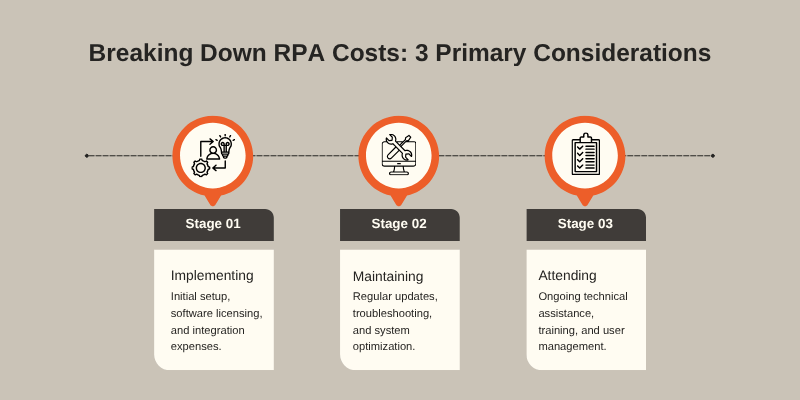
The answer to how to calculate ROI for RPA begins with measuring the cost of RPA. Calculate it following these three areas;
- Implementing: this includes the overall planning, designing and development fee, licensing, infrastructure setup, and staff training.
- Maintaining: This includes the need for bot updates and system updates, as well as curing any technical issues.
- Attending: This includes charges for observation of the RPA results, handling costs, etc.
Measuring Tangible and Intangible Benefits of RPA
In order to precisely understand the ROI of RPA, firms are required to quantify tangible and intangible business outcomes. Tangible benefits are quantifiable in terms of cost and time, whereas intangible benefits push quality, innovation, and long-term performance. Together, these benefits create an irresistible business case to implement automation across processes and departments.
1. Reduced Operating Costs
One of the most apparent advantages of RPA is the immediate reduction in operating expenses in manual-intensive departments. Bots can run 24/7 without interruption, reducing the need for overtime, new hires, or temporary labor support. These cost savings also include the removal of training, administrative management, and human error that results in rework or penalties.
2. Increased Revenue
As RPA accelerates service completion and does away with bottlenecks, companies can finish more transactions and serve customers quickly. Speedier turnaround and higher accuracy enable organizations to complete more orders, process more invoices, or close sales more quickly. With back-office functions running smoothly, companies can expand operations and make more money without proportionally increasing their workforce.
3. Unified Workforce
Robotic process automation streamlines mundane, rule-based processes, freeing up employees to concentrate more on creative, decision-making, and client-facing work. This produces a better-balanced workforce in which humans and machines are complementary, with both doing what they do best. Staff satisfaction increases as employees are relieved of the drudgery of repetitive, mundane work, which alleviates burnout and optimizes productivity.
4. Speed and Scalability
RPA significantly enhances the velocity at which operations are performed, frequently decreasing processing time from hours to minutes. First and foremost, bots can be easily scaled up to cover more workloads during peak times at no extra cost. This is vital for companies that are growing or suddenly face an unexpected change in demand, like seasonal companies or start-ups.
5. Quality and Value Realization
Since bots implement pre-specified rules consistently, process quality increases, and bugs or errors become virtually nonexistent. Better quality translates into lower customer complaints, reduced rework, and enhanced confidence in internal processes. This inherently leads to quicker realization of value through automation, thus strengthening the RPA ROI over time.
6. Improved Customer Experience
Customers receive quicker service delivery, fewer mistakes, and quicker resolution times, which results in higher satisfaction levels. RPA helps the frontline employees by retrieving customer data quickly and enhancing the systems to offer smooth interactions. The repeat business and word-of-mouth referrals by satisfied customers drive both top-line and bottom-line growth.
7. Innovation
Workers escape from mundane tasks and can concentrate on strategy, innovation, and creative problem-solving. Therefore, this revolution has a propensity to come up with new concepts, new products, and process innovations within the enterprise. Hence, automation promotes a culture of constant improvement where groups work towards finding improved ways to work and create value.
8. Maximized ROI
These advantages of cost reduction, additional revenue, and enhanced quality all combine to optimize the RPA ROI over time. Businesses need to think not only about the upfront cost but also about the long-term and perpetual advantages of automation. Businesses that tie RPA to their objectives generally see long-term advantages in operations, compliance, and customer service.
9. Automated the Right Processes
Selecting the right processes to automate is the secret to a high return on automation investment. Organizations ideally should automate repetitive, rule-based, high-volume processes with minimal variation or human judgment. Incorrect or too complicated tasks should be automated, as they decelerate efficiency and delay the achievement of expected value.
10. Identified Processes
A successful automation starts with correctly identifying what business processes exist and are ready for RPA. Many times, it comprises process audits to determine the quantity, error rates, and workflow complexity of current workflows. RPA software development companies like A3Logics ensure proper identification, enabling RPA initiatives to be directed towards where they can have the most significant impact.
11. Assessed for Automation
After identifying the processes, the next step is to consider them for the feasibility of automation, their cost, and potential return. Specific brainstorming tasks need to be left entirely for humans, or they may need redesigning before automation. Utilize scoring models or RPA evaluation tools to determine processes that can continue down the automation pipeline and be beneficial.
12. Prioritized Automations
Not all processes need to be automated simultaneously, and therefore, prioritizing based on business impact will most probably lead to success. Begin with tasks that deliver quick wins, are high-visibility in nature, or produce immediate cost savings to establish stakeholder buy-in and momentum. Incrementally move toward more sophisticated processes once successful proof of outcomes in early adoption is achieved.
13. Optimized Processes
Streamline the current process before deploying RPA to eliminate inefficiency and enhance flow. If the existing system is already flawed, then the automation results will also be flawed. So, address bottlenecks first before optimizing for improved returns. Process optimization enhances bot productivity and optimizes the long-term viability of the automation project.
14. Planned Deployment
A successful deployment strategy provides uninterrupted integration of robots with existing processes and systems. This involves pilot testing, phased rollout, stakeholder training, and continuous performance monitoring from day one. Effective planning minimizes resistance, prevents disruption, and enables companies to harness the maximum potential of RPA in a minimum time frame.

Explain the Best Practices and Common Pitfalls
Successful ROI of RPA depends on the degree to which your RPA strategy is well conceived, well executed, and well managed. Adopt these best practices and avoid the most common pitfalls to get maximum value.
Best Practices for ROI Calculation
- Align Automation Objectives with Business Goals: Ensure every RPA project addresses a particular business goal—cost reduction, productivity, or customer satisfaction, for instance.
- Begin Small and Expand Gradually: Begin with pilot deployments for low-risk, high-volume processes to prove the value before infusing more RPA across different departments.
- Involve Cross-Functional Teams Early: Incorporate IT, operations, and business users to develop an integrated and pragmatic automation plan.
- Use ROI Calculators and Data-Driven Planning: Use resources like an RPA ROI calculator to study processes and set proper performance targets.
- Continuous Monitoring and Optimization: Monitor bot performance after deployment and optimize now and then to hold on to value and get the highest long-term RPA ROI.
Common Pitfalls that Hinder ROI
- Wasting Money on the Wrong Automation: Don’t automate intractably mutable or unstructured activities with indeterminate output and redundant effort.
- Neglecting Changes: Insufficient preparation of teams results in resistance, misinterpretation, and reluctant user adoption, thereby eliminating the automation value.
- Underestimation of Total Costs: Businesses fail to include indirect costs like maintenance, software upgrades, or bot management that consume actual ROI.
- Not Monitoring Post-Deployment: Without ongoing measurement, it is difficult to know whether automation is delivering anticipated returns or needs to be tweaked.
By not falling into such traps and following the above best practices, your organization will get effective RPA ROI outcomes.
Tools and Resources for ROI of RPA Calculation
Free online ROI RPA calculators allow you to enter basic details like labor cost, bot hours, and the number of tasks. They will provide you with the ROI figures automatically, which will help you decide if a process needs automation or not.
- Downloadable Special Case Templates
Downloadable Excel/Google Sheets templates for exceptional cases and end-to-end planning are available and can be used in your business. These calculators allow you to input various forms of cost, anticipated savings, and even anticipated growth over time.
- Vendor-Specific ROI Tools
Many RPA-developing companies provide ROI calculators to showcase the functionalities and capabilities of their platform. These calculators can provide real-time analysis and integrate with performance dashboards.
Selecting Tools and Customizing Them for Your Organization
Choosing the right tools and personalize them for your organization is crucial. But, not every other tool will be suitable for your needs. Hence, keep the following factors in mind and pick the right tool.
- Align Tool Capabilities to Business Complexity: Select a tool based on the number of workflows you need. It will help automate your complexity level.
- Customize Inputs for Precision: Look for calculators where you can provide parameters. They include such as exception handling, error rates, and time savings for employees as customizable inputs.
- Update ROI Models Periodically: As your automation initiative matures, adapt your ROI models to include rising efficiencies and savings. This helps you keep your RPA ROI front and center at all times, allowing you to better plan and grow.

Conclusion: ROI of RPA
Measuring the ROI of RPA enables business organizations to quantify success, lower costs, and extend automation with certainty and transparency. With proper tools, strategy, and planning, RPA returns money and lasting business transformation in all the major industries.
So, make your business future-proof with smart RPA integration with A3Logics. Their expertise helps you stay aligned with the most effective RPA use cases and ensure ROI without delay.