
Robotic Process Automation (RPA) is an effective, path-breaking software technology that has impacted businesses worldwide. It helps create, deploy, and manage bots (software bots) capable of mimicking human actions. These bots interact with digital systems and replicate actions like entering data, clicking buttons, moving files, and other tasks, thereby freeing up human employees. This post dives deeper into the future of RPA in 2025, how it works, and its role in simplifying processes and boosting efficiency.

Evolution of RPA
RPA has evolved from screen scraping in the early 90s and 2000s to AI-integrated solutions. It was initially only created to handle repetitive tasks, but now it can also perform cognitive functions. Over time, RPA bots have also started to leverage advanced technologies like machine learning and AI, because of which the bots can handle complex decisions.
Market Outlook and Growth Projections
Here, we have briefly explored the market outlook and growth projections of RPA through some intriguing stats. However, if you want to dive deeper and crunch more intriguing stats, check out our post on Must-see Robotic Process Automation (RPA) statistics in 2025 –
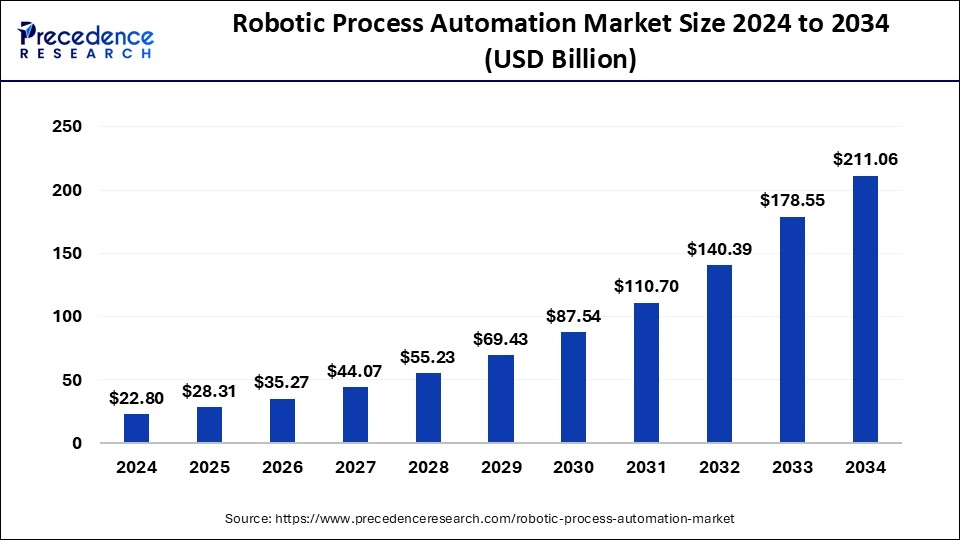
Forecasts for RPA Market Size and Growth By 2025
- The global RPA market size is valued at $28.31 billion in 2025.
- An estimated 80% of companies will adopt intelligent automation by 2025.
- The potential economic impact of knowledge work automation is expected to be $5-7 trillion by 2025.
- RPA bots help cut delivery time by 50% and ensure faster delivery.
- 40% of organizations implementing RPA faced cybersecurity challenges.
Regional Adoption Trends and Sector-Specific Growth
- North America leads the RPA market with a share of 38.92%.
- Around 80% of finance leaders have implemented RPA.
- 43% of manufacturers have RPA; 92% have reported better compliance.
- In healthcare, RPA helps decrease claim processing time by 90%.
Role of RPA in Business Process Outsourcing (BPO)
RPA helps revolutionize the BPO in several ways. It speeds up processing times, so service vendors only need to hire a few full-time workers to do simple tasks such as transcription and data encoding.
By boosting operational efficiency, RPA helps providers handle mundane and repetitive tasks and helps human workers focus on more strategic and creative jobs. Talking of repetitive tasks, RPA leverages ML algorithms and statistical models to enhance accuracy and quality while accomplishing repetitive tasks.
Amidst various other ways in which RPA benefits the BPO industry, one that stands out is its ability to refine customer experience. RPA speeds up responses to queries; RPA-powered chatbots, along with IVR and email ticketing systems, provide a more reliable consumer support.
Importance of RPA in Digital Transformation
Let’s have a look at how RPA helps in improving operational efficiency, automating tasks, streamlining business processes, and saving costs –
1. Improve Operational Efficiency
RPA helps reduce human errors, speed up workflows, and ensures consistent performance across various kinds of operations, helping businesses run faster and smoother.
2. Automate Repetitive Tasks
RPA bots can handle routine tasks like report generation, moving files, data entry, and others, freeing up employees. They can focus on more important, creative, and strategic tasks.
3. Streamline Business Processes
With RPA in place, businesses can connect different systems seamlessly. Furthermore, it can simplify workflows and eliminate manual steps, thereby making business processes faster and more efficient.
4. Adapt and Improve Over Time
Thanks to AI and ML algorithms, RPA bots can learn from patterns, past interactions, and exceptions, and adapt to changing business needs and marketing conditions.
5. Save Costs and Increase ROI
By automating tasks, RPA reduces operational costs related to resources, labor, and time. Since RPA implementation helps businesses see benefits quickly, they can see increased ROI instantly.
Current State of RPA – Consumption Across Industries
RPA is widely used across various industrial sectors, such as healthcare, BFSI, manufacturing, IT, and many others. It helps improve efficiency, automate repetitive tasks, reduce costs, and increase productivity.
The future of RPA in 2025 in industries is characterized by integration with AI and ML, increased adoption, and a move towards more intelligent automation. In the future, by adapting RPA in the workflow, organizations are expected to achieve greater efficiency and reduce human errors.
Key Trends Shaping the Future of RPA in 2025
1. Hyperautomation and AI Integration
Hyperautomation, along with AI, ML, and process mining, is expected to dominate the RPA space and is the future of RPA in 2025. Instead of individual tasks, hyperautomation helps automate entire workflows. It creates autonomous operating systems that need minimal human intervention.
2. Emerging Sectors Adopting RPA (Healthcare, Education, Construction, Agriculture)
Emerging sectors adopting RPA are one of the key RPA trends of 2025. Let’s quickly explore the impact of RPA across industrial sectors –
i. Healthcare
Automation has and will streamline claims processing, patient management, and billing. It is taking the load off providers who can now focus more on patient care. Here’s a comprehensive article that dives into how RPA is transforming healthcare through real-world use cases and automation benefits.
ii. Education
Adoption of RPA in the education sector can help automate tasks like marking attendance, grading assignment/ exam sheets, scheduling class events, amongst others. These are the tasks that take the mind of teachers from the actual jobs i.e. teaching.
iii. Construction
In the construction center, RPA can help automate tasks like payroll management, invoice processing, and document handling, and reduce administrative overhead. It can also streamline purchase order creation and inventory tracking.
iv. Agriculture
RPA can automate tasks like monitoring crop health, irrigation, and even harvesting, freeing up farmers and helping them focus more on core farming activities. It can also help optimize resources and reduce waste.
3. Examples of Innovative Use Cases in these Industries
RPA is innovatively used across various industries, including healthcare, education, and agriculture. Let’s have a look at how the use of RPA is shaping the future of multiple sectors in 2025 –
i. Healthcare
RPA can play a key role in minimizing menial admin tasks by reducing resources dedicated to them. For instance, it can streamline all health data from different sources into one centralized platform. RPA can also help ensure that all electronic patient data adheres to privacy protocols by regulating access and permission rights.
ii. Education
For various online courses, bots can be programmed to pick students’ names from the attendance list each session. These bots can further place a check mark to mark students’ attendance. Teachers can then quickly digitize and transfer attendance data into spreadsheets for actionable insights.
iii. Construction
RPA has shaped the future of the construction industry in more ways than one. For instance, RPA bots can produce cost-to-estimate reports, pulling data from contractors and suppliers, importing it into the project budget, and then generating real-time analytics. Eventually, these can be segregated into daily, weekly, and on-demand reports.
iv. Agriculture
RPA-powered automated systems can help gather and analyze data with utmost precision. The data can then be leveraged for crop management, soil health monitoring, and accurate forecasting. The outcome is better crop yields and quality, ensuring sustainable farming practices.
4. Cloud-Based and Low-Code/No-Code RPA Platforms
The cloud-based and low/ no-code RPA platforms are one of the RPA trends shaping the future of RPA in 2025, and here’s how –
Cloud RPA bots run on third-party cloud servers that are compliant with regulations such as the US Privacy Act, HIPAA, and various others. As such, cloud TPA servers provide superior security compared to on-premise RPA.
Now, let’s discuss how low/no-code is shaping the future of RPA in 2025. Unlike traditional RPA, low-code or no-code RPA bots are easy to maintain since there is hardly any programming involved. This implies that non-technical users with little to no coding experience can easily handle these bots.
5. Enhanced Security, Governance and Compliance
Considering the fact that RPA bots handle sensitive data in industries like agriculture, healthcare, banking, finance, and others, the future of RPA in 2025 is heading towards treating bots like digital employees. They’ll be assigned roles and permissions and continuously monitored just like human employees.
Enterprises are adopting “Shift-left” RPA. This means they are integrating security considerations and practices early in the RPA development and deployment lifecycle instead of applying security practices only once the bots are deployed.
6. Lifecycle Management and ROI Optimization
Foreseeing the future of RPA in 2025 – lifecycle management and ROI optimization are two crucial factors.
As companies gain more experience with automation over time, they move beyond just testing or using a few bots. They start managing larger, more complex automation systems. This “maturity” involves better planning, scaling automation efforts, improving processes, and focusing on long-term value rather than just quick wins.
With the increase in automation, industries are moving beyond just using and testing a few bots. They are starting to manage larger and more complex automation systems. With this, industries have begun to focus on RPA lifecycle management and ROI optimization. Here is what this entails –
- Identify inefficiencies in automation strategies, recommend enhancements, and meet business goals, in the process delivering maximum ROI.
- Provide a centralized platform to manage bot portfolios. This helps reduce duplication, and as such, bots remain effective and efficient throughout their lifecycle.
- Maintain detailed audit trails and documentation. This, in turn, helps boost ROI by reducing compliance risks, avoiding rework, and simplifying future bot improvements.

RPA Implementation Best Practices for 2025
1. Importance of a Robust RPA Process Design Blueprint
A robust RPA process design blueprint is key to a sustainable and successful automation journey. It provides a framework for developing, deploying, and maintaining RPA solutions. The blueprint helps establish best practices and standards, allows for easier scaling, and ensures consistency. It also helps minimize risks associated with automation projects, including security breaches, errors, and compliance issues.
2. Key Components: Process Selection, Stakeholder Engagement, Documentation, and Performance Metrics
Let’s have a look at some key components that will have a significant impact on the future of RPA in 2025 –
- Process Selection
In RPA strategy, choosing the right tasks to automate is crucial, as these impact the ROI and success of the program. Ideal processes are high-volume, repetitive, and rule-based. Poor selection of tasks leads to wasted efforts and minimal benefits.
- Stakeholder Engagement
Collaboration with stakeholders involves gathering their insights to understand the processes and identifying potential areas for automation. Once you have identified these, it is time to create a detailed documentation of each process, including inputs, outputs, and dependencies.
- Documentation
Documentation serves as a guide through which all parties – developers, stakeholders, business analysts, and end-users ensure that everyone understands the process. Well-documented RPA processes include information about the process logic, exceptions, and error handling.
- Performance Metrics
Performance metrics help organizations define the level of robot deployment performance. Some key RPA performance metrics include speed, accuracy, software, workforce safety, hardware, and more. The metrics help get a bird’s-eye view of RPA success and analyze its benefits.
3. Step-By-Step Approach to Creating an Effective RPA Design Document
Here’s a simple step-by-step process of creating an effective RPA design document –
Step 1 – Define Scope
Describe all the processes that need to be automated. In this step, don’t just describe the processes but also define their purpose and business goals.
Step 2 – Document Inputs and Outputs
Mention what data the bot will need to start the process, and in what format. Also, mention what the bot is expected to produce.
Step 3 – Break Down The Process Flow
Break down each step of the process clearly. For this, you can use detailed descriptions or interactive flowcharts.
Step 4 – Identify Rules and Conditions
This is where you define the decision-making logic of the RPA bot. It should be on the lines “if X happens, do Y”. The decision-making logic should cater to different data types and how to route unusual cases and exceptions.
Step 5 – Specify Applications Involved
In this section, you list every tool, system, or software platform the RPA bot will interact with during the automation process, his could include web applications, SAP, desktop software, databases, etc.
Step 6 – Include User Roles and Permissions
Define who will access what. This has to be done for both RPA bots and human users. While user roles define a user’s level of access, permissions grant specific actions within the system.
Step 7 – Define Error Handling
This step is crucial as it defines how you will handle unexpected events or errors.
Step 8 – Set Key Performance Indicators or Metrics
In this document section, you clearly define the key performance indicators. These metrics might include how quickly the bot responds, instances when it completes the processes accurately, etc. The metrics help ascertain whether the bots can meet business goals.
Step 9 – Security and Compliance
Mention all the compliance measures the bot should meet in your desired industry.
Step 10 – Get Approval from Technical Teams and Stakeholders
In the last stage, share the document with all technical teams and stakeholders, gather their feedback, and identify and work on loopholes.
Challenges and Considerations
1. Potential Hurdles In Adopting Advanced RPA Technologies
The future of RPA in 2025 looks bright as the technology per se offers great benefits; that said, it also comes with challenges, some of which are mentioned below. –
Integration with Existing Systems
Integration of RPA with existing systems poses one of the main challenges. Almost 45% of companies using AI and robotics have encountered issues integrating or deploying RPA with current systems. The reason is that a company’s existing system often combines different technologies, protocols, and user interfaces.
Here, inappropriate unstructured data can cause issues, as there is a need for additional technologies such as OCR and AI to process the data. Secondly, RPA solutions may have limitations when implemented alongside other solutions like mobile apps, SaaS, and IoT devices.
Need for Robust Infrastructure
RPA bots require a stable and robust infrastructure that allows the bots to function around the clock. It needs to have enough processing power to sustain the additional stress placed by RPA bots. The infrastructure should also ensure data security via adequate protection, since RPA bots often process sensitive customer data. In this regard, there are multiple ways this challenge can be met.
Having unique login credentials for each bot and avoiding hard-coded access rights to validate RPA scripts and regular views are a few of them.
RPA Bot Maintenance
An RPA bot’s job doesn’t end at creation—ongoing maintenance can bring its own set of challenges and complexities. For example, the bots can experience downtime and find it difficult to keep up with constantly changing business needs. Without proper analytics and monitoring, it can be challenging to gauge the effectiveness of RPA bots.
Scalability
As an organization scales, so does their data and workload. Additionally, the automated processes may also change. This kind of scalability may not be supported by RPA systems that support small capacities, and as a result they may start underperforming.
Resistance To Change
Employees may fear that RPA bots will replace their jobs, and as such, they may show resistance to it. Even if the employees adopt RPA, initially, RPA bots may disrupt existing workflows, which might cause many to resist the implementation of RPA. Or, existing employees may find it challenging to shift their mindset and alter their work practices.
2. Change Management And Workforce Impact
When adopting advanced RPA technologies, both – change management and workforce impact pose major challenges because RPA often disrupts existing workflows. It also impacts the job role of existing employees. Without proper training, clear communication, and involvement, productivity may decline, and employees may resist change, fearing that their job will be replaced.
Additionally, adapting to new tools requires both a mindset shift and upskilling. This implies that RPA adoption isn’t just about adopting the technology; it is also about managing human factors and building trust.
3. Vendor And Tool Selection Criteria
Since the RPA market is evolving rapidly, with emerging features, new vendors, and integration of technologies like cognitive AI, it is difficult to choose the right tool for specific organizational needs. What further adds to the complexity is the proliferation of different RPA solutions such as RPA-as-a-service, low-code, no-code RPA, etc.
The next challenge that surfaces is selecting a vendor who can offer advanced features like machine learning and cognitive AI to enable more intelligent and complex automation.

Conclusion
The digital landscape, especially the future of RPA in 2025, is driven by intelligent automation is evolving at a magnificent pace. As a business that wishes to thrive, if you have adopted RPA, you are on your way to progress, but to cut the competition, you must adopt future-ready RPA. This blog is just a small effort in that direction. Here, we have covered everything from current RPA trends in 2025, challenges, practical strategies, and more.