The demand for food delivery is expected to reach $2.02 trillion by 2030, with North America and Asia outperforming all other regions in the market. In 2025, food delivery apps have gone beyond being simply a convenience; they now represent a trillion-dollar force that is a significant part of the world’s economic growth, driving interest in how food delivery apps make money across global markets.
Apps like DoorDash, Uber Eats, and Grubhub deliver over four billion orders annually and are used by more than 2.85 billion people worldwide. But behind this explosive growth lies an important question:
How food delivery apps make money. Well, the answer is not straightforward.
In this blog, we will break down the evolving food delivery app revenue model, explore real-world monetization strategies, and analyze what product leaders, investors, and founders need to know in 2025. Let’s begin right away!
Overview of Food Delivery App Revenue Model
The backbone of most delivery apps is a two-sided marketplace that connects both restaurants and consumers with couriers as the logistical link. The platform acts as the middleman, taking a cut from the revenue of both sides in the transaction. The most common food delivery app business model is formed on these three sources mainly:
- Commission fees: Money charged to restaurants per order
- Delivery and service fees: The amount that is paid by consumers
- Subscription models: Giving perks and discounts to top users with a small monthly fee.
Food Delivery App Market Statistics
- The global food delivery market is expected to grow to $2.02 trillion by 2030.
- Over 2.85 billion people worldwide used online food delivery services in 2023, which is more than 37% of the total population that could use such a service.
- The food delivery market in the U.S. alone broke the $353 billion barrier in 2024, with DoorDash being the king of the jungle with a market share of 67%, followed by Uber Eats with 25%, and Grubhub with 8%.
- Among the most visible success cases are Uber Eats and DoorDash, which were the ones that generated profits even in recent times – Uber Eats achieved a positive operating margin in 2023, and DoorDash reported $123 million in net income for 2024.
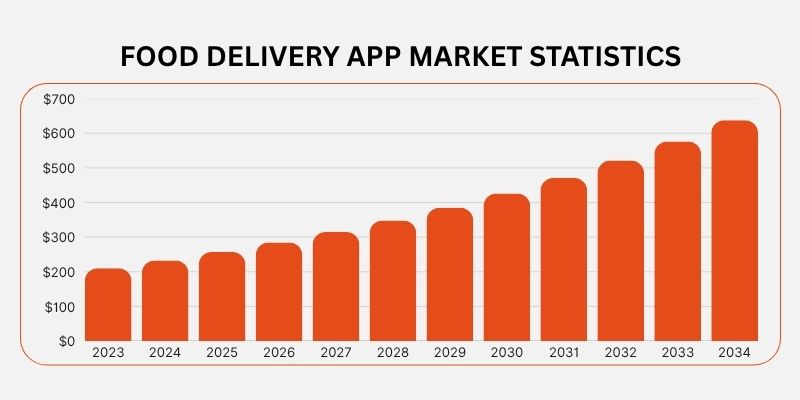
These figures demonstrate a growing sector where Food Delivery App Monetization involves not only acquiring customers but also optimizing revenue for each sale.
How Food Delivery Apps Make Money?
1. Commission-Based Revenue Model
The most basic part of the food delivery app revenue model is the commissions charged to the restaurants. It’s common for them to charge 15% to 30% fees depending on the service or advertising they pick. For example:
- DoorDash has a tiered structure—Basic (15%), Plus (25%), and Premier (30%) plans.
- Uber Eats has a similar arrangement, where commissions fluctuate between 15% and 30% for delivery orders and roughly 15% for pick-ups.
- Grubhub also provides greater search visibility to restaurants that increase their commission rates.
The above structure ensures that the receipt scales up with the order volume at the restaurant, which is what makes this model the backbone of revenue models of food delivery apps. However, this model has been the subject of harsh criticism for leading to the erosion of restaurant margins, which in turn causes lawsuits and the introduction of commission caps in cities like San Francisco and New York, as well as during the COVID-19 pandemic.
Even in light of these issues, the bulk of the revenue for numerous delivery platforms still comes from commissions. When examining how food delivery apps make money, it is quite evident that tweaking pricing levels and bundling them with value-adds (like measurement tools and promotional boosts) makes these platforms more indispensable to restaurant partners.
2. Delivery Fees: The Most Visible Revenue Stream
Delivery fees can be defined as the most evident direct cost on the part of the consumer. These charges are often variable with the following factors affecting them:
- The distance separating the restaurant and the customer
- Driver availability
- Local demand conditions and order timing
The service charge is not the only thing customers usually pay; sometimes, customers have to cough up additional fees that are set to cover platform operational costs. Consider a typical order that contains:
- $4.99 delivery fee
- 10% service fee
- $2.00 small order fee (if order is below a certain threshold)
The customer-facing fees not only support the platform’s bottom line but also play a small role in offsetting the cost of courier services. This is a crucial factor in how food delivery apps make money. Nevertheless, increased fees have been a primary trigger of customer discontent. In 2024, some reports caught the public’s attention, revealing that fees on certain orders exceeded 30% of the meal price, thereby reigniting debates on the issue of pricing transparency.
To address the issue of fee fatigue and maintain customer loyalty, apps are introducing subscription models as an alternative—a strategy we will explore in the fifth point.
3. Restaurant Listing Fees and Premium Placement
With food delivery apps creating a larger ecosystem, Platform visibility has become a very important asset. Thus, it has created a new revenue stream: listing fees and sponsored placements.
Key monetization tactics include:
- Sponsored listings: Restaurants pay more money to appear at the top of search results.
- Marketing fees: One-time or recurring payments for home screen promotions or ads.
- Onboarding fees: Some platforms have recently charged open setup or integration fees, particularly in niche markets.
These fees, in turn, enable restaurants to consider marketing investments that acquire new customers and boost sales. At the same time, they represent high-margin, non-transactional revenue for the platforms. For example, Grubhub has allowed restaurants to “bid” for higher commissions by offering better visibility—a practice that has maximized the use of the platform’s inventory.
By these revenue streams, Apps are digitally turned into advertising platforms. Food Delivery App Monetization is thus expanded not only to transactions but also to digital advertisement.
4. Surge Pricing and Dynamic Delivery Fees
Following the ride-hailing trend, surge pricing has emerged. It helps both with logistics optimization and revenue enhancement.
With surge pricing, you have the following:
- Additional fees are put during the peak consumption and driver shortage periods.
- These fees, which are generally $2 – $5 per order, not only draw in more couriers but also capture extra value from the immediate users.
- Algorithms calculate real-time supply-demand mismatches which result in these price changes.
For example, on a Friday night during a dinner rush or during a rainstorm, the delivery prices may be automatically changed. The customer then gets a pop-up message that says, “Extra fee due to high demand in your area.”
This approach aids unit economics during high-fulfillment cost windows. But if used too often, it can lead to consumer churn if not handled carefully.
5. Subscription Models
Subscriptions are a way for companies to continuously earn money without having customers to make new purchases every time. The subscriptions however are like the ticket to loyalty. They are seen on the platforms as:
- DashPass (DoorDash) – $9.99/month
- Uber One (Uber Eats) – $9.99/month
- Grubhub+ – $9.99/month, or Free for Amazon Prime users
The subscriptions for the platform enhance Customer Lifetime Value (CLTV) by increasing the frequency of orders. Even when delivery fees are waived, platforms still receive commissions on those orders, meaning that volume, not per-order margin, is the primary source of profit.
6. Advertising and Sponsored Listings on Food Apps
Food companies often sell sponsorships on their app pages. A funnel through ad-sales sponsorship is ideally suited for food delivery apps that have accumulated numerous ad requests. This way highlights how food delivery apps make money beyond transactions. It results in generating a higher volume of non-transactional revenue sources, such as marketing fees and sponsored listings.
Forms of advertising include:
- Sponsored listings: Paid placements in search results.
- In-app banner ads: Promotions for snacks or credit card offers.
- Brand partnerships: Co-branded deals with national or regional advertisers.
The cash is flowing from this channel because it is the line that has become a high-margin revenue stream. Some examples:
- Uber Eats and rides surpassed a $1 billion run rate for ads in 2024.
- DoorDash’s ad revenue grew YoY to more than $100 million.
Ads are contextual and actionable because they appear at the exact moment the user is ordering. The apps thus utilize first-party data for advertising purposes, allowing them to be effective and generate more revenue.
For any Food Delivery App Development Company, the ad-tech infrastructure should be built to meet future demand, from auction-based sponsored ads to AI-driven personalization.
7. Revenue from Cloud Kitchens and Virtual Restaurants
Cloud kitchens also offer another way how food delivery apps make money. Operating these kitchens can either be done either by partnering with platforms or these kitchens can be run by the platforms themselves, which:
- Lower the burden on restaurants’ kitchen costs, leading to food truck scaling or the initiation of virtual brands.
- Help fill the market gap and increase sales volume and customer base.
- Implement new revenue-sharing schemes for the delivery apps.
For Example:
- DoorDash delivers food with their kitchen spaces designed specifically to share with other brands. DoorDash takes a cut on the sales rather than collecting rent.
Cloud kitchens are a practical application of the vertically integrated mode in the food delivery app business model, with platforms being involved in both fulfillment and product generation. They have high operating complexity, but on the other hand, they can generate more revenue and be more scalable compared to the usual third-party delivery.
8. B2B Partnerships and White-Label Solutions
A newly emerging trend in the revenue models of food delivery apps involves monetizing infrastructure through B2B partnerships and white-label delivery services. These approaches are independent of the end consumer and hold the potential to harness other ecosystems.
Ways of implementation are:
- White-label delivery: Restaurants or retailers utilize the platform’s driver network but do not use its app. Uber’s “Uber Direct” and DoorDash’s “Drive” services offer this.
- Corporate accounts: Services like Uber Eats for Business or DoorDash for Work offer group ordering, stipends, or scheduled deliveries for enterprises.
The primary income here is derived from:
- Fees are charged per delivery to the business.
- Monthly fixed or usage-based types of agreements for the integrated technical solutions.
- Partnership deals (e.g., Grubhub’s collaboration with Amazon Prime) where the third party pays to subsidize subscriptions or promotions.
9. In-App Promotions and Discounts Funded by Restaurants
Promotions serve as an essential mechanism for driving order volume, and they also stand as a strategic weapon for monetization, especially when funded by third parties. The restaurants reach an agreement with the platform, mainly in the following ways:
- Sponsor discounts (e.g.,“$5 off on orders over $25”).
- Pay for free delivery promos.
- Flash sales are hosted on the app, with the restaurant covering the costs.
These services are charged a fee or higher commission; in return, the Company runs these campaigns.
10. Data Monetization and Market Insights for Food Brands
The subtle yet perhaps most powerful approach is the use of aggregated and anonymized data to provide value-added services in Food Delivery App Monetization. Examples are:
- Trend reports for restaurant partners show which cuisine was the most popular in the region.
- Kitchen planning heatmaps that help brands identify areas with limited service.
- Consumer insight dashboards are sold to CPG companies, optimizing their promotional campaigns.
If you are exploring how food delivery apps make money, data monetization has consistently been a high-margin source.
11. Third-Party Logistics and Delivery-as-a-Service (DaaS)
The hospitality delivery-as-a-service (DaaS) is a reflection of the evolution of computer networks as logistics solution providers rather than just facilitators of food orders.
Examples include:
- DoorDash Drive and Uber Direct offer per-order delivery fulfillment to external businesses.
- Retail partnerships with pharmacies, flower shops, or convenience stores.
- E-commerce integrations where the app handles delivery for non-food orders.
Generally, the monetization mechanism would be a flat rate per delivery, which is contractually negotiated. For instance, a supermarket could use DoorDash Drive in order to deliver the orders taken on its own app by charging a fixed $6-8 per trip.
This helps in:
- Increasing the driver utilization without incurring extra costs for customer acquisition.
- Providing a diversified revenue stream beyond food.
- Amortizing the debt on tech and logistics over more transactions.
12. Cross-Selling Grocery and Convenience Items
The last part of how food delivery apps make money is the vertical growth area, especially with the introduction of grocery, alcohol, and convenience deliveries. It is already more than a strap-on addition and is rapidly becoming a core revenue driver.
Key moves:
- Uber’s acquisition of Cornershop, a provider of grocery delivery, is a significant game-changer for the company.
- DoorDash’s DashMart stores offer a variety of packaged food, pet supplies, and household essentials.
- Collaboration with major retailers, including Walgreens, CVS, and 7-Eleven.
Tips to Choose the Right Monetization Strategy for Your Food Delivery App
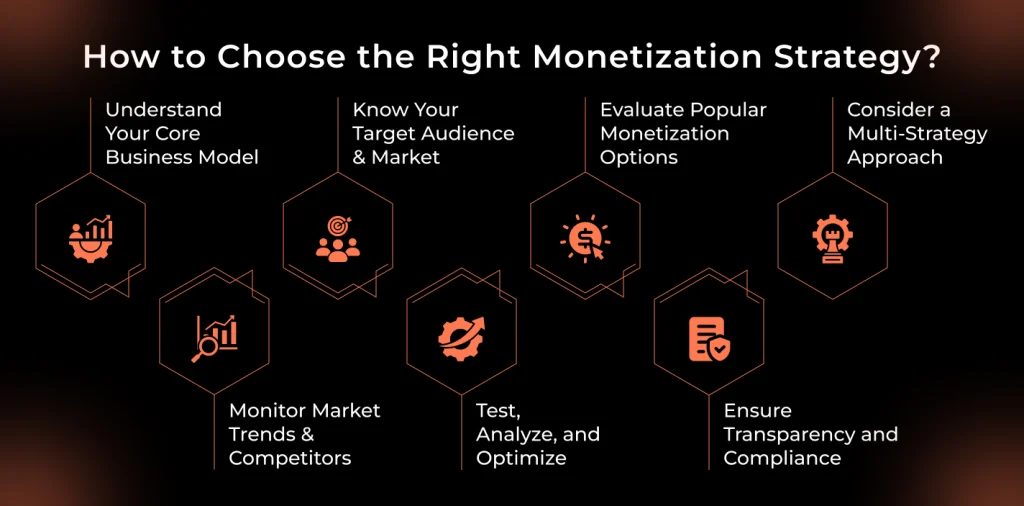
1. Understand Your Core Business Model
Initially, you need to verify if you are running as a full-stack delivery provider (like Uber Eats), a marketplace aggregator, or a hybrid model. Each of these models needs a different type of monetization strategy mix. Full-stack platforms are heavily dependent on delivery and service fees, whereas aggregators tend to prefer commissions and sponsored listings more.
2. Know Your Target Audience & Market
User expectations, willingness to pay, and restaurant economics vary by geography and demographics. In price-conscious areas, service fees or surge pricing should be used only when necessary. On the contrary, big cities with affluent residents who have a premium subscription and virtual brand models should consider adopting this. Conducting research is crucial for tailoring your Food Delivery App Monetization strategy to align with the audience’s behaviors.
3. Evaluate Popular Monetization Options
Utilize common modes, such as commissions, delivery fees, and subscription lists, as well as sponsored ads, as leverage. The idea is to avoid betting solely on a single one of them. In understanding how food delivery apps make money, it is clear that a diversified approach is the key.
For instance, if pushback from restaurants increases, it may result in a decrease in your effective take rate; advertising and B2B services can help mitigate that.
4. Consider a Multi-Strategy Approach (Hybrid Monetization)
Companies with the best performance rely on multiple income sources. Uber Eats and DoorDash, for example, earn from the use of six or more concurrent monetization levers. Such a mixed model strengthens the company and enhances how food delivery apps make money across different market conditions.
5. Monitor Market Trends & Competitors
From fee regulation to AI-powered delivery optimization, market trends come and go. Regular news is the key. If a rival launches a new loyalty program or advertising feature that attracts more customers, consider adapting. Your food delivery app features should evolve continuously.
6. Test, Analyze, and Optimize
Pick an A/B testing tool that uses data to assess things like fee policy, ad placements, or newly added subscription perks. The behavior of your customers will tell you which strategies succeed and which ones hinder development.
7. Ensure Transparency and Compliance
Monetization should have clarity in balance. Consumers should be aware of the details about what they are being charged for, while restaurants benefit from the investment made.
A transparent price helps not only in maintaining customer trust but also in avoiding obvious legal entanglements in heavily regulated markets.
Challenges in Food Delivery App Revenue Generation
- High Variable Costs: Transportation payments, customer service, insurance, and refunds put much pressure on your profits.
- Thin Profit Margins: Even DoorDash, a leader in the industry, reported only ~1% net income on billions in revenue in 2024.
- Restaurant Pushback: The commission fees of 20 to 30% are unattractive to many small businesses.
- User Fatigue on Fees: Increased delivery and service fees have driven consumers away and led to backlash, especially when the amount at checkout was different from the menu price.
- Regulatory Constraints: Cities such as San Francisco and New York have halted platforms by imposing caps on commission fees, thereby prompting the platforms to seek alternative revenue streams.
- Platform Saturation: The stagnation kept the users from accessing the product in mature markets. Increasing revenue requires ARPU (Average Revenue Per User) to grow, rather than relying on volume alone.
Addressing these challenges gives the need for strategic diversification. Companies that are venturing into on demand app development services can greatly benefit from including the flexibility to pivot revenue streams.
How A3Logics Can Help You Monetize Your App Effectively?
At A3Logics, we fulfill our primary mission of helping both startups and enterprises design, develop, and scale delivery platforms with monetization strategies. Here is how we can help:
- Custom-Built Monetization Architecture: Whether you are adding subscription tiers, advertising modules, or dynamic pricing engines, our team develops scalable backend logic with full financial audit trails.
- End-to-End Development: As a full-stack mobile app development company, we build driver apps, customer portals, merchant dashboards, and admin panels—all optimized for revenue operations.
- AI & Analytics Integration: We implement real-time data analytics and machine learning algorithms to recommend upsells, adjust delivery pricing dynamically, or even suggest virtual brand creation based on ordering patterns.
- White-Label & B2B Capabilities: Planning to offer Delivery-as-a-Service or integrate with restaurant POS systems? We develop flexible APIs and DaaS logic to empower B2B monetization.
- UX-Focused Fee Presentation: Our design team ensures fee structures are displayed transparently, maintaining user trust while optimizing revenue per session.
With over 21 years of experience across food tech, logistics, and retail delivery ecosystems, A3Logics is your partner in building and scaling a revenue-optimized platform. If you’re ready to launch or improve your solution, partner with a Food Delivery App Development Company that understands both the technology and the business.
Conclusion
Today, when people ask how food delivery apps make money, the answer is no longer just “commissions.” The school rules of top-tier platforms are that they create diverse income through a hybrid ecosystem these days: commissions, consumer fees, ads, subscriptions, third-party logistics, data products, and cross-category delivery.
Understanding the revenue models of food delivery apps requires technical and strategic knowledge.
If you are a business owner, product lead, or investor analyzing a delivery platform opportunity, the important truth to remember is that profitability is not accidental but rather it is engineered. Therefore, build your reputation on a sustainable, multi-channel revenue base.
And if you need a strategic partner to Build Your Own Food Delivery App, A3Logics offers the development capabilities, domain knowledge, and execution strength to bring it to life.