Businesses across various industrial domains deploy valuable resources to avoid legal issues and meet compliance requirements. In the absence of automated compliance checks, this can be tedious, painstaking, and prone to errors. Robotic Process Automation for compliance enables easy adherence to laws and policies related to customer and employee privacy, data security, and integrity. In this blog, we’ll discuss how RPA eases compliance checks in operations.
Did you know –
92% of businesses have improved compliance with RPA. In industries like manufacturing, RPA can be used to automate tasks like quality assurance, improve order fulfillment, and ensure adherence to regulations. In this blog – We’ll discuss how automating compliance checks with RPA can reduce human errors in routine tasks and meet industry standards and government regulations.
Understanding the Need for Compliance Automation

The complexity of automating compliance checks with RPA; and its involvement in various business operations can make it a challenge. RPA can make compliance accurate and efficient by integrating smoothly with various systems and software. All it takes is process discovery and selection, and businesses can automate compliance to save resources. However, it is not as easy as it may sound. While we are not negating its enormous benefits, it does come with its share of challenges.
Challenges in Manual Compliance Processes
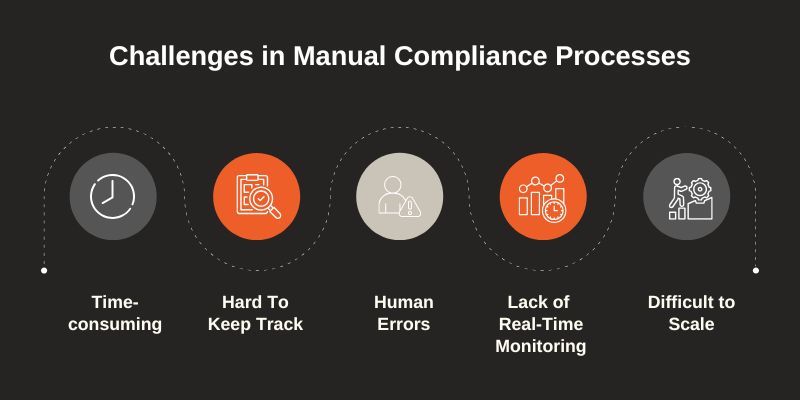
- Time-consuming and Slow
Manual checking of compliance is time-consuming since people have to review logs, bot activities, reports, and data one by one. This ultimately defeats the purpose of automation.
- Hard To Keep Track of all Activities
Considering that RPA bots run 24/7, it’s difficult for human teams to keep track of all activities. In the absence of automation, important things may go unnoticed.
- Human Errors
People can make mistakes. For instance, they might misread a log, skip a step, or even forget to document something. A single compliance error can lead to more severe penalties, including legal issues or fines.
- Lack of Real-Time Monitoring
Manual checks occur after an issue arises. The reactive approach implies that companies fix issues after the damage is already done.
- Difficult to Scale
As companies scale and add more bots to their process, the compliance work increases. Manually managing compliance-related tasks can be overwhelming and place a significant burden on the workforce.
Impact of Regulatory Changes on Enterprises
Adherence to regulatory changes can impact businesses. They must ensure regulatory adherence to new rules, or they might face penalties in the form of revenue losses, fines, or even legal actions. So, how does regulatory changes impact operations?Let’s have a look at some more challenges in the regulatory adherence process.
Let’s have a look at some more challenges in the regulatory adherence process.
- Disruptions in Operations.
Regulatory adherence can disrupt existing processes – requiring significant adjustments to both systems and workflows.
- Damage Reputation Due to Failure
Failure to comply with regulations can lead to – legal challenges, fines and ultimately, cause damage to an organization’s reputation.
- Increasing Costs
Regulatory adherence can also ask for investment in – infrastructure, technology, and personal training.
- Administrative and Legal Hurdles
Navigating complex compliance requirements and regulations can be resource-intensive and time-consuming.
What is RPA and how does it support compliance?
Overview of Robotic Process Automation
Before discussing how automating compliance checks with RPA can be useful; how RPA can streamline compliance automation and contribute to digital transformation, let’s understand what RPA is. It is a software technology that uses – robots. These bots mimic human actions especially while working with digital systems. It uses AI agents in order to manage – unstructured data, emails, documents, and images. RPA helps bots make smarter decisions by recognizing patterns, and adapting to changes.
Regulatory and Compliance Workflows
RPA is increasingly being used in regulatory and compliance workflows – to automate repetitive, rule-based tasks, and automating compliance checks with RPA is becoming increasingly popular. Here’s how it makes workflows more effective –
- Reduction in errors
By automating procedures – RPA reduces errors and guarantees uniformity in compliance activities.
- Create an audit trail.
RPA systems use audit automation to create detailed logs of every step in a process. These logs help during future audits and act as proof that the company followed compliance rules. This makes it easier to track what happened and when, across different procedures.
- Real-time monitoring and compliance alerts.
RPA can check compliance procedures continuously. This can help organizations identify potential deviations, allowing for proactive intervention.
- Scalability and Efficiency
RPA promotes digital transformation by – adapting to shifting regulatory environments. It processes vast amounts of data and allows enterprises to scale their compliance efforts.

Key Benefits of Automating Compliance Checks with RPA
Here are the key benefits of automating compliance checks with RPA –
1. Enhanced Accuracy
RPA reduces mistakes in compliance tasks. Bots perform tasks like data validation, calculation, and report creation. This way operations are likely to be carried out without braking rules.
2. Improved Efficiency and Speed
By using robotic process automation in compliance, repetitive and rule-based tasks can be automated. RPA helps free up human resources for more important tasks that require strategy. It also helps reduce response times for compliance processes.
3. Cost Savings and Scalability
Automating compliance checks with RPA results in cost savings and scalability by improving accuracy, reducing labor costs, and leading to faster and efficient processes. As a result, businesses can effectively manage the increasing compliance requirements and reduce expenses.
RPA Use Cases in Compliance Across Industries
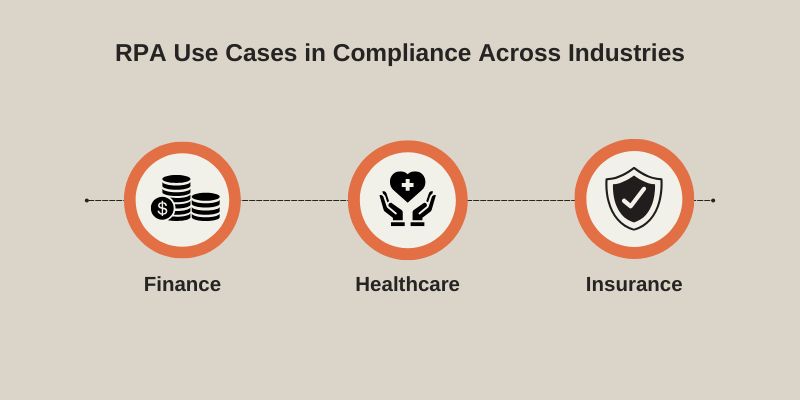
The benefits of automating compliance checks with RPA can be seen across various industrial domains such as –
1. Financial Services and Banking
Errors in financial services can be abysmal, and here’s how RPA in finance can be a great help: RPA helps maintain adherence to compliance protocols. It thereby reduces the risk associated with non-compliance. It also helps maintain data security by conducting fraud detection. To do that, it automates the analysis of transaction patterns and identifies anomalies.
2. Healthcare
Robotic process automation can help automate processes such as data entry, updating, and migration, while ensuring full compliance with HIPAA regulations for electronic protected health information, also known as ePHI. Through automated compliance checks, RPA can automate access control and tracking. This ensures that only authorized personnel can access sensitive patient data. With robotic process automation in compliance, data handling can be automated while reducing the risk of human errors.
3. Insurance
Regulatory compliance tools can be used in insurance to verify customer data, generate compliance reports, and keep user data protected. It can automatically update processes and monitor regulatory changes. By automating compliance, RPA can reduce the risk of penalties.
Best Practices for Implementing RPA in Compliance
1. Define Clear Compliance Objectives
Defining clear compliance objectives means setting exact goals that RPA bots must acheive to meet regulatory requirements. It further makes sure that bots stick to the correct steps, rules, and ways of handling data. When these goals are clear, designing accurate and effective RPA workflows becomes much easier.
2. Choose the Right Processes to Automate
Identify repetitive compliance-related tasks that are prone to errors. Analyze current processes and identify areas for improvement. Finally, prioritize processes based on potential for improvement, however prioritize tasks in which compliance is crucial.
3. Ensure Auditability and Transparency
An RPA bot audit is a comprehensive review of the RPA environment to ensure that bots are functioning effectively and comply with relevant regulations. In industries like healthcare and finance, it is important to maintain transparency in automated processes since these have regulatory bodies that demand records of all decisions and transactions.
In industries like healthcare and finance, it is important to maintain transparency in automated processes since these have regulatory bodies that demand records of all decisions and transactions.

Future of Compliance Automation with Intelligent RPA
1. Integration with AI and Machine Learning
One of the advantages of integrating AI in automating compliance checks with RPA is the ability to deliver real-time insights. For example, instead of waiting for quarterly reports, organizations can access up-to-date dashboards that show their control effectiveness, current risk ability, and regulatory stance. Integrating machine learning in regulatory compliance tools can help bots detect anomalies and learn from patterns. ML adds adaptability to compliance tasks.
2. Proactive Regulatory Monitoring

In several ways, proactive regulatory monitoring with intelligent RPA or iRPA is emerging as a key aspect of future compliance automation. For example, consider the example of RPA in finance and banking; RPA can automate repetitive and manual tasks in compliance management, such as data entry, compliance reporting, and risk assessment. Automated compliance tools can monitor regulatory changes and updates, making sure that compliance procedures and processes are always up to date with the latest requirements. They extract relevant information, track changes, and trigger necessary actions when needed.
How to Choose the Right RPA Development Company
Choosing the right robotic process automation development company is very important, especially for following rules and regulations. The right company will ensure your automation is safe, keeps your data protected, and avoids legal trouble. They will also build solutions that match your business needs and are ready for audits.
Here are some important points to keep in mind :
1. Evaluate Domain Expertise
When selecting a RPA service provider, choose one that has experience in your domain. For instance, if your company specializes in risk management, your chosen service provider should be proficient in deploying RPA for risk management. You can ascertain this by checking their track record, the number of years they have been in your chosen market, and whether they have experience in your domain. Also, check the RPA regulatory compliance tools they specialize in.
2. Look for Customization and Scalability
A one-size-fits-all solution may not fit your processes; you need an company that can accommodate your project’s evolving requirements and growth, tailoring RPA bots to your domain-specific tasks and scaling them as your business grows. This involves adding more bots as your business volume increases; handling increased data volumes, and integrating with new software.
3. Check for Post-Deployment Support and Compliance Knowledge
Throughout your automation journey (or even after deploying bots), the company providing robotic process automation development should give you access to comprehensive technical support, customer success managers, and knowledge base. You can also verify if your chosen company holds certifications related to international standards, such as SOC 2, ISO 27001, and GDPR compliance, ensuring data protection.
Why Choose A3Logics?
If you wish to automate and scale your operations while ensuring adherence to regulatory norms, you need the help of a seasoned AI development company. A3Logics is one of the best companies that offers RPA solutions that can help you reduce employee workload, comply with regulations, and focus more on strategic, analytical, and creative work.
A3Logics is one of the best companies that offers solutions that can help you comply with regulations. Here are some reasons to choose A3Logics for automated compliance checks –
Proven Expertise in RPA Solutions
We’re experts in RPA platforms like UiPath, Power Automate, and Blue Prism. To ensure successful automation, we can help you choose the one that best fits your business needs.
Industry-Specific Compliance Knowledge
At A3Logics, we establish frameworks that ensure compliance with industry regulations and standards across regulatory-intensive industries such as including healthcare, banking, finance, and others. Our control measures and policies help businesses maintain audit readiness and mitigate risks, ensuring the smooth and secure operation of automated systems. We make sure that all our custom RPA solutions meet global standards. These include standards like HIPAA, GDPR, and ISO 27001.
End-to-End Development and Support
We build bots that work smoothly with the systems you already use. Our bots include features like smart analytics and automated tasks. We also give consistant support, with our team checking and updating the bots regularly to keep your automation running better over time.
Conclusion
To conclude automating compliance checks with RPA saves time, reduces manual errors and saves resources. It ensures consistent and trackable processes that meet regulatory standards; reducing errors, interruptions, and task complexity.
RPA for audit automation helps create audit trails; supports real-time monitoring, and helps businesses adapt to regulatory changes. With automated compliance tools – Companies can avoid costly penalties, improve operational efficiency and reduce the risk of non compliance.