
Blog Summary
Introduction
Businesses make use software bots that copy human behavior to automate repetitive tasks via RPA software development. Data entry, record updating, report generation, and transaction processing are some of the common tasks that these bots can pull of. The core benefit for which businesses across the globe opt for its implementation are an increase in speed and overall accuracy.

A lower rate of errors and reduced operating costs are some bonus advantages that generally tag along. Employees can concentrate on more strategic work that calls for human judgment by eliminating the manual labor involved in daily tasks.
For those who feel too intimidated or confused by the idea of RPA, this guide is literally all they’d ever need. It seeks to make learning easier and give a concise rundown of robotic process automation software development (what more could one ask for?). The main elements that make up RPA software, the processes that are required for creating it, the budget that you’ll need to set aside, and the problems that may arise – you’ll find it all covered. What’s more? We’ve also mentioned several bonus suggestions and best practices that will add a cherry to the cake.
Market Trend of RPA Software Development
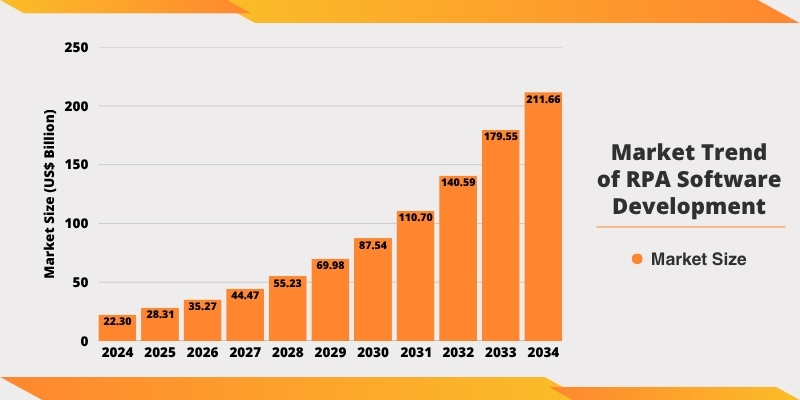
When speaking about RPA, discussing the latest market trends that tag along is as important as discussing its benefits. It helps you form a clear perspective about its current role in the technological landscape. That being said, let’s check out what’s hot in the market about RPA software development solutions:
1. Growing Demand Worldwide
The demand is such that, while you read about it, there may be hundreds or thousands of businesses who’d be signing up a contract with a technology partner. That means this is just the beginning, and we may see a time when this number turns into millions.
2. Market Size and Expansion
By 2030, the global RPA market is expected to grow to a value of over $20 billion, according to Gartner and various other reliable market analysts. Want to know who’s been the driver all along? The answer is small and large businesses and organisations worldwide.
3. Industry-Wide Adoption
Manufacturing, Retail, Logistics, and Healthcare are just a few domains to begin with (the list just won’t end). From handling basis repetitive process to managing high-volume data, RPA has been doing it all.
4. Transition to Hyperautomation
In order to achieve hyperautomation, or more intelligent automation, businesses are combining RPA tools with analytics, AI, and machine learning.
5. Cloud Acceleration and Remote Work
RPA adoption is being further accelerated by the growth of remote work and cloud-based solutions, as companies seek low-touch, scalable solutions that are manageable from any location.
6. Popularity of Low-Code/No-Code
Low-code and no-code platforms are being adopted by more businesses, which speeds up deployment and makes RPA development accessible to non-technical users.
Key Features of RPA Software
Features that provide both flexibility and scalability to satisfy various business needs are crucial when creating RPA software. Ease of use, robust integration capabilities, security, and informative reporting are some of the most important components of successful robotic process automation software development. The following are the main characteristics of reliable RPA software:
1. Low-code/No-code Interface
Its user-friendly interface enables users to create automation workflows without knowing how to write complicated code is one of the most crucial features. Both developers and business users can quickly design processes with drag-and-drop tools. This feature expedites development, lessens the need for IT teams, and opens up automation to a wider group of workers.
2. Connecting Legacy Systems
Many businesses still use old software and systems that are difficult to replace. These legacy systems must seamlessly integrate with good RPA software. It can accomplish this by using techniques like direct database access, API calls, and screen scraping, which simulate user interaction on the screen. This guarantees that all business applications, even those that weren’t intended for robotic process automation software development, can be automated.
3. Orchestration and Scalability
Multiple bots operating at once should be manageable with RPA software. Users must be able to schedule tasks, assign priorities, manage workflows, and control how bots communicate with business systems and one another. This coordination guarantees that automation can effectively manage growing workloads and expand with the company.
4. Features related to security and compliance
When bots access sensitive data or systems, security is crucial. Role-based access control is one feature that limits who can alter or manage automation workflows. Data sent between bots and systems is protected by encryption, and traceability is ensured by thorough audit logs. These features assist businesses in adhering to data protection laws like HIPAA and GDPR while leveraging RPA software development solutions.
5. Analytics and Reporting in Real Time
Real-time visibility into bot activity, error rates, and performance metrics is provided by integrated dashboards. Teams can track the health of automation and pinpoint areas for development with the aid of these insights. Analytics eventually aid in process optimisation and ROI maximisation.
The RPA Software Development Process
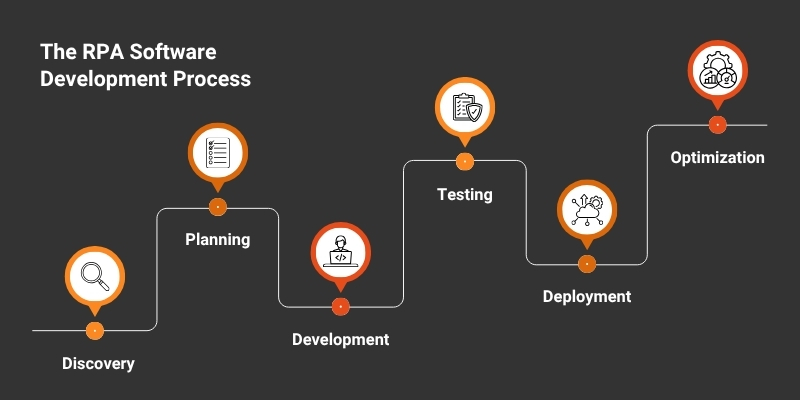
To ensure that the automation provides genuine business value, creating RPA software requires a methodical, structured process. Businesses can successfully deploy bots and steer clear of common pitfalls by following these crucial steps.
1. Finding the Process and Evaluating Feasibility
Finding tasks that are good candidates for RPA software development solutions is the first step. Repetitive, rule-based, and labour-intensive tasks are considered ideal. Estimating the return on investment (ROI) and assessing the difficulty of automating these tasks are also crucial. Prioritising which processes to automate first is made easier by this assessment.
2. Planning and Designing Workflows
Following process selection, teams outline the precise steps the bot will take. A common tool for visualising the workflow is a flowchart or diagram. This step also entails specifying how the bot will input, process, and output data as well as accounting for potential exceptions or errors.
3. Development of Bots
Robotic process automation software development tools or custom scripts are then used to build the bots. Every stage of the procedure, including reading emails, extracting data from documents, and updating different systems, has logic written by developers.
4. Validation and Testing
Bots are tested in various scenarios after they are developed to ensure that they function properly and are free of errors and inaccurate data. To make sure the automation lives up to expectations, business users verify the outcomes.
5. Implementation
Bots are introduced into the live production environment following successful testing. They are scheduled to complete tasks at the right times and are configured to operate securely.
6. Upkeep and Ongoing Enhancement
Continuous monitoring is necessary for RPA software development solutions to track bot performance. Workflows are updated when business processes change, bugs and issues are promptly fixed, and bot actions are optimised for efficiency and speed.
RPA Software Development Cost Breakdown
Planning an RPA project requires an understanding of the cost factors. Here is a thorough explanation:
1. Licenses (Bot/User/Server-Based Models)
The majority of RPA tools make use of licensing models. The quantity of bots, users, or servers affects the price. Depending on the tool and usage, annual costs can vary from $5,000 to $50,000.
2. Costs of Custom Development
Developers, analysts, and testers are required if you’re creating bots or whole RPA software development systems from the ground up. Development expenses can range from $10,000 to $100,000 or more, depending on the size of the project.
3. On-premises vs. Cloud Infrastructure
Cloud-based RPA may be less expensive up front and is simpler to scale. Servers, IT personnel, and additional setup are required for on-premises solutions, which can be expensive.
4. Costs of Training and Support
To control and run bots, teams need to be trained. Additionally, you might require continuous assistance from platform providers or consultants.
5. Anticipated ROI Schedules
Within six to twelve months, the majority of businesses begin to see a return on investment. Bots reduce errors and save time, which speeds up investment recovery.
Top RPA Tools & Platforms
There are numerous tools for RPA software development solutions on the market, each with special advantages. The infrastructure, objectives, and needs of your company will determine which one is best for you.
One of the most widely used platforms is UiPath, which is renowned for its robust community support and easy-to-use interface. Both technical and non-technical users can benefit from its extensive automation features.
Automation Anywhere offers enterprise-grade scalability and cloud-native features. For big businesses wishing to safely automate intricate processes, it’s perfect.
For companies that already use Office 365, SharePoint, and Azure, Microsoft Power Automate is a good choice because it integrates well with the Microsoft ecosystem.
Businesses that require strong security, governance, and scalability prefer Blue Prism. It works best in large-scale, regulated settings like insurance or banking. These platforms are appropriate for various use cases of robotic process automation software development and industries because they provide a variety of features, such as analytics, low-code development, and integration capabilities.
Also Read: UIPath vs. Blue Prism

Common Challenges and How to Overcome Them
Despite the obvious advantages of RPA, there may be a number of implementation-related issues. Adoption will go more smoothly if these problems are recognized and addressed early by RPA software developers.
1. Choosing Inappropriate Procedures
Failures may result from automating the incorrect tasks, such as those that call for judgement or frequent modifications. For better results, concentrate on procedures that are clear, governed by rules, and repeated.
2. Integration Challenges
Automation may encounter challenges due to legacy systems and data silos. To cut down on friction, select RPA tools with robust integration features and include IT teams early on.
3. Managing Change and User Resistance
Workers may fear that RPA software development solutions will endanger their employment. Involving employees early on, outlining how RPA will support them rather than replace them, and offering training are all crucial for seamless transitions.
4. Absence of Internal Automation Knowledge
RPA projects could stall in the absence of qualified staff. To bring in the required expertise and support, establish an internal Centre of Excellence (CoE) or collaborate with seasoned RPA partners.
Businesses can make sure that their RPA initiatives provide steady and long-lasting value by proactively managing these obstacles.
Best Practices for RPA Implementation
Successful robotic process automation software development implementation necessitates a methodical and deliberate approach. Businesses can maximize the benefits of automation and steer clear of common pitfalls by adhering to best practices.
1. Begin Small, Grow Quickly
To test your RPA efforts, start with a low-risk, high-impact procedure. Verify the outcomes, then, using the knowledge gathered, extend automation throughout departments.
2. Describe success metrics and KPIs
Prior to implementation, clearly define performance indicators. To precisely gauge the impact of RPA software development, monitor productivity, cost effectiveness, error reduction, and time savings.
3. Keep Robust Records
Workflows, decision rules, and exception handling are all steps in the automation process that should be documented. Proper documentation aids in compliance and makes updates easier in the future.
4. Continued Training and Assistance
Continuously train your teams to handle automated processes and work with RPA tools. Provide technical assistance as well to guarantee seamless operation and prompt problem solving.
5. Establish a Model of Governance
Establish roles, duties, and guidelines for controlling robotic process automation software development workflows and bots. This guarantees accountability, consistency, and alignment with corporate objectives.
Businesses can lower operational risks, achieve stable and scalable automation, and reap the long-term benefits of their RPA investments by adhering to these guidelines.
How RPA Supports Business Process Optimization
Since it increases process accuracy, lowers costs, and improves efficiency, robotic process automation is essential to business process optimization. It helps RPA software developers find manual, repetitive tasks and automate them, which improves resource efficiency and streamlines workflows.
1. Simplifying Procedures and Cutting Down on Errors
Errors and delays are common in manual processes, particularly when handling big data sets. RPA bots greatly lower the likelihood of human error by operating continuously and without fatigue. This guarantees adherence to both internal and external policies and improves data accuracy.
2. Boosting Worker Output
RPA software development solutions allows workers to concentrate on strategic and creative work by automating repetitive and time-consuming tasks. Instead of spending hours on manual data entry or reconciliation, teams can devote more time to customer service, innovation, and process improvement.
3. Enhancing Reaction Times through Real-Time Processing
RPA bots work around the clock and can complete tasks far more quickly than humans. This enables companies to finish tasks like document verification, transaction processing, and report generation in a fraction of the time. Quicker responses, faster service delivery, and higher customer satisfaction are all results of real-time processing.
4. Improving Control and Visibility
Dashboards and analytics features that offer insights into process performance are frequently included with robotic process automation software development tools. Businesses can use these insights to monitor KPIs, spot bottlenecks, and enhance workflows over time.
Organizations can increase their agility, responsiveness, and competitiveness by automating and optimizing key business processes. RPA helps businesses adapt their operations without completely redesigning their current systems, laying the groundwork for digital transformation.
RPA vs Traditional Automation: What’s the Difference?
Despite their differences, have their own set of pros and cons. Let’s take a look at some of the most important factors that distinguish the two:
1. Rule-Based Adaptability of RPA vs. Static Scripts
Conventional automation frequently makes use of rigid, hard-coded scripts. RPA bots are more adaptable and have a higher tolerance for change.
2. Adaptability and Simplicity of Use
RPA software development doesn’t require significant system modifications. It functions well in a variety of applications and imitates user actions.
3. Adequacy for Contemporary Cloud/Hybrid Settings
RPA can operate in hybrid, on-premises, or cloud environments. It is future-ready because it readily adjusts to various configurations.

Real-Life Use Cases of RPA in Different Industries
RPA is extensively utilized in many different industries to increase productivity, lower errors, and save expenses. Here are a few actual use cases:
1. Medical care
RPA facilitates the automation of billing, claims processing, patient record management, and appointment scheduling in the healthcare industry. Bots ensure accuracy and minimize manual labor by extracting data from systems and forms. This enables medical personnel to concentrate more on patient care.
2. Finance
RPA software developers is hired by banks and other financial organizations to expedite compliance checks, loan processing, and account opening. Real-time fraud risk monitoring, report generation, and transaction reconciliation are all possible with bots. This satisfies regulatory requirements while improving turnaround time.
3. Retail
RPA is used by retailers for supply chain management, order processing, inventory control, and customer support. Bots help increase customer satisfaction and cut down on operational delays by automatically managing returns, sending shipment notifications, and updating stock levels.
4. Human Resources (HR)
Payroll processing, attendance monitoring, and employee onboarding are all made easier by RPA. It guarantees accurate data capture and maintenance across systems, which lessens HR’s workload and expedites response times.
These use cases all demonstrate how RPA improves accuracy and performance in quantifiable ways. Because of its adaptability, RPA can be used in a variety of departments and tasks, enhancing the effectiveness and efficiency of businesses in a variety of industries.
Choosing the Right RPA Partner for Your Business
To ensure that RPA works in favor of your business outcomes, it’s important to pick the right kind of partner. Ideally, these are the factors you shall consider before finalizing a technology partner for Robotic process automation consulting services:
1. Qualities to Consider in a Development Partner
Select partners who have a lot of industry knowledge and technical experience. Examine their prior work and customer testimonials.
2. Certifications, Assistance, and Experience with Customization
Seek certifications in automation tools such as Automation Anywhere or UiPath. Make sure they can customize solutions and offer post-deployment support.
3. The Significance of Development Strategy
RPA is guaranteed to be in line with business objectives through a strategic approach. A good partner minimizes risks, aids in roadmap definition, and effectively scales the solution.
Getting Started with RPA: A Step-by-Step Checklist
To guarantee success, implementing RPA requires a methodical approach. This is a detailed checklist to assist your company in starting RPA software development:
1. Examine Current Procedures
Start by identifying time-consuming, repetitive, rule-based tasks that are prone to errors. Give low-complexity, high-volume processes priority.
2. Choose the Appropriate Tool
Select an RPA platform based on your company’s infrastructure, objectives, and size. Think about support, scalability, integration potential, and ease of use.
3. Create a Pilot Project
To test the tool and confirm its business value, begin with a small, controlled implementation. Decide which process to automate and keep a careful eye on its performance.
4. Develop Teams
Inform your internal teams about RPA’s operation. Create a Centre of Excellence (CoE) or assign important individuals to oversee and direct automation projects.
5. Scale and Measurement
Utilise KPIs to monitor your pilot’s performance. After it’s successful, expand automation to additional departments and improve procedures in light of lessons learnt.
This robotic process automation software development checklist reduces risks, expedites return on investment, and establishes the groundwork for sustained automation success. Businesses can confidently incorporate RPA into their workflows if they have a clear roadmap.
Future of RPA: What’s Next?
The pace at which RPA is growing across a wide range of business is nothing short of remarkable. In the years that follow, the future for its evolution looks brighter than ever. Here is what you can expect in the times that are yet to come:
1. Intelligent Automation (IA)
Combining RPA with artificial intelligence (AI) will allow bots to handle unstructured data, make decisions, and enhance results through learning.
2. Trends in Hyperautomation
In order to automate as many processes across departments as possible, businesses are moving towards hyper automation, which combines RPA, AI, machine learning, and analytics.
3. The emergence of citizen developers
More non-technical staff are learning how to create and implement bots thanks to the proliferation of low-code and no-code platforms, which speeds up automation efforts across the entire organization.
4. Adoption of Cloud-Native RPA
Cloud-based RPA software development solutions are becoming more popular because of its scalability, flexibility, and lower infrastructure costs, which make it simpler to deploy bots across locations and manage them remotely.
5. Increased Attention to Governance and ROI
In order to better manage automation pipelines, track ROI, and maintain regulatory compliance throughout the automation lifecycle, businesses are investing in tools and frameworks.
6. Connecting to Enterprise Systems
In order to facilitate smooth process flows and data synchronisation, RPA tools will keep developing to better integrate with ERP, CRM, and other enterprise platforms.
7. Additional Use Cases in Different Industries
The use of RPA is spreading beyond back-office tasks to include marketing, IT support, customer service, and other traditionally less automated departments.
Conclusion
RPA software development is a smart solution for automating repetitive, rule-based tasks that consume valuable time and resources. It helps businesses reduce manual errors, speed up operations, and cut costs. With benefits like increased accuracy, better compliance, and 24/7 task execution, RPA is transforming how organizations operate. By understanding its core features, such as low-code platforms, real-time analytics, and secure integration, companies can make informed decisions about how and where to implement automation.
Developing an RPA software development solution involves more than just building bots—it includes careful planning, identifying the right processes, selecting tools, and ensuring strong testing and maintenance. Costs can vary depending on licensing models, infrastructure choices, and the level of customization needed.
When done right, RPA offers high returns on investment in a short span of time. Best practices such as starting small, training teams, and tracking KPIs help ensure long-term success. Over time, RPA systems can scale across departments, driving larger transformation goals.
As RPA continues to grow with AI and cloud capabilities, it is becoming a key part of digital transformation strategies. Choosing the right robotic process automation consulting company, like A3Logics, with proven experience and industry-aligned solutions, can help businesses avoid common pitfalls and achieve faster, more sustainable results.