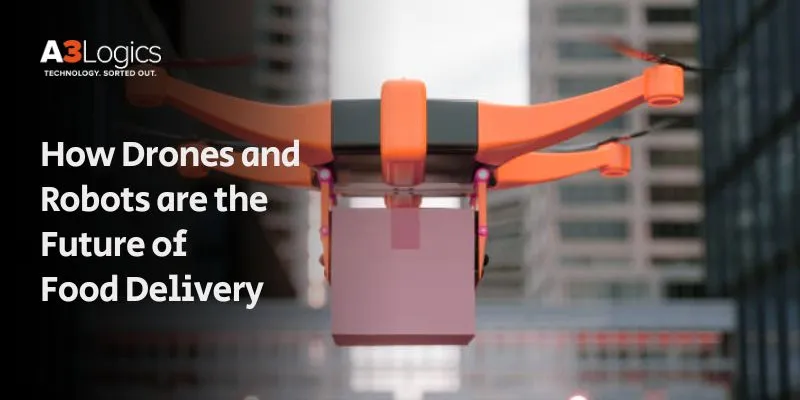
Food delivery apps have evolved from simple online ordering systems to sophisticated platforms integrating various technologies in food delivery. Robot food delivery and drone food delivery are now at the forefront of this transformation. As a future of food delivery, these advanced systems offer faster deliveries, provide contactless service, and reduce human errors, creating a premium experience for users.
While we’ll discuss drone and robot food delivery a little later in this post, let’s have a look at how food delivery apps have evolved, starting from basic phone orders to sophisticated online platforms. The evolution is worth mentioning from a business point of view, as it helps gauge how the technology is changing customer expectations and what to expect from the future of food delivery.
Introduction To The Evolution Of Food Delivery Apps
In 2024, it was estimated that nearly 2.1 billion people worldwide used food delivery apps, and around 1.5 billion used online grocery delivery services. This illustrates the significant growth and expansion of the online food delivery market.
Let’s first explore the fascinating journey of food delivery apps – how food delivery has evolved from simple phone orders to today’s advanced online apps, and more –
1. Pizza to the Royalty
In the 19th century, the first-ever pizza was delivered to King Umberto I of Italy and Queen Margherita.
2. Home Delivery
Local restaurants began food home delivery in the 1940s.
3. Rise of Automobiles
Post World War II era saw a boom in food delivery, especially in urban areas, thanks to the rise of automobiles. Pizzerias were the first to capitalize on the food delivery trend.
4. Pizza Delivered via the Internet
In 1994, Pizza Hut launched Pizzanet, allowing customers to order and get pizza delivered via the internet. This was followed by Waiter.com, launched by WorldWideLater in 1995, an online restaurant delivery service that featured more than 60 restaurants in the San Francisco Bay Area.
5. Platforms that Aggregated Menus from Restaurants
The early 2000s saw a rise in platforms like Grubhub that aggregated menus from various restaurants, making it easier for customers to browse options and place orders.
6. The Rise of Smartphones Led to an App Revolution
The late 2000s and early 2010s saw a surge in smartphone adoption and mobile app development. Subsequently, this explosion changed the way people interacted with food delivery platforms. This time period saw the advent of apps like Uber Eats, DoorDash, and Postmates that pioneered the use of mobile apps for food delivery.
Many of the features that we see in food delivery apps could be seen – browsing menus, real-time order tracking, seamless payment options, etc.
7. Impact of COVID-19
Lockdowns and social distancing measures led to a surge in food delivery services. Contactless delivery options became a standard, and there was an integration of advanced technologies such as AI-powered chatbots and drone deliveries.
8. The Future
As we have been discussing in this post, the future of food delivery depicts the increased use of drones and robots. For instance, McDonalds, Starbucks, and Walmart recently teamed with automated drone-delivery startup Flytrex to test its drone delivery system.
The company has already made successful deliveries in North Carolina. Another drone company, Wing, owned by Google’s parent company, Alphabet, has partnered with several restaurants, including Chick-fil-A.
Insights from Industry Experts about the Rising Role of AI/Robotics in Food Delivery
- According to a recent report by Market.us, the global food robotics market is projected to reach approximately $8.9 billion by 2033.
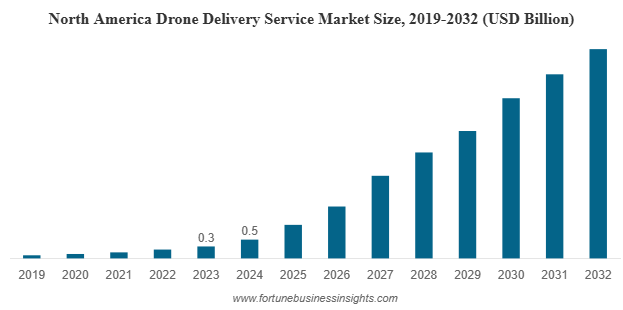
- The global drone package delivery market was valued at $314.4 million in 2023 and is projected to reach $5.76 billion by 2032.
- Gartner predicts that in 2026, more than one million drones will be carrying out retail deliveries, up from 20000 in 2020.
- Food delivery robots from companies like Starship have separate compartments for hot and cold food and can carry the equivalent of three shopping bags.
Current Trends in Food Delivery
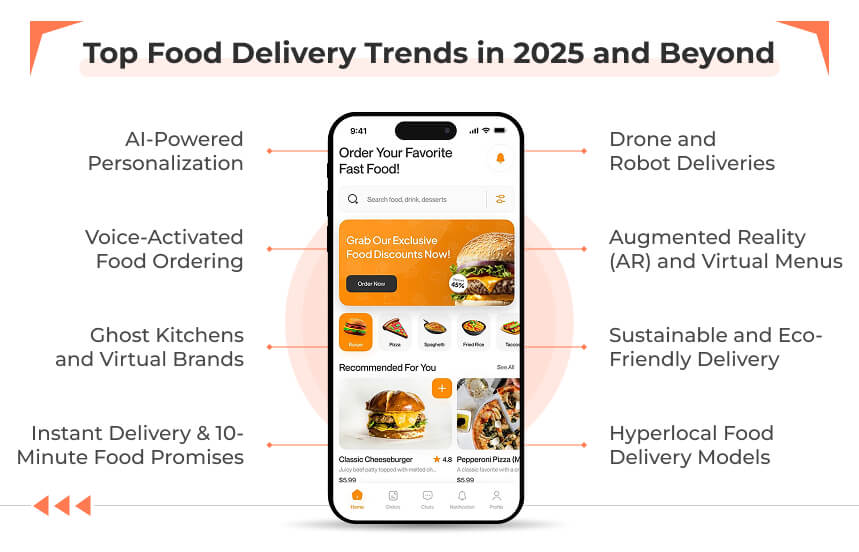
Let’s quickly have a look at some of the key food delivery trends apart from the inclusion of drones and robots –
- AI-powered personalization – Food delivery platforms utilize AI and ML algorithms to analyze historical order data, along with several other aspects.
- AR and Virtual Menus – Using AR technology, customers can use their cameras to view their dishes right in their environment.
- Ghost kitchen and virtual brands – Both are delivery-only concepts. Where a ghost kitchen doesn’t exist in brick and mortar form, a virtual kitchen operates from an already existing restaurant. Both only deliver food to customers online.
- Hyperlocal food delivery – As an emerging trend, this model enables businesses to cater to the specific needs of a particular geographical area.
- Voice-activated food ordering – Many restaurants and online food delivery platforms have started integrating AI-powered speech recognition, allowing customers to place orders using voice commands.
We have curated a post that discusses all these trends in greater detail, along with the numbers that substantiate the advancements.
Challenges with Traditional Food Delivery Systems
Since we are discussing the promising future of drone and robot-based delivery, it would be useful to ponder the challenges with traditional food delivery systems –
1. Food Quality
Maintaining food quality standards when delivering food from one restaurant to another location is one of the biggest challenges that robot Food Delivery will overcome.
2. Managing Customer Expectations
For companies, meeting customer expectations for food delivery is a challenge. They want their food to be delivered faster and fresher while maintaining certain personalization standards.
3. Technology Integration
Integrating technologies in food delivery for delivery tracking, order management, and customer communication, though important, can be complex.
4. Acing The Competition
For a company just starting out in the food delivery domain with limited financial resources, competition from established big players can be a significant challenge, as these players have sufficient financial and operational resources to keep competition at bay. Or, for that matter, outdo the competition.
5. Numerous Logistics Challenges
On the surface, traditional online food delivery systems and apps may appear to function smoothly, but they require extensive logistics planning to achieve success. The various food delivery logistics challenges include managing delivery expectations, inefficient order management, inefficient multi-delivery route planning, handling customers, just to name a few.
6. High Operating Costs
Operating a food delivery business, especially one that handles its preparation and delivery, can be a costly endeavor. These costs stem from various factors, including the salaries of personnel appointed for delivery, packaging expenses, the technological infrastructure required for operations, and others.
7. Deliver Correct Orders
When managing multiple customer orders, it can be challenging to deliver orders on time and with utmost precision. Not only that, but it can also be further difficult to track order status in real-time.
8. Integration of Convenient Payment Modes
Cashless payments are one of the best technologies in food delivery. That said, it can be challenging to incorporate easy and convenient modes of payment, such as e-wallet integration, payments through online banking, debit/ credit cards, etc.
What is Robot and Drone Delivery?
Robots and drones are emerging technologies in the food delivery industry. They are transforming how restaurant-based meals and groceries are transported from one location to another.
Both robot and drone (Unmanned Aerial Vehicles) delivery systems can be programmed to work autonomously or be controlled remotely to deliver food items.
Autonomous robots are gaining popularity for local deliveries, navigating streets and sidewalks. Drones are aerial robots that offer faster delivery times, as they fly directly through the air, avoiding traffic, roadblocks, and other obstacles. They can reach remote areas where traditional delivery vehicles might not be able to.
The Rise of Robots and Drone Delivery
As consumers rely on fast and reliable doorstep delivery, there is an ever-increasing pressure on retailers to incorporate faster delivery systems to stay ahead of the competition.
Drone and robot delivery systems are positioning themselves as delivery mediums that can quickly and efficiently bypass geographical hindrances and road congestion, and thereby deliver food at an unmatched pace.
Let’s examine a comparative study that demonstrates how drone and robot delivery can enhance last-mile delivery by improving speed and efficiency.
| Aspect | Robot Food Delivery | Drone Food Delivery |
| Navigation | Safe ground navigation in crowded areas and on sidewalks. | Bypass traffic by flying over roads. |
| Areas that could benefit | Urban zones, college campuses. | Remote and disaster-prone areas |
| Meal/ food package size | Larger and heavier meals. They can carry multiple food delivery orders at once. | Perfect for small and lightweight packages. |
| Speciality | Enclosed and secure compartments to keep food safe from rain, dust, and other dirt particles. | Drones are faster (since they fly) and can deliver food safely, while maintaining quality. |
| Path | Mostly specified paths – sidewalks, or specially designed paths. | Programmed with GPS coordinates, it can deliver food over long distances. |
Probable Challenges in Robot and Drone Food Delivery
Let’s have a look at the kind of challenges drone and robot food delivery methods face or may face in the near future –
1. Regulations
Regulation hurdles are a big challenge for both robot and drone food delivery methods. Many countries and cities are still developing regulations for autonomous delivery robots. Drones, too, require clear regulations for safe operations, especially when operating in busy urban areas.
2. Public Acceptance
There may be initial resistance and skepticism from the public regarding drone and robot food delivery methods. For instance, initially, the public may show resistance when sharing the sidewalk with robots. Education and gradual introduction can help fix the issue.
3. Privacy and Security Concerns
Both drone and robot food delivery methods carry privacy and security concerns. Measures must be in place to prevent tampering or theft of robots and their cargo. The use of drones also raises privacy concerns due to their ability to capture video and images.
4. Infrastructure Challenges and Battery Life
Robot and drone-based food delivery methods may face infrastructural challenges. Let’s consider robot-based food delivery; infrastructure challenges may include a lack of dedicated pathways, lanes, or sidewalks. Furthermore, uneven pavements, crowded streets, and stairs can disrupt smooth navigation for robots.
Drones, on the other hand, may face challenges such as a lack of standardized landing zones and restricted airspace. Battery life is another hurdle that might limit the range and frequency of deliveries.
5. Environmental Factors
Environmental factors, such as adverse weather conditions, poorly constructed roads, extreme heat, and dust, can significantly impact the food delivery methods using drones and robots. The reason is that these environmental factors can damage the electronics systems embedded in drones and robots.
6. Technical Challenges
At several points, drones and robot food delivery systems may hit technical snags. For instance, advanced AI and navigation systems designed to navigate complex environments and safely avoid obstacles may fail to do so.
Top Companies That Are Innovating Food Delivery With Robots and Drones
Food delivery with robots and drones is not a thing of the past. Many large companies have already begun using robots and drones for food delivery. We’ll discuss some of the top companies leading this change and how they are making food delivery faster, smarter, and more reliable –
1. Domino’s
At multiple instances, Domino’s delivered hot and fresh pizza, not by traditional food delivery means, but by drones.
It delivered the world’s first pizza by drone to a couple in New Zealand in 2016 and did it again in 2023 by offering pizzas with the help of a drone named Te Kaahu. In the latter case, the drone had a precision delivery altitude of up to 60 meters, meaning it could hover and lower the Domino’s delivery gently to the ground from a safe height.
2. Uber Eats

Uber Eats has been testing and deploying robot delivery services in several locations, such as Tokyo, Japan, Jersey City, Austin, Texas, and Dallas,Texas. The robots are equipped with AI and sensors to navigate sidewalks and can avoid obstacles like cars and pedestrians.
They have secure compartments designed to safely transport food that can only be unlocked by a customer using the food delivery app. Furthermore, customers can monitor the robot’s location and check the estimated time of arrival through the app.
3. Foodora

Foodora, a leading food delivery brand, has partnered with Tele2 and Aviant to utilize drone technology, receive operational support, and benefit from 5G connectivity.
Customers can place orders through the Foodora app, and drones would deliver meals directly to their property by lowering packages into the garden, and further ensuring that no one is underneath during the drop-off.
4. DoorDash
DoorDash has partnered with companies like Coco Robotics to test a robot delivery service in cities such as Los Angeles and Chicago.
Eligible customers will be able to see the availability of robots through the DoorDash app. The robots are designed for short-distance deliveries and can carry up to 22 lbs of food. Once the robot arrives, customers receive a text message with a link to unlock the robot’s compartment and retrieve their order.
Benefits of Robotic Food Delivery (Automating Food Delivery)
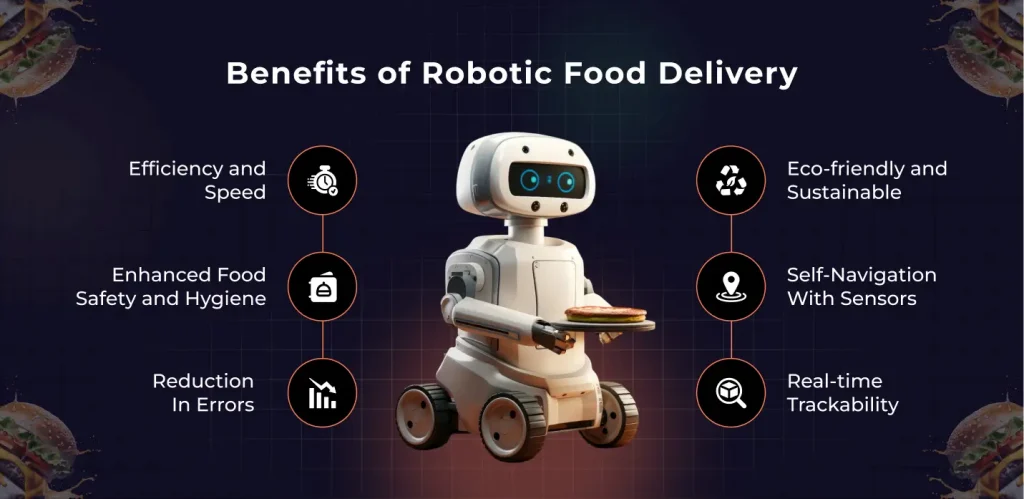
1. Efficiency and Speed
By utilizing advanced navigation solutions such as Visual SLAM and Laser SLAM, Robots follow optimal routes, avoid traffic, and delays. This ensures that food reaches customers faster and fresher.
2. Enhanced Food Safety and Hygiene
Robots operate in a controlled environment. Robotic food delivery systems are supported by maintenance platforms that ensure consistent safety standards and hygiene. All this contributes to enhanced food safety and hygiene.
3. Reduction In Errors
As one of the technologies in food delivery aimed at reducing errors, food delivery by Robots and AI can help reduce errors. For instance, once an order is placed, it can be assigned directly to a robot that ensures it picks up the food from the correct restaurant and delivers it to the intended recipient.
4. Eco-friendly and Sustainable
Many delivery robots are electric-powered and produce zero carbon emissions. With the ability to optimize delivery routes, travel distances are minimized and so is the environmental impact.
5. Self-Navigation With Sensors
The future of food delivery is about smart and automated robots that will be intelligent enough to optimize routes. They’d use cameras, sensors, and GPS to find the fastest and safest route even when navigating the most critical areas.
6. Real-time Trackability
Robotic deliveries can provide a more transparent and predictable delivery experience through autonomous navigation, real-time tracking, and automated operations.
7. Increase In Cost Effectiveness and Efficiency
Robot food delivery proves to be cost-effective to both businesses and customers. For businesses, it reduces operational costs as compared to human labor. On the other hand, customers can benefit from reduced delivery fees, making the service more appealing and accessible.
Benefits of Food Delivery By Drones
1. Increased Accessibility
Drones can easily reach hard-to-access locations where traditional vehicles might struggle or may not reach. In addition to this, drones can deliver food to areas affected by unforeseen events like earthquakes, floods, and heavy traffic jams, thanks to their ability to fly over damaged routes and blocked roads, ensuring that people receive meals quickly and safely.
2. Faster Delivery
Drones can fly through traffic and avoid roadblocks, buildings, and other obstacles. In a busy city environment, they can easily conquer traffic and deliver food in a much faster manner. All this, while ensuring that the food stays fresh even during peak hours.
3. Contactless Delivery
Although robotic food delivery is generally contactless, it may still require some interaction with robots. In drone food delivery, drones can drop packages at a designated spot, such as a balcony, backyard, or garden, making true contactless delivery easier.
4. Food Delivery To Moving Vehicles, Boats and Unstable Surfaces
Consider this – You have received food delivery orders from people on the move; in a moving train, on a boat, people standing in a queue, etc. What would you do? That’s where drones present themselves as the future of food delivery, you can deliver food straight to a person, regardless of whether they are in a moving vehicle, or even if they are in a long queue or crowd.
5. Reduce Environmental Impact
A drone runs on electricity or batteries, unlike vehicles that run on petrol or diesel. This means fewer harmful gases and a reduction in pollution. Another reason drone food delivery can be environmentally friendly is that drones can fly in the air, which translates to less fuel idling in jams.
Future Possibilities
The future of food delivery is evolving, thanks to innovative methods such as drone and robot food delivery. Such technologies in food delivery will become increasingly prevalent, offering faster, efficient, and sustainable delivery solutions. Let’s have a more detailed look at the possibilities –
1. AI Powering The Future of Food Delivery
With advanced AI, robots, and drones, food delivery will go beyond simple navigation. They could predict traffic patterns, create priority routes, adjust in real-time according to weather conditions, and avoid roadblocks.
2. Better Battery Life
In the future, robots and drones for food delivery will have significantly improved battery life, along with systems that could potentially help drones and robots repair minor damages autonomously. We might also have wireless recharge systems that could charge the devices mid-route and adapt to harsh conditions with minimal human input.
3. More Personalized Delivery Experiences
AI-powered systems could predict customer needs and preferences, potentially offering personalized delivery options. Furthermore, AI will be able to track preferences, making it feel that each delivery is prepared just for the customer.
4. Better Environmental Sustainability
Drone- and robot-based food delivery is poised to reduce carbon emissions by cutting down on fuel-powered vehicles, including cars, bikes, scooters, and more. Since drones and robots would use electric power, there would be lower fuel consumption and cleaner air. Additionally, we can expect reduced greenhouse gas emissions and smaller carbon footprints per delivery.
5. Smarter Apps for Drone and Robot Delivery
We can expect that apps to be the main brains behind drone and robot-based food delivery. With these apps, both food providers and users will be able to adjust every operation in real-time. They’ll be able to predict orders, track their progress, track the estimated time of arrival, monitor weather, and more, all by accessing the food delivery app.
Custom food delivery app development will play a crucial role in building more innovative apps that can efficiently manage, track, and personalize drone and robot deliveries.
Getting A Successful Food Delivery App Developed
For those planning to build food delivery apps, this promises a massive market full of opportunities, especially for those who wish to integrate futuristic technologies, such as Drone and Robot food delivery.
Want a food delivery app that helps you thrive in this market? You can trust A3Logics with app development, and here’s why –
With A3Logics as your food delivery app development company, you can grow your food venture with a custom food delivery app developed by in-house experts who know the industry inside out. They build solutions tailored to your goals, helping you stand out in a competitive market.
With us, you can build a scalable food delivery app on the lines of Uber Eats, DoorDash, GrubHub, and more.
What you can expect from us –
- 21+ years of experience in developing custom-built apps.
- End-to-end food delivery app development – from consulting to development to post-launch support and maintenance.
- AI-powered fraud detection, real-time tracking,and more.
- Integration with technologies such as IoT, blockchain, cloud computing, etc.
Conclusion
We are entering an era where immediacy isn’t just a feature, but an integral part of customer service.
When customers crave their favorite food, the question shouldn’t be “What do they need?” Instead, the focus should be on “how quickly to deliver it?” Drone and robot delivery can easily bridge that divide by accurately predicting customer preferences and further delivering orders in record time. By tapping into technologies like drones and robots for food delivery, you can expect to prosper in a competitive food delivery market.
If you’re planning to enter the food delivery space, this post provides a clear picture of both the current landscape and what’s to come, enabling you to build smarter, future-ready solutions.