
Do you still execute your takeoffs manually? If this is the case, you are most likely spending more time sorting through paperwork and plans than putting together estimates and bids. You’re probably not alone. While construction takeoff software has been around for decades, many industry professionals still do their material takeoffs and estimates by hand.
Obtaining buy-in to implement new technology can be difficult. First, you must obtain budget clearance to purchase any new equipment or software, which requires demonstrating a return on investment. Then you must gain end-user buy-in and have them embrace using whatever new technology you purchase rather than returning to old methods of doing things, not because it is easier or superior, but simply because it is familiar and how they have always done it.
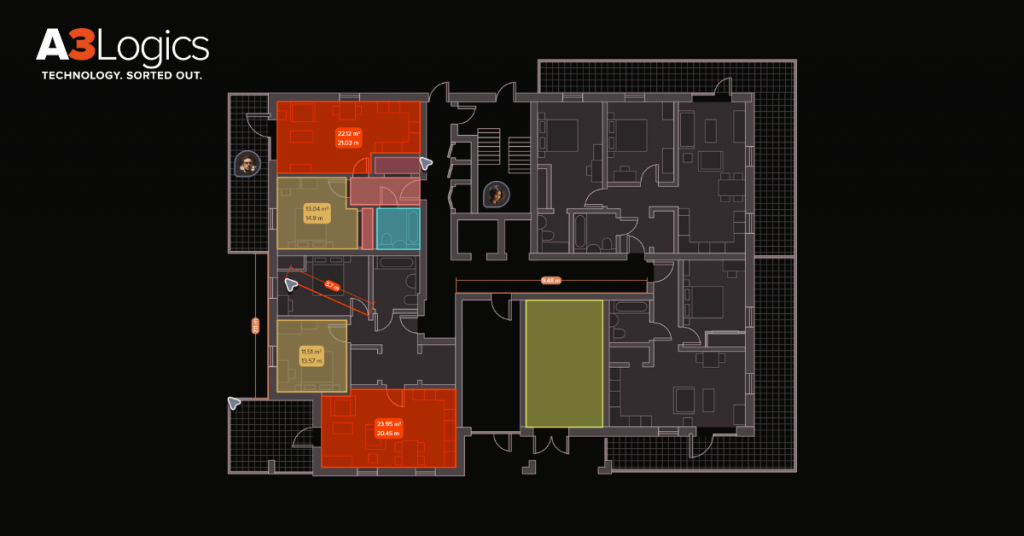
Previously, building firms that were the first to adopt and apply new technologies simply benefited from a competitive edge over others that did not. Construction technology is evolving so rapidly that organizations that refuse to accept it will become extinct. And AI is playing an important role in simplifying the traditional takeoff software.
Traditionally estimators needed to personally go through drawings, count items and measure areas/lengths which is generally a tedious process and prone to manual errors. Now with AI coming into play this process is optimized and simplified.
In this blog we have taken a look at what AI takeoff software is in construction and how it can benefit the construction industry.
With right AI development services you can streamline your construction processes and optimize workflow for better cost estimation and reduced wastage. Connect with the leading industry experts at A3Logics for a tailored AI-driven solution today.

What is AI Takeoff Software?
AI takeoff software refers to construction technology that uses artificial intelligence to automate the “takeoff” process—the step in construction estimating where you measure quantities (materials, labor, time, and costs) directly from digital blueprints or plans. The modern construction AI takeoff software makes use of both QTO for comprehensive project estimation and MTO for material procurement and planning.
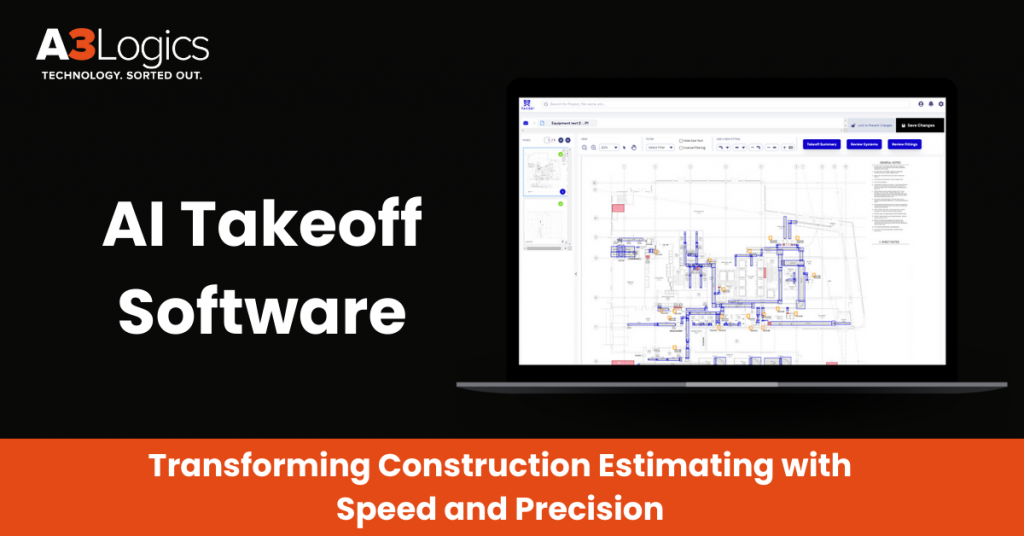
Both have an important role to play in takeoff software but first let’s understand the difference between the two.
Understanding The Difference Between QTO And MTO
The global Quantity Takeoff AI market size reached USD 1.15 billion in 2024, driven by the rapid digital transformation across the construction sector and the increasing adoption of artificial intelligence in project estimation workflows. The market is projected to expand at a robust CAGR of 18.4% from 2025 to 2033, reaching an estimated USD 5.87 billion by 2033.
Quantity takeoff is a broad process that takes care of the measurable elements of the project. This part helps in automated extraction of the quantities from the blueprints or the BIM models. This not only covers the materials but also consists of items that are in connection with labor, equipment and also subcontracting. QTO enables estimators to get a complete picture of requirements, supporting accurate cost estimation and prep for bids.
Now when it comes to MTO, it is the focused result of the takeoff process. The Construction Takeoff Software helps generate the exact list of materials required. It can be for steel, concrete, lumber, pipes, wiring and various other things. It can also give the specific estimation for the size, grade and the type. In contrast to QTO, MTO is used mainly for the purpose of procurement. Negotiating with the vendors and managing the supply chain rather than giving the complete cost analysis.
Using computer vision and Machine learning AI takeoff software scans, interprets, and extracts data from digital construction drawings. Rather than manual measurement, AI identifies symbols, dimensions, and materials straight from the blueprint. Then the construction material is classified into – walls, doors, windows, flooring, or electrical systems. It also cross-reference it with the project requirements and cost database.
Limitations of Traditional Takeoff Methods
> Manual measuring and data entry
Traditional takeoff methods are often dependent on manual measurements and data entry. The process was time consuming. This was often causing a delay in the project timelines and slowing down the bidding process. This delay might have an impact on bidding since contractors may miss deadlines or submit bids that are less competitive. Manual takeoff, on the other hand – can be effective for small tasks with basic designs where speed is not a priority.
> High chances of human errors & miscalculations.
When comparing precision, manual takeoff is mainly dependent on the individual conducting the work. Mistakes can be made easily, such as misreading a scale or adding numbers incorrectly. These errors might accumulate and cause issues later. However in the cases of digital takeoff mitigates numerous dangers by automating computations and delivering precise data.
> Difficulty handling large or complex projects.
Traditional takeoff methods are fine for small scale enterprises it can be challenging when it comes to large scale and complex projects. Because the data and material vary so much it can be difficult to keep a track of all of it and the estimation can be off. Leading to wastage and extra expenditure. AI driven takeoff software can take into account various factors and give a pretty accurate estimate of the cost and materials.
> Limited collaboration and version control.
Another drawback of traditional methods is that they offer limited collaboration and version control. Often making it hard for teams to share updates, track changes, or maintain consistency across multiple stakeholders.
How AI Increases the Takeoff Process?
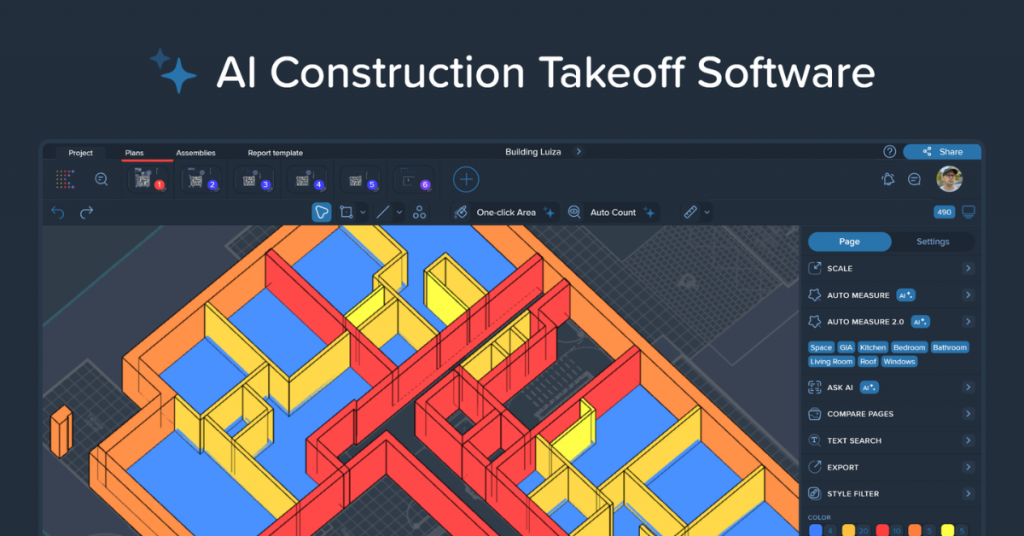
Below is how AI is becoming the central figure in elevating the construction takeoff process.
1. Automated quantity extractions from drawings.
Manual takeoffs have always been time-consuming and labor-intensive. Estimators used to click, measure, and markup on screen carefully – spending hours simply to obtain the quantities. With AI, this is now automated. It can read digital blueprints, recognize various building components such as walls and floors, and instantly determine the amount of material required.
Not only does this save considerable time, but also enables estimators to concentrate on higher-value activities such as planning costs and working with clients.
2. Intelligent detection of construction components
Construction prices continue to fluctuate. Prices on materials increase, labor rates change, and lead times can move. But old pricing data is frequently employed by traditional estimating techniques, which will make the estimates obsolete immediately.
AI assists by leveraging current data. It draws in the most recent material price, labor rate, and availability, so the estimates reflect what’s going on in the marketplace.
This keeps estimators current, allows them to make more precise bids faster, and prevent surprise expenses down the line.
2. Enhanced precision & error minimization.
Minor estimating errors can cost significant amounts of money. AI assists by detecting measurement errors, identifying missing items, and recommending cost-saving options through the use of past data and vendor data.
By eliminating human errors, AI construction takeoff software prevents rework, surprise changes, and cost overruns, thereby enabling the entire project to proceed more efficiently and remain on schedule.
3. Time efficiency: hours cut down to minutes.
With AI powered takeoff software it has become so much easier to reduce the cost and material estimation. With AI intervening the job which would usually take days to finish can be finished within minutes and that too with real numbers for data driven results and real-time data.
4. AI based real-time team collaboration.
Estimating software that uses AI is designed to integrate with the software your team already uses, such as Building Information Modeling and project planning or accounting applications. That allows all the critical project information, including estimates, schedules, material orders, and reports, to remain linked and up-to-date in one location.
When all things work together in harmony it’s simpler for teams to remain organized and make smarter decisions. This will assist the team to keep projects running smoothly from beginning to end.
Top Advantages of AI Takeoff Software
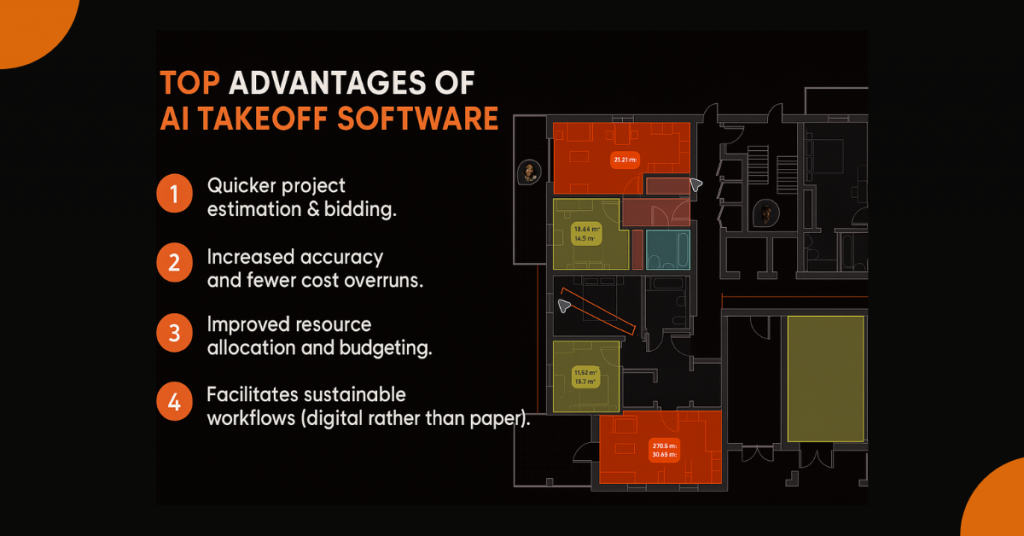
Let us examine the top advantages of using AI driven takeoff software.
1. Quicker project estimation & bidding.
Time is a factor when it comes to construction, particularly in the turnaround time from bid requests. AI construction takeoff software has the ability to turn tasks that would take days or weeks into hours. This enables teams to get bids ready and out the door more quickly, without losing detail or precision. Being fast and precise allows you to bid on more jobs and remain competitive in a rapidly changing market.
2. Increased accuracy and fewer cost overruns.
Minor errors in estimation can cause major issues down the line. With AI, estimates take into account real-time prices and historical project information, not conjecture. What this implies is cost projections are more precise from the outset, thereby making contractors more confident when bidding or budgeting.
For instance, if the price of materials typically goes up in some seasons, AI can account for it. This prevents surprises down the road and makes the overall project more reliable.
3. Improved resource allocation and budgeting.
AI doesn’t just measure materials – it also assists. AI makes better use of time, money, and manpower by considering past project data, making it recommend:
- Percentage of budget spent
- Percentage of budget remaining
- Best suppliers on price and reliability
- How many staff are required at each phase
- Budget revisions for fluctuations in the marketplace
- This results in more streamlined project delivery and less surprise expenses.
- Improved cooperation through cloud-based solutions.
4. Facilitates sustainable workflows (digital rather than paper).
Going digital with takeoffs reduces paper usage, which helps make your business more sustainable. No printing out reams of blueprints; it’s all done digitally – which is better for the planet and easier to organize.
Short of it, AI construction takeoff is not simply a technological improvement – it’s more intelligent and effective construction estimating and project management. It assists crews in being competitive, cutting costs, and providing improved outcomes.

Real-World Applications & Use Cases
Here are some of the real world applications and use cases of AI takeoff software development.
> Healthcare Building Construction Projects
AI takeoff software guarantees proper blueprints analysis for hospitals, diagnostic facilities, and laboratories where health and safety measures compliance is paramount. They assist in estimating specialized materials (e.g., sterile floors, HVAC components) and optimize project schedules to prevent expensive delays.
> Residential & Commercial Building
For residential developments, apartments, and office complexes – AI takeoff software accelerates quantity estimation, minimizes rework, and enhances cost estimating. They also enable developers to manage multi-unit or high-rise ventures with greater accuracy in material planning.
> Industrial Projects (Factories, Warehouses)
Massive buildings demand optimal management of structural elements, utilities, and safety elements. AI-based takeoff systems assist contractors in anticipating requirements for – steel, pipes, electricals, and ventilation systems – guaranteeing precision and minimizing wastage of bulk purchases.
> Smart City & Infrastructure Development
Urban development initiatives such as; roads, bridges, utilities, and intelligent infrastructure are enhanced by AI automation. The software facilitates real-time collaboration between stakeholders, increases sustainability planning; and helps maintain government-compliance rules for big and complex constructions.
Popular AI Takeoff Software Tools (Examples)
Various businesses are venturing into developing AI driven takeoff software. Some of the popular ones include.
Togal.AI – Employs cutting-edge deep learning algorithms to provide very precise takeoffs. It automates reading blueprints, freeing contractors from hours of manual labor and minimizing errors.
iBeam – Excels in automated processing of blueprints, which allows construction teams to rapidly extract material information and quantities for improved project planning.
Kreo – Renowned for intelligent label detection and automation – Kreo assists in identifying and categorizing construction items with minimal human intervention, guaranteeing accuracy in estimates.
Beck Technology – Architectural trade takeoffs are its area of specialty; with the platform automating cost estimating and design processes to facilitate easy collaboration between architects and contractors.
Attentive.ai – Features an easy 3-step automated takeoff process that is simple enough for users with limited technical knowledge to quickly produce accurate estimates.
Challenges & Considerations
Though AI takeoff software comes with many plus points, there can be some challenges and problems that we need to take into consideration.
Accuracy is based on the quality of the input drawings – AI takeoff tools are best when blueprints and plans are – clean, detailed, and standardized. Inaccurate or poorly scanned documents or incomplete drawings can produce inaccuracies.
Learning curve at the start – Although automation makes it easier – construction professionals might need training on how to use the software appropriately – how to interpret results, and how to rely on AI output.
Integration with current project management infrastructure – Most companies already have systems such as – BIM, ERP, or other types of scheduling software. If you want seamless integration with these systems you need to make sure your software is ready because it is essential to prevent workflow interruptions.
Implementation costs – Licensing fees, training costs, and installation fees can be high. The long-term return on investment (ROI), though – usually far exceeds these costs due to greater accuracy, lower labor, and quicker project completion.
The Future of AI in Takeoff and Construction Estimation
The future of AI in takeoff and construction estimation is pretty bright. And there are various technologies that are ready to improve the industry and ensure that the construction industry never remains the same.
Let’s take a look at some of the future trends of AI in takeoff and construction estimation.
> More sophisticated machine learning algorithms for precision
Next-generation AI solutions will utilize deeper – neural networks and contextual learning to identify even minute aspects in blueprints, enhancing precision and minimizing rework.
> BIM integration
AI launchpad solutions will be more closely integrated with BIM, enabling teams to create estimates straight from 3D models and coordinate real-time updates between design, planning, and construction.
> AI-based predictive analytics for budgeting & project risks
Going beyond measurement – AI will look at past data to predict possible risks, budget variations, and slippages and support proactive decision-making.
> Growing adoption by industries for speed and competitiveness
With construction companies being asked to complete projects quickly and economically, AI takeoff adoption will grow on residential, commercial, industrial, and infrastructure projects as well.
Best Practices for Adopting AI Takeoff Software
Before you start with your AI takeoff software there are a few things that you can do to ensure that your project goes smoothly. Here are the best practices to follow before adapting AI takeoff software.
1. Start with pilot projects – Implement on smaller or less complicated projects first – This is to test the efficiency of the tool. This will help you to iron out workflows before company-wide roll-out.
2. Train estimation teams – Don’t skip this step as good training ensures – estimators and project managers are well-versed with the software’s capabilities. This will help in ensuring that the team can confidently use the AI generated data.
3. Assure quality blue print inputs – Clear, precise, and standard drawings guarantee accuracy. Implement quality control inspections prior to inputting blueprints into the system.
4. Periodically monitor ROI and make process changes – Ongoing measurement of time saved, error avoided, and cost savings. Utilize those findings to refine workflows – and make the case for spreading adoption to larger projects.
Conclusion
AI isn’t simply a new thing in construction estimating – it’s a game-changer. The AI gives estimators the tools they need to work – quicker, smarter, and more correctly than ever before by automating quantity takeoffs, adding real-time cost data, and reducing human error. An AI doesn’t replace human expertise; it works with it to free up professionals to focus on strategy, judgment, and making decisions. What happened? More competitive bids, fewer expensive surprises, and better project results.
As the construction industry changes – AI-powered takeoff tools will be necessary to keep things running smoothly, accurately, and ahead of the curve. In today’s fast-paced market, those that adapt early will have an obvious advantage.
Why Choose A3Logics for AI Takeoff Software Development?

At A3Logics we can built custom AI driven takeoff solutions that are designed to bring speed, precision, and automation into your estimation process.
It reads- digital blueprints, detects key construction elements, and automatically generates accurate material quantities that can dramatically reduce the time and effort required-
- Our team has expertise in AI Development Services with proven AI/ML solutions across industries.
- We offer custom construction software Development that are tailored for construction businesses.
- Our AI experts have a strong domain knowledge in AI construction estimation and project management integration.
- Role of AI in Product Development is pretty important that is why our team of experts has more than 22 years of experience in delivering AI-powered design & product development
- We offer end-to-end support from the first consultation, development, deployment, and maintenance. We are with you at every step of the way.
The role of AI does not just end there, it has various use cases it has in the construction industry. Take a deeper look at the role of AI Interior Design App Development.