
Imagine sending a technician to the wrong site.
They show up without the right parts.
The customer waits. Hours pass. Frustration builds.
And when they finally leave, the customer is already thinking about your competitor.
Unfortunately, such cases have become a common challenge for many companies that are still using outdated field operations. Organizing a field service is the most multifaceted and resource-consuming task in the current business environment. Be it utilities, telecom, HVAC, construction, or healthcare, organizations find it very challenging to manage mobile workforce, customer expectations, and regulatory requirements simultaneously.
Traditional ways on which people relied have become obsolete amid tough market competition. The customers want to receive real-time service updates, and the executives insist on data-driven performance improvement.
This is the reason why Field Service Management Software has turned into the facilitator of operational excellence. FSM is made to open the door to job scheduling, technician efficiency tracking, and the improvement of customer communication. It is so core in business today that businesses view it as a must-have.
In this article, we will understand the current FSM ecosystem, which includes benefits, costs, future trends, and more.

What is Field Service Management Software?
The term Field Service Management Software refers to the digital platforms that are intended to plan, execute, and monitor field-based operations. The key features are job scheduling, route optimization, mobile access for technicians, inventory control, billing, and real-time customer engagement.
Modern Field Service Management Software Development applications can easily integrate with CRMs such as Salesforce, ERP systems, and IoT assets. Consequently, this all-important ecosystem ensures that data is meticulously entered at every stage of the business process from request for service to the issuance of the final invoice.
FSM software is available in several service models:
- Cloud-based SaaS FSM software: Subscription-driven, scalable, and mobile-friendly.
- On-premise FSM platforms: These systems are generally preferred by regulated sectors that are monitored closely and require strict controls.
- Custom-built FSM applications: They are developed for organizations where the workflows and need for integration are unique.
Field Service Management Software Market Statistics
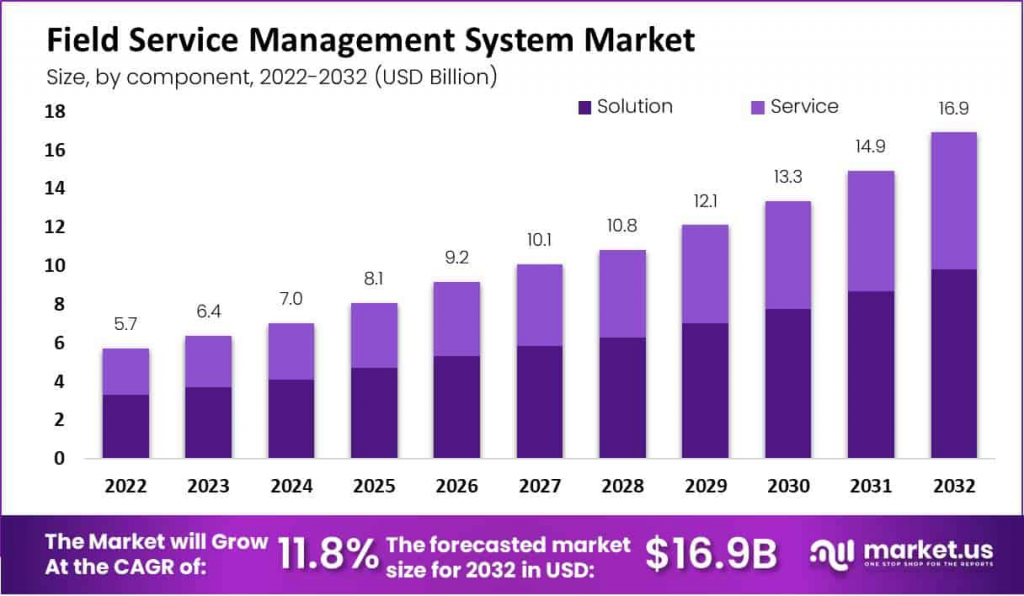
The FSM market has been on an upward trend and has observed intense growth over the past five years. In 2025, the global FSM market is valued at USD 8.1 billion, and is forecasted to reach about USD 16.9 billion by 2032, with a 11.8% CAGR.
Key factors driving growth include:
- U.S. adoption: The US market is $2.8 billion in 2025 and is expected to grow by 8 to 9 percent each year, which is a major adoption driver. Moreover, as companies face rising labor shortages, this helps them cope with customer demands. A Salesforce survey revealed that 74% of mobile workers view customers’ expectations as being much higher; thus, real-time status updates are mandatory.
- Efficiency improvements: Users of FSM software report an increase in first-time fix rates, decreased repair time, and reduced asset downtime. Route optimization allows fleets to reduce fuel expenditures and drive time, which can be a huge cost for many service fleets.
Benefits of Field Service Management Software for Small Businesses
1. Dramatically Improved Operational Efficiency
FSM platforms are a game-changer for businesses that used to manually schedule jobs. Depending on the size of the business, the chance of assigning automated jobs can save between 25% and 30% of idle time. For smaller businesses, that means more technicians are working and faster response times.
2. Enhanced Customer Experience & Communication
Field Service Management Software for Small Business facilitates real-time notifications, technician ETAs, and the ability to immediately create digital receipts for customers. Survey results indicate that communicating in real-time has a significant effect on satisfaction, and by being able to do so, small businesses can create customer loyalty that results in repeat business.
3. Increased Revenue and Profitability
FSM Solutions can increase revenue by virtue of increased missed appointments, an increase in first-time fix rates, and upselling when technicians are in a service customer’s home. The firms that have embraced an FSM software solution have been able to achieve significantly better results, and they very clearly have a pathway to profitability.
4. Better Resource and Asset Management
FSM tools provide a complete view of the vehicles, tools, and spare parts. Losing money on misplaced or non-utilized inventory is common among small businesses. Asset tracking feature integrated into FSM platforms protects against asset drain and it helps to keep the stock balanced, thereby avoiding shortages.
5. Data-Driven Decision Making
Field Service Management Software is capable of providing detailed information about the time spent on the job, how the team is performing, and who the clientele is. The availability of dashboard analytics allows small firms to identify underperforming service lines, make better decisions on workforce allocation, and formulate optimal pricing strategies. With AI field service management, small businesses gain instant insights and future-ready predictions without heavy analysis.
6. Improved Safety and Compliance
Regulatory compliance for small businesses is often not at the forefront of their thoughts. Field Service Management Software for Small Business comes with safety checklists, compliance workflows, and automatic digital records. This reduces their exposure and risk of penalties.
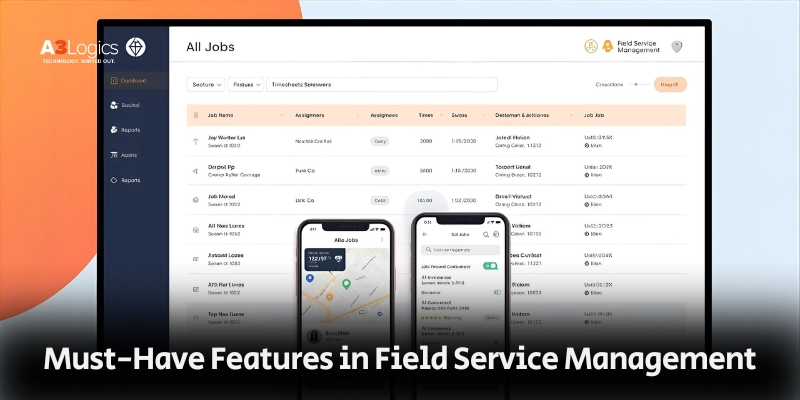
Common Field Service Management Software Features
1. Job Scheduling & Dispatching
Automatically scheduling with algorithms limits technician tasks to their time availability, expertise, and capability, as well as location. This helps lower travel costs and enhance FTF.
2. Mobile Access for Field Workers
Mobile applications that allow technicians to view work assignment and status, update the work status, capture customer signatures, and develop customer invoices in real-time are essential for a mobile workforce.
3. GPS Tracking & Route Optimization
GPS tracking in real-time and AI-powered route optimization can support reduced fuel usage and increase the amount of work per day. Route optimized delivery vehicles often realize 15–20 percent savings when compared with fleets operating without the route optimization capacity.
4. Inventory & Asset Management
Field Service Management Software providers also provide inventory tracking or asset management integration. This is very helpful in monitoring parts usage, trigger automatic reorders when job parts reach a low queue status, and prevent delays due to a lack of inventory.
5. Customer Management (CRM Integration)
The inclusion of CRM integrations helps collect and centralize holistic customer data, which forms a 360-degree view. This mainly includes SLAs, preferences, service history, recurring work orders, and job specifics information like date and time.
6. Billing & Invoicing
Field service techs can develop and deliver digital invoices on-site, and trigger workflows to receive payment right then and there. This helps reduce billing cycles to hours instead of weeks, therefore improving cash flow.
7. Analytics & Reporting
Analytics with dashboards help FSM system managers with KPIs like average response time, mean time to repair (MTTR), customer satisfaction scores (CSAT), and other metrics.
8. Work Order Management
FSM digitized work orders, maintaining integrity related to job level details, dependencies between tasks, and accountabilities for the technician.
9. Time & Expense Tracking
Field workers are able to submit their working hours and expenses via Mobile apps, improving payroll accuracy, and giving managers access to real-time cost visibility.
Cost of Field Service Management Software Development
The total Field Service Management Software Development expenditure may vary widely due to factors such as the number of features, degree of difficulty, and business needs. Custom FSM development is not like SaaS tools. It requires an exhaustive analysis of the features, integrations, and scalability needs.
As per the industry standards, the cost of creating a feature-rich FSM application usually scales from $80,000 to around $250,000, while the enterprise-level, fully customized FSM solutions are above $500,000. In the following, we will explore the core elements influencing cost.
1. Software Complexity
Functionality depth is the major cost driver in software complexity. Minimal Field Service Management Software for small firms with functions like scheduling, mobile access, and billing may be basic. On the other hand, the platforms will be quite advanced depending on their supporting capabilities such as IoT incorporation, AI advances in scheduling, and statistics in real-time, which is why it requires complex software architecture and testing.
For instance:
- Basic MVP FSM system: $40,000 – $80,000
- Advanced FSM ecosystem with AI/IoT: $200,000 – $500,000+
2. Technology Stack
Technology choices directly affect both development time and long-term costs.
- Frontend: React Native or Flutter enables mobile-first design for technicians.
- Backend: Node.js, Python, or Java with scalable cloud infrastructure.
- Database: PostgreSQL, MongoDB, or cloud-native databases for larger scale operations.
- Integrations: APIs for Salesforce, QuickBooks, or ERP platforms.
Microservices and cloud-native architecture are more scalable than having monolithic systems, but the initial costs are higher.
3. Customization Needs
Companies like oil & gas, construction, and utilities, they cannot go with prebuilt solutions. These companies have very unique workflows that generic SaaS tools cannot replicate.
With customization, there is addition of work order templates, compliance rules, multi-language support, etc. In general, you can expect an increase of around 20-40% in the budget, depending on how many of the modules need to be changed.
4. Team Location
The geographical location of the development teams is a major determinant of the costs:
- North America/Western Europe: $80–$150/hr
- Eastern Europe/Latin America: $40–$70/hr
- South Asia: $25–$40/hr
Most smart businesses prefer outsourcing to build cost-efficient systems maintaining the same quality.
5. Integration Requirements
Like all software solutions, FSM applications never run independently. They build up through integration with ERP, CRM, IoT, and payment gateway tools. It takes a good deal of development effort to integrate, for example, Salesforce CRM or Oracle NetSuite ERP, which may add anywhere from $20,000 to $50,000 to project costs.
Bottom Line: Field Service Management FSM Software development budget must not be solely based on core functionality. The concerned parties should also consider integrations, security hardening, and scalability features. Without this, organizations risk underfunding projects and facing higher long-term maintenance costs.
Future Trends in Field Service Management Software Development
1. The Rise of AI and Predictive Analytics
With the help of AI, it is now possible to move from manual dispatch processes to algorithmic scheduling that links skills, parts, and physical distance automatically. Predictive Models that highlight likely breakdowns far ahead of time are capable of fabricating work orders that not only suggest solutions but also include necessary parts of the list.
2. Augmented Reality (AR) for Remote Assistance and Training
AR is like overlaying steps onto the technician’s view, which combines layering AR and this one thus enabling expert support without a second truck roll. Within Field Service Management Software, AR sessions are tied to work orders, asset IDs, and checklists, so evidence and outcomes are captured automatically.
3. Integration of Internet of Things (IoT) for Predictive Maintenance
The application area of IoT in systemic predictive maintenance has one or several property streams that integrate supporting data from external sources. The data thus collected helps the FSM system generate work orders after verifying faulty indicators. The system arranges parts and suggests booking the craftsman who already has developed working knowledge of the issue. Continuous asset historical data mining improves fault-filling and optimizing parts inventory.
4. The Shift to Outcome-Based Service Models (XaaS)
The service is shifting to assured outcomes like uptime, throughput, or SLA compliance. The FSM Software needs to manage the contractual KPI, risk escalation, and scheduling that protect the committed outcomes. Thus, instead of predicting the failure, the company will start billing based on usage or subscription, thus incorporating contracts and entitlements.
5. Hyperautomation in Field Service Operations
Workflows are structured along chains of AI, rules, and RPA, so use case routine steps run end-to-end without human touch: triage → schedule → parts order → technician brief → report → invoice. FSM Software starts to be event driven, as it becomes dynamic and responsive to triggers, signals, and responses from CRM, IoT, and inventory, in real time. There are exceptions that are handled by humans; everything else executes programmatically.
6. Enhanced Focus on Sustainability and Green Operations
Solutions that prioritize route optimization, visit consolidation, and paperless workflows to lower fuel, time, and waste. Field Service Management Software tracks reductions in vehicle miles traveled, idling, use of digital forms, and parts reuse or returns. It helps to lower both environmental impact and costs. Asset data further supports preventive maintenance, extending the lifecycle of equipment.
7. 5G and Edge Computing for Real-Time Data Processing
With low-latency networks and edge nodes, FSM apps deliver AR support, high-resolution media, and instant telemetry on-site. FSM Apps become connected and synchronized when they are connected to the network. Yet, they perform locally when the connection is limited, thanks to the preservation of checklists, parts scans, and photos. Diagnostics typically run at the edge where summaries flow to the cloud.
8. Advanced Customer Communication and Self-Service Portals
Customers can now easily schedule visits and approve quotes without ever connecting to support. FSM Software provides secure portals that mimic the internal work orders for clients, where they can see all the updates, documentation, and invoices in the same place.
9. The Evolution of FSM Platforms into Full-Service Ecosystems
FSM is becoming a giant hub that can connect with CRM, ERP, payments, telematics, and IoT. It’s a clean master data for customers, assets, and parts. FSM Software brings marketplace contractors, procurement, returns, and warranty flows under the same fabric.
10. Prioritizing Technician Experience and Enablement
Design is focused on the tech; offline-first mobile apps, one tap changes to status, barcode and QR scans, and knowledge articles embedded into assets make/model. Field service management software briefs technicians with parts, hazards, prior fixes and AR-backed steps for completion before getting on site.
Why Choose A3Logics for Your Field Service Management Software Development?
Choosing a suitable partner for Field Service Management software development is the primary factor for achieving efficiency and scalability in both the short and long term. A3Logics is a reputed Workforce Management Software Development Company due to its talent and experience in creating tailor-made FSM platforms for varying fields including utilities, HVAC, logistics, and healthcare. Here is how we differ from others:
1. Proven Expertise in Custom Development
A3Logics is known for the development of applications that are exactly suited to the specific workflow of your organization. Whether it is sophisticated dispatch methods, IoT-driven predictive maintenance, or regulatory compliance modules, we engineer the solutions according to their precise operational requirements.
2. Integration-First Approach
A3Logics guarantees seamless integration with CRM, ERP, and third-party applications. Our engineers link FSM systems not to be isolated but rather to be a part of a harmonized digital ecosystem from Salesforce and ServiceNow to QuickBooks and SAP.
3. Focus on Technician Experience
Since technician primacy is the most important element of the appropriate FSM acceptance, A3Logics creates mobile applications which are very easy to use, offline, and with AI-powered advice. This ensures more adoption, as well as a significant increase in productivity.
4. End-to-End Software Development Services
We have a breadth of software development services which include discovery, performance, and UX design, deployment & ongoing support.
5. Industry Recognition
With over 20 years of expertise, global delivery, and recognition in numerous analyst reports, A3Logics has proven to be a leader in digital transformation on a global scale.

Final Thoughts
Field Service Management Software has grown beyond just scheduling functionality. It also encompasses aspects such as workflow efficiency, compliance, and profitability (driven by AI, IoT, and predictive analytics). Organizations now face the added dilemma of going from proving the value of FSM to being able to find a provider that can meet their needs completely and can quickly grow as they scale.
In 2025, it’s essential to find the right Software Consulting Services partner.
This is where A3Logics comes in. We put your organization in front of specific FSM platforms that have been created with our years of engineering expertise, modern tech stack, and domain expertise.
Connect with us today!