
If you are in real estate, you already know how complex the overall system is. A lot of paperwork, weeks of property viewings, and inaccurate valuations all make the process tough and not easy to handle. To sum up, the result is lengthy cycles, a lot of inefficiencies and outcomes that are almost never predictable.
However, AI is the game changer here. AI is implementing automation in both property valuations and tenant screening, and allowing people to experience 3D tours virtually. AI for Real Estate is turning one of the oldest industries into a customer-centric and data-driven ecosystem. The work that used to take several months can now be done in a few days with a higher degree of accuracy, transparency and efficiency.
In this blog, we will discuss the application and benefits of AI in Real Estate Industry. We will also explore real-world case studies, implementation challenges, and more. Let’s begin!
The Role of Artificial Intelligence in Real Estate
AI interacts with large amounts of structured and unstructured data, including property records, pricing trends, geospatial information, consumer behavior, and social sentiments. This creates insights that drive more efficient decision-making and the discovery of superior outcomes.
Traditional manual research can take a long time, while AI for Real Estate puts the information through a processing system so you can receive real time value, driving decisions that will lead to better outcomes.
For buyers and tenants, AI offers highly customized recommendations and user engagement through conversational agents. Brokers and platforms, AI realizes predictive valuations, lead scoring, and fraud detection functionality. For property managers, AI automates maintenance and tenant screening. Developers, AI enables smarter site selection, design improvement, and construction risk mitigation.
AI is not a substitute for real estate professionals but is a helpful tool that increases their decision-making capabilities and creates value add at a larger scale.
AI in Real Estate – Key Statistics
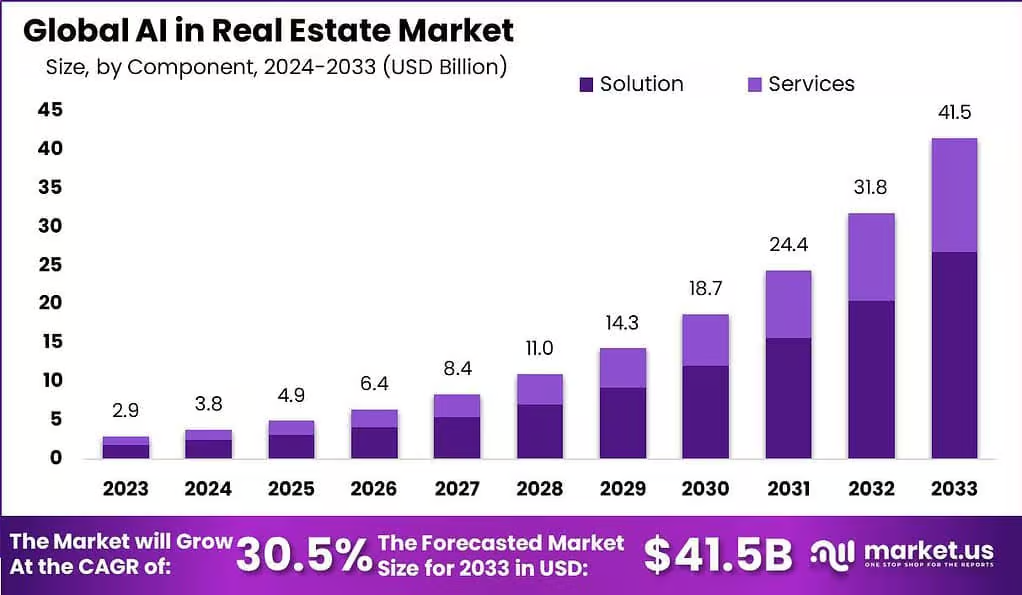
- Market Growth: The AI in Real Estate global industry is expected to expand from $4.9 billion in 2025 to $41.5 billion by 2033, having a CAGR of over 30.5%.
- Adoption: A survey conducted among CEO groups found that 97% of real estate firms are seeking out AI, with the majority i.e. 14% actually using it already and 28% at it in pilots or early adoption.
- Efficiency Gains: Studies conducted state that up to 37% of property tasks can be automated by AI which will even lead to the saving of $34 billion in costs by 2030.
- Customer Experience: AI-powered staging can raise inquiries by as much as 200%, and chatbots can improve lead conversion by 33%.
These data points showcase the growing influence of AI Applications in Real Estate on all groups that are involved.
AI Applications in Real Estate
A. For Buyers & Tenants
1. Intellectual Property Search
AI for Real Estate platforms analyzes buyer preferences, past behavior, and budget to surface highly relevant listings. Natural language processing (NLP) enables questions like “2-bedroom apartments near schools in Los Angeles under $4,000/month.” This increases faster decision making and a better satisfaction level for both buyers and tenants.
2. Virtual Tours & Augmented Reality (AR)
Matterport, for example, uses AI and AR to create immersive, 3D virtual tours of properties. Buyers and tenants can actually “walk through” properties from anywhere, thus removing the need for up to 40% of in-person viewings. That is a huge benefit when you consider cross-border transactions and the evolution of remote engagement as a result of the pandemic.
3. Chatbots & Virtual Assistants
An AI agent for real estate can deal with all kinds of inquiries 24/7, make appointments and lead customers through mortgage calculators. According to Gartner, the forecast is that 80% of common customer service problems will be resolved without human intervention by 2029, which is why conversational AI is an integral part of real estate customer service.
4. Personalized Property Recommendations
Redfin and other tech-enabled platforms employ machine learning algorithms that sift through users’ past history, saved searches, and demographic details to provide custom property recommendations.
B. For Agents, Brokers, and Platforms
1. Automated Valuation Models (AVMs)
AI for Real Estate valuation models analyzes historical sales data, geographic trends, and prevailing market conditions to generate automated property value estimates in real time. While not entirely precise, the models refine as time passes and the data are examined, allowing property value estimates to be provided more efficiently and quickly than traditional onsite manual approaches.
2. Lead Scoring & Nurturing
Machine Learning can sort leads to educate and prioritize leads based on the likelihood to convert. This enhanced insight saves brokers time and helps to ensure that the maximum return on marketing efforts is achieved.
3. Market Forecasting and Investment Insights
Data Analytics for Real Estate combines AI with economic inputs to assist with predicting neighborhood-level appreciation trends, forecasting rental fishing opportunities, and identifying areas of greatest potential for investment returns.
4. Fraud Detection and Risk Assessment
AI for Real Estate can check for unanticipated patterns of payment behavior, duplicate records or any forged documents in the real estate transactions. AI can help the platform raise red flags as issues and behaviors are identified in real-time. This provides an agency or firm the opportunity to meet compliance standards and limit exposure to identified fraud.
C. For Property Management
1. Predictive Maintenance
There are sensors embedded in multiple parts like HVAC, elevators, and other building systems. These sensors gather data and AI for Real Estate models use real time data to predict future maintenance needs. This way, we can minimize any unexpected breakdown of the equipment in the building.
2. Smart Building Optimization
By means of the IoT-driven AI system, buildings become more energy-efficient by automatic control of the room temperature, heating, and cooling through occupancy data as well as real-time energy usage. Thus, IoT-integrated systems make the operations of the building eco-friendly, lead to lower utility costs, and improve tenant comfort without requiring any manual intervention.
3. Tenant Screening
An AI Agent for Real Estate can sort out rental applications by examining elements such as credit history, employment records, and behavioral patterns. This method helps in eradicating the expression of bias, speeds up the process of decision making, and assists property managers in making more standardized, data-backed decisions.
D. For Developers & Construction
1. Site Selection & Feasibility Analysis
AI for Real Estate can assess demographic, environmental, and zoning data to spot sites for development. This prevents the risk of investing in underperforming areas.
2. Design Optimization
Generative AI tools can help you build design layouts that help you optimize natural light, energy efficiency and cost-effectiveness of the systems put together. These tools help architects explore more options and thereby improve functionality and sustainability.
3. Construction Risk Management
There are several risks such as supply chain problems and labor shortages in construction projects. AI models can predict these risks by checking multiple variables in real time. AI in real estate helps us do better construction planning and reduce the chances of costly risks.
4. Automated Document Processing
On a large scale, there is management of thousands of permits, contracts, and compliance documents. AI for Real Estate can extract, refine, and organize accurate information automatically. This reduces manual efforts to such an extent that it enables high-speed work and accuracy in admin workflows.
Major Benefits of Implementing AI in the Real Estate Industry

1. Data-Driven Decision Making
AI goes beyond the data to transform it into actionable insights which help the firm to take right decisions on their rates, number of investments, and the market. Firms using advanced AI Solutions for Real Estate achieve better transparency and predictability in outcomes.
2. Enhanced Customer Experience
Firms use AI chatbots, personalized recommendations, and virtual tours to provide digital-first and seamless customer experiences. This not only improves customer satisfaction scores but also minimizes churn from both buyers and tenants.
3. Cost and Time Efficiency
AI automates repetitive tasks such as verifying documents, screening of tenants, etc. On the construction side, predictive analytics help faster planning and execution. This overall saves huge time and money.
4. Improved Risk Management
There are always risks associated with real estate work due to high valuation. These risks can be easily tackled by AI helping detect fraud, predict maintenance, and monitor compliance. This reduces financial and operational risks, saving cost and time.
5. Higher ROI for Investors
AI for Real Estate offers market intelligence, asset performance, and risk exposure to the investor. It plays a significant role in decision-making, which is smarter based on the used data and besides, it helps in the improvement of the portfolio outcomes and the delivery of the highest and more steady returns in the long run.
While AI improves investment analysis, financing strategy remains equally important. Investors can complement data-driven decisions with a DSCR playbook, such as Griffin Funding’s, which explains cash flow-based financing strategies that can simplify acquisitions and support portfolio growth.
Real World Examples of AI for Real Estate
1. Zillow – AI for Home Valuation (Zestimate)

Zillow’s Zestimate is an AI app which uses ML models trained on data points like comparable sales and tax assessments to give real time valuation of the property.
Zillow claims that on average they record median error rates of 1.83% for home listings available on the market, which makes it trusted by both property buyers and sellers. The success of Zestimate proves the ability of AI for Real Estate Listings to enhance transparency and give users the power of decision-making with appropriate information.
2. Compass – AI-Powered Agent Tools

Compass has managed to establish itself as the technology-first brokerage through agents being equipped with AI Tools for Real Estate. The tools include predictive lead scoring, marketing automation, and a dynamic pricing strategy, for instance, to name just a few. For example, Compass utilizes predictive analytics to assess the chances of a prospect signing a deal based on statistics, which in turn enables agents to utilize their time better.
The integrated AI platform clearly shows how a brokerage can become unique in the market through digitized engagement.
3. Redfin – Personalized Property Recommendations

Redfin uses AI to help users get personalized property matches. It checks past history, location likes or dislikes and financial budget for the property. Its recommendation engine increases conversion rates and significantly improves the customer journey.
4. Rex – AI Chatbots and Lead Nurturing

Rex streamlines engagement with the help of conversational AI. The chatbot within the platform gives instant answers to buyer queries while nurturing hot leads. By the automation of front line communication, Rex is a very practical example of a good ROI from using an AI Agent for Real Estate.
5. Matterport – Virtual AI-Enhanced Property Tours

Matterport makes property tours more appealing with the use of AI and computer vision. Prospective buyers can check remote spaces which in turn will improve buyer engagement and reduce the rate of unnecessary site visits. Thus, virtual property tours are an example of a powerful AI application in Real Estate for sales and marketing.
6. Skyline AI – Investment Decision Support

Skyline AI, an entity that was taken over by JLL, uses the principles of deep learning to gather and analyze knowledge on thousands of property attributes. This tool is used to discover trivial assets and to assess price growth, all of which is done with greater accuracy than any other method. This is the proof of AI dealing with the investment side of the Real Estate Industry by making firms optimize.
7. Localize.City – AI for Buyer Insights

Localize.City is using AI to give hyper-localized information to the buyers. The platform does the analysis of the neighborhood-level data as sunlight exposure, traffic noise, and the quality of schools. By bearing in mind factors other than the money and space a Localize.City brings out the point of how AI for Real Estate can make the decision process more intelligent through contextual intelligence.

Challenges in Implementing AI for Real Estate
1. High Implementation Costs
Though large firms can easily deal with the AI deployment costs, small brokerages and property managers mostly find it difficult. The technological support to AI for Real Estate that can be developed and maintained requires financial inputs beyond $500,000 on an annual basis. Training, data procurement, and continual modeling upkeep are some of the reasons that mid-tier firms view as obstacles.
2. Data Privacy Concerns
Demands for AI platform necessitate the existence of confidential data like cashflow statements, tenant histories, and geospatial data. Compliance under frameworks like GDPR and CCPA thus becomes a thorny issue. By integrally applying advanced privacy controls, the properties’ companies could keep up with data trustmark with clients and mainly when AI Agents for Real Estate projects handle customer data on a large scale.
3. Resistance to Change
A sizable population of personnel in the real estate industry, most of the time, is resistant to tech-advancements, “the robbing of jobs” being their main fear. Brokers and agents may find the AI as an enemy rather than a supportive tool. This cultural obstacle can hamper the start of projects, despite looking at the clear benefits.
4. Regulatory Compliance
AI-enabled property assessment and advice must comply with fair housing laws and lending rules. Algorithmic biases resulting in incorrect information for tenant screening or property recommendations can get firms into legal issues. Regulators must think of this especially in consumer facing brands and should look for proper compliance in models.
5. Quality of Data
The overall output of AI tools mainly depends on the data they rely on. Missing or obsolete data can result in wrong predictions, incorrect valuations, and eventually loss of trust. AI models must be accurate, consistent and reliable to have correct data in output. Quality data is the main parameter for the success of any AI tool for real estate.
Solutions to Overcome AI Implementation Challenges in Real Estate Industry
1. Adopt Scalable AI Solutions
Companies can make use of scalable SaaS AI Tools for Real Estate which do not pose a financial burden on designing costly custom systems. The modular structures enable companies to test AI applications in conjunction with other platforms (e.g., chatbots or predictive maintenance) before the full deployment to their environment.
2. Strengthen Data Security
Encryption, access control, audit trail, etc. are used for the protection of property data that are sensitive. AI for Real Estate platforms must have all the security measures and compliance to avoid any data leak issue. The application of Blockchain in Real Estate also enhances security by providing a solid impenetrable mechanism within the system.
3. Collaborate with AI Development Experts
Collaboration with a Custom Software Development company makes the rollout process not only quicker but also more compliant and scalable. External technical support would be relevant at the points where companies do not have a tech facility.
4. Focus on Clean and Reliable Data
Establishing data governance protocols is paramount. It is imperative for firms to emphasize the collection of accurate data, linking together the datasets, and executing proper monitoring. The provision of clean, reliable data directly results in the high accuracy of AI Solutions for Real Estate thus enhancing the return on investment.
5. Prioritizing Explainable AI (XAI) for Trust
Explainable AI is another component that ensures the output of the AI platform is understandable and transparent. This way, companies avoid regulatory risks and they also manage to build trust on the part of the clients with respect to the application of AI in the Real Estate Industry.
Emerging Trends in AI and Automation for Real Estate Industry
- Generative AI for Design: These AI models are also being used to design building floors, arrange spaces, and create blueprints.
- AI-Powered Sustainability Tools: Smart predictive devices in buildings reduce energy waste and help to achieve ESG goals.
- Digital Twins: AI Copies of digital twins mimic real estate property in a virtual environment for performance testing and predictive maintenance.
- Integration with IoT: Smart sensors that are connected via the internet which feed data directly to AI platforms thus promoting predictive maintenance.
- Cross-Technology Fusion: The AI for Real Estate Listings, IoT, and blockchain intersection is reshaping property transactions and management ecosystems.
The above-discussed trends paint a clear picture of the AI in Real Estate Industry being mostly unified, interoperable, and explanatory in the future.
Develop Custom AI Solutions for Real Estate with A3Logics
A3Logics operates on a global level as a well-known technology partner for the past 2 decades, and AI applications are the company’s forte, especially ones tailored to the needs of property managers, brokerages, developers, and investors.
Being a prime Real Estate Software Development Company, we deliver solutions ranging from predictive maintenance platforms to AI-enhanced valuation systems. Our service portfolio includes:
- Custom Property Intelligence Platforms: Integration of predictive analytics for pricing, demand forecasting, and lead scoring.
- Tenant Experience Solutions: Deployment of AI Agents for Real Estate that provide seamless engagement through chatbots, personalization engines, and intelligent virtual tours.
- Smart Building AI Integration: Optimization of energy efficiency, preventive maintenance, and ESG compliance.
- AI-Enhanced Investment Portals: Providing institutional investors with tools for real-time asset performance monitoring and risk assessment.
By offering the full cycle from strategy consulting to deployment, we at A3Logics are available for real estate firms to access their maximum ROI.

Conclusion
The implementation of AI for Real Estate is the turning point in the industry’s transformation from relying purely on human judgment to data-driven decisions through automation.
AI is improving property value and driving more customer satisfaction with predictive maintenance and fraud detection. AI addition is giving tangible advantages to end-users, property agents, property managers, and developers.
There are many serious challenges like security and compliance concerns. To make your AI system compliance ready and free from any cyber attacks, it is recommended to partner with an experienced AI Development Services partner like A3Logics.
AI for real estate is a massive opportunity that you should not miss.
Connect with us today!