
The financial sector has always been quick to embrace the latest technologies to enhance efficiency, minimize risk, and personalize customer experiences. And this is pretty evident by the fact that banks spend an average of a whopping $650 billion in IT and Technology. Artificial Intelligence (AI) is one of the most revolutionary developments, and more so AI agents, which are revolutionizing everything from anti-money laundering to customized banking.
AI uptake in banking is gaining momentum, with 85% of banks currently using AI in some form, and 93% anticipating AI to increase profits over the next five years. Nevertheless, merely 34% of banks have strategically implemented AI, reflecting potential for improvement. One of the areas where AI agents in finance are making a significant difference is credit scoring and loan processing.
In this blog we are going to understand the role of AI agents in credit scoring, what an automated credit evaluation system is and how AI credit evaluation software development is revolutionizing the financial industry through implementation of AI in lending.
Understanding AI Agent in Credit Evaluation
The financial industry is heavily dependent on credit evaluation. Oftentimes one wrong decision could cause loss, increasing default risks and losing customer trust.
With the use of AI agents, are utilized to continuously scan financial information, credit requests, and borrower data in real-time to identify inconsistencies or potential risks.
With AI credit evaluation software development being brought into the scene, AI agents are thus capable of performing sophisticated processes of credit evaluation and financial statement analysis on seeing the following process: performing end-to-end procedures of credit evaluation with a look-out for an optimum workflow.
The AI agents also send run-time warnings against the pattern to be examined by the credit analysts whenever there is any doubt or indication of a deviation that requires closer examination.
In such a manner, the process is carried out with fewer instances of human subjectivity involved, thus enhancing the accuracy of credit scoring and risk analysis.
How Automated Credit Evaluation Works?
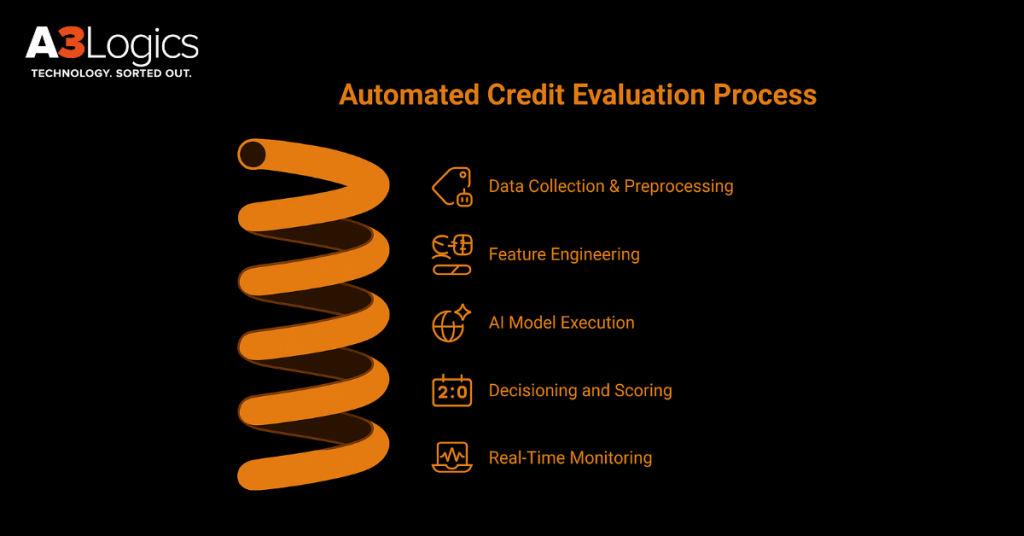
Before going ahead with AI credit evaluation software development, it is important to understand how it works.
> Data Collection & Preprocessing
Automated credit assessment starts with data collection and preprocessing, during which information is collected from various sources like credit bureaus, banking transactions, payment history, utility bill payments, and other non-traditional data like digital wallet usage or employment information.
Raw data can be incomplete or inconsistent, so preprocessing is essential to eliminate errors, delete duplicates, standardize formats, and adhere to data privacy laws. This process provides the basis for precise, and non-discriminatory credit assessment.
> Feature Engineering
Once ready, the data then transitions into feature engineering, where attention is paid to extracting meaningful predictors of money behavior. These may range from repayment frequency and debt-to-income ratio to spending patterns, saving behavior, and job stability. More advanced statistical techniques and derived variables, like credit utilization rates or income-to-loan ratios, are constructed to enhance predictive capability. Through careful construction of these features – the system optimizes both the accuracy and interpretability of credit decisions.
> AI Model Execution
The clean dataset is added into AI/ML model for predicting creditworthiness. These models on the basis of institution can differ from logistic regression and random forests to sophisticated gradient boosting machines or neural networks. This then produces a probability score on the basis of applicant repayment chances. Bias detection algorithms can be added for fairness, preventing the applicant from being discriminated against due to non-relevant or non-financial information.
> Decisioning and Scoring
Having set predictions, the process then moves to decisioning and scoring – whereby applicants are given risk ratings or credit scores. Banks set cut-offs that decide whether or not an application is approved automatically – rejected, or sent for manual examination. In addition to approval judgments, automated systems can also determine – credit limits, rates of interest, and repayment terms according to the applicant’s risk profile, thus balancing financial inclusion with sound risk management.
> Real-Time Monitoring
Last but not least, automated credit assessment includes real-time surveillance of borrowers even post-approval. Latest data streams, for example – repayment performance, income fluctuations, or market fluctuations, are constantly examined to update risk profiles. This real-time monitoring enables lenders to identify early warning signs of financial stress or default risk. Models are also updated on a periodic basis to incorporate changing borrower behavior and macroeconomic developments, so that credit decisions remain relevant and reliable over time.
Why Automated Credit Evaluation Matters?
The relevance of AI credit evaluation software development – is higher than ever before. The world’s financial system is more intricate, diverse, and data-intensive than ever. Here’s why AI agents in credit scoring are becoming indispensable:
1. Speed and Efficiency
The AI agents in credit scoring can review thousands of applications within minutes, compared to days and weeks when done by human analysts. This not only presents a quicker means of enhancing customer experience, but allows lenders to scale operations without necessarily increasing employees at their disposal.
2. Scalability and Cost Reduction
Whether it’s a fintech start-up or a multi-national bank, AI-powered systems provide credit risk assessment on a scalable basis without the incremental expense of heavy staffing in an underwriting department. With intelligent automation, the financial institutions save significantly in terms of operational expenses.
3. Accuracy and Predictive Power
The AI agents in credit scoring discover small trends and correlations of information that a human may easily overlook. That translates to better credit scoring, fewer defaults and better health of the loan portfolio.
4. Inclusion and Accessibility
The traditional credit systems normally exclude individuals with a bad credit record. The AI agents widen access to credit by employing secondary data points like mobile phone behavior, internet payment behavior and workplace behavior.
5. Regulatory Alignment and Auditability
New-generation AI credit analysis tools are built to keep up with financial regulations. They also provide open decision-making frameworks that are audit-enabled, enhancing trust in AI systems.
Credit Risk AI Agents: Managing Risk Like Never Before
Credit Risk AI Agents are sophisticated, self-learning machines intended to transform the way financial institutions evaluate and manage credit risk. Contrary to conventional rule-based systems, these AI agents learn constantly from massive amounts of structured and unstructured data, including transaction information, payment history, market trends, and even non-traditional sources such as utility bills or digital traces. This enables them to give a real-time, 360-degree vision of borrower risk profiles.
They are able to replicate many different scenarios – for example stress-test loan books, and forecast likely defaults with much higher precision than traditional models. They have the decision-making power to go beyond static credit scoring to dynamic risk oversight. This enables banks, NBFCs, and fintechs to instantaneously modify – credit limits, pricing, or terms of repayment as borrower actions or economic conditions evolve.
Another significant benefit is their scalability and automation. AI agents are capable to process loads of applications at once and mark anomalies this has led to lower manual mistakes in underwriting. They also come with fairness and bias-checking features ensuring credit decisions stay compliant and unbiased.

How AI Agents Reduce Bias in Credit Evaluation?
Credit bias has existed for a long time, particularly against marginalized groups. The conventional credit framework tends to depend upon sparse historical records, which may incorporate and perpetuate prevailing socio-economic inequities. This is how the story is changing with AI in finance:
1. Inclusive Data Sources
The unconventional and diverse data data is taken into consideration by AI agents, such as gig economy earnings or the habit of making online payments, leveling the underbanked group’s opportunity.
2. Fairness-Aware Algorithms
The ethical AI algorithms are developed in a manner that minimizes bias and eliminates it through techniques such as adversarial debiasing or counterfactual fairness.
3. Continuous Model Audits
Current AI Agent Development Services include monitoring devices that assess models of discriminatory outcomes on a continuous basis, which assists in complying with the fair lending policies.
4. Explainable AI (XAI)
With XAI coming into play in AI credit evaluation software development, clear and readable model predictions make lenders and regulators vigilant and audit-proof decision-making.
Real-Time Credit Evaluation with AI Agents
One of the most revolutionary powers of AI in credit management is real-time assessment. While other systems do a credit risk assessment just once during loan origination, AI agents constantly track borrowers’ activity. Here’s what they can accomplish in real time:
- Identify sudden income or transaction declines
- Flag missed utility payments or late payroll deposits
- Update risk scores dynamically as borrower circumstances change
- Warn underwriters to initiate corrective measures (e.g., restructuring of loans)
This ongoing feedback loop prevents defaults and enhances loan recovery rates – a lifeline for lenders operating in high-paced economies.
AI Credit Analysis vs. Traditional Models
While old credit models are – inflexible, sluggish, and tend to be limited to confined datasets, AI-based credit analysis offers a brighter, more responsive way. With big data, automation, and sophisticated machine learning – AI facilitates swifter decision-making, more equitable lending, and better risk management for financial institutions.
Let’s compare them in depth for a better understanding.
| Aspect | Limitations of Traditional Models | Advantages of AI-Driven Credit Analysis |
| Data Handling | Relies mostly on structured financial data from credit bureaus and banks | Integrates structured + unstructured data (transactions, utility bills, digital footprints, social signals) |
| Accuracy | Uses static scoring models prone to outdated risk assessments | Continuously learns from new data, improving accuracy and predictive power |
| Speed & Scalability | Manual reviews make processing slower and less scalable | Automates credit evaluation, handling thousands of applications in real time |
| Risk Detection | Limited ability to capture subtle behavioral or market risks | Detects hidden patterns, early warning signals, and emerging risks dynamically |
| Fairness & Bias | Can unintentionally reinforce historical biases | Includes fairness checks and bias mitigation to promote equitable lending |
| Adaptability | Hard to adjust during economic shifts or crises | Easily retrains models to adapt to changing borrower behavior and conditions |
Conventional credit rating systems, although effective in the past, have severe limitations in today’s globalized financial environment. They are greatly reliant on formatted data like credit bureau reports and bank history – which may not always reflect the whole financial situation of a candidate. Consequently, most creditworthy individuals like gig economy workers, first-time borrowers, or non-formal banking population are left unpenetrated.
Further, static scoring models take time to respond to abrupt economic changes, resulting in out-of-date risk determinations and the failure to capture early warning signs.
Why Choose A3Logics for AI Agent in Credit Evaluation?
At A3Logics, we create smart, secure, and unbiased AI agents for credit assessment to enable financial institutions to automate and enhance credit decisions. Here’s how the leading AI development company A3Logics makes a difference.
> Proven AI Expertise
We have expertise in crafting tailored AI agents for credit risk assessment with rich technical and financial domain experience.
> Bias-Resistant & Explainable AI
Our AI credit evaluation software development solutions are built to reduce bias and provide transparent, auditable decision flows — ensuring fairness and transparency.
> Real-Time Credit Evaluation
We facilitate real-time risk assessment with dynamic borrower monitoring to curtail defaults and enhance responsiveness.
> Fully Customizable Services
From data pipes to UI integration, we provide end-to-end, scalable credit evaluation systems adapted to your workflow.
> Compliance-Ready & Secure
Our AI credit evaluation software development, comply with international regulations such as FCRA, GDPR, and ECOA, with inherent data security and privacy best practices.
Our work doesn’t just end here; our experts also provide long-term support, periodic model updates, and performance tuning to ensure your credit systems remain accurate and effective.
Future Outlook: AI and the Democratization of Credit
With the rise of AI credit evaluation software development, the future of credit assessment is being reshaped with a strong push towards democratization of credit. Once upon a time loans and financial products were only accessible to those with well-established credit histories. And millions of people and small businesses were not given the opportunity to work outside the formal banking systems. With AI in financial modeling the potential for bridging this gap through potential datasets has increased.
It offers various alternative options such as utility payments, digital wallet usage, e-commerce transactions and even mobile phone activity for evaluating credit worthiness making credit accessible to many.
AI systems are evolving and not only increasing the accuracy and boosting risk prediction but also they are bringing in fairness and transparency into lending decisions. Bias detection and Explainable AI models help the financial institutions make decisions that are profitable while being compliant across regulatory frameworks.
Plus with adaptive scoring coming into play lenders can automatically adjust credit limits and loan terms for making sure that both the borrower and institution is safe.
At a global level, the use of AI in credit analysis may spur financial inclusion by supporting underserved communities, micro-entrepreneurs, and consumers in emerging markets. By reducing entry barriers – AI-based credit systems can unleash new economic opportunities and encourage social mobility. In the years ahead, we can look forward to AI changing the face of credit evaluation from a static – exclusionary process to a dynamic, inclusive, and data-driven ecosystem that empowers lenders and borrowers alike.
Final Thoughts – AI Agent in Credit Evaluation
With the changing financial landscape, auto-credit evaluation is not a choice anymore – it’s a necessity. With real-time decision-making to mitigate systemic bias, automated credit evaluation system agents are transforming the way lenders evaluate risk and provide access to credit.
AI credit evaluation software development already is changing how businesses onboard, underwrite, and manage portfolios. Businesses using modular – real-time AI credit analysis are lowering risk exposure, enhancing compliance, and growing faster than their peers. The future of credit workflows is modular, explainable, and auditable, and it’s available right now.