
The traditional car insurance claims process can be challenging for both policyholders and insurers. Where insurers have to deal with manual paperwork and multiple verification steps, policyholders are often left waiting for the exact status of the claims. And, even after diligent efforts, insurers and policy providers can still make errors, hampering customer experience.
With AI Car Insurance Claim Approval System Development, things can be made hassle free. The growing adoption of AI in insurance can be highlighted by the fact that 82% of insurance companies are now using AI in claims processing.
In this post, we’ll discuss how AI Car Insurance Claim Approval System Development is revolutionizing the industry. We’ll also dive into the challenges, benefits, and everything that goes into building a smarter, faster, and more transparent claim approval process powered by artificial intelligence.
> Importance of fast and accurate claim approvals for insurers and customers.
A digitized claim processing system can boost efficiency, customer experience and cost effectiveness. Here’s how –
1. Customer self service portals
By developing AI car insurance claim system, you can offer your customers a self serving tool that lets them submit a claim and get hassle free follow up on the progress.
2. Automate front and back office operations
Once a claim is submitted, AI powered tools can extract data and evaluate the request. After evaluating the data, it is moved to necessary systems so that further actions can be taken.
3. Cost savings
AI based systems automate repetitive tasks, those that require additional manpower. By reducing staff not only do these systems save cost on their salaries but also add accuracy in operations. The systems can work for a long time without making any errors.
> Introduction to AI Car Insurance Claim Approval System Development
AI is changing auto insurance claim approvals by automating tasks. In that, role of AI in auto insurance claim management software includes assessing vehicle damage, detecting fraud, and verifying documents. By automating such processes, insurers can approve claims faster while ensuring that there are no errors.
What is an AI Car Insurance Claim Approval System Development?
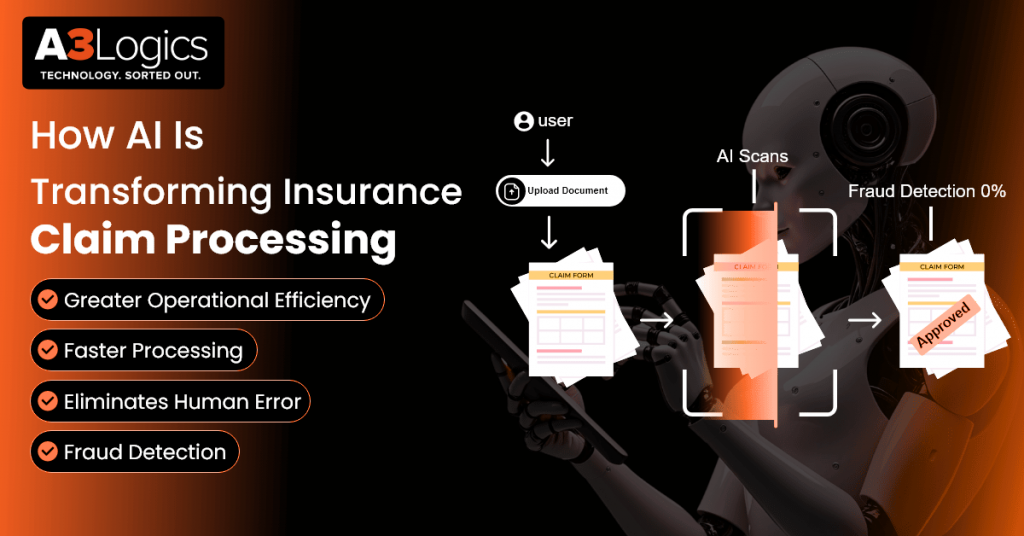
An AI powered car insurance claim approval system uses artificial intelligence to automate the entire claim process; right from the time claims are submitted to the time the payout is released.
The process begins with filing a claim. They provide details of the incident in the form of photos and documents. The AI evaluates these details and routes it based on complexity. Next, AI technologies such as computer vision, natural language processing and others analyze the submitted data.
The embedded algorithms check for anomalies. If found correct, the AI generates and estimates and further sends the claim for human review. Since the process is not entirely automated, a human adjuster looks at nuanced details to make better judgement.
How AI integrates with existing insurance systems?
AI integrates with existing insurance systems by connecting core platforms through APIs, modernizing legacy code and using a modular “ecosystem” approach to augment specific business functions. The integration enables AI tools to automate and enhance operations such as claims processing, underwriting, and customer service.
Challenges in Traditional Car Insurance Claim Processing
1. Manual verification delays
Traditional claims processing relies on manual data entry, multiple handoffs between departments, and paper-based workflows. To process each step, a significant amount of time is required. As a result, claims often sit in queues for manual review, not to mention the complex approval chains that staff struggle with. Furthermore, the staff spends several hours in repetitive data entry instead of focusing on serving customers. Things can get even worse during peak periods or when there is a staff shortage.
2. Human errors leading to inaccurate claim approvals
Insurers may end up miscalculating repair costs, incorrectly assessing damages, or overlooking policy details. Such discrepancies can hinder claim approvals. Policyholders, on the other hand, might receive an accurate settlement amount, i.e., it could be less or more. In either case, this can result in losses for insurers and damage their credibility.
3. High operational costs
In the case of traditional car insurance claims, you have to employ staff who can handle various claim processing tasks, such as verifying documents, handling paperwork, etc. This implies spending more on employees and resources. Apart from this, additional operational costs include manual data entry, error corrections, printing and storing documents, and other similar expenses.
4. Risk of fraudulent claims
In contrast to an AI-driven car insurance claim system, traditional systems are often unable to identify fraud effectively. The manual review procedures are both laborious and prone to errors. These costs insurers money and increase policyholders’ premiums.
5. Poor customer experience due to slow processing
In terms of traditional car insurance claim processing, errors arise when claims depend heavily on manual assessment of vehicle damage, paperwork coordination, and policy coverage.
How AI Transforms Car Insurance Claim Approval?

1. Automated Claim Intake
In an AI car insurance claim system, AI chatbots and smart forms are used. AI-powered chatbots assist customers in filing and validating claims, as well as providing real-time updates on their claim status. Smart forms, on the other hand, make car insurance claims fast and accurate. They guide users in checking documents, assessing damage with AI, spotting fraud, and routing claims automatically.
2. Document & Image Analysis
An AI car insurance claim system developed by a computer vision development company conducts damage detection using advanced algorithms. These systems can match a car with evidence documents and identify damaged car elements, and further, estimate the preliminary charges and repair costs.
3. Predictive Risk Analysis
AI evaluates claim validity and estimates costs. It anticipates risks and trends based on historical and real-time data. Predictive analytics powered by AI can detect high-risk car insurance claims, enabling targeted investigations. Using the heads-up, insurers can focus on these and save themselves from incurring a loss.
4. Decision Support & Approval
Through AI car insurance claim system development, you can develop systems that enable AI-assisted or fully automated approvals. AI in insurance can help insurers make informed decisions regarding common types of claims. They can easily analyze uploaded vehicle photos to detect damage, verify coverage, and review the claim process in a matter of seconds.
5. Customer Communication
An AI-powered car insurance claim system establishes a smooth communication with customers regarding their claim. At every stage of the claim; instant updates are sent to the customers via app or email. This way, both policyholders and insurers can stay informed.

Benefits of an AI-Powered Claim Approval System
AI car insurance claim systems offer several benefits. Some of them are mentioned below –
1. Faster Claim Processing
By automating time-consuming tasks such as data entry and document verification, AI-based claim approval systems shorten the claim resolution cycle; from weeks to minutes. Not only can insurers process claims faster, but they can also process larger volumes of claims accurately.
2. Improved Accuracy
AI in insurance automates data extraction with the help of optical character recognition. This minimizes chances of manual errors, and helps in performing real-time data validation and compliance checks; reducing claim denials.
3. Fraud Detection
Using predictive analytics and machine learning, insurers can analyze past and present claims. Based on this, they can identify anomalies and patterns that indicate potential fraud. This lets insurers flag suspicious cases for further investigation before releasing a payout.
4. Cost Efficiency
By developing AI claim approval systems, you can help institutions reduce costs. Here’s how – the AI-powered systems reduce operational expenses associated with managing and processing claims. With this functionality, AI lowers administrative costs and eliminates rework.
5. Enhanced Customer Experience
AI-powered car insurance claim systems make the claim process faster and transparent. Customers can easily file and track claims through self-service portals, while real-time updates keep them informed at every stage until the final payout is released.
6. Scalability
As opposed to traditional systems, AI-based claim approval platforms can automatically process several claims simultaneously with speed and accuracy. AI-based claim approval systems can handle increasing numbers of claims efficiently, and that too, without slowing down or recruiting staff.

AI Use Cases in Car Insurance Claim Approval
1. Automated Claim Intake
Automated claim intake in AI car insurance claim approval works by using AI technologies such as computer vision to analyze uploaded videos and images of vehicle damage, optical character recognition (OCR) to read documents’ text and natural language processing (NLP) to interpret text from reports and forms. Cumulatively, these technologies capture and organize claim information faster.
- Also Read: AI Claims Management Software Development in Insurance: Use Cases, Benefits, and Challenges
2. Damage Assessment via Computer Vision
After the policyholders upload the photos and videos of the damaged car, the system uses computer vision to detect damage components like scratches, dents, and broken parts. It accordingly estimates repair costs and generates a damage report.
3. Fraud Detection and Prevention
Through automated claim approval software development, you can have systems that analyze incoming claims, policy updates, and customer interactions in real-time. The tools can spot suspicious behavior and alert insurers to take actions promptly. Since AI models are trained on vast historical fraud datasets; the tools can recognize patterns that are typical to fraudulent activities.
4. Predictive Claim Risk Analysis
Using predictive analytics, an AI-based car insurance claim approval system uses historical claim data, policyholder information, and external factors to assess the potential cost of a claim. The AI system predicts which claims may be prone to fraud, high-risk or likely to exceed typical costs. Based on this prediction; insurers can prioritize investigations, allocate resources efficiently and make informed decisions as far as approvals are concerned.
5. Automated Document Processing
AI car insurance claim approval systems use machine learning, natural language processing, and deep learning to automatically process unstructured data in various insurance documents such as invoices, claim forms, etc. Insurers needed manually enter data, or even oversee processes, every now and then.
6. Integration with Telematics and IoT
When processing car claims, AI-based systems leverage telematics and IoT to collect real-time data from vehicle sensors. They capture details such as impact, speed, and location during a mishap. The AI analyzes these details to assess damage, and reports any possible frauds. It further reduces eliminating the need for manual inspection.
Key Technologies Behind AI Claim Approval Systems
> Machine Learning Models
Machine learning models train systems on vast data consisting of historical claims. Over time, the systems are able to predict outcomes and improve accuracy without much human involvement. The machine learning models are further backed by predictive analytics to analyze customer behavior and other risk factors to forecast potential costs.
> Computer Vision
It allows the AI to see and interpret visual data. For instance, AI can analyze uploaded photos and videos of damaged vehicles. Next, the system accurately detects damage like scratches, dents, broken parts, etc. Based on this, it processes the damage assessment; estimates repair costs and helps the AI system to either approve or reject the claim.
> Natural Language Processing
This element of an AI-powered car insurance claim approval system enables AI systems to process unstructured, text-based data from multiple sources. It is often pared with Optical Character Recognition to extract key information from medical reports, claim forms, customer emails, etc It uses advanced large language models to summarise key details for insurers so that they can extract relevant information in a very short span of time.
> Robotic Process Automation (RPA)
During automated claim approval software development, bots are deployed in the system. These help automate high-volume, repetitive and rule-based tasks. For example, RPA bots can automatically transfer data between various applications and legacy systems. In addition to that, they can automate data entry from First Notice of Loss (FNOL).
Implementation Considerations for Insurers
> Integration with existing claim management systems
A smooth integration of AI car insurance claim system with an existing claim management system is essential. This can be made possible by leveraging APIs and middleware solutions that help synchronize AI-driven processes with existing databases. Also, insurers won’t need to tweak their existing infrastructure.
> Data privacy and security compliance
When implementing AI in insurance systems; considering data privacy and security compliance needs is key. AI-based claim systems handle a lot of sensitive customer data. Hence, complying with privacy laws such as HIPAA and GDPR is critical. To adhere to these measures, insurers must implement strong encryption, secure data storage, and role-based access.
> Training AI models with historical claim data
During AI car insurance claim system development, insurers should use extensive datasets covering a variety of claim system scenarios. By using various scenarios and training the models regularly with updated data; the systems will remain accurate. Furthermore, they will be able to adapt to new patterns.
> Balancing automation with human oversight
There is no denying the fact; that AI enhances claims processing and can help in reducing mistakes. However, humans are still required when dealing with unclear or complex cases. Therefore, insurers should use a system where AI can manage simple claims and humans can check cases involving disputed claims.
> Measuring success: KPIs for speed, accuracy, and customer satisfaction
The success of AI car insurance claim system widely depends on various factors. To evaluate success, insurers should look at key performance indicators such as approval accuracy, claim processing time, fraud detection rate, and customer satisfaction (CSAT) scores. By measuring these metrics, you can identify bottlenecks, assess ROI, and accordingly tweak the AI car insurance claim system to improve it.
How A3Logics Can Help?
1. Custom AI Claim System Development
- As a leading insurance software development company, A3Logics delivers custom AI solutions to automate claim intake, assessment, and approval. The systems we develop help institutions reduce manual efforts; accelerate settlements, and minimize errors.
- We integrate AI-powered claim systems with your existing insurance management tools. This lets insurers adopt advanced automation without hampering current processes.
2. Advanced Computer Vision & NLP Integration
- Our systems perform automated damage assessment using computer vision for accurate repair estimates; they automatically analyze vehicle damage from uploaded photos and videos. Using this, insurers can perform faster assessments and estimate repairs accurately.
- NLP-powered document processing for faster claim validation.
Using NLP, A3Logics’ AI solutions extract and process information from unstructured documents such as invoices, claim forms, and customer emails. This enhances claim validation. At the same time also eliminating manual data entry errors.
3. AI models that detect anomalies and prevent fraudulent claims.
A3Logics develops AI models that analyze claim data to detect inconsistencies, and potential fraud patterns. By flagging suspicious claims early, insurers can prevent fraudulent payouts and increase customer credibility.
4. End-to-End AI Development Services
A3Logics provides end-to-end AI development services. We start by studying your claim processes to find automation opportunities. Then, we train AI to manage key tasks like damage assessment, document checks, and fraud detection, and integrate it with your platforms for smooth, efficient operations.
Conclusion – AI Car Insurance Claim Approval System Development
Filing auto insurance claim has been slow, paper-work heavy and tedious. With advances in AI car insurance tech, much of these process can be automated, from damage assessment, claim intake, to settlement recommendation, customer communication and more. Insurers can now rely on AI powered tools to accelerate car insurance claim processing. Through this blog, we saw how AI powered automated claim approval software development can revolutionize the auto insurance landscape.