
Machine Learning (ML) is transforming the banking industry by automating workflows, improving decision-making, and providing highly personalized services. Banks are using ML to detect fraud in real-time, underwrite credit smarter, predict risks, and provide customers with efficient support. This change is not only enhancing the efficiency of operations but also transforming customer experiences, which allows banks to be more responsive to changes in the market and customer requirements.
Google has identified four key building blocks for Gen AI in banking: explainability, regulation, privacy, and security. The role of AI and Machine Learning in banking is increasing with the change in customer expectations. These technologies ensure that banks are ahead of future risks, regulations, and cybersecurity threats as well as facilitate innovation. ML-based solutions promote strategic benefits, enhance profitability, and long-term sustainability.
What is Machine Learning in Banking?
Machine learning in banking refers to the application of smart algorithms that interpret past financial information to predict or make decisions. It allows banks to process the intricate customer and transaction patterns automatically without the involvement of human resources.
ML models efficiently assist primary banking tasks like fraud prediction, credit scores, and customer segmentation, by learning through experience. The major technologies involved are:
> Artificial Intelligence
AI forms the basis that enables machines to replicate human decision making and reasoning. In the banking industry, it drives high-level automation, virtual assistants, and intelligent systems that process data to provide real-time insights in an effective manner.
> Data Analytics
It is the process of analyzing structured and unstructured data in order to identify useful information. It makes sure that the ML algorithms are applied to clean and accurate data, which enables banks to project trends and measure performance accurately across operations.
> Natural Language Processing
NLP helps computers to read and comprehend human language, written or spoken. In banking, it assists chatbots, sentiment analysis, and document classification through interpretation of customer messages and extraction of meaningful information with the required accuracy.
> Predictive Modeling
It refers to statistical methods and algorithms that forecast probable future events. This enables banks to predict credit defaults, fraud and effectively manage customer churn through trend identification, based on transactional history.
Machine Learning vs. Traditional Data Analysis in Banking
Adaptive Learning
The traditional models are not trained to acquire the new patterns of data, while ML is learning continuously. With the variation in customer behavior or fraud methods, the ML models automatically adapt to ensure that predictions remain accurate and reliable.
Scalability
Traditional analysis cannot work with huge amounts of data, whereas ML can efficiently process large amounts of data. It can process millions of transactions fast and precisely, uncovering useful patterns that can be easily missed by manual methods or simple statistical tools.
Complex Pattern Recognition
The traditional models usually rely on the linear relationships among variables, which do not provide a lot of insights. ML detects more profound and non-linear relationships among several variables, assisting banks to reveal some hidden behavioral trends that signal risks or new opportunities.
Automation
Traditional analysis involves human experts manually following and interpreting results. ML automates all these decision-making processes, credit score, fraud detection, and risk control in real-time with less human involvement and increased operational efficiency.
How is Machine Learning Used in Banking?
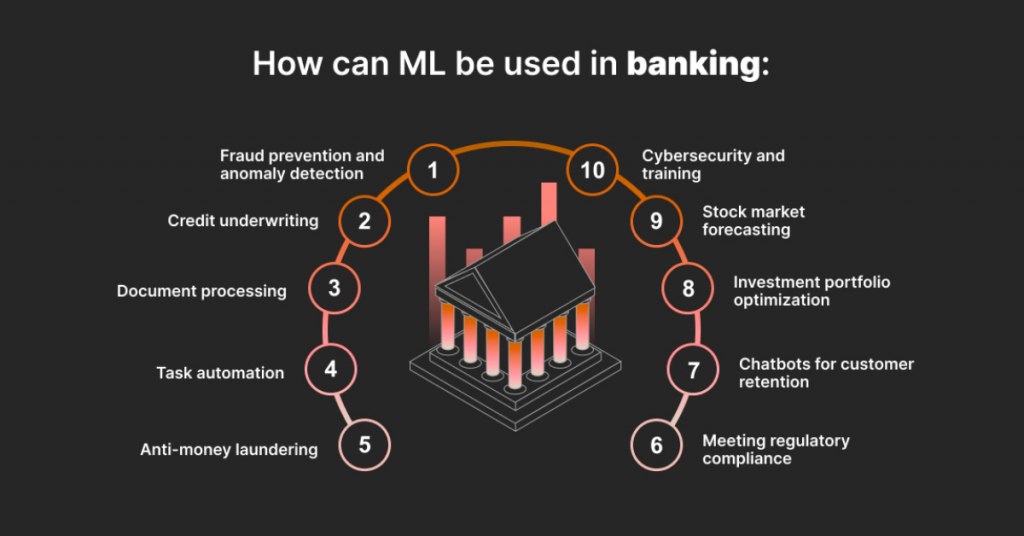
1. Credit Underwriting
Machine learning in banking transforms the process of credit underwriting by using a large amount of data to identify the creditworthiness of a borrower. Conventional approaches rely on fixed credit ratings and simple financial measures. However, behavioral information, income trends, spending patterns or even alternative information like utility payments or online activity are processed by ML models. This strategy provides a more dynamic and correct image of the financial reliability of a borrower.
These models assist banks in automating loan approvals and minimizing human bias in decision-making. They are able to instantly evaluate applications, estimate the likelihood of a risk, and allocate individualized credit limits. The predictions made by models become more accurate as they keep on learning through the repayment histories. This results in accelerated approvals, reduced defaults and better customer experience in lending processes.
2. Fraud Detection
Fraud detection is one of the most impactful machine learning applications in banking today. ML algorithms keep track of millions of transactions and detect suspicious behavior by analyzing spending patterns, location discrepancies, and behavioral patterns. Through the process of analyzing the structured and unstructured data, the models can identify anomalies, which can suggest card fraud, identity theft, or manipulated payments, before the harm is done.
With fraudsters constantly evolving their tricks, ML systems keep up with the advancement to identify the new threats without being manually reprogrammed. These models minimize the occurrence of false positives while making sure that valid transactions are not misidentified. This technology enables banks to keep security, protect assets, and build customer trust in an efficient and effective manner.
3. Hyper-Personalization
One of the most transformative machine learning use cases in banking is hyper-personalization. ML models study detailed behavioral and transactional data to learn the preferences, goals, and life stages. With this knowledge, banks will be able to offer a personalized product like credit cards, loans or savings plans. Such accuracy will boost interest and the chances of product acceptance.
Hyper-personalization also allows timely offers with the appropriate channels, including mobile apps or emails, and this guarantees response rates. Predictive analytics assists banks in knowing what the customers will need next. The more customers interact, the more models can optimize their knowledge, and this gives a feedback loop that brings long-term loyalty and customer lifetime value.
4. Task Automation
Machine learning is useful in automating some repetitive and time-consuming tasks that were formerly done manually by the banks. With intelligent automation tools, processes such as KYC verification, reviewing of loan documents, data entry, and compliance reporting are done. These systems detect patterns, information and verify data with a high degree of accuracy.
Automation of manual operations helps banks to decrease operational failures, increase speed and efficiency of service delivery. The staff members are relieved of the monotonous administrative operations and are able to focus on more important strategic tasks. This not only reduces costs but also increases productivity within the departments. ML enables task automation, which allows accuracy, consistency, and reduced turnaround time during day-to-day banking processes.
5. Cybersecurity Enhancement
Machine learning in banking is one area that enhances digital security by actively identifying threats in cybersecurity. ML systems constantly track network activity, logs on the server, and patterns of user access in order to detect anomalies that could signal cyberattacks. They identify anomalous access behaviour, unauthorized entry or data exfiltration attempts in a timely and precise manner.
Instead of using pre-defined rules, as traditional security systems do, ML-based cybersecurity uses past attacks to draw conclusions about future vulnerabilities. This allows real-time incident response, threat classification as well as automatic mitigation. These systems evolve over time, providing smarter and faster defense mechanisms to the banks. This strategy greatly minimizes cyber threats in terms of breaches, downtime and financial losses.
6. Risk Management
ML for risk management in banking is vital for maintaining financial stability and resilience. Machine learning models assess the market data, the performance of loans, and the macroeconomic indicators to predict possible risks. They find credit, liquidity and market risk more precisely, as they determine intricate connections among variables that are not considered by the traditional models.
ML can be used in stress testing and scenario planning by modeling market shocks or interest rate changes. This helps banks to make good decisions concerning portfolio diversification and capital distribution. Early signs of default or market volatility are also observed using predictive analytics. Consequently, banks can reduce exposure, optimize portfolios and obey regulatory requirements in a better way.
7. Chatbots and Virtual Assistants
Chatbots and virtual assistants have become important machine learning use cases in banking for customer service transformation. Such AI platforms can respond to thousands of customer questions simultaneously and provide immediate answers on a 24/7 basis. Chatbots use natural language processing to find the intent of the customer and deliver a contextual solution in real time, which is personalized.
They also help reduce workload of the customer service team since they respond to routine inquiries such as account balances or transactional issues. When needed, they automatically transfer more complicated cases to human agents. Virtual assistants get better as time progresses, increasing the quality of conversation. This will result in a more productive, responsive and satisfying customer experience through various service channels.
8. Document Processing
Document processing is one of the most practical machine learning applications in banking that enhances back-office efficiency. Machine learning eases the handling of documents through optical character recognition and NLP that identifies important data with accuracy. It categorizes documents, validates data fields and marks inconsistencies to be reviewed by humans when necessary.
This smart automation will lessen the workload and improve the accuracy of data management. It also guarantees quicker turnaround for activities like loan processing, KYC validation and compliance reporting. Working with document-intensive workflows, ML helps banks to be efficient in their operations, preserving accuracy and safety. This ultimately reduces errors, speeds up approval and boosts compliance readiness throughout the organization.
Benefits of Machine Learning in Banking
1. Improved Personalization
Machine learning in banking facilitates hyper-personalized services through the analysis of customer behavior, spending habits and preferences. It assists the banks in prescribing the appropriate products, like credit cards or investment plans, at the most appropriate time. These models can adjust to changes in customer lives through continuous learning so that each of the offers is relevant, engaging, and aligned to personal financial needs.
2. Reduced Operational Costs
Automation of machine learning helps the banks reduce the human resources and administrative workload. The checks on document verification, data entry, and compliance are faster and more accurate. This greatly reduces human error and resource costs. In the long term, banks become more efficient in their operations without compromising on quality of services and this enables staff to focus on strategic and customer-centric initiatives.
3. Accelerated Decision-Making
Making faster and data-driven decisions is one of the important benefits of machine learning in banking. Credit checks, fraud detection and risk assessment are done in real time and this enables banks to act swiftly as per the demands of the customers. This speed enhances competitiveness and customer satisfaction. Faster decisions can also allow the leadership to make strategic decisions in a timely manner with the help of trusted and factual information-based intelligence, making the business more agile.
4. Enhanced Fraud Prevention
Machine learning for fraud detection can assist banks in detecting suspicious activities before it is too late and money has been lost. Backed by the constant monitoring of the transactions, ML models identify suspicious spending patterns and raise alerts in real time. They likewise adjust to new fraud methods as criminals change their tactics. This ongoing learning guarantees increased security to the bank and its clients, creating a long-lasting trust and dependability.
5. Better Risk Management
ML for risk management in banking is a tool that facilitates proper prediction of possible risks like market change or loan default. Algorithms process past and live data to identify emerging risks in a timely manner. This assists the banks in undertaking preventive measures before things get out of control. Regulatory compliance and portfolio optimization can also be facilitated with the help of predictive modeling, which makes institutions more sustainable in unstable economic conditions.
6. Streamlined Customer Support
Chatbots and virtual assistants can guarantee continuous customer support and immediate response. They solve routine questions effectively, leaving human agents with complex cases. As time goes by, these systems acquire customer preferences and become more accurate. This leads to faster resolution, uniform service delivery and a more fulfilling and personalized banking experience that builds long-term customer relationships.
7. Improved Credit Scoring Accuracy
Machine learning improves credit scoring because it considers a wider scope of information than the traditional credit report. It incorporates behavioral trends, records of transactions and alternative financial information. This results in more favorable and inclusive credit ratings. The models are constantly upgraded, thus increasing accuracy as time progresses, allowing the banks to approve more dependable borrowers with reduced chances of default and limited operational losses.
8. Efficient Document Processing
One of the most practical benefits of machine learning in banking is operational efficiency. Loan forms, identity proofs and compliance reports can be handled by banks with minimum human effort. This reduces delays or errors and simultaneously maintains high levels of accuracy. As a result, it results in quicker, more trusted and cost-effective operational workflow, thus improving compliance efficiency and overall productivity.

Machine Learning in Banking: 4 Key Implementation Steps
> Identify Your Business Case
Application of machine learning in banking commences by setting clear objectives that will support strategic business priorities. Banks ought to define areas of pain during their operations, like loss of money through fraud, delay in loan approvals, or client turnover. The management can prioritize investments by assessing which processes can be best automated or predicted using analytics.
After identifying significant issues, banks should set attainable objectives like increasing the rate of approval or decreasing fraud detection. This will make the ML initiative have a stated purpose and anticipated results. An effective business case offers guidance, stakeholder support, and adoption of technology in line with organizational strategy and return of investment.
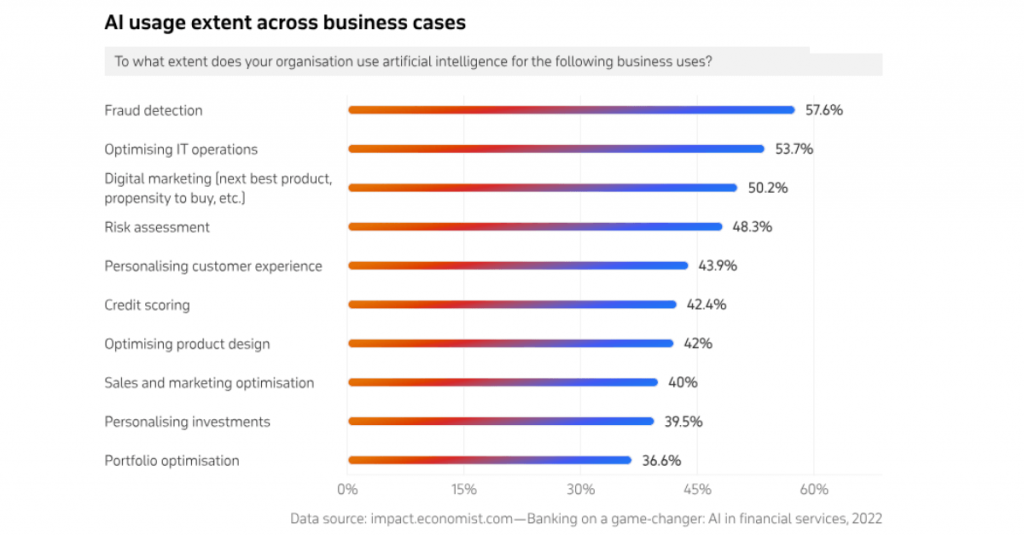
> Prepare Data
Every successful ML project is built on quality data. Banks need to gather and consolidate organized information like transaction history and account records, as well as disorganized information like documents and customer interactions. Cleaning, integration, and normalization of data are important stages that enhance the reliability and accuracy of the model.
There is also the need to observe good standards of governance and compliance during data preparation. Sensitive data must be anonymized and kept in a secure location to comply with the regulatory standards. With a properly structured data ecosystem, the banks can then employ it to train ML models that offer consistent, trustworthy and meaningful predictions for various business functions.
> Understand Your Algorithms
The selection of an appropriate algorithm will define the success of an ML solution in a banking context. Supervised learning models can be used in credit scoring or detecting fraud, whereas unsupervised models can be used when it is necessary to segment customers or identify anomalies. Reinforcement learning can help to optimize decision-making in the pricing sphere or management of investments.
Banks are also faced with the challenge of balancing model accuracy and interpretability as regulations tend to demand explainable results. Regular testing, validation as well as monitoring of the performance helps to check that the algorithms are not biased and are effective. Recognizing the capacity and constraints of the individual models allows banks to implement ML solutions that are ethical, efficient and compliant.
> Help Your Employees Adapt to Change
The adoption of ML requires not only technology but people as well. To make sure that the objectives of the project are aligned, banks should promote coordination between data scientists, engineers, and business teams. This collaboration contributes to the smooth integration of ML solutions into current work processes and decision-making models.
Employees should also be trained and made aware of how to work with AI-driven systems without fear. The staff should learn how to interpret the outputs of models and apply data in a responsible manner. Promoting a culture of innovation and flexibility should help banks to achieve easy integration of ML technologies and ensure the maximum value of digital transformation in the long term.
How A3Logics Can Help?
Machine learning in banking requires an appropriate combination of technical skills, domain knowledge, and integration experience. A3Logics is a company with years of experience in AI development services, and it provides banks with tailored solutions that are aligned with their business objectives. The following are some of the ways through which A3Logics can assist banks to make the most of machine learning:
> Custom ML Model Development
A3Logics creates and trains customized ML models to solve certain banking needs. These include fraud detection, credit scoring, and process automation. Their models are developed with quality information and superior algorithms that will give an accurate prediction, a robust performance, and a full commitment to the operational goals of the bank.
> Fraud Detection and Risk Analysis Solutions
The company develops smart fraud detection engines to detect anomalies in real-time transactions. Their solutions minimize false positives and are used to identify hidden fraud patterns. A3Logics also creates predictive risk analysis solutions that determine the exposure of the portfolio, investment optimization strategies, and regulatory compliance.
> End-to-End System Integration
A3Logics makes it easy to integrate ML models with the existing infrastructure of a bank. This involves linking models to the core banking system, CRM and data warehouse. Their team offers AI consulting services, workflow automation, and monitoring tools that bring the machine learning insights to business teams in a convenient way.
Conclusion
Machine learning in banking is changing the way financial institutions work, innovate and serve their customers. ML helps provide efficiency, security, and personalized banking experiences, all of which contribute to growth and reduce fraud detection. Nonetheless, effective implementation requires a clear strategy, comprehensive data, and seamless integration.
Partnering with banking software development experts such as A3Logics would make sure that banks implement ML in the most responsible and efficient way.