
Applying Machine Learning and AI to credit risk modeling is now the core focus of the finance industry that is transforming lenders’ assessment of borrower risk. Credit risk modeling has long relied on statistical techniques and past data, but AI models deliver a more precise and real-time solution due to advances in complex algorithms and computer power.
Organizations can discover new insights and development opportunities while minimizing credit risk using AI and machine learning. By facilitating the convergence of various data sources – including social media usage, and transaction records, these technologies enhance risk analysis and provide greater access to loans for underserved populations. Moreover, the AI for credit risk modeling evaluation methodology is more flexible and scalable . This enables it to respond to evolving market conditions and regulation requirements.
In this blog, we will provide a holistic method for addressing the in and outs of creating credit risk models using AI development services. Banks and other financial institutions – can gain deeper knowledge about the, creditworthiness of borrowers, improve lending decisions, and lower default risk. This is done using – advanced data analytics, predictive modeling, and algorithmic approaches.
From understanding the fundamentals of credit risk to discussing cutting-edge role of AI in banking, this blog gives a complete summary of the key concepts, methods, and issues involved in building AI-based credit risk models.
Credit Risk Modeling – A Overview
Credit risk is the loss the happens to an investor or lender when a borrower does not repay their loan or meet financial obligations. This is a natural part of lending and investment that stems from the uncertainty around a borrower’s ability or their willingness to repay the debt. There are -economic conditions, industry circumstances, borrower features, and credit agreement terms that influence credit risk.
Credit risk models are essential in the financial sector as they enable, lenders and investors to evaluate and monitor credit risk properly. Credit risk models utilize statistical methods, past information, and financial metrics to measure the probability of default or non-payment by borrowers. The significance of credit risk models can be articulated as follows:
Risk evaluation
Credit risk models provide meaningful information on the creditworthiness of borrowers, enabling lenders to make sound credit extension and investment in financial products decisions. By estimating the probability of default and losses, the models facilitate risk reduction of financial losses for lenders and investors.
Pricing and risk-based decisions
Credit risk models drive pricing policies for – lending, bonds, and other credit products depending on the perceived level of risk. Interest rates, terms, and collateral terms are modifiable by lenders to mirror the risk profile of borrowers. Additionally, risk-based decisions like credit approvals, credit limit, and loan restructuring are governed by the findings derived from these models.
Portfolio management
Through portfolio management credit risk models help in asset allocation, diversification and risk optimization. Through the analysis of credit quality and performance of a single asset or borrowers in a portfolio, financial institutions are able to strike an optimal balance of risk and return requirements. This allows them to create diversified portfolios that meet the risk appetite of the organization as well as regulatory needs.
Regulatory compliance
Credit risk models are essential for regulatory compliance among financial institutions and especially banks. Regulatory bodies mandate credit risk measurement and management – including the Basel Accords – which stipulate the application of standardized approaches or internal models to compute regulatory capital reserves. Using sound credit risk models, institutions are able to achieve regulatory compliance and improve risk management.
How A3Logics Leveraged ML in Credit Risk Assessment?
Our client, a leading fintech company, was experiencing an escalating crisis as outdated risk assessment approaches made them unable to identify loan defaulters. This was causing higher level of bad debts, their investors were rapidly loosing confidence, inefficiencies due to human errors and rapidly decreasing profitability. They joined hands with A3Logics to transform their credit risk management through machine learning.
To help them with the issue A3Logics crafted a machine learning based model that seamlessly integrated with the client’s existing loan sanctioning process. Using Informatica the solution processed and consumed data, with the help of sophisticated algorithms risk rating was performed and Tableau dashboards gave real time intelligence. Ongoing learning pipelines made the model better with each use, building a forward-looking, future-proof system.
The outcome was revolutionary: $7.5M saved in bad debt, 3% growth in profitability, 2X gain in investors, and 100% transparent reporting. Employees were relieved of iterative work, customers experienced quicker and more equitable approvals, and investors regained faith in client’s performance.
This partnership was able to address the immediate problems, it was also able to set new standards for credit risk management for the fintech industry. Combining our technical expertise and people-first design method we got rid of the clients problems giving it a sustainable competitive edge.
Read in depth about what we offered them right here.
Types of Credit Risk
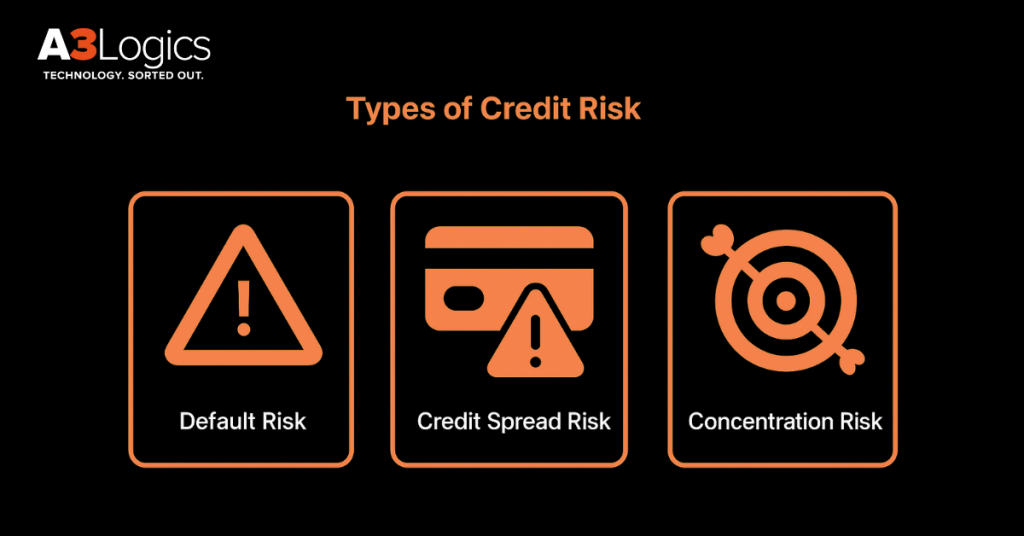
Majorly there are three types of credit risk. Default, credit speed and concentration risk. Let’s understand them in depth.
1. Default Risk
Also known as default probability and default hazard – default risk means the possibility of an individual to fail to repay a debt. This is the risk that occurs when borrowers default on their loans because they are unable or unwilling to repay, resulting in financial loss for lenders or investors. The causes of default risk are unfavorable economic conditions, worsening financial health of the borrowers, and shifting market dynamics.
Default risk can fluctuate based on the creditworthiness of the borrowers, collateral quality, and credit agreement terms. Also, did you know that banks that use AI driven predictive analytics have reported up to a 15% drop in loan default rates?
2. Credit Spread Risk
Credit spread risk, or spread risk or credit spread volatility, is the risk of negative movements in the spread between the yield on credit-sensitive securities (such as corporate bonds, credit default swaps) and risk-free securities (such as government bonds). This risk comes from shifts in market views of – credit quality, liquidity levels, and macroeconomic influences bearing on the pricing of credit instruments. Credit spread risk may affect the fixed-income portfolio valuation and performance – especially for portfolios that are exposed to credit-sensitive securities.
3. Concentration Risk
Concentration risk, also referred to as exposure risk or portfolio concentration risk, occurs when there is excessive dependence upon one borrower, industry sector, geographic area, or asset class in a portfolio. If a substantial part of a portfolio is highly concentrated within a specific entity or sector, the exposure to potential negative events impacting that entity or sector is heightened, making the portfolio’s overall risk exposure greater. Concentration risk may be caused by poor diversification strategies, market forces, or investor decision-making.
Financial Functions and Operations Impacted by Credit Risk
1. Loan underwriting
Loan underwriting, the process through which the lenders evaluate and assess the creditworthiness of potential borrowers. This function and operation is majorly affected by credit risk considerations. Let’s take an example here: the underwriting division of the banks properly evaluates mortgage applicants, analyzes various factors like income, employment details, credit score and property value to understand their repayment capacity and default risk.
When it comes to credit risk assessment underwriting plays a very important role in influencing the approval, pricing, and the loan structure. Lenders should be capable of balancing risk and return objectives while ensuring that they are complying with the regulatory standards and internal risk management policies.
2. Portfolio management
Another important function that is affected by credit risk is portfolio management. Especially when it comes to an investment portfolio that consists of credit sensitive assets like bonds, loans and structured products. Portfolio managers need to assess and monitor the credit quality, default risk and credit spread dynamics of personal security or asset classes for optimizing risk adjusted returns. If you want an effective portfolio management strategy you need to involve diversification, risk mitigation and an active monitoring of credit exposures to reduce the impact of adverse credit events on portfolio performance.
3. Regulatory compliance
Credit risk management is part of regulatory compliance for financial institutions that operate in highly regulated markets. Regulators place strict requirements on institutions to evaluate, monitor, and manage credit risk exposures to ensure financial stability and the interest of stakeholders. Regulatory compliance with standards like the Basel Accords, Dodd-Frank Act, and International Financial Reporting Standards (IFRS) involves implementing recommended methods. This important for measuring capital adequacy, stress testing, and reporting credit risk exposures.

Limitations of Traditional Credit Risk Models
The traditional credit risk models call for a transformation. The legacy models are not able to keep with the rising demand and have many limitations. A few of the drawbacks include
> Static nature of the models
The loan market is constantly changing and one of the major drawbacks of the traditional credit risk models are that they are based on static assumptions and data. This means that it is not able to capture the ever-changing dynamic of credit risk. These use fixed input variables and assumptions about borrower behavior, economic conditions, and market dynamics. This means there is limited scope for limited flexibility and adaptability.
It compromises the accuracy and predictive power as it is unable to understand the changes in creditworthiness, market conditions or the merging risk factors.
> Overreliance on historical data
Credit risk models often use historical data to forecast foreseeable credit loss and the probability of defaults. Although historical data offer useful information on past credit history and patterns – they might not reflect the full complexity and uncertainty of credit risk behavior in changing market settings.
Over dependency on historical data generally causes model bias, extrapolation mistakes and bad risk evaluation. This especially true during times of – economic distress or structural change in the financial system.
> Inability to handle complex and nonlinear relationships
The traditional credit risk models cannot identify complex interrelations and interdependencies between the factors that drive credit risk. Credit risk is determined by a number of variables – such as borrower profiles, industry conditions, and market mood. Classical models could either reduce these interrelations to oversimplifications or miss significant drivers of risk, leading to insufficient risk measurements and poor decision-making.
Advantages of Machine Learning in Credit Risk Assessment
Where on one side the traditional models are unable to meet the rising issues, businesses leveraging ML models for credit risk assessment are thriving. In this section let’s take a look at the various benefits that machine learning implementation can offer.
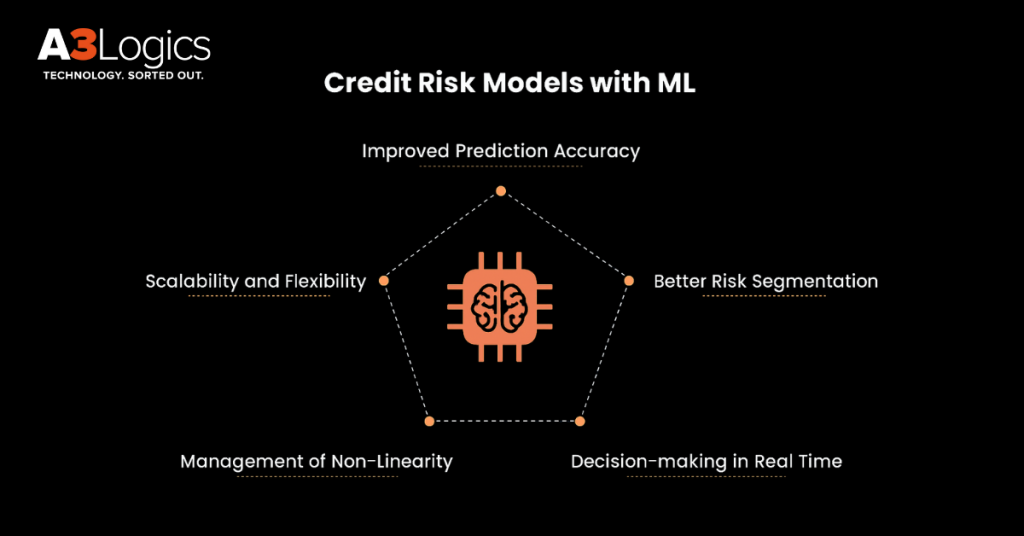
1. Improved Predictive Power
ML models for credit risk assessment beat conventional statistical approaches by pinpointing – nuanced, intricate patterns within big datasets. Financial institutions are thus able to, forecast defaults, delinquencies, or repayment habits with enhanced precision, drastically lowering credit losses.
2. Better Risk Stratification
Rather than lumping borrowers into broad groups, ML facilitates detailed risk profiling. It allows lenders to distinguish between low-, medium-, and high-risk borrowers more accurately, promoting fairer lending policies and better interest rates.
3. Real-Time Decision-Making
With ML-powered automation, lenders are able to process huge volumes of credit information, behavior signals, and transaction history instantly. This enables real-time loan approval, accelerated credit scoring, and better customer experience without any compromise in risk control.
4. Adaptability and Scalability
Machine learning in credit risk learns constantly from fresh inputs of data – evolving with changing borrower habits, economic cycles, or regulatory requirements. They scale without difficulties across millions of loan applications – and are well suited to both retail and enterprise lending.
5. Ability to Handle Non-Linear Data
Legacy models are not equipped to handle intricate, non-linear dynamics linking borrower traits and default likelihoods. ML is able to handle varied data types, social signals to transaction logs — detecting latent correlations that enhance overall credit risk assessment.
Use Cases of Machine Learning in Credit Risk Modeling
ML is transforming, how credit risk modeling works. In this section, we will take a look at the various use cases of machine learning in credit risk modeling.
1. Default Prediction
ML models analyze borrower history, expenditure behavior, income stability, and payment conduct to forecast the likelihood of default.
- Facilitates early risk detection to enable proactive interventions.
- Decreases non-performing assets by way of preventive measures.
- Boosts financial stability of lending institutions.
- Enables data-driven credit policy for inclusive growth.
2. Credit Scoring
In contrast to conventional methods – ML uses alternative datasets like utility bills, rent payments, mobile money transactions, and e-commerce transactions.
- Increases financial inclusion for the underbanked population.
- Produces more comprehensive and representative credit scores.
- Less dependent on stale FICO-type scoring models.
- Improved financial inclusion in new markets.
3. Risk-Based Pricing
With the intervention of ML – lenders are now able to modify interest rates and terms of the loan as per a borrower’s individual risk profile. It assists in ensures price is a function of true risk, optimizing profitability with fairness in lending.
- Facilitates fair pricing according to true risk.
- Improves profitability with optimized risk-return trade-off.
- Get sensible borrowing with clear terms.
- Less loss due to broad-brush loan pricing strategies.
4. Fraud Detection
ML detects anomalies in real-time. Such as unusual spending or identity mismatches, preventing fraudulent loan applications and transactions with greater speed and accuracy than rule-based systems.
- Recognizes identity theft, synthetic identities, and collusion.
- Highlights unusual patterns of transactions in real-time.
- Reduces false positives over rule-based systems.
- Builds customer trust by preventing fraud.
5. Portfolio Management
ML enables lenders to maximize loan portfolios through risk concentration forecasting across customer segments.
- Balances high-risk versus low-risk loans.
- Enhances return on assets with better allocation.
- Reduces exposure to the system in times of economic downturn.
- Delivers actionable insights for diversification tactics.
6. Credit Decision Automation
From applications to approval with ML driven automation there is low need of human interference. This means faster credit approvals, low bias and consistent decision making.
- Reduces human intervention and prejudice.
- Increases loan approvals and disbursements.
- Standard decisioning
- Improves customer satisfaction with quicker service.
7. Customer Segmentation
Borrowers can be segmented on income, risk segments, repayment ability, or lifestyle behaviors.
- Facilitates hyper-personalized lending products.
- Enhances marketing campaigns with targeted promotions.
- Improves repayment compliance by personalizing terms.
- Increases customer loyalty with relevant services.
8. Dynamic Loan Pricing
Loan terms and interest rates can be dynamically adjusted using ML models. Particularly that account for – market fluctuations, customer risk scores, and demand-supply conditions in real time.
- Reacts quickly to changing financial situations.
- Saves lender margins while remaining competitive.
- Offers transparency of loan terms.
- Matches customer affordability with market conditions.
9. Compliance Monitoring for Regulations
Machine learning helps to monitor whether it is being compliant to not. It does this by flagging non-compliant transaction, report generation and ensuring audit readiness with zero to less manual efforts.
- Identifies non-compliant or high-risk transactions.
- Reduces the cost of compliance using automation.
- Ensures audit and inspection readiness.
- Minimizes penalties for non-compliance.
10. Early Warning Systems
ML helps in identifying warning signs like lowering repayment abilities or a change in financial habit. This allows lenders to take preventative measures before any default escalation.
- Prevents defaults from minor problems.
- Facilitates timely restructuring of loans.
- Improves customer relationships with advance outreach.
- Reduces portfolio risk through early intervention.
11. Credit Limit Management
By continuously analyzing customer data ML, helps set and adjust credit limits dynamically. Ensuring responsible lending while maximizing customer engagement.
- Promotes responsible lending.
- Enhances customer engagement with flexible credit.
- Reduces overexposure to high-risk borrowers.
- Maximizes utilization rates for profitability.
12. Collections Optimization
ML predicts the most effective collection strategies. Such as optimal contact time or repayment plans, improving recovery rates while reducing customer friction.
- Recommends optimal communication channels and timings.
- Better repayment recovery rates.
- Minimizes operational expense in collections.
- Reduces customer friction through empathetic methods.
Step-by-Step Guide: Building a Credit Risk Model Using Machine Learning
1. Data capture & cleaning
What to capture: repayment history, internal loan application fields, transaction histories, credit bureau scores, KYC/demographics, collateral data, collections logs, external macro indicators (interest rates, unemployment), and collections logs.
Alternative signals (telco/utility payments, psychometric) if allowed and available.
Preprocessing needs: deduplicate & join sources,canonicalize IDs, time-stamp all, validate range and types – impute or mark missing values – drop or winsorize outliers.
Explicitly specify your target (e.g., 90+ days late within 12 months) and that label generation must only consider data observed at decision time (no lookahead/target leakage).
Feature engineering: define rolling behavior features (delinquency trends), credit utilization, payment speed, time-since-last-default, WOE/binning for category variables, and interaction features. Store preprocessing artifacts (scalers, encoders) in a feature store or pipeline such that training and production share the same transforms.
Class imbalance: expect few defaults — keep resampling (SMOTE, stratified sampling) on hand, class weights, or cost-sensitive losses as needed.
2. Choosing the right machine learning model
Start simple & explainable: logistic regression as a compliance friendly baseline as it is well-calibrated, and can be explained.
Go non-linear where needed: tree-based models (XGBoost / LightGBM / CatBoost) are well-suited to dealing with heterogeneous features and missingness.
Advanced choices: neural nets for high-dimensional, text, or sequence data (payment sequences); survival models (Cox, survival forests) for time-to-default.
Selection criteria: predictive power, interpretability (regulatory audits), latency (real-time scoring), robustness to missing values, and ease of monitoring/retraining. Often the best solution is a staging or ensemble approach: LR for interpretability + tree ensemble for lift, with decision rules on top.
3. Training the credit risk model
Train/validation/test split: use time-aware splits like out-of-time validation for, mimiking deployment and avoid leakage. Use nested CV for hyperparameter tuning when needed but preserve temporal ordering.
Pipelines: deploy end-to-end pipelines e.g., scikit-learn, MLflow, or Kedro that include transforms, feature selection, training, and metric computation.
Imbalance handling: employ class weights, threshold tuning, or resampling only on the train set.
Hyperparameter tuning: Bayesian optimization (Optuna), random/grid search with early stopping for gradient boosting. Track experiments with MLflow/DVC.
Robustness checks: adversarial/stress tests, scenario-based simulations – and sensitivity to missing/corrupted features.
4. Model evaluation and validation
Technical metrics: AUC-ROC, PR-AUC (more suitable to imbalanced data), precision/recall at business thresholds, F1, calibration (Brier score, reliability plots), KS statistic, Gini.
Business metrics: forecasted loss, profit/loss plots, uplift, accept rates, and cost-sensitive confusion matrix (false accept cost vs false reject cost).
Stability & fairness: Population Stability Index (PSI) for feature drift, stability of feature importance, fairness metrics (disparate impact, demographic parity) if regulation necessitates so.
Explainability: Employs SHAP or LIME for local and global explanations – creates model cards and documentation to be used for governance.
Validation: out-of-time validation and backtesting throughout history; regulatory-style model validation with data lineage, assumptions, and limitations.
5. Deploying the model
Packaging & serving: containerize model with preprocessing e.g.,Docker, serve using REST/gRPC (FastAPI, KFServing) for real-time scoring or batch jobs scheduled for nightly scoring. Leverage a model registry like – MLflow, Seldon and feature store like Feast to share reproducible features.
Integration: integrate scoring into loan origination systems – have decision logic, and have human-in-the-loop for borderline cases.
Release strategy: shadow testing meaning score live traffic without actually taking action, canary releases, and A/B tests before full release. Have secure access, encryption in transit & at rest, and data governance compliance.
6. Post-deployment monitoring & improvement
Operational monitoring: input logs, predictions, latencies, and downstream outcomes. Track model performance metrics (AUC, calibration), data drift (KL divergence, PSI), prediction distribution drift.
Business monitoring: monitor approval rates, default rates vs. expectation, vintage analysis, and financial KPIs (NPAs, expected loss).
Feedback loop & retraining: record seen outcomes to label fresh data, determine retrain triggers (time-related or drift-triggered), and auto-retrain pipelines with CI/CD e.g., Airflow, Kubeflow. Have a model promotion and approval governance process.
Governance for active models: regular examination of models, audit logs, versioned documents, and fairness / regulatory tests. Calibrate probabilities as needed (Platt scaling/isotonic) and have a human appeal process for controversial decisions.
- Also Read: AI in Financial Modeling: Applications, Benefits, Implementation Strategies & Future Trends
How Can A3Logics Help?
With more than 10 years of experience in building machine learning and artificial intelligence driven solutions, A3Logics is the perfect partner for all credit risk modeling software solution needs. Here is why we stand out from the rest-
> Expertise in AI/ML model development
Our experts at A3Logics build and implement highly advanced machine learning and artificial intelligence driven credit risk modeling solutions, for accurate credit risk default prediction, fraud detection and portfolio optimization.
> Compliance-focused and scalable ML systems
We build solutions that are perfectly aligned with various regulatory frameworks across the globe. While our experts ensure scalability, transparency, and seamless integration with your financial ecosystem.
- Also Read: The Role of AI in Auto Claims Management Software
Conclusion
We can see a technology driven future for credit risk modeling. As the financial institutions are evolving AI, Data analytics and regulatory frameworks are driving responsible and forward thinking approaches to credit risk management.
Machine learning and credit risk management with AI offer unprecedented opportunities to enhance the accuracy, efficiency, and fairness of credit risk modeling. Working with a technologically driven company like A3Logics ensures that you financial business is ready to stay one step ahead of the competition. Credit risk modeling is now capable of performing task that were never before possible thanks to machine learning and artificial intelligence. Financial institutions are able to now make informed decisions that are beneficial for both the banks and borrowers.