The insurance industry is changing deeply—its main drivers being data, analytics, and artificial intelligence. The global insurtech funding has gone up by 40% to $1.27 billion in just one quarter, which is a clear indication of the energy behind AI-driven capabilities. In a world where U.S. insurers are hit with about $308 billion in fraud losses every year, AI predictive analytics has been elevated from a mere option to a business imperative.

With the help of machine learning, real-time data streams, and intricate risk modelling, insurers are able to move into the future with speed and accuracy by assessing underwriting risk in a proactive manner, catching fraud at the early stages, and tailoring customer engagement. Moreover, they are doing it with greater speed and accuracy.
The power to convert huge datasets into actionable insights is changing the definition of “smart insurance”, thus customer expectations keep rising and regulatory pressure never ceases.
In this blog we are going to take a look at the importance of predictive analytics in insurance and how predictive analytics software for insurance is making a difference in how the insurance industry works.
What is Predictive Analytics in Insurance?
Predictive analytics in insurance incorporate past data, intelligent learning models, and statistical algorithms to help insurers predict scenarios that may happen to them, such as the probabilities of a claim, of the customer leaving the company, of the fraud, or the underwriting risk. Conventional means of analysis can only describe what has happened in the past, but insurance data analytics indicate effects to the insurers and the possibility of their taking the preemptive steps.
It is a must first to know the difference between three primary types of analytics that form the ecosystem of the insurance company before seeing the benefit of predictive analytics:
Descriptive Analytics:
Is mainly about giving the brief of the historical events—claims filed, customer segments, loss ratios, premium trends. The chief concern answered here is: “What happened?”
Diagnostic Analytics:
Utilizes the data pattern for the identification of the cause of an event, for instance, a sudden spike in claims or increasing activity of lapse rates. This type of analysis answers the question: “Why did it happen?”
Predictive Analytics:
The work of AI predictive analytics is done by the combined use of machine learning techniques, statistical models, and data mining methods to achieve the predictive risk management, detection of anomalies, and customer behavior estimation. The question answered by this hypothetical is: “What is likely to happen next?”
Insurance Predictive Analytics Are Built Around Three Essential Components:
Data Mining is the process of obtaining worthwhile patterns from massive datasets such as policy history, claims records, demographics, telematics, IoT data, and financial behavior.
Machine Learning (ML) – Algorithms that learn from past data, such as random forests, neural networks, and gradient boosting, to predict risks, detect fraud, optimize pricing, and improve underwriting decisions.
Statistical Modeling – Regression models, probability scores, and actuarial methods that quantify risk, estimate loss frequency, and support evidence-driven decision-making.
By incorporating these components, insurance providers are given the tools to evolve their business practices thereby the company activities will be less reactive but on the contrary predictive, proactive, quick and oftentimes optimized by the use of algorithms.
The Power of AI in Predictive Analytics
Artificial Intelligence has taken predictive analytics a step further to a level, which is hardly achievable by conventional statistical models. Whereas normal actuarial and rule-based systems operate on fixed assumptions, AI systems learn continuously from millions of data points. Therefore, they improve their accuracy, adaptability, and speed in every segment of the insurance value chain.
AI and ML Supercharge Predictive Modeling
Machine learning algorithms have made it possible for insurers to analyze complex non-linear patterns in customer behavior, claims trends, and risk factors. These are patterns that humans and simple models are unable to detect.
Also, traditional predictive modeling tools need manual feature selection; but modern ML models can automatically identify the important variables—such as driving behavior from telematics, health patterns from wearables, or fraud detection in insurance from historical claim anomalies.
This leads to:
- More precise risk scores
- Earlier detection of fraudulent activities
- Better customer segmentation
- Faster and more accurate claims prediction
Deep Learning & NLP: Understanding Behavior at Scale
Deep learning models—especially neural networks—are very good at handling unstructured data such as images, videos, sensor data, and voice recordings.
For example:
- Computer vision can analyze accident photos to estimate repair costs instantly.
- Natural Language Processing (NLP) extracts information from claims descriptions, customer emails, and adjuster notes to identify inconsistencies or fraudulent activities.
- Speech analytics can evaluate call center conversations to identify churn risk or customer frustration in real time.
With these technologies being implemented, it has become easier to comprehend consumer habits with such a level of detail that was not attainable before.
Enabling Dynamic Pricing, Claims Forecasting & Fraud Detection
With the help of AI in insurance, companies can significantly improve and innovate their core processes.
Dynamic Pricing – By using autonomous systems, insurance companies can determine the appropriate price for a unit of risk i.e. set the premium for auto, health, or property insurance. The insurance predictive modeling does so by taking into account real-time behavior (telemetry), market trends, and risk scores.
Claims Forecasting – Based on customer behavior, demographics, weather patterns, and IoT sensor data, it predicts the frequency and severity of the claims that might be reported.
Fraud Detection – AI systems flag those claims that are likely to be fraudulent by comparing them against the patterns of millions of previously occurred cases, thereby significantly reducing losses and fraud-related payouts.
Such automation not only improves accuracy to a large extent but also greatly speeds up the making of decisions – thus, operational time and costs are reduced dramatically.
Real-World Examples: How Top Insurers Are Using AI
The foremost global insurers are the pioneers in the adoption of AI predictive analytics in insurance:
- Allstate implements AI and ML models to predict the severity of claims, to automate claim routing, and optimize pricing through telematics data.
- AXA has installed an AI-powered fraud detection system which analyses historical patterns, social graph data, and customer interactions for identifying that segment of claims which are at high risk of fraud.
- Progressive creates tailor-made premium plans based on the real-time driving data by using AI-driven usage-based insurance (UBI) models.
- Lemonade is mostly dependent on deep learning and NLP bots which help in instant claim approval and delivering the risk forecast with remarkable precision.
AI predictive analytics in insurance industry have brought about a revolution. This is manifesting as the transformation of the processes of risk assessment, claims handling, and customer service. The outcomes of this are smarter decision-making, faster operations, and stronger profitability across the board.
70%+ of Large Life Insurance Carriers Already Use Predictive Analytics
According to Deloitte’s 2022 Insurance Industry Outlook, 67% of insurers say they will be investing more in data analytics technologies over the next few years.
State-of-the-art data analytics methods enable further enhancement of the speed, accuracy, and reliability of insurance forecasts. Already 70% of large life insurance carriers and 40% of large health insurers employ predictive analytics in their business operations. Among mid-size companies, predictive analytics adoption stands at about 20–67%, with the projected growth of 20–30%+ across different insurance market segments.
How Predictive Analytics Works: The Process Simplified
While there are different kinds of insurance predictive analytics modeling, the introduction of the technology itself into business processes is a six-step undertaking:
> Problem identification and goal setting
First, the problem to be solved and the goals to be achieved should be understood clearly by the team working on the predictive analytics solution.
> Data gathering and structuring
The raw data should be centralized in one place; like a data warehouse system. It can be manually or automatically pulled there.
> Cleaning raw data
A quality dataset should contain only standardized, unique, and complete entries. All duplicates, incomplete entries, and irrelevant entries need to be removed in order to prepare it for predictive modeling.
> Predictive model development
The data analytics specialist selects the most suitable modeling techniques and trains the algorithms on pattern identification using the available dataset.
> Testing and deploying the models consists of
Before the model rolls out enterprise-wide, it has to be tested against various scenarios, fine-tuned to avoid incorrect conclusions or unexpected behavior.
> Performance monitoring
The specialists should monitor the predictive analytics models that have been deployed, to weed out inaccuracies and inefficiencies that may result from changes in patterns, data, etc.
Key Benefits of Predictive Analytics in Insurance
The insurance industry is changing to be more responsive, efficient, and error-free, with the help of predictive analytics in insurance for decision-making across underwriting, claims, customer service, and other areas.
1. Enhanced Fraud Detection and Prevention
By comparing normal with abnormal, AI-based anomaly detection systems are able to spot the differences in a very short time, in patterns spread in a large number of claims. Since the false claims are stopped at inception, the insurance companies can save money, reduce the number of times their people are cheated, and thus enhance the efficiency of the investigative units in the insurance company.
2. Improved Customer Experience and Retention
Insurance predictive modeling lets companies know the individual customer needs, hence by using personal policy suggestions, proactive retention tactics, and customized customer liaison the company can deliver more value to the customer. Consequently, customer satisfaction and loyalty over time are the outcomes.
3. Automated Processes and Faster Decision-Making
Underwriting and claim approval can be automated with the help of predictive analytics in insurance; which is able to provide instant risk assessment and claim prediction. Thus, the time allotted for execution is shortened, and the manual work of staff is minimized to a great extent.
4. Optimized Cost and Resource Allocation
When claim numbers, pressure points, and risk exposures are predicted, the presence of the adjusters, agents, and the money can be arranged more efficiently by the insurance company. Besides securing an efficient operation, the administrative costs are lowered.
5. Data-Driven Business Strategies for Market Adaptation
The insights gained from predictive analytics in insurance assist insurers in spotting the risks that are coming, understanding why certain areas are not profitable, and realizing opportunities in the new markets. This gives a firm foundation to strategy implementation, new product creation, and fast market reactions.
6. Innovative Product Offerings Based on Predictive Insights
Products like usage-based insurance (UBI), dynamic pricing schemes, and personalized policy bundles are some of the products that AI-driven insights enable, thus allowing the insurance companies to have a competitive advantage and also to open up new avenues for revenue generation.
The Role of AI in Accelerating Predictive Analytics
AI is like a superpower for predictive analytics, as it brings about improvements in speed, accuracy, and scaling of operations in the insurance sector.
AI for Automated Data Cleansing and Preparation
Most of the data that insurance companies have is in an unstructured form, such as emails, notes on claims, medical reports, photos, and more. The AI tools bring about the automation of data extraction, cleansing, duplication, and normalization, thereby producing high-quality datasets that are fit for accurate modeling.
Real-Time Predictions with AI and Cloud Analytics
The AI models that work on cloud platforms are capable of instantly processing data that is being streamed from telematics sensors, IoT gadgets, customer interactions, or market feeds. So, this allows for continual risk scoring, on-the-spot fraud detection, and immediate premium changes.
Generative AI for Scenario Modeling and Simulations
GenAI systems go through thousands of different possibilities in record time, for example, natural disasters, sudden spikes in claims, or volatility of the market. It lets insurance companies figure out how much risk they are exposed to, prepare ways to lessen the impact, and check the validity of their pricing models all in a smarter way.
AI Dashboards for Predictive Insights and Visualization
Sophisticated dashboards simplify, from the complex data, the understandable, and the actionable – thus equipping executives, underwriters, and claims teams with the latest predictions, trends, and risk patterns that they can see at once.

Challenges in Implementing Predictive Analytics
Predictive analytics in insurance can revolutionize the situation, but it has a number of obstacles as well.
1. Legacy Infrastructure and Data Silos
A large number of insurance companies are still reliant on old-fashioned legacy systems that are hardly compatible with modern AI tools. The unlinked data sources complicate the issue of constructing centralized predictive models that are stable and dependable.
2. High Implementation Complexity and Data Security Concerns
For implementation of predictive analytics in insurance, extensive measures for data integration, usage of cloud, and imposition of cybersecurity are needed. Preserving data privacy and following the rules make the process more intricate, especially when dealing with confidential financial or medical records.
3. AI Model Transparency and Regulatory Compliance
Insurance companies have to guarantee that their predictive models are not only explainable but also comply with regulations like GDPR, HIPAA, and state insurance laws. AI systems operating in a black-box manner might create issues in terms of trust, bias, as well as the ethical side of decision-making.
9 High-Impact Use Cases of Predictive Analytics in Insurance
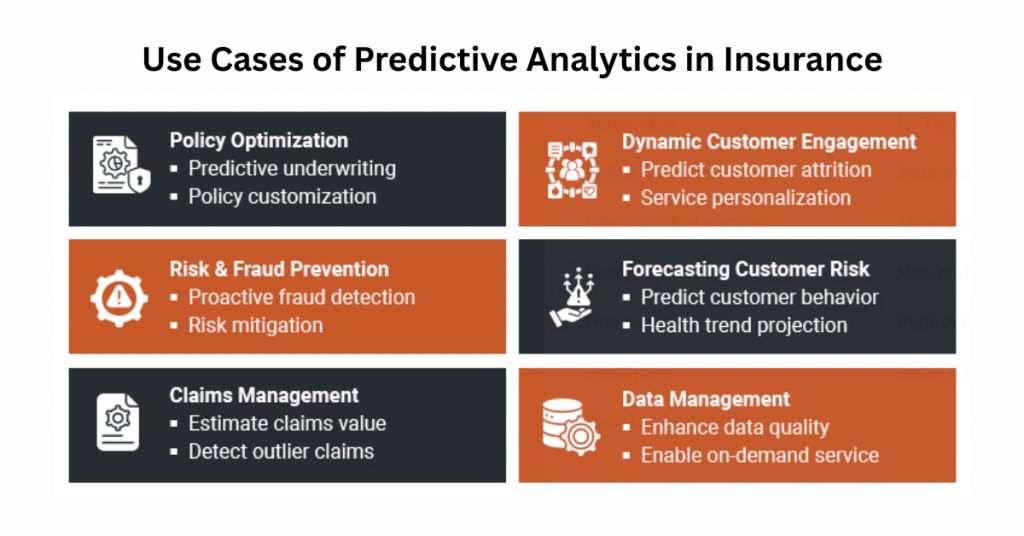
1. Predictive Analytics in Assessing Risks in Underwriting
By integrating the claims history, behavioral data, financial records, and third-party datasets, predictive analytics in insurance fundamentally changes the accuracy of risk assessment in underwriting. Machine learning models can evaluate a huge number of risk factors simultaneously—something traditional actuarial methods are limited to. McKinsey revealed that insurers using predictive models have accomplished a reduction of loss ratios by 3–5% and a considerable improvement of underwriting efficiency (up to 30 %).
These powerful models also permit detailed risk division, which leads to more reasonable pricing and a more intelligent selection of portfolio risks. Therefore these mundane tasks can be effectively automated while underwriters are given the liberty of dealing with complex cases.
2. Predictive Analytics in Detecting Fraud
Internationally, fraudulent activities in the insurance industry lead to a loss of more than $80 billion yearly (FBI estimation). With the help of predictive analytics in insurance makes a move towards fraud detection by first identifying the discrepancies in the newly-submitted claims that are then compared with fraud patterns accumulated over the years.
AI-powered anomaly detection helps identify areas where falsehoods in the data may occur such as unaccounted narrative for the claim, exaggerated repair cost, untrustworthy medical report, and irregular client behavior. According to the report made by Accenture, setting up a predictive fraud system can bring down the incidences of falsification therefore companies’ profit margins can improve noticeably. Affected are also the investigators, whose efficiency is upgraded by the proper allocation of high-risk claims.
3. Predictive Analytics in Accelerating Claims Processing
Using predictive analytics in insurance offers capabilities like automated claim routing, instant estimation of payouts, and triaging of cases by severity and complexity. Leads that Carrier to performance optimization through AI claim management software development have shortened the period in which settlements are reached by a good 30% and have also, in a significant way, decreased the administrative outlays. Machine learning is used as a tool to make predictions about which cases, thus, would have fatal consequences, need human scrutiny, or be fast-tracked.
These developments have resulted in the alleviation of the bottleneck problem and, therefore, are contributing to the smoothness of the customer experience. PwC estimates that the use of predictive technology for claims automation is capable of bringing about a multi-billion-dollar saving for the insurer industry every year, while customer satisfaction ratings are increased by 20–25%.
4. Predictive Analytics in Preventing Claims
With the help of subsidized models, the insurance companies can prevent the occurrence of the loss events before they happen, and that is achievable by deep diving into policyholders’ habits, looking for definitely human induced changes, environmental factors and Internet of Things (IoT) sensor data.
Here is a good example: the use of telematics in the auto industry has decreased the number of car crashes which is why the frequency has fallen by 20%, and home IoT solutions can effectively stop 70% of all major water leakages from happening. The predictive maintenance program in the area of commercial insurance is a multipurpose tool, which plays a vital role in the prevention of breakdown of any type of equipment, fire situations, and cases of employees getting injured in the workplace.
Besides the fact that it is a forecasting tool, it is also mutually beneficial as insurers can both pinpoint where risks will take place and advise on preventive actions—thus, claim volume will be lessened, customer safety will be enhanced, and the overall loss exposure will decline.
5. Predictive Analytics in Predicting Customer Churn
Customer churn is a drain on insurers’ revenue holding back the yearly premium income in the market mainly related to health and auto sectors. Predictive analytics is the one to spot the signal of churn at an early stage through identification of behavioral patterns such as less interaction with the service, payment infrequency, or negative feedback. According to Bain & Company, Carriers involved in churn prediction models have been able to bring down the attrition rates by 5–25%.
The information from these models gives the insurers a chance to maintain long-term relationships with customers by returning with personalized retention offers, optimizing communication timing, and implementing proactive outreach – all of which are supportive of cord stays and creating a reliable flow of income.
6. Predictive Analytics in Personalizing Customer Experiences at Scale
The present-day customers demand their insurance services to be personalized—pricing to product recommendations included. The use of predictive analytics is supported by customer information, lifestyle statistics, and risk profiles in accomplishing the mentioned system for insurance, discounts, and even communication.
Deloitte believes that customer-driven predictive analytics powered personalization’s could elevate customer satisfaction scores even to 30–40% and cross-sell rates by 20%. AI is even at the helm of personalized wellness programs, usage-based auto policies, and dynamically changing home insurance premiums. Such a degree of individualization nurtures trust, encourages conversion, and makes a difference in how insurers can compete in the markets.
7. Predictive Analytics in Streamlining Underwriting
Predictive analytics in insurance greatly accelerates underwriting by facilitating the automation of routine data extraction, risk scoring, and eligibility checks. A report by EY states that the use of AI in insurance underwriting by carriers leads to a 40–60% reduction in processing time, which is especially the case for simple or mid-complexity cases.
The pre-analyzed data, risk predictions, and recommended pricing that are provided to underwriters, enable them to concentrate on judgment-intensive cases. This constitutes a faster policy issuance, lower errors, and a more scalable insurance operation – the advantages of which are particularly extended to digital-first insurers and insurtech.
8. Predictive Analytics in Powering New Insurance Products
Once they have a grasp of consumers’ behavior and the market trends by means of predictive analytics, insurers can easily produce innovative offerings such as usage-based insurance, pay-as-you-drive, parametric insurance, and on-demand micro-policies.
These products are essentially based on real-time data and predictive scoring models that help in dynamically pricing the coverage and adjusting the latter too. McKinsey states that the rate of product adoption in segments where predictive analytics has been employed for product development is increased by as much as 50%.
The versatility resulting from this can assist insurers in developing the customer base of younger, tech-savvy individuals and in getting into the under-served niches.
9. Predictive Analytics in Implementing Proactive Risk Management
Through predictive analytics in insurance, insurers gain the ability to foresee not only the near but also long-term risks of any kind of the emerging ones such as climate-related, operational, cyber, or demographic.
AI models take into consideration past data as well as real-time inputs to determine loss trends and to design simulations of the future. Capital planning gets more accurate by as much as 20% for carriers employing predictive risk models, as per NAIC statements.
These features enable the building of a framework for risk prevention thus, having a positive effect on mitigation, underwriting, and solvency management besides the customer pool which enjoys the enhanced trust and satisfaction resulting from proactive risk alerts and personalized safety recommendations.
How AI Is Reshaping Predictive Analytics in the Insurance World to the Next Level?
By allowing real-time intelligence, automation, and hyper-personalization, AI is changing the game of predictive analytics in insurance sector. The advent of AI insurance software development services has totally changed the way information is gathered, analyzed, and utilized throughout the insurance lifecycle.
Insurers of the present have to fuse AI models with big data pipelines, IoT instruments, telematics, medical wearables, smart home sensors, and cloud analytics to be able to generate a seamless milieu where insights come consecutively.
Such a confluence gives carriers not only the chance to carry out traditional predictions but also to use prescriptive analytics whereby AI will do more than just forecast results but also suggest the best course of action whether it is: fraud alerts triggering, premium adjustment, equipment breakdown prediction, or even personalized retention campaigns provision.
Also, AI technology is leading the field to autonomous insurance operations where underwriting, claims, fraud detection, and customer interactions can be automated to a certain extent or fully automated. According to McKinsey, AI could automate half of the insurance processes that are done today, thus the costs can be reduced by 30–40% and response time will be improved drastically.
The use of conversational AI for FNOL (First Notice of Loss) and deep learning models that come up with risk scores in a matter of seconds are only a few examples of how the insurance ecosystem of the future will be able to function at a higher level of speed, intelligence, and transparency.
How A3Logics Can Facilitate Your Predictive Analytics Journey?
A3Logics enables insurance companies to realize the power of predictive analytics by providing them with full-spectrum AI, data engineering, and digital transformation services. Our team builds tailor-made predictive models that serve the different functions of risk assessment, fraud detection, claims automation, and customer intelligence because we have a lot of experience in the field of insurance carriers, TPAs, and insurtech innovators.
It doesn’t matter if you want a fully AI-powered platform or just want your current system to be enhanced, our team will provide you with the perfect solution that is in line with your operational objectives.
We provide end-to-end AI integration and automation services that include machine learning technology implants in underwritings, claims, and insurance fraud detection automation development. Additionally, A3Logics is proficient in modernizing the data of the old systems so that the data remains clean, well-structured, and unified and then the models perform their functions correctly.
As far as scalability and regulatory requirements are concerned, our team implements predictive analytics measures on platforms that are native to the cloud (AWS, Azure, GCP) and secure with the availability of features such as governance, encryption, and failover. By having A3Logics as your technology partner, you will be equipped with a predictive analytics engine that is not only advanced but also scalable and innovative.

Conclusion
AI-driven predictive analytics is a major factor in changing the insurance industry in the most fundamental way. This has been evidenced by such results as intelligent underwriting, accelerated claims decisions, fraud detection that is proactive and customer-centric deeply personalized experiences. In the face of challenges such as intensifying competition, changing customer expectations, and increasing operational costs, insurers still persist in the idea of implementing AI-based predictive models that have become a must-have rather than an option to their mission.
The carriers who will be able to leverage real-time data, automate decision-making, and deliver personalized products at scale will be the ones to thrive in the insurance industry of tomorrow.A3Logics, a leading AI development company has domain expertise, advanced AI capabilities, and seamless cloud integration. Our services allow insurance companies to ramp up their predictive analytics endeavors resulting in them becoming more agile, data-driven, and future-ready.
Whether your coming point is or growth point in your analytics journey, A3Logics can provide the necessary infrastructure and leadership to help you succeed in an AI-first insurance landscape.