
The topic of artificial intelligence in architecture is also changing the manner in which buildings are designed, built, and managed at a very high rate. In the past architectural processes were highly manualized, man-intensive and trial and error processes.
The current role of AI in architecture enables architects, city planners, and construction teams to use computational intelligence in order to improve precision, innovation, and effectiveness.
The use of AI-based tools is growing at a faster rate worldwide due to the necessity to increase the speed of design processes, have sustainable solutions to buildings, and higher levels of safety.
The world AI architecture market is set to reach USD 1.0 billion by the year 2024 and expand highly to USD 18.1 billion by the year 2033 due to a high CAGR of 38.3 per cent.
Companies are scavenging to integrate AI with BIM systems, 3D visualization software, and buildings controlled by IoT to become smarter in their choices. The advantages of AI in architecture are as follows:
- Faster decision-making during early-stage planning
- Reduced operational and construction costs
- Improved energy efficiency and sustainability
- Enhanced creative exploration through generative design
- Safer and more resilient construction workflows
Such benefits are turning the development of AI in architecture software into a strategic consideration among companies that are interested in remaining competitive in an industry that is changing rapidly.
The Role of AI in Modern Architecture
The role of AI in architecture in contemporary times is not an easy one; it affects every element of the building design, construction, and administration after the house is occupied. It allows architects to calculate advanced data sets of information about the circumstances of the site, materials, structural loads, climate, and human actions. AI is used to enhance decision-making processes through predictive modeling, real-time simulation, and performance analysis.
Key contributions of AI in architecture include:
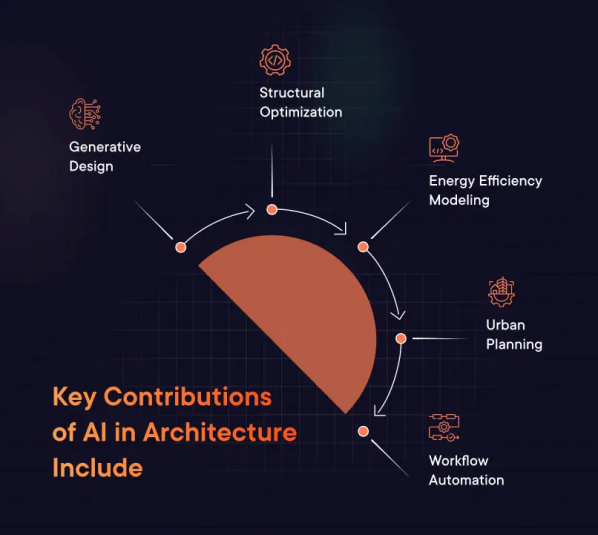
- Generative Design: AI produces different design selections within the constraints of the budget, materials, and environmental concerns.
- Structural Optimization: Machine learning predicts the movement of loads and where potential breakdowns may occur.
- Energy Efficiency Modeling: Simulations of energy use are used by AI to propose environmentally friendly buildings that should be considered.
- Urban Planning: Predictive analytics helps in brainstorming smarter and more resilient urban areas.
- Workflow Automation: AI minimises monotonous tasks like requesting documents, taking off materials, and compiling reports.
With AI and human creativity working together, architects will have an opportunity to be conceptual and leave the work of data analysis and repetitive work to AI.
Top 10 AI Use Cases in Architecture
Below are the major AI use cases in architecture which we have discussed in detail.
1. Streamlining Early-Stage Planning
The conceptual planning is one of the most important and time-consuming stages of the architectural development in the early stages. Due to the automation of complex calculations, AI aids in speeding up this process, as well as in the simulation of early design constraints, which traditionally costs a lot of manual work.
AI-based applications are able to process zoning regulations, topographic information, weather statistics, and historic site data, and generate design suggestions practically in real time.
Instead of taking weeks to assess what is feasible, architects can have a quick idea about the best massing forms, location, and environmental compatibility of a building. This radically minimizes mistakes and enables early interaction with clients to valid and data-driven design options.
2. Improving Architectural Mapping
Although the practice was not new, architectural mapping always included hand-drawn site plans, manual surveys, and analysis of the existing buildings. Mapping is now more precise and effective in AI in construction and architecture.
With computer vision systems powered by AI, one can scan a setting, identify structural elements, and create a digital representation of a photograph or laser scan.
Such models are able to expose deviations between the planned and actual conditions during construction very fast, allowing teams to identify any structural problems in an early stage and prevent costly rework. In matters of renovation or heritage restoration, AI adds extraordinary value to the projects, as it is capable of recreating the current state without invasive surveying.
3. Optimizing Sketching and Concept Design
AI is used to assist the creative stage by converting abstract concepts into images. The DALL·E 2 and Midjourney models of generative AI have emerged as a key instrument of concept exploration.
Architects may feed in descriptions, thematic stimulants, or scribbles, and AI creates elaborate conceptual images that are in compliance with particular aesthetic or functional requirements. These visual products can be used as a starting point to explore design more, and can be used to allow architects to refine them more quickly, as well as to convey ideas to their clients more effectively.
AI refines even hand-drawn sketches into high-fidelity 3D models and removes redundant modeling work. Moreover, it encourages deeper creative experimentation throughout the design process.
4. Streamlining Compliance and Regulatory Analysis
The zoning regulations and building code can also significantly slow down the design process. The process of interpreting the regulations will also be simplified with the help of artificial intelligence because it will be able to read design documents and compare them with the local requirements of buildings.
As it identifies potential violations at their early stages, AI removes time and redesign wastage, as well as legal liability. It also suggests pre-conformity of design proposals.
Regulations concerning fire safety, accessibility, structural load, and environmental impact can be automatically verified through the assistance of AI-based rule engines, and, that way, the architects can be certain that their design would be legitimate according to the legal requirements before submission.
5. Improving Urban Planning
City planning requires a great deal of information on the utilization of large systems in transportation, utilities, population patterns, and the environment.
Predictive modeling and spatial analytics assist AI in exploring such parameters to help make smarter urban development. AI simulates traffic flow based on building locations and predicts heat retention in densely populated areas. Moreover, it identifies socioeconomic trends that can influence urban design and guide better planning decisions.
This results in better resource efficiency, less congestion, and a better environment in cities. To develop more sustainable, inclusive, and resilient communities, AI can be used in urban planning.
6. Optimizing Building Energy Management
Environmentally friendly architecture is necessary because the sustainability requirements of the world are narrowing down. AI can assist architects in creating buildings that use less energy and offer advantages to the occupants.
AI assesses the use of HVAC, lighting, insulation, or natural ventilation approaches through the use of data-driven simulations. It will project the performance of a building with different weather conditions and give recommendations on how it can be improved to reduce the operational cost.
This goes further than design to the post-construction work. After the building is occupied, the AI systems keep observing the energy consumption by using IoT sensors and adjusting systems on the fly to reduce wastage and make sure the system works as efficiently as possible.
7. Enhancing Construction Safety
Adopting AI in construction emphasis is on safety. The AI will enhance safety since cameras and sensors will be used to scan the working locations and detect hazardous conditions automatically.
Computer vision systems identify whether workers use protective gear, operate equipment correctly, and enter restricted zones. Moreover, machine learning algorithms analyze historical accident data to predict potential hazards, enabling construction managers to intervene on time.
AI improves compliance with the law, reduces accidents, and helps to fulfill architectural works through predicting risky conditions. Such application of AI in building eases the construction of safer locations, and also improves the project time and financial adherence.

8. Enabling Parametric and Generative Architecture
The parametric architecture and the generative architecture attach significant importance to the algorithmic connections of the parts of design. The AIs enhance this area by processing large amounts of data to develop streamlined building forms that respond to the surrounding and construction problems.
Architects can change such parameters as the strength of the material, budget, direction, and space constraints, and the AI system can generate new variations in real-time, including the needs.
This aspect paves a new creative door, and the architects are free to explore strange shapes and shapes that are not practically viable and time-saving through manual construction.
9. Automating Documentation and Reporting
A list of materials, compliance forms, schedules, documentation, and floor plans can be rather time-consuming for an architect. Artificial intelligence in architecture performs these tasks by interpreting the design model and generating the needed documentation on its own.
The emergence of AI in architecture takeoff software provides accurate cost breakdowns and quantity estimates with minimal manual input.
Automated reporting allows for minimizing human mistakes, decreasing the project timetable, and ensuring that documentation can match every change in the design. This helps the architects and the contractors to focus on the high-level decisions rather than the administrative functions.
10. Revealing Structural and Safety Hazards
Structural safety is paramount during the design and construction stages. Structural models are scanned through AI tools to determine where a failure may happen.
They test load distribution, material stress, environmental impact, and extreme structural behavior. Moreover, machine learning models detect anomalies or weaknesses that humans may miss, helping prevent future damage or structural failure.
AI uses predictive maintenance devices to track a building’s overall health throughout its life and indicate when repairs are needed. Moreover, this approach makes the built environment safer and extends the lifespan of structures.
Examples of Leading AI Solutions in Architecture
Several AI solutions are redefining architectural design. Below are some of the major examples of leading AI solutions in architecture.
1. Autodesk Spacemaker

The Autodesk spacemaker uses generative design and environmental simulation to determine the feasibility of a site within a reasonably short period of time. It analyses variables like sunlight, noise, wind, and zoning restrictions, providing an opportunity for an architect to test a number of designs, simplify the layouts, and reach a decision, making it on the basis of data at a more advanced level of planning.
2. Delve by Sidewalk Labs

Delve incorporates AI in optimizing urban development projects based on the spatial data, building density, sunlight, traffic, and land usage. It also allows planners to experiment with different design solutions, and this improves the efficiency, sustainability, and community impact of large-scale projects like Wembley Park.
3. Arup Neuron

Arup Neuron is an in-real-time building performance monitoring solution that is based on AI and can optimize the energy use, HVAC, lighting, and comfort of occupants. It detects inefficiencies, forecasts maintenance requirements, and assists in sustainable and data-driven management of facilities in a building throughout its lifecycle.
4. DALL·E 2 & Midjourney

DALL·E 2 and Midjourney create architectural visuals of high quality based on textual prompts or drawings. These artificial intelligence tools make concept design faster, more creative, and enable architects to experiment with numerous aesthetic and functional options without having to do a lot of manual modeling.
5. Microsoft AI Projects (Daniel McDuff)

Daniel McDuff has led AI projects at Microsoft focused on human-centric architectural design to understand how people interact with built environments. Moreover, AI evaluates emotional and physiological responses to lighting, space, and layout, enabling architects to design buildings that enhance comfort, productivity, and overall well-being.
These solutions reveal the use of AI in architecture to enhance speed, accuracy, and creativity.
Emerging Technologies Complementing AI
AI’s effectiveness is amplified when integrated with other technologies. Let us go through the major emerging technologies for artificial intelligence in architecture.
1. Building Information Modeling (BIM)
BIM is a centralization of 3D models of buildings that combine the architectural, structural, and MEP data. These models are analyzed using AI, which can optimize layouts, uncover clashes, forecast material requirements, improve collaboration, and allow for smarter decisions and more efficient planning.
2. 3D Printing
The use of AI replaces the use of 3D printing as it enables the creation of the elements of the building as accurately as possible, potentially eliminating the waste of resources and labor costs. AI designs assembly paths, shapes, and structures in ways that support sustainability, accelerate prototyping, and enable intricate geometries. Moreover, it makes possible forms that conventional methods simply cannot create.
3. Augmented & Virtual Reality (AR/VR)
AR and VR provide graphical immersion of AI-generated architectural designs. The knowledge, teamwork, and decision-making process of the design processes can be enhanced through interactive exploration of spaces by the design professionals and clients, as well as testing of design options, ergonomics, or aesthetics.
4. Internet of Things (IoT)
IoT gadgets gather real-time information about building systems, the environment, and the activity of occupants. This data is used to maximize energy consumption, make a building more comfortable, anticipate maintenance, and develop responsive and adaptable buildings that increase sustainability and optimize functionality in a building.
5. Integration of These Technologies
BIM, 3D printing, AR/VR, and IoT + AI help to promote faster development of architectural software. This synergy creates the possibility of smarter design, accurate construction, real-time monitoring, and predictive maintenance that create sustainable, innovative, and efficient building solutions throughout the lifecycle.
A combination of these technologies enhances the process of creating AI in architecture software and also guarantees smarter design, construction, and maintenance.
Challenges of Implementing AI and Solutions
Despite its advantages, adopting AI in architecture faces challenges. We have listed some of the major challenges faced during these software development services.
1. Data Quality and Integration
Disjointed or incoherent data restricts AI from giving useful information in architecture. Through integration of digital processes, architects will be able to pull together data from various sources, making it reliable, consistent, and easily integrated so that analysis and decision-making through AI can be enhanced.
2. High Costs and Lack of Expertise
The introduction of AI models in architecture is costly and time-consuming in terms of investment and professional expertise. Leveraging cloud-based AI applications and services lowers development costs. Moreover, pre-trained models let firms deploy sophisticated AI without extensive in-house skills.
3. Resistance to Technology
The traditional workflow may hinder AI adoption because architectural teams are often unfamiliar with it and fear potential disruption. Training and pilot projects, as well as a gradual integration of the staff, will contribute to gaining confidence, familiarizing oneself with the benefits, and adopting AI-enhanced workflows successfully.
4. Ethical and Creative Concerns
Human creativity in architectural design is under threat because of overdependence on AI. Having a balance between automation and human control enables architects to maintain creative control and enjoy the efficiency of AI, which is data-driven, ethically responsible, innovative, and context-sensitive.

How A3Logics Can Help?
A3Logics will be providing AI development services, as well as AI architecture software development services, to the architecture and construction sectors. Their offerings include as follows:
1. Custom AI Architecture Software Development
A3Logics creates custom AI-driven software that can meet the specific architectural and construction requirements, such as design automation, predictive modeling, and workflow optimization, so that the firms can maximize the accuracy of changes, shorten the project schedule, and make data-driven design decisions.
2. BIM Tools and Generative Design
They connect with AI, BIM, and generative design software to help architects optimize layouts and detect clashes. Moreover, these tools simulate design proposals and improve team interaction. Additionally, they streamline collaboration to ensure greater efficiency and design quality.
3. AI Solutions Energy optimization, Safety, and Visualization Solutions
The A3Logics employs AI-based applications to utilize the energy more efficiently, monitor the compliance with safety, and generate realistic visualizations. These technologies reduce the cost of operations, ensure that they comply with regulations, and provide the most immersive and data-driven data to smarter building management.
4. AI takeoff software development for automated project estimation
Their AI takeoff software development is used to calculate digital plans, the quantities, materials estimations, and costs projections, eliminating manual errors, quicker project estimation, and enhanced accuracy in budgeting, procurement, and resource planning.
By partnering with A3Logics, companies will enable the use of AI in construction and architecture to improve workflow efficiency, sustainability, safety, and innovation, and ensure that the projects are completed on time, on budget, and within the industry-leading standards.
Conclusion
The field of architecture is transforming the whole life cycle of building design, construction, and operations through artificial intelligence. Using the analytical capabilities of AI and the creativity of humans, architects and construction industry professionals can speed up the planning process, come up with the best designs, and make better decisions.
Based on AI, companies will gain increased efficiency regarding the use of energy, reduce waste, and implement environmentally and socially responsible construction practices, addressing environmental and business challenges.
AI predicts hazards and monitors construction sites in real time, improving safety and workflow management. Moreover, it automates repetitive tasks, allowing teams to focus on major challenges and drive greater creativity.
Furthermore, AI in architecture enables the research of generative and parametric designs and enables architects to experiment with complex shapes and layouts that were not possible previously.
With the implementation of smart software becoming standard in the construction and architectural industry, organizations utilizing AI-driven services in the present will have a competitive advantage, creating more aggressive, safer, sustainable, and incredibly innovative projects that will establish new standards in the future of the built environment.