
The banking sector always had strong competition. It is very difficult to be noticeable among your competition in the respective sector due to the services being provided to both business and general clients. The list, with slight variations, includes the following: receiving deposits, providing credits, issuing loans, operating debit or credit cards, exchanging money, and so on.
The development of computer technology and the outbreak of the global pandemic resulted both in an increasing need for distant financial services and therefore the widespread application of digital banking instead of the conventional type of brick-and-mortar banking. This is where the role of customer analytics software for banking comes in – a latest fintech solution implemented by a bank is no longer a competitive advantage; rather, it is a necessary condition for a financial organization to be updated regarding time.
Customer analytics software in banking helps financial institutions gain a 360-degree view of their customers by analyzing transactional, demographic, and behavioral data, leading to highly personalized experiences and, on average, a 415% three-year ROI.
However, what can give a competitive advantage to the bank over its competitors when all else is equal? To perform successfully in the sector, you need to work with advanced customer analytics software for banking to ascertain the needs and decode the expectations of your target audience. In the beginning of the third millennium when digitalization was at its pinnacle, these analytical as well as predictive methods were accomplished using data analytics software.
Customer Data Analytics in Banking: A Closer View
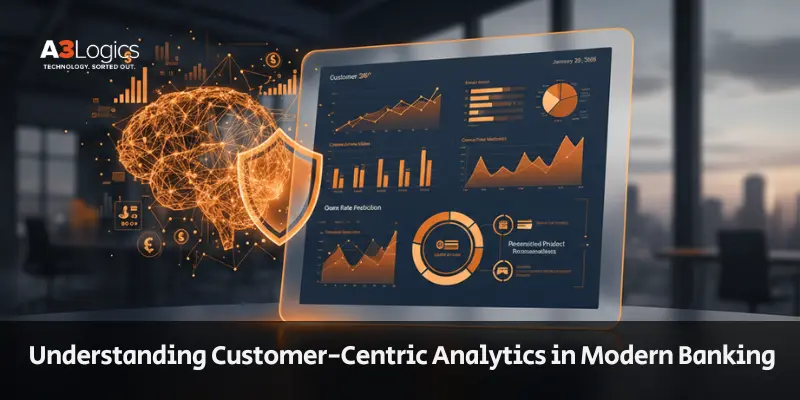
Customer data analytics services for banks involve the examination of the information of the clients to discern their behavior and preferences. This has enabled the banking industry to transcend simple reporting and incorporate insights via customer data analytics.
Banks customarily examine three large types of customer data. The demographic kind includes customer age, earnings bracket, occupation, geography, and life stages. Such fintech software development services enable lenders to segment their customers, perform KYC verification, and offer financial services tailored to general customer needs. Behavioral and transactional data, on the other hand, records customer activities, such as spending behavior, payment records, and product usage. Digital engagement data is related to how customers engage with mobile, websites, and customer services. Such data allows lenders to gain a better insight into customer experience levels, engagement depth, and preferred engagement channels.
Customer analytics software for banking today is driven by big data technology, machine learning algorithms, and artificial intelligence tools. These tools and technologies allow for real-time analysis and decisioning on data and allow for predictions to be made regarding customer behaviors based on established data patterns. Banking customer analytics tools differ from conventional analytics tools in terms of anonymity.
Key Benefits of Customer Analytics Software in Banking
1. In-Depth Customer Insights
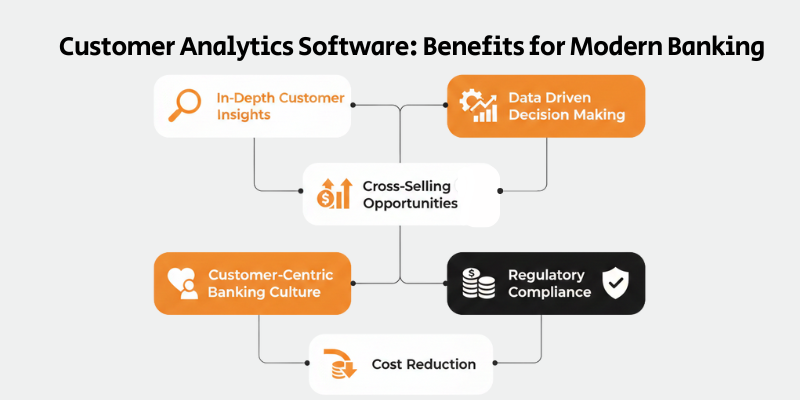
The Customer analytics software for banking helps banks to gain a 360-degree customer view by integrating account, channel, and system information. This helps banks to identify customer behavior, financial requirements, habits, preferences, and lifecycle status, hence allowing them to design an effective customer engagement strategy.
2. Data Driven and Informed Decision Making
Large volumes of data collected by banks can be converted into intelligent insights by analytics software, that in turn helps banks make better decisions regarding their services. Also, predictive analytics help banks in forecasting the future so that they can prepare strategies accordingly.
3. Cross-Selling & Upselling Opportunities
Detailed analytics helps figure out the patterns of preference and life stages from the available information of the customers. This enables the banks to provide apt offers to the clients when the need arises and boost the conversion rates and overall profitability without the need for an aggressive sales strategy.
4. Building a Customer-Centric Banking Culture
Customer analytics software for banking allows for a personalized experience in both digital and physical interaction points. Through alignment with individual behavior and preference, banks can better deliver relevance, consistency, and satisfaction in their service. It is an approach that focuses on customers, thereby reinforcing trust, improving loyalty, and creating relationships in a competitive financial services sector.
5. Cost Reduction and Operational Efficiency
Analytics tools eliminate the need for manual analysis of insights, thus minimizing manual dependency. This streamlines operations; it cuts services and processing costs; it optimizes resources; it increases the speed at which responses to customers can be provided.
6. Regulatory Compliance and Reporting
Banking customer analytics software enhances data accuracy, traceability, and governance associated with banking operations. These platforms assist with audit readiness, reporting, and regulatory requirements for continuous monitoring. By ensuring improved KYC, AML, and risk management processes, financial institutions are better placed to mitigate compliance risk while promoting institutional accountability and transparency.
Top Challenges Customer Analytics Software Solves for Banks
1. Customer Data Handling and Integration
Banks run on a variety of loosely connected systems, and this causes fragmentation and inconsistency in customer data. The banking analytics software solutions encompasses data from core banking systems, CRM systems, payment gateways, and online channels and makes fragmented and unstructured data from loosely connected systems uniform and accurate to yield insights at an enterprise level.
2. Advanced Customer Segmentation
Conventional segmentation techniques are highly dependent upon static demographic data and generic segmentation. The customer analytics solution helps in performing micro-segmentation by leveraging AI and real-time behavioral and engagement data. It helps the banks in identifying very precise segments of customers.
3. Personalization of Banking Services
It is hard to provide personal services in a scalable manner without the use of automation and deep analytics. The customer analytics software for banking used in the analysis of customers provides interpretations of the actions, desires, and related finances of the clients, enabling banks to shift from general interaction to personal banking.
4. Automation of Customer Interaction
Customer intelligence software for banks power intelligent automation across customer touchpoints. They power chatbots, automated service workflows, and AI-driven campaign engines that respond in real time to what customers do. This reduces manual workloads, improves response consistency, and enables scalable insight-led engagement across digital and service environments.
5. Monitoring of Customer Feedback
Banks get tremendous amounts of customer feedback from various surveys, apps, social platforms, and support channels. With AI in banking, banks apply real-time sentiment analysis and track feedback on service issues, emerging trends, or experience gaps for quicker resolution to further reinforce continuous customer experience strategy improvements.
6. Real-time analytics capability
Traditional reporting systems operate on delayed data cycles. Customer analytics software for banking delivers real-time insight through the processing of live transactional and interaction data. With this, decisions can be made more quickly, immediate risk can be detected, dynamic personalization can occur, and timely operational responses-both at the sales and service level and in respect to risk-can take place.
7. Risk Analysis and Management
The customer analytics tool enhances risk evaluation by performing behavioral assessments and transactional analyses. This will provide better assistance in credit risk modeling, early indication of financial duress, and ongoing behavioral risk assessments and will allow banks to effectively control their exposure to risk without simply acting after a crisis occurs.
8. Fraud Detection and Prevention
Fraud patterns are highly volatile and need to be continuously monitored. Customer analytics software enables the identification of unusual behavior and patterns of money laundering and fraud, as done through machine learning algorithms, which are processed instantly. This enables the earlier disruption of the process and saves the bank money.
Customer Analytics Software: Successful Banking Use Cases
Customer analytics tools are an essential part of banking to enable them to convert their customer information into valuable intelligence that helps them build better customer experiences, mitigates risks, and enhances growth. The integration of customer behavior, transactions, and digital data enables banking institutions to act on their knowledge in areas like customer engagement and credit approval.
1. Personalized Digital Banking Experience
Customer analytics tools allow banks to present customers with differentiated digital experiences, product offerings, and communications tailored using individual behavior, context, and preferences. On the basis of spending behavior, usage, and engagement, individualized dashboards, notifications, and offers are sent, thus improving relevance, engagement, and satisfaction for customers on mobile as well as web banking channels of banks.
2. Customer Churn Prediction and Prevention
Banks now use analytics for the earliest indications of disengagement, for example, reduced activity, low balances, complaints related to services, and change in behavior for transactions. Banking data analytics solutions point to customers who are most at risk of disengagement so that banks take the initiative to reach out to them for assistance and retention.
3. Credit Scoring and Loan Approval Optimization
Customer analytics software for banking complements the traditional risk assessment process with behavioral data and information derived from transactions. The technology allows for a more informed risk classification model, faster processing of loan approvals, and consistency in the underwriting process of the banks. Customers will benefit from reduced hurdles in the loan decision process of banks.
4. Omnichannel Engagement and Campaign Optimization
Customer analytics software combines data from branch, call center, mobile, web, and direct marketing channels. This enables banks to engage their customers in a coordinated and consistent manner through all points of contact. The performance of any campaign can also be measured in real-time, and interactions can also change dynamically based on customer behavior, which enhances conversion and communication efforts.
5. Fraud Detection and Transaction Monitoring
Advanced analytics software for banking utilizes machine learning-based models on transaction data streams to pinpoint anomalous behavior, irregular expenditure patterns, as well as synchronized fraudulent activities. Also, customer analytics software enables constant monitoring, real-time notifications, as well as automated action, thus limiting the impact of credit card fraud while causing minimal disruptions to genuine transaction processes.
Enhancing Customer Retention with Customer Analytics
Customer retention has emerged as a focal point because the cost of customer acquisition is increasing. Customer analytics software helps banks transition from the current reactive attitude towards customer retention and predictive relationship-building.
1. Detection of Initial Churn Indicators
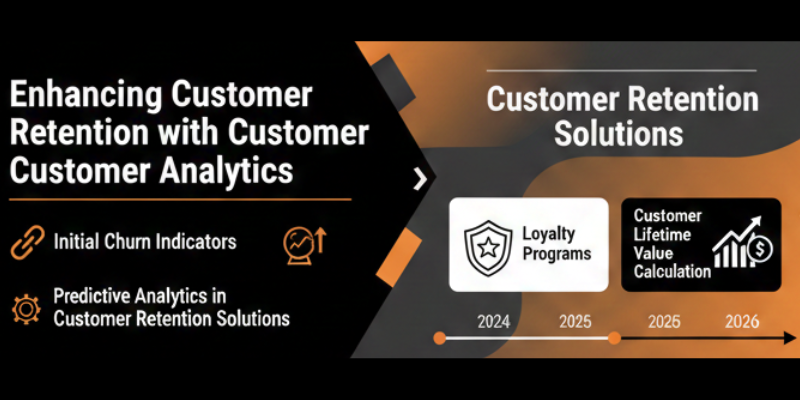
Analytical systems also continually observe changes in behavior such as diminished engagement, dwindling balances, channel abandonment, and service dissatisfaction. Such precursors enable banks to reach customers before they leave the institution in the first place.
2. Predictive Analytics in Customer Retention Solutions
Machine learning algorithms make predictions concerning customer churn likelihood, as well as suggestions for appropriate customer retention activities. Thus, banks can implement active customer engagement initiatives, service optimisation, as well as specific financial product offerings according to a customer’s risk level.
3. Loyalty Programs Powered by Customer Insights
Customer analytics can help in designing reward programs that are aligned to the motivations of customers. Instead of generic rewards that are offered currently, banks can think of rewards that are aligned to their behavior patterns, stages, and value segments to which customers belong.
4. Customer Lifetime Value Calculation (CLV)
Analytics solutions calculate and measure the CLV of customers by leveraging information on revenues, cost, risk, and engagement metrics. The result of CLVs enables financial institutions to focus on valuable accounts, optimize product offerings, make informed retention decisions, as well as measure the ongoing effects of CX initiatives.
How to Build Customer Analytics Software for Banking
1. Data Collection & Integration
The key underlying infrastructure of every banking analytics system is unified data. Every customer analytics software needs an integration layer that integrates data from core banking systems, CRM solutions, mobile/web applications, payment systems, as well as third-party data that is pre-approved by the bank. This layer enables data ingestion, cleansing, normalization, as well as data sync into an analytics system.
2. Reporting and Advanced Analytics
The analytics engine should have capabilities related to descriptive, predictive, and prescriptive analytics. Descriptive analytics helps describe what has occurred, predictive analytics helps estimate what may happen or what are the risks in the future, and prescriptive analytics helps suggest what should be done. This helps banks transition from traditional reporting to continuous decision support.
3. Interactive Dashboards
Role-specific dashboards enable insights to be extracted from complicated data. Business executives, marketing experts, service-oriented units, and risk managers need specific visualizations based on key performance metrics. Interactive dashboards enable users to view performances, drill down through segments, and measure overall success in real-time results.
4. Customer and Contact Management
With a centralized layer of customer management, it consolidates identities, accounts, interactions, and behavioral history into one single profile. This-single truth about every customer-serves personalization, continuity of service, effective relationship management, and collaboration across departments.
5. Customer Segmentation Engine
Customer segmentation analytics in banking should support rule-based and AI-driven segmentation. Rule-based models will provide fast operational grouping, while machine learning models will identify micro-segments based on behavior, value, risk, and life-stage signals. This is the segmentation engine that drives the targeting, personalization, and lifecycle strategies.
6. Social Media Management and Listening
Social listening tools extend analytics beyond internal systems: tracking brand mentions, service conversations, and sentiment across social platforms provides real-time insights into customer perception, emerging issues, and engagement trends influencing a bank’s reputation and experience strategy.
7. Email Tracking and Engagement Analysis
Email analytical modules analyze open rates, clicks, conversion actions, and behavior responses. Such information influences engagement scores, optimization processes, and personalization engines to help banks assess communication results and improve communication strategies.
8. Campaign Management
A campaign management layer helps in the automation and data-driven engagement of customers over email, mobile, web, and services. The campaign engines leverage the insights from analytics in the processing of the customers according to their behavior and lifecycles.
9. Customer Satisfaction and Experience Metrics
Experience measurement tools allow the tracking of the Net Promoter Score, Customer Satisfaction, and Customer Effort Score. When tied together with behavioral and transactional data, such metrics can indicate the sources of loyalty and areas of friction that impact directly upon retention.
How A3Logics Can Help Banks with Customer Analytics Software
Custom Customer Analytics Software Development
A3Logics, a leading AI development company develops and constructs personalized customer analytics platforms for banking and financial technology companies. Unlike others, which are based on standardized platforms, A3Logics’ platforms are developed as per the data environment and regulatory conditions of each financial institution. This enables the platform to serve banking operations and processes effectively and accordingly.
AI-Enhanced Analytics, Machine Learning, and Real-Time Analysis
A3Logics uses cutting-edge AI/ML technologies that help deliver predictive as well as prescriptive analytics for banking operations. The solution is applicable for uses such as churn prediction, customer segmentation, fraudulent activities, as well as credit risk assessment. Also, real-time data processing enables instantaneous action on new data signals of customers by the bank.
Secure, Scalable, and Compliance Ready Solutions
Security and compliance considerations, therefore, remain embedded across all A3Logics platforms. Moreover, A3Logics designs each platform with scalable, enterprise-grade security and audit-ready architecture. Consequently, these platforms support growth while meeting KYC, AML, and data privacy compliance requirements.
Integration with Core Banking Systems and third-party platforms
A3Logics has expertise in analytics platform integrations with banking systems, CRM platforms, payment gateways, digital banking channels, and approved third-party services. It provides customers with an integrated data domain that helps overcome data silos.
End-to-End Support Across the Analytics LifeCycle
With A3Logics, the entire development life cycle – from analytics consulting and design, development, and deployment to ongoing maintenance – is taken care of. There is also close interaction between the development teams and banking customers to identify use cases for model development and optimize the model’s performance based on the needs that arise from time to time.
Conclusion
With the rise of electronic banking from an exception to a norm, customer analytics utility has migrated to a strategic plinth, rather than a supporting one. Today, banks do not compete on their services or prices alone; rather, the intensity and effectiveness of their customer understanding, forecasting, and servicing become their points of competition. Customer analytics software for banking helps in achieving such a transition by aggregating disparate data to create a real-time intelligence-based system.
From serving personalized digital experiences to churn predictions to optimal credit decisions to improved fraud detection capabilities, customer analytics can help banks shift from reactive to proactive and from traditional to customer-centric models of banking. This helps banking institutions move from their assumptions to informed decisions, from automation to intelligence, and from general engagement to relevance.
Banks and financial institutions are able to create better understanding and build trust and establish a competitive advantage with the help of advanced analytics solutions for customers, like the ones developed by A3Logics, in the financial services environment that is becoming increasingly data driven.