For decades, Electronic Data Interchange (EDI) has allowed information to move freely across organizations within a single supply chain. However, despite its role in B2B interactions, the future of EDI remains questionable.
Despite all of the benefits they can provide, legacy systems have struggled to meet the desire for seamless supply chain results, which is central to EDI’s goal. Incompatibility with internal systems and many protocols might lead to manual process information silos, resulting in limited visibility. Although constraints in internal supplier systems will always be a concern, cloud-based tools and managed services can now reduce their impact and considerably simplify operations.
However, it remains unclear if EDI will be a long-term solution to these challenges. Web services and APIs have been identified as potential EDI alternatives, with the latter being advocated as a cheaper, faster, and more flexible option. However, new solutions are more likely to supplement rather than replace modern EDI systems, contributing to the creation of a new category of EDI.
After decades of pioneering industry-leading EDI solutions, Data Interchange’s objective is to create a new category of EDI known as “EDI-as-a-Service.”
In this post, we’ve combined our years of experience to look at what the future of EDI will look like after 2025, and we’ll show why flexible and multifaceted solutions like EDI-as-a-Service will define it.
Key Trends Shaping the Future of EDI
Digital transformation, automation, and the growing requirement for real-time data interchange are all having a big impact on the future of EDI. In 2024, the global Electronic Data Interchange (EDI) software market was worth $2.08 billion. The market is expected to increase from $2.31 billion in 2025 to $5.30 billion by 2032, with a compound annual growth rate (CAGR) of 12.6% throughout the forecast period.
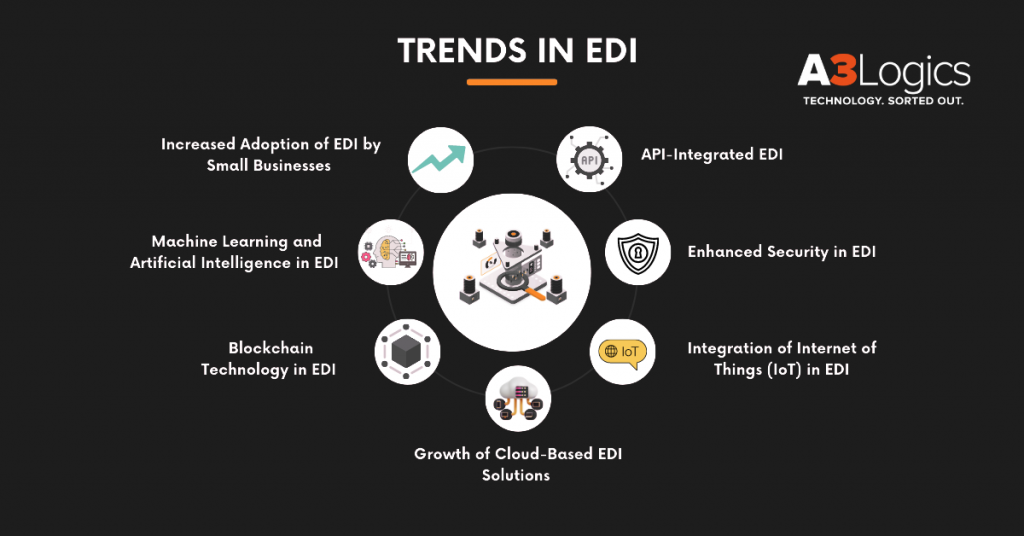
In 2024, North America had the biggest share of the worldwide electronic data exchange software market, with 52.4%. As supply chains throughout the world become more complicated and customers want firms to respond right away, a few important factors are shaping the future of EDI:
> API and EDI Integration:
New businesses are moving away from batch-based EDI and toward real-time API-based EDI architectures. This mix of EDI innovations lets businesses keep the structure and rules of EDI while also using the speed and flexibility of APIs. This is especially true in retail and logistics, where having up-to-date information on shipment, inventory, and billing is quite important.
> Cloud-Based EDI Platforms:
The Cloud EDI solutions are replacing old on-premise systems since they are faster to set up, cost less, and can grow with your business. Cloud solutions make it easier to work with trading partners, keep things up to date, and access them from anywhere. Cloud use also makes EDI more possible for small and medium-sized businesses.
> Combining AI and machine learning
Artificial Intelligence is making EDI trends better by finding mistakes automatically, speeding up document mapping, and predicting problems in supply chain processes. EDI with AI and ML cut down on the need for human input, improve accuracy, and assist people make smart choices by using predictive analytics.
> Using Blockchain to Keep EDI Safe and Open
Blockchain in EDI is a technology that is being utilized to help people trust EDI transactions. It keeps an unchangeable record of all data exchanges, which lowers the risk of fraud, ensures compliance, and automates procedures that involve more than one party, especially in the pharmaceutical and food supply chain industries.
> IoT-Driven Data Exchange
By combining Internet of Things (IoT) devices with EDI, it is now able to keep track of commodities and assets in real time. Adding IoT in EDI transactions, such as location, temperature, and handling conditions, makes the supply chain more transparent and helps people make better decisions.
> EDI-as-a-Service (EDIaaS):
As-a-service models are changing EDI from a tool that costs a lot of money to a service that you can pay for as you go. EDIaaS suppliers offer managed services that make IT work easier and help businesses quickly enroll partners and stay in line with trading regulations.
> Low-Code and Mobile EDI Tools:
As more people move about for work, mobile-enabled EDI dashboards and low-code platforms are becoming more popular. Without a lot of technical knowledge, these tools let business people set up connectors, keep track of transactions, and fix problems.
> Regulatory & Compliance Evolution:
EDI systems are being upgraded to address the newest international and regional compliance demands like e-invoicing mandates (e.g., GST e-invoicing in India, PEPPOL in Europe), tax reporting requirements, and digital signature standards. Contemporary EDI platforms are changing to stay compliant with these continually evolving standards.
Increased Adoption by Small and Medium-Sized Businesses (SMBs)
The future of EDI depends a lot on how popular it is becoming with small businesses. At one time, only big companies could afford EDI innovations and technology, but now it is more affordable and available, making it a good option for smaller businesses. Because most industries are competing against each other, even small businesses have to do business-to-business transactions that involve sending large amounts of data quickly. EDI is great at this.
For example, a small merchant may need to exchange invoices, purchase orders, and delivery alerts with several suppliers. Small firms can use EDI to automate these exchanges and avoid manual errors, allowing them to speed up their processes while saving time and resources.
Also, since small businesses want to develop, EDI systems are great for these kinds of difficulties since they can manage more data exchanges without losing efficiency.
The Role of Machine Learning and Artificial Intelligence in EDI
Combining EDI with AI and ML is making B2B transactions more automated, flexible, and smart. In the past, EDI systems needed people to map data by hand and were not very flexible. With AI, smart data mapping can automatically find and align formats amongst trading partners, which cuts down on onboarding time by a lot. Machine learning models can find problems like missing fields or duplicate invoices. They can also fix mistakes in real time and make data more accurate.
AI also gives us predictive insights by looking at transaction histories to figure out how much inventory we need, find problems in the supply chain, and find late payments. Natural Language Processing (NLP) makes EDI even more powerful by taking information from unstructured sources like emails and PDFs and turning it into formats that EDI can use. AI-driven EDI systems change the how and when they communicate based on how their partners act, which makes transactions go more smoothly. AI-powered real-time dashboards show performance data, and fraud detection algorithms look for strange patterns to help make sure that tax and trade rules are followed.
In general, EDI with AI and ML is making it a better, smarter, and more future-proof solution for today’s business environments.
Blockchain Technology in EDI
Blockchain technology is changing the future of EDI by making digital business transactions more open, safe, and unchangeable. EDI systems have always used centralized servers and trust-based communication, which can be open to data tampering, delays, and problems with audits. Blockchain keeps track of every transaction in a decentralized ledger that can’t be changed. This protects the data and lowers the chance of fraud or unauthorized alterations. Smart contracts are agreements that are coded on the blockchain and carry out themselves.
They automate EDI tasks like confirming orders, processing invoices, and settling payments without any help from people. This makes operations more efficient and cuts down on a lot of administrative work. Blockchain in EDI also lets people track things and see audit trails in real time, so everyone can check the status of payments, shipments, or transactions at any moment. This is especially useful in fields like logistics, medicines, and banking where it is important to follow the rules and be able to trace things.
Blockchain in EDI improves confidence between trading partners and fosters more flexible and robust EDI ecosystems by making it possible to communicate securely between peers and minimizing the need for middlemen.
Integration of Internet of Things (IoT) with EDI
The combination of IoT in EDI is changing the way organizations share data and run their operations. IoT devices collect real-time data from physical assets like machines, cars, and inventory systems. When this data is combined with EDI systems, it makes it possible for businesses to communicate automatically and intelligently.
For instance, sensors in a smart warehouse can keep watch on stock levels and automatically start EDI activities like shipment notices or purchase orders when the stock level falls below a certain point. In the same way, GPS-enabled IoT devices can communicate real-time position and condition data to EDI, which can then use this information to update shipment status reports or send alarms.
This combination improves supply chain visibility, reduces the need for human work, and speeds up the accuracy of transactions. Because of this, firms have fewer delays, make better decisions, and run their operations more efficiently. IoT in EDI integration is becoming a significant part of Industry 4.0 transition in the digital logistics and manufacturing sectors.
Growth of Cloud-Based EDI Solutions
Cloud-based EDI solutions are becoming more popular because they are easy to use, affordable, and can grow with your business. Cloud-based EDI solutions let businesses grow their EDI operations as needed. For instance, an e-commerce business that is growing quickly may easily add more EDI capabilities to manage a sudden increase in orders during busy shopping seasons.
Cloud-based EDI systems also let you access data from anywhere, which is becoming more and more important as more people work from home. Employees can access, keep an eye on, and manage EDI transactions from anywhere, which makes operations run more smoothly.
Another big benefit is that it is cost-effective. Setting up and keeping up with traditional on-premises EDI infrastructure can be expensive. On the other hand, many cloud-based EDI systems charge a monthly fee, which lowers the cost of getting started and makes EDI easier for small and medium-sized businesses to use.
For instance, a small manufacturer might not have the money or technology to set up a full-fledged EDI system on their own premises. They can get the benefits of EDI innovations without having to spend a lot of money up front by picking a cloud-based EDI supplier. This lets them compete on an equal level with bigger companies.
Enhanced Security Measures in EDI
As businesses rely more on electronic data exchange for vital business activities, the security of these transactions has become a top responsibility. As a result, improved security features and standards will play an important role in shaping the future of EDI.
Cyber dangers are becoming sophisticated. EDI systems, being critical components of a company’s IT infrastructure, are not immune to these hazards.
Protecting the integrity and confidentiality of EDI data is critical. As a result, EDI solutions now include advanced security features like encryption, two-factor authentication, intrusion detection systems, and more.
As global data protection requirements get stricter, businesses also have to make sure that their EDI transactions follow these rules. EDI service provider are putting more emphasis on capabilities that help them follow the rules.
For instance, in a hospital where EDI is used to send patient information, the system has to follow rules like HIPAA in the US. Healthcare providers may stay in compliance and protect sensitive patient information using EDI systems that have better security features, like tight access controls and audit logs.
API-Integrated EDI Systems
API-integrated EDI solutions are the next step in business data interchange. They combine the standardized structure of classic EDI with the flexibility and real-time capabilities of modern APIs (Application Programming Interfaces). Traditional EDI uses batch processing and set communication windows, whereas API-integrated EDI lets systems send and receive data instantly and on demand, which makes them more responsive and flexible.
Businesses can use APIs to connect EDI platforms directly to ERP, CRM, and logistics systems, making sure that data flows smoothly from start to finish. This cuts down on delays, gets rid of mistakes made when entering data by hand, and lets you update your inventory, confirm orders, and track shipments in real time. For instance, a store can utilize an EDI solution that works with an API to get real-time updates regarding the progress of purchase orders from several suppliers without having to wait for scheduled EDI transmissions.
API-EDI hybrid models are becoming more popular in fast-paced markets like India’s e-commerce and manufacturing sectors because they make it easier to scale, enroll partners quickly, and follow new digital rules. This integration makes the supply chain more easier to see, helps partners work together better, and makes customers much happier overall.
Why A3Logics for Future-Proof EDI Services?
Our EDI services, built to order, are designed to be secure, scalable, and flexible—be you a startup managing B2B integrations or an enterprise consolidating complicated supply chain processes. With solid expertise in API integration, cloud-based EDI platforms, and AI-powered automation, we ensure smooth migration from legacy systems and ongoing EDI optimization.
We also provide industry-specific EDI infrastructure for healthcare, retail, logistics, and manufacturing—ensuring quick onboarding, global standard compliance (such as X12, EDIFACT, PEPPOL), and seamless trading partner communication.
Why A3Logics?
Flexible Solutions: We customize each EDI infrastructure to your precise operational, compliance, and partner integration requirements.
Safe Infrastructure: Our solutions meet ISO 27001 standards and offer encryption, access controls, and audit trails at the enterprise level.
Scalable Platforms: Our infrastructure can handle any number of transactions, from 10 to 10,000 a day.
24×7 Support and Monitoring: Our support team makes sure everything runs well by correcting problems before they happen.
Conclusion
The future of EDI is not fixed—it’s agile, smart, and connected. Legacy EDI systems, as they’re called, may have been foundational, but no longer can accommodate the instantaneity of today’s global businesses. As cloud technologies, API-based communications, blockchain, and AI mature, those companies that upgrade their EDI approaches will find an advantage in speed, precision, and partner interaction.
Sneaking up on EDI systems is no longer an option—it’s mandatory. Businesses need to transcend legacy systems and embrace agile, extensible solutions that keep pace with today’s rapid, highly connected environments.
Working with specialists such as A3Logics makes sure your EDI system is future-proof, secure, and perfectly aligned with the technologies driving your business growth.