The traditional process of underwriting is no longer viable due to increasing customer expectations, regulatory strictness, and demand for cost-saving work methods. AI adoption in insurance has become essential for modernizing underwriting, which can boost operational efficiency and streamline insurers’ productivity at a low expense.
AI-driven innovative tools bring digital transformation in underwriting, accelerating the overall process without increasing insurers’ workloads. Industry is witnessing a boom in AI insurance underwriting trends, as evidenced by the surveys depicting that 70% of global insurers will be shifting to global AI adoption in insurance underwriting by 2028.
Market Reality: Why Underwriting Is Under Pressure
Due to the following reasons, the companies must go after the underwriting modernization trends
1. Increasing Application Volume
- Online platforms and self-help features have made it convenient for applicants to apply for insurance. This digital shift to insurTech market trends has led to a surge in policy purchases, rendering the traditional underwriting process unable to handle all of them manually.
- Many low-income applicants opt for small plans, which increases the volume of transactions for underwriters to earn the same amount of income as from a large policy. The high workload and urge for accuracy, plus profitability, invite AI adoption in insurance.
2. Cost & Efficiency Gaps
- The underwriting process includes several operational expenses related to collecting data, employing staff, and meeting regulatory compliance.
- Manually handling often slows down the policy issuance process, causing delays, and dissatisfied customers may move to another provider.
- Manual data collection consumes 30%–50% of underwriting time, which could have been dedicated to more strategic tasks.
These costs and efficiency issues in traditional methods demand digital transformation in underwriting.
3. Regulatory & Compliance Expectations
- The insurance industry is strictly controlled by the regulatory authorities, and they seek transparency in the underwriting process to safeguard clients’ rights and ensure ethical conduct.
- All policy-related documents must be according to standardized formats and error-free in order to prevent any kind of monetary fines, legal consequences, or non-compliance penalties.
- Authorities demand easily accessible audit trails to check proper recording of the underwriting process, as well as compliance fulfillment at review time.
All this regulatory pressure has motivated global AI adoption in insurance underwriting.
Market Data: AI Adoption Trends
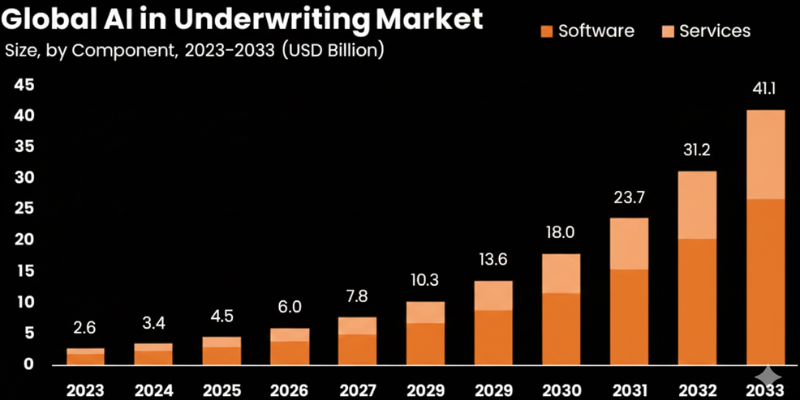
1. Verified Industry Statistics
- 70% insurers are implementing or expanding AI underwriting
- 30–60% reduction in underwriting cycle time with automation.
- 25–40% reduction in operational costs.
- 50–70% improvement in Straight-Through Processing (STP).
- 35–45% higher accuracy in risk scoring.
2. Why AI Adoption Has Accelerated
- Current customers do not want to wait for long to get their quotes or claim settlements, calling for AI adoption in insurance.
- An expanding numbers of applicants and market trends builds a pile of data to consider while processing claims, increasing the level of complexity.
- The industry faces a talent shortage in actuarial and underwriting roles when the old employees leave the company, but AI can learn from their experience and pass it to new joiners.
- InsurTech competition is pushing innovations in AI underwriting trends to keep the companies relevant in the market.
6 Challenges (and hidden opportunities) for Life Underwriters Today
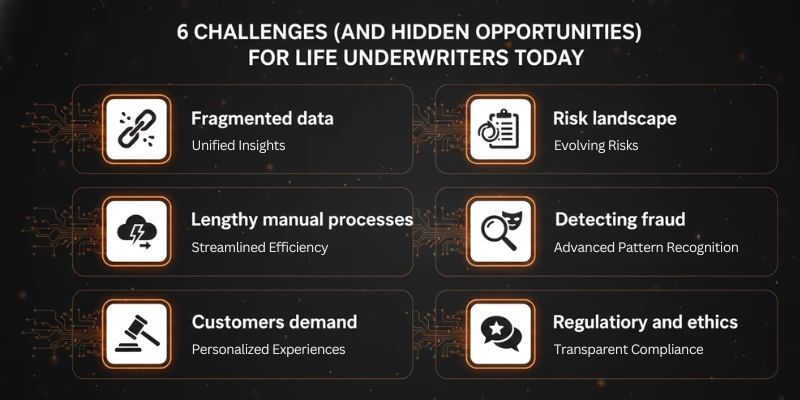
1. Fragmented Data
Data collected by a life underwriter comes from different sources and formats, causing information overload. It takes hours to combine this data and extract key details for accurate calculations.
This complexity and risk of errors create an opportunity to leverage underwriting modernization trends. They can simplify the complex task of searching summary of an applicant’s health and history, and save their significant time.
2. Lengthy manual processes
Manual processes are slow and labor-intensive, demanding repetitive hand typing and sifting through piles of medical documents. It increases workloads and chances of missing important values during data entry, leading to delays and inconsistent policy decisions.
AI-supported digital transformation in underwriting can serve as a mechanical clerk, handling loads of repetitive tasks within minutes. It automates the routine decision and reduces waiting time, benefiting both customers and life underwriters.
3. Risk landscape
Every day, new medical history data enters the system for each customer. This includes COVID-19 effects and genetic results. Modern wearables also add continuous health updates. These additions increase data volume and reshape the risk landscape. Traditional underwriting methods cannot keep pace with this rapid data growth.
However, ML and AI insurance underwriting trends offer the way out by finding patterns in large data sets and their correlation with health risks, providing accurate insights to the life underwriters.
4. Detecting fraud
Fraud detection is becoming more challenging as the volume of data and applicants is increasing. Life underwriters face difficulties in discriminating between genuine claims and fraudulent ones due to loopholes in the blunt rules.
Underwriting modernization trends provide an edge to this risk identification issue by locating suspicious activities instantly. AI digs into the various data spots to find patterns and look for anomalies by searching past and present details of an applicant from distinct sources.
5. Customers demand
Customers nowadays prefer to buy insurance with just one click without getting involved in any lengthy and time-consuming processes. Every extra day spent on issuing a plan may cause them to shift to another provider that offers fast service.
AI enhances the underwriting process by checking the required number of tests for a particular applicant and asks only relevant questions on the basis of their age and medical records. InsurTech market trends leverage AI-driven predictive analytics to offer personalized policies to its customers in a short time.
6. Regulatory and ethical requirements
HIPAA and GDPR critically supervise the customer’s health data usage by life underwriters, increasing compliance complexity. Further, AI adoption in insurance raises ethical concerns in algorithms and model training due to the risk of bias for a particular set of data.
Life underwriters can use advanced AI auditing tools to check bias in the model and NLP to explain the decision’s rationale and fulfill compliance requirements.

What Exactly Is AI-Based Underwriting?
In order to deeply understand AI insurance underwriting trends, let us explore its associated components and differentiation from traditional processes.
a. Defined Components
- Data ingestion and extraction are two main stream actions under AI underwriting trends, which include the collection of data from various medical and non-medical sources and deriving relevant information needed for the underwriting process.
- Predictive risk modeling is applied to the extracted insights to figure out the potential losses or claims related to a specific applicant.
- Automated decision engines working under AI insurance underwriting trends analyze the risk score, historical data, and compliance alignments to approve or reject an application without manual intervention.
- Generative AI assistants help the underwriters by communicating with customers and designing personalized plans for them based on their responses.
b. How It Differs From Rule-Based Underwriting
- AI underwriting trends using Machines Learning algorithms automatically improve themselves as time passes, unlike the manual reprogramming and fixed rules approaches.
- Predictive analytics provides real-time risk insights, which are missed in the rule-based underwriting process.
- Global AI adoption in insurance underwriting digitalizes the records, which reduces human dependency for documentation, contrasting with fixed rule methods, requiring personnel oversight.
Key AI Technologies Transforming Underwriting
1. OCR & Document Intelligence
AI underwriting trends now use OCR and document intelligence tools to read and extract key data. These tools process medical, financial, claims, and KYC documents with over 95% accuracy in data profiling.
2. Machine Learning
ML algorithms advance predictive scoring and automated risk classification as per the related past details of the applicant. It helps in loss probability forecasting and deciding optimum premiums accordingly.
3. Natural Language Processing (NLP)
NLP enables reading of unstructured documents and medical/clinical text interpretation
Driven from distinct sources. It is also used for fraud detection by locating suspicious entries or past transactions.
4. Generative AI & Underwriting Copilots
New generation AI and its Copilot features provide real-time policy recommendations to the customer as per their preferences and behaviour. These tools can also prepare summaries of complex reports and drafts of underwriting notes.
Emerging Trends That Are Shaping AI Underwriting
The following factors are reshaping insurTech market trends like AI underwriting:
1. Expansion of Embedded Insurance
Customers’ need for instant approval of their policy application is leading to more automation in the form of embedded insurance. Now policy is being attached to a purchased product or service for its protection or repair, without applying separately.
2. Hyper-Personalized Products
One policy for all no longer works for modern insurance customers. Businesses now use behavior-based pricing powered by data-driven segmentation to personalize premiums.
3. Digital-Only & On-Demand Insurance
Micro-insurance is so much in demand, specifically in low-income groups or for temporary needs of insurance, such as for travel booking, the gig economy, or device protection policies. AI insurance underwriting trends enable insurers to earn profits from these short-term, small plans through intelligent analytics.
4. Increased Regulatory Push for Transparency
Regulatory authorities seek convenient AI audit trails to monitor ethical and transparent use of algorithms and get logical explanations of underwriting decisions.
Business Benefits Observed by Insurers
Insurers can leverage several benefits from AI insurance underwriting trends, as explained below:
- AI-driven underwriting processes are comparatively economical as these reduce the need for physical infrastructure, intense labour, and heavy investments in storage systems.
- AI underwriting trends provide modern tools that can automate repetitive activities, accelerate the work process, and optimize its efficiency.
- Predictive analytics facilitates risk assessment and helps in designing personalized plans for individual customers. It increases their insurance experience and helps businesses retain them for the long term.
- AI adoption in insurance streamlines new revenue sources for organizations by promoting innovative product development through advanced technologies.
Industry-Specific Use Cases
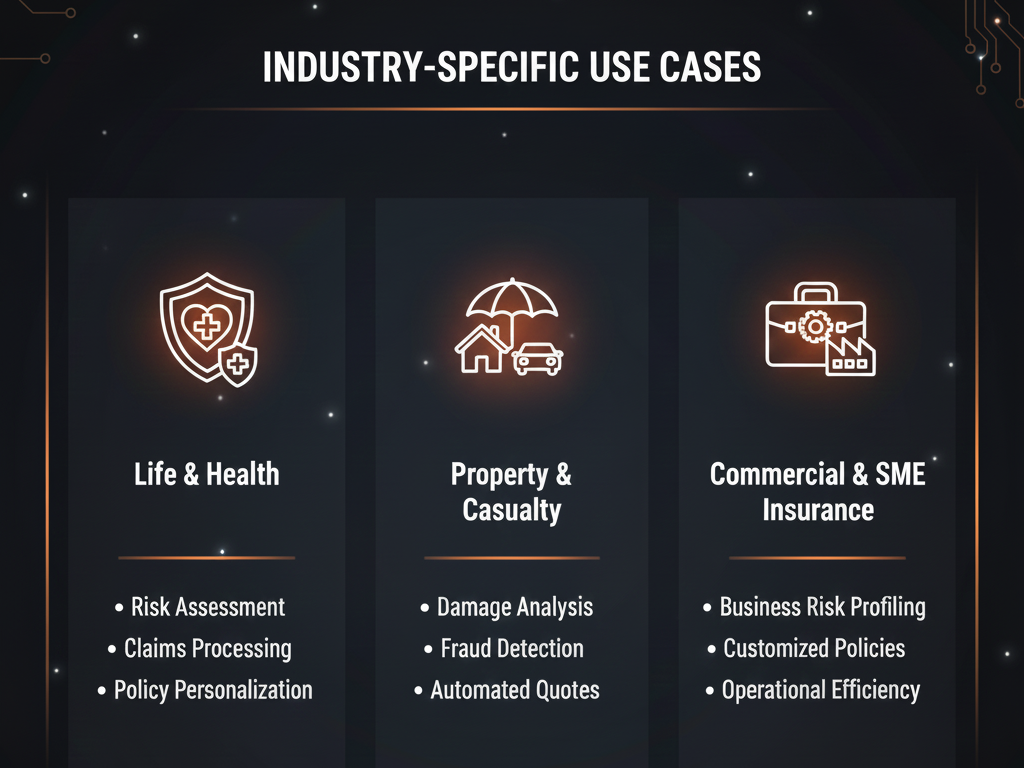
Different industries are leveraging AI insurance underwriting trends to grow their businesses and improve ROIs in the following ways:
1. Life & Health
- Smart AI tools like OCR read and extract relevant data from both structured and unstructured documents, such as medical reports, physicians’ notes, prescriptions, and lab results.
- Predictive analytics is applied to the collected data for Mortality/morbidity scoring, to guide underwriters in assigning fair prices for different medical insurance.
2. Property & Casualty
- Advanced AI algorithms can offer image-based property risk assessment, which helps underwriters to evaluate underlined future likelihood of damage in a property.
- ML models facilitate fraud detection by identifying suspicious patterns in the claim history of a policyholder and prevent insurers from making faulty payments.
3. Commercial & SME Insurance
- While underwriting for an SME or business entity, an insurer uses AI tools to determine its financial health and premium payout capability by analysing its historical data and current market status.
- Advanced analytics helps the insurance providers in portfolio-level risk modeling for their SME clients and balances out the capital allocation.
Implementation Pathway for Insurers
An insurer can switch to AI insurance underwriting trends through the following systematic approach:
Step 1:
Evaluate current underwriting workflow maturity and identify key areas, such as risk assessment or documentation handling, which will generate the highest benefits from automation.
Step 2:
Identify documents and sources that can provide clean, digitaliable, and accessible data ready for model training and automation.
Step 3:
Implement Document AI, OCR, and ML risk models to extract useful information from a large variety of platforms accurately and automatically get useful information.
Step 4:
Build secure data pipelines to ensure smooth and safe data flow between relevant stakeholders, as well as to comply with regulatory standards.
Step 5:
Integrate with PAS, CRM, and claims systems to streamline the insurance journey with better workflow and customer satisfaction.
Step 6:
Define KPIs, such as STP rate, cost reduction, and accuracy percentage, to measure ROIs and success from AI adoption in insurance.
Step 7:
It should also be ensured that continuous model governance and bias checks are taken to ensure the long-term accuracy, compliance, and fairness of AI models.
Challenges & Considerations
Alongside the numerous benefits of adopting AI underwriting trends, there are significant challenges to consider while switching to new technology:
- If the data quality is poor, it will lead to incompetent and biased AI model training, resulting in unstable and erroneous outcomes.
- It is a tedious and costly affair to integrate modern AI insurance underwriting trends with legacy systems, requiring heavy investments in infrastructure and employee training.
- Explainability, accountability, and user trust are major concerns when using AI for underwriting decisions, specifically in data-sensitive industries like health and finance.
- Regulatory bodies put extra pressure on implementing robust security measures and attaining compliance needs when AI in underwriting is involved in the major policy decisions.
- The workforce may resist automation due to the fear of losing a job or a lack of required skills. However, with proper communication and training programs, they can be adapted to the change.

How A3Logics Enables AI-Based Underwriting Transformation?
A3Logics is one of the leading names as an AI Development Company and a preferred choice for technological transformation due to its high-end service records.
- Our AI underwriting automation framework includes the latest tools like ML, NLP, and OCR, to automate data collection and interpretation tasks.
- Our predictive ML-based risk models justify the integration of AI in underwriting by proactively engineering insurance fraud detection automation and enabling insurers to take accurate data-driven decisions.
- At A3Logics, our expert teams offer GenAI Underwriting Copilot, which assists the underwriters in documentation, data analysis, and creating personalised plans.
- We offer end-to-end implementation, security & compliance, and insurance software development services that can scale with the evolving underwriting needs.
Conclusion
AI insurance underwriting trends are surely reshaping the traditional work processes and providing a range of benefits to the underwriters, customers, businesses, and the economy. We realized the role of AI in helping Insurers reduce underwriting costs, increase operational efficiency, and enhance customer experience. However, the perks do not come alone; several challenges are also there to consider before following the insurTech market trends. Contracting with an IT and AI expert like A3Logic can streamline efficient AI adoption in insurance.