The Rise Of AI Agents And How They Are Different From Traditional Chatbots
For quite some time now, we have seen traditional chatbots help businesses answer FAQs and basic customer queries with speed and efficiency. And they do deserve credit for that.
However, workplaces are becoming more complex by the day, and so are customer queries. Since the scripted traditional chatbots fall short when it comes to handling complexity, whether in operations or when handling customer issues and queries, we are seeing a rise in AI agents. When handling complex interactions, a traditional chatbot relies on predefined static scripts. An AI agent leverages LLM to understand the interaction better, and it dives deeper into the context and understands the purpose well.
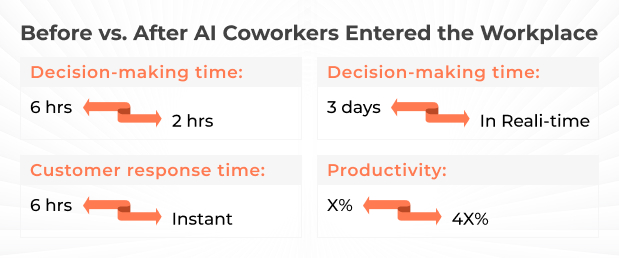
What Happens When AI Becomes Part Of Your Daily Team?
We have clearly demonstrated that AI agents’ futures are bright. AI agents are shaping the future of workplaces by highlighting their ability to go beyond traditional chatbots. From automating repetitive tasks to supporting complex decisions involving insights, AI agents in your modern businesses can do wonders.
By including AI agents as coworkers, companies can unlock smarter insights, faster workflows, and reduce operational friction. AI-human co-working can make teams more productive and help them adapt to dynamic business needs, where the human counterparts can focus on more strategic and creative tasks.
In our opinion, the future of workplaces will be defined by a hybrid model, where humans and AI agents will team together, where AI will take off the mundane load off human colleagues.
What Are AI Agents And Their Role In Workplaces
Before we discuss what AI agents are and their increasing and valuable role in workplaces, have a look at this example –
A logistics manager struggles with rerouting deliveries during heavy rains where many areas of the location are clogged. His coworker, an AI agent quickly analyzes road closures, weather updates and fleet location in real-time. It then, optimizes all routes accordingly making deliveries quicker and safer.
The example highlights how AI agents are becoming indispensable digital allies in modern workplaces. Let’s first understand what AI agents are before we briefly discuss their role –
What Are AI Agents?
AI agents are systems or applications that can make decisions and perform tasks autonomously, often with no or minimal human intervention. They are designed to act in a specific environment to achieve a set of goals. They leverage natural language processing and machine learning to understand and respond to input, learn from their experiences, and adapt to dynamic environments.
Role of AI Agents In Workplaces
Here are some points that highlight the role of AI agents as coworkers. However, this is not an all-inclusive list –
- Automate repetitive and well-defined tasks such as email management, scheduling, calendar management, report generation, customer support, document summarization, data entry, etc., freeing up human employees.
- While performing tasks, AI agents as colleagues reduce errors, increase productivity, and improve accuracy.
- Enhance decision making by quickly analyzing large data sets; identify patterns and provide actionable insights.
- Deliver 24/7 customer support; resolve their queries instantly.
- Reduce costs associated with redundant manual processes, human errors, and wasted resources.
Stats To Show How AI Agents Are More Efficient
- Businesses implementing advanced AI agents have reported a 42% reduction in resolution time.
- Gartner predicted that in 2025, AI agents will be involved in 80% of all customer service interactions.
- In material science research, AI integration has led to a 44% increase in material discoveries and a 39% rise in patent filings.
- An MIT study also found that companies using AI agents have improved customer satisfaction scores by 22%.
- 65% of respondents report that their organization is regularly using generative AI.
- 75% of banks with over $100 billion in assets actively implement AI agent technology
The Rise of Hybrid Workspaces with Humans + AI Collaboration
The rise of hybrid workspaces signifies a shift towards seamless collaboration between humans and AI. We are not just talking about the future of workplaces; AI is becoming an integral part of daily operations across industries such as healthcare, retail, customer service, banking, and finance, etc. This has given rise to a new work model, a hybrid workforce, where AI and humans collaborate to enhance efficiency, productivity, and innovation.
Unlike what many might think, AI-human co-working isn’t about AI replacing humans; it is rather about augmenting human capabilities by handling repetitive, time-consuming tasks, letting employees focus on more strategic and creative tasks.
AI agents are making their way into our daily lives as consumers and busybodies. Most smartphones are looking to address the demand for AI co-piloting now. While digital assistants like Siri have been used to great effect as commonly as greatly underutilized, AI tech’s improvement has spurred appetites. With hardware and software advancements taking significant leaps, users can expect AI agents to accompany them wherever, whether people are at home or looking for the answer to ‘what is an eSIM’ before they head abroad.
Factors Fueling The Rise of AI Human Co-working
Several factors are fueling the rise of human and AI collaboration at workplaces –
- Cutting-edge technologies such as RPA, machine learning, and AI have reached a new level of sophistication, making AI-human collaboration important in workplaces.
- AI agents on the team can help swiftly adapt to changing market trends by providing AI- and data-driven insights.
- Since AI helps automate repetitive tasks, humans can focus on creative and strategic work, increasing efficiency and saving costs.
- At organizations where it’s challenging to hire a skilled workforce to handle mundane, rule-based, and repetitive tasks, AI agents can be hired as coworkers.
- AI agents as colleagues can help human counterparts analyze massive datasets, offer insights, and find patterns. Paired with human judgment, smarter and wiser decisions can help make informed strategies in real-time.
- These days, work environments demand smarter and more flexible tools. AI helps manage remote teams, monitor performance, and automate communication, eliminating the need to micromanage.
Benefits of AI Coworkers
24/7 Availability
AI agents as co-workers can operate continuously without needing time off, ensuring that business operations and processes run continuously around the clock. With the ability to work tirelessly 24/7, AI agents as colleagues can be fruitful when dealing with operations or international clients in different time zones while also providing constant support even after working hours.
Data-Driven Decision Making
AI co-workers are capable of processing large datasets quickly and providing valuable insights based on real-time information. Using this data they can identify trends, anomalies and patterns that human coworkers may not be able to find.
Reduction in Errors
The difference between human and AI agents is that humans suffer from distractions and fatigue because of which they can make errors. AI agents, don’t get tired or get distracted. They can follow programmed rules with precision and thereby process data faster without errors while adhering to compliance checks.
Increased Productivity
When performing repetitive and time-consuming tasks, AI agents in a team demonstrate high efficiency. By automating tasks such as data entry, basic communication, and scheduling, AI helps human colleagues to focus on more strategic and creative tasks. This helps accomplish business-related goals faster and maintain team productivity.
Scalability
One of the benefits of AI human co-working is that AI agents as coworkers reduce the need to hire additional workforce, and at the same time, help businesses scale. When handling an increased number of customers, dealing with changing business goals, processing dynamic data, AI agents in the team, can work tirelessly across time zones. As a result, companies can scale operations, launch new services and serve more customers.
Constant Learning
AI agents in the team leverage cutting-edge machine learning algorithms to learn and improve over time. As a result, they become better and more efficient in handling tasks. When compared to human counterparts, AI agents as coworkers don’t need frequent retraining, which further adds long-term value.
Difference Between AI Agent Coworkers and Traditional Chatbots
| Aspect | AI Agent As Coworkers | Traditional Chatbots |
| Autonomy | AI agents operate autonomously. For example – trading bits can analyze market trends, execute trades and adjust strategies in real time. | Chatbots have minimal autonomy. They rely on predefined scripts and workflows. For example, a chatbot, when asked about refund, may direct the customer to refund policies but may not process a refund. |
| Complexity | AI agents can handle complex, multidimensional problems. They are capable of substantiating their recommendations with insights | Chatbots can only handle straightforward processes; they are efficient for linear and predefined tasks. |
| Capability to learn | AI agents are equipped with advanced learning mechanisms such as supervised, unsupervised, and reinforced learning. They can improve with time. | Most chatbots operate on fixed datasets and might not see a significant improvement in their performance. |
| Cross-integration with external systems | As far as the cross-integration aspect is concerned, AI agents may be difficult to set up and may be slightly costlier but once set up they can work well with external systems and this can be a big benefit in the long run. | Chatbots may be easy to set up, but their utility is confined to a single platform, like a website or messaging app. |
Real-Life Case Study For Using AI Agents In Workspaces And In Team
L’Oréal
L’Oréal, a world leader in beauty products employs AI agents across various facets of its operations to enhance personalization, efficiency and customer engagement. Powered by generative AI, its new personal AI beauty assistant can help customers build custom shopping lists, beauty routines, and product recommendations. Their virtual online assistant, Lore leverages GenAI to interact with wide range of customers on platforms like WhatsApp and Instagram.
Bosch
Bosch Power Tools use Agent Copilot as a virtual assistant to listen to ongoing calls, and retrieve relevant information from knowledge bases to provide next best action. It analyzes the caller’s tone and sentiment to tailor responses appropriately. After the call, Agent Copilot, transcribes the conversation and summarizes the key points, eventually streamlining the documentation process.
Elevance Health
Elevance Health uses AI to improve healthcare and streamline operations. It’s health OS platform is powered by AI to close care gaps and share real-time patient data and boost follow ups after hospital stays. For claims, Elevance uses PEGA’s Smart Claims Engine to automate tasks, reduce errors and speed up training for staff. All in all AI tools enhance patient outcomes and make operations more efficient and less costly.
IBM
IBM’s AskHR tool, a purpose-built platform helps automate over 80 common HR processes. It is integrated with IBM’s Watson Orchestrate platform and enables managers and employees to perform tasks such as viewing compensation history, requesting time off, retrieving pay slips, updating personal information through a natural language chat interface. The system has demonstrated high adoption rates with 96% of managers and 93% executives using the tool; leading to 40% reduction in HR operating costs.

Challenges and Considerations for workplaces with AI agents as Co-workers
While there are many potential benefits of AI agents as co-workers, the challenges and considerations of implementing or onboarding them as coworkers in the team must be addressed –
- Talent and Skills Gap
There is a huge demand for AI/ML expertise; however, the supply is less. Companies need to invest in upskilling their workforce and hire people who can develop, deploy, and maintain AI agent systems.
- Complex Maintenance
We can’t ignore the fact that AI agents are still in their nascent stage; as such, even with automation, they need to be monitored by humans on various fronts—performance, data accuracy, speed, etc.
- Integration With Existing Systems
Cross-integrating AI coworkers with existing systems (especially legacy systems) can be costly and requires careful data flow and compatibility considerations.
- Adapt to Dynamic Business Needs
AI agents must adapt to dynamic business needs, which requires careful strategy and implementation practices.
- User Acceptance and Trust
End-user adoption is very important when incorporating AI agents into teams and understanding their true value. It is essential to build trust, address concerns surrounding job displacement, and impart adequate training.
- Privacy and Security
It is essential to ensure that sensitive data is protected when incorporating AI agents. Privacy, regulation, legal, and other compliances should also be adhered to strictly.
- Bias and Fairness
AI agents as coworkers can reflect biases from their training data, leading to unfair decisions. To ensure fairness, companies must use diverse datasets and conduct continuous audits.
The Future Outlook
AI agents are the future of workplaces. As coworkers, AI agents can address intricate problems with a level of adaptability and ingenuity, matching up with the human workforce. They can perform workflows, reason, understand context, learn from mistakes and generate creative solutions.
AI agents have already proven their worth across various industries. For instance, in software development, drug discovery, and customer service, AI agents are already delivering productivity. In taxation, AI agents help produce complex documents that previously took weeks to deliver.
In the near future, you will soon be able to describe an agent what you need via natural language or programming and the AI agent will create it. The workspace future with AI agents goes beyond simple automation – it is a synergy of human and AI agent collaboration and dynamic oversight.
Who To Choose for Building AI Coworkers?
At the outset, if you are exploring AI agent integration, partnering with a trusted Generative AI development company is key. A3Logics, is one of the companies that offers AI agent development services. We deploy AI agents such as AI sales agents, process automation agents and others to boost efficiency, streamline operations and enhance growth.
Here’s why you should choose A3Logics as your AI agent development company –
- Our autonomous AI agents can adapt to any business environment.
- We offer custom AI agent solutions like – AI agent development, AI agent consulting strategy, conversational AI development, AI agent integration, among others.
- Our AI agents come with endless capabilities. They can automate customer support, enhance data analysis, optimize marketing campaigns, improve supply chain management, and more.
- We develop AI agent solutions that think, adapt and scale with your business.
Conclusion
To wrap up, we explored what AI agents are and how they go beyond traditional chatbots. Unlike traditional chatbots that follow scripts and are restrictive, AI agents utilize natural language processing and advanced algorithms to understand the context and accomplish tasks.
We have also delved into how some of the big names like Loreal, Bosch, IBM and Elevance use AI agents to improve decision-making, enhance customer service, and boost productivity. Their success shows how AI agents can bring real value when integrated thoughtfully into daily operations.
The future of work looks bright with AI agents and humans working side by side. Operational workflows are becoming more streamlined, tasks are getting done faster, and teams are experiencing less stress and more focus. With AI handling routine jobs, humans can now spend more time on creative and strategic work.
FAQ
What is an AI workforce?
An AI workforce refers to a group of intelligent digital systems or agents that work alongside or in place of humans to perform tasks. These AI systems use machine learning, natural language processing, and automation to analyze data, make decisions, and complete repetitive or complex work. Unlike traditional software, AI workers can learn from experience, adapt to new scenarios, and collaborate with humans to enhance productivity, accuracy, and business agility across industries.
Can AI replace human workforce?
No AI can’t replace human workforce; While some roles may evolve or phase out, it is intended to augment human workforce not eliminate them. Humans bring creativity, empathy, ethical judgment, and strategic thinking—qualities that AI cannot replicate. The future will likely involve hybrid teams where AI handles automation and humans focus on leadership, problem-solving, and innovation.
How will AI change the workforce?
AI will reshape the workforce by transforming roles, workflows, and required skills. Repetitive tasks will be automated, freeing humans to focus on more strategic and creative work. Job roles will evolve, requiring new technical and analytical capabilities. Companies will need to reskill workers, adapt management strategies, and adopt human-AI collaboration models. This shift will increase productivity, reduce operational costs, and create new opportunities—marking a transition to agile, AI-augmented teams across industries.
What are the key aspects of AI agents as coworkers?
AI agents as co-workers are intelligent systems that support humans by handling repetitive, data-intensive, or time-sensitive tasks. Key aspects include their ability to learn and adapt, work autonomously or collaboratively, and integrate into existing workflows. Unlike basic automation, AI agents can reason, understand context, and make decisions. They reduce manual effort, improve accuracy, and speed up processes, allowing human workers to focus on creativity, strategy, and interpersonal tasks that AI cannot handle.
Give examples of AI agent as coworkers?
AI agents are useful across industries as supportive coworkers. In customer service, AI agents answer queries, escalate complex issues, and provide real-time insights. AI agents in healthcare assist in diagnosis and patient monitoring. In software development, AI tools write and test code. Logistics managers use AI agents to reroute deliveries during disruptions. These examples show how AI agents work alongside humans, enhancing productivity without replacing the human touch or oversight required in critical tasks.