
Increasing automation, advanced technological solutions, and customers’ rising expectations for convenience and speedy services have led to immense growth in the number of digital lending platforms. In 2024, these platforms had a global market size of USD 10.55 billion and were projected to grow at a CAGR of 27.7% from 2025 to 2030.
The digital lending platforms simplify the process of borrowing since customers are connected to financial institutions, which boosts the volume of loans. They drag the approval process, simplify the work process for the lenders, and give easy loans to borrowers at competitive rates with slimmed margins.
The emergence of this modern fintech economy facilitates easy loan acquisition for small individual borrowers, such as students and workers. However, this inclusion demands advanced risk assessment solutions due to increased credit risks.
Legacy models fail to deliver real-time, speedy analysis of borrowers’ profiles due to their reliance on limited data and slow, manual processes. Traditional methods highly depend on static historical data without integrating frequent updates and real-time economic situations. Thus, the outdated, slow risk assessment mechanisms are no longer viable in today’s fast-paced market dynamics.
Here, AI credit risk modeling is filling the gap between the fintech market shift and limitations of conventional tools. To stay in the game of competition, lending institutions should be in a position to make the right and timely lending decisions, but should also make sure that they are not victimized by loan defaulters. Automated processes and predictive capabilities of AI and ML influence financial institutions to use them for credit risk assessment in digital lending.
The Changing Landscape of Credit Risk in Banking & Fintech
Banks and fintech institutions are facing risk-based lending in the modern credit system due to the following factors:
1. Rise of Digital-First Borrowers
The boom in social media platforms and generational shift has raised expectations for a better standard of living, generating more purpose for borrowing. Young people with low income seek digital and convenient loan facilities, opening the door for new credit models such as BNPL (buy now pay later), instant loans, micro-lending, and embedded finance.
However, these borrowers usually have little or no prior borrowing history, making it challenging for the banking and fintech institutions to assess their risk profile. There is only limited data available to check their creditworthiness, leading to inaccurate inclusion or exclusion.
2. Increasing Default Risks & NPAs
Due to the increasing number of minor and individual debtors along with volatile economic conditions, accurate and fast risk assessment becomes complicated for banking and fintech institutions.
In addition, limited and scattered data lengthen the borrower’s risk profile building process, resulting in delayed lending decisions with inaccurate risk anticipation. It exposes lenders to defaults in repayments and augmented NPAs (non-performing assets).
3. Regulatory Pressure & Compliance Challenges
As the list of borrowers is expanding, regulatory pressure from RBI, Basel III/IV, and IFRS 9 is burdening the banking and fintech institutions to follow more robust parameters to protect both debtors and creditors.
Lenders need to ensure transparency and explainability in their credit models to exhibit soundness in the risk assessment procedures and ethical followership.
Limitations of Traditional Credit Risk Modelling Approaches
Traditional methods of credit risk scoring encompass several limitations that fall short in keeping up with the modern complications of the digital lending economy. The shortcomings of this approach necessitate the implementation of AI credit risk models for banks and other fintech institutions.
1. Rule-based and static scoring systems
This model operates according to fixed rules, has a fixed procedure, and does not incorporate any change or update in customer behaviour or even market dynamics. Such a strict manner of assessing the risk level does not consider the current situation in the market, and it provides inaccurate or compromised marking with a long response time.
2. Dependence on historical credit bureau data only
Legacy frameworks of credit risk scoring depend on historical data of customers to analyze their capacity to repay. It often neglects small and first-time borrowers who do not have any past loan history, depriving genuine and capable loan seekers of financial inclusion.
3. Inability to process real-time and alternative data
As stated earlier, traditional models rely on historical data only; they do not capture or analyse real-time additional details available from alternative sources. For instance, a new borrower may lack a credit record, but his financial strength can be assessed from his spending habits and past transactions. But the legacy mechanism does not consider these data for risk profiling of an individual.
4. Slow decision-making and poor scalability
These credit risk models usually review the creditworthiness of an applicant manually, which consumes significant time, delaying the approval process. In the fast-paced world, customers want quick response and convenient lending, not feasible with slow decision-making. Additionally, to stay competitive in the market, institutions can not easily scale their traditional mechanism to match evolving needs without spending high costs and time.
5. Lack of explainability and audit readiness
Legacy methods also lack transparency behind any lending decision, which can trigger compliance issues regarding explainability and audit requirements.
What Is AI-Powered Credit Risk Modeling?
AI credit risk modeling is the application of advanced tools like AI and ML algorithms to generate creditworthiness scores for a borrower by analyzing their comprehensive real-time data from distinct sources. This is a current digital approach that accelerates the risk evaluation process and increases its accuracy and speed in making decisions, as well as the fair inclusion of borrowers.
The following components play a major role in AI-driven credit risk analysis:
a. Machine Learning (ML)
Machine learning in credit risk modeling is the fundamental driver of this modern approach, enabling systems to identify hidden and complicated patterns from huge databases and find correlations among them. Its learning and adapting capabilities provide fast, accurate risk assessment, while incorporating evolving customer behaviour and market conditions.
b. Predictive analytics
They deliver actionable insights from historical as well as real-time customer data, allowing explicit prediction about the defaults for credit risk modeling in fintech. Correct estimation of risk profile and informed proactive decision-making help the lenders optimally price the loan amount.
c. Big data processing
AI credit risk models for banks are capable of analysing huge volumes of structured and unstructured data from different sources, providing a complete look at a customer’s financial health.
d. Alternative data sources
Indirect financial data of customers derived from their past purchase transactions, online behaviour, and social media activities is also analysed by AI and machine learning in credit risk modeling.
Traditional vs AI-based credit risk models
| Criteria | Traditional models | AI-driven models |
| Data | Historical and structured financial data | Real-time, big data, including both structured and unstructured, from diverse sources. |
| Modeling techniques | Static and rule-based | Dynamic and adaptive |
| Risk assessment accuracy | Low to moderate due to exclusion of the latest updates | Predictive, accurate results supported by real-time actionable insights |
| Speed | Slow and time-consuming due to manual review | Fast decision-making through automated risk assessment |
Why AI-Powered Credit Risk Modeling Is Essential in the Digital Lending Era
The following are the key benefits of AI credit risk modeling in fintech and banking institutions:
1. Faster and Smarter Lending Decisions
- AI-driven credit risk analysis uses predictive analytics of real-time data to offer faster risk assessment.
- In contrast to manual processing, automated detection of anomalies and fraud potential enables speedy approval decisions without compromising accuracy.
2. Improved Risk Accuracy & Default Prediction
- Machine learning in credit risk modeling is highly efficient in evaluating vast amounts of big data and finding patterns and correlations. The 360-degree view of a customer’s past and recent activities enables early identification of high-risk borrowers.
- Lenders can apply a dynamic pricing policy for different customers according to their risk profile and prevent themself from passing bad loans and NPAs.
3. Ability to Use Alternative & Real-Time Data
- The implementation of AI in credit risk management in banking and fintech uses customers’ alternative and real-time data from different sources.
- They could involve their banking transactions, social media activities, mobile activities, and past bill payments and transactions.
- This data is used to identify the behavioural and spending patterns, which are indicators of their financial stability.
4. Enhanced Regulatory Compliance & Transparency
- Real-time review of customer behavior and market condition fluctuation on AI-driven dashboards provides clear, transparent, and reliable inputs. Modern AI can clearly explain the working of its models using NLP and the reason behind certain approval or denial of lending decisions.
- Automatic conversion of the unstructured and incomplete data into structured data can be done through AI credit risk modeling, which improves the quality of data.
- Credit risk assessment in digital lending must be bias-free and offer equal credit opportunity for all social classes, irrespective of their demographics. AI models include a fair monitoring system and are trained to detect the overinfluence of one factor on the whole output.
5. Scalability for High-Volume Lending
- An increasing number of lenders and borrowers are building piles of data and AI in credit risk management, which offers full scalability to make millions of credit decisions with maximum accuracy.
- Fintech platforms and digital banks have to process tons of credit applications daily, making AI credit risk modeling an ideal solution for them for quick responsiveness.

Key Use Cases of AI Credit Risk Modeling in Banking & Fintech
AI credit risk modelling is mostly used in the following types of lending practices in banks and fintech institutions:
1. Digital loan origination platforms
First-time borrowers usually connect to digital loan platforms for quick and convenient borrowing. Credit risk assessment in digital lending is used by these platforms to speed up their approval process while assessing each applicant’s risk profile accurately.
2. Buy Now Pay Later (BNPL)
AI credit risk modelling enables lenders to check the creditworthiness of buyers purchasing on an installment basis. It safeguards the banks and fintechs from default risks, while serving their customers with instant credit approvals.
3. MSME & SME lending
AI-driven credit risk assessment in digital lending allows financial institutions to lend money to small and medium enterprises with limited credit history. ML algorithms study their other relevant data, such as their cash flow statements and business data, to analyse their financial stability.
4. Consumer & personal loans
Modern methods of credit risk modelling in fintech eliminate a one-size-fits-all approach and equip the lenders with individual assessments for personalised loans. They use AI-powered scoring methods to finalise interest rates for each customer on the basis of their respective risk profile.
5. Credit line management
AL and ML tools help the lenders manage their credit line efficiently by regularly updating customer behavioural data, such as withdrawal or repayment. It allows the lenders to limit or extend offers on the basis of available balance and regular assessment using AI credit risk modelling.
6. Portfolio risk monitoring
Banks and fintechs can early detect portfolio risks by analysing market fluctuations or changes in customer behaviour. It allows them to monitor in advance for potential defaults in loan payments and manage the credit portfolio accordingly.
Business Benefits of AI-Powered Credit Risk Modeling Solutions
Banking and fintech businesses leverage several benefits from the AI credit risk modeling, revolutionizing their profits and lending practices, even in the dynamic landscape of consumer behaviours and economic conditions.
- AI-powered solutions offer quick and accurate risk assessment of each customer segment, reducing default rates and NPAs.
- With automated processes, lenders can provide a fast response to the loan applications, increasing approval rates with controlled risk.
- ML and AI-driven credit risk analysis eliminates the need for human intervention for reviewing the risk profile of a borrower. It not only fastens the underwriting process but also reduces related manual costs.
- Modern methods of digital lending reduce bad debts and operational costs by employing real-time automated risk analytics. It increases the overall cash flow at a faster rate in a competitively shorter time.
- Earlier fraud risk identification helps businesses to come up with more superior portfolios with customized interest rates.
- Reliable and real-time risk evaluation of credit risk management by AI quickly increases the approval process and allows giving the customer a credit rate, increasing their trust and satisfaction.
Implementation Challenges & How to Overcome Them
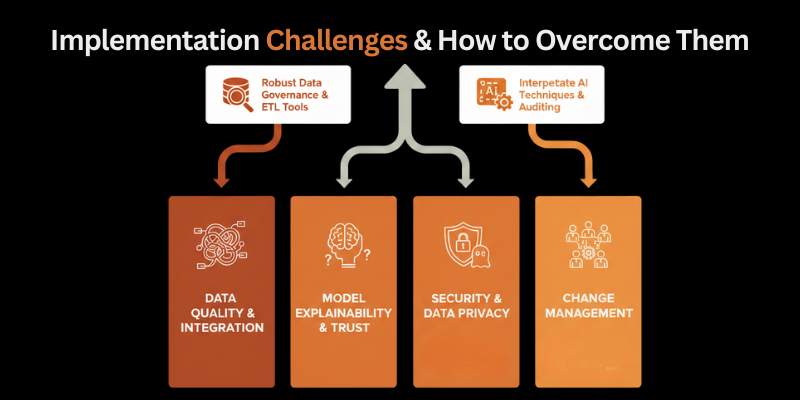
Digital lenders and banks encounter various issues in embracing credit risk modeling with the help of Machine Learning and AI. These are the most significant ones:
1. Data Quality & Integration
Incomplete or inconsistent data from different sources, and integrating them in one place, often creates hurdles in the quality training of AI models.
However, with proper governance and data cleansing, organizations ensure reliable, accurate data and consistently generate actionable insights.
2. Model Explainability & Trust
Traditional AI models do not clearly explain the process of reaching a certain outcome, affecting users’ trust due to a lack of transparency.
Lenders must incorporate human review at different stages and employ explainable AI techniques to provide a rationale behind the decisions.
3. Security & Data Privacy
Due to the use of big data by ML algorithms, security and privacy have become major concerns. Implement robust measures and regular monitoring to safeguard the data from cyber attacks and ensure compliance with security regulations.
4. Change Management
This is the most prominent application barrier from the side of employees and technical infrastructure. To cater to change resistance, involve the workforce in proper training programmes and equip them with AI skills and knowledge about its positive impacts on their job and business.
Best Practices for Adopting AI Credit Risk Modeling
Fintech software development requires a systematic approach to successfully implement AI credit risk modeling. The following is the list of guidelines that should be considered:
- Do not install a full-fledged model at the start; go for a trial version with pilot models to test the performance and introduce required alterations.
- The rule-based and AI models should be combined to adopt the benefit of a hybrid approach, opting to use a mixed system.
- Also, keep a constant check on AI models to ensure the predictive analytics is accurate and to avoid the development of biased algorithms.
- Ensure the use of explainable AI to provide clear reasoning behind certain credit approval or denial decisions and comply with customers’ and regulatory expectations.
- Always select an expert technology partner who has decent experience in the AI and Machine Learning development services, along with industry knowledge.

How A3Logics Can Help Banks & Fintechs?
Fintech software development requires a systematic approach to successfully implement AI credit risk modeling. The following is the list of guidelines that should be considered:
- Do not install a full-fledged model at the start; go for a trial version with pilot models to test the performance and introduce required alterations.
- The rule-based and AI models should be combined to adopt the benefit of a hybrid approach, opting to use a mixed system.
- Also, keep a constant check on AI models to ensure the predictive analytics is accurate and to avoid the development of biased algorithms.
- Ensure the use of explainable AI to provide clear reasoning behind certain credit approval or denial decisions and comply with customers’ and regulatory expectations.
- Always select an expert technology partner who has decent experience in the AI and Machine Learning development services, along with industry knowledge.
Conclusion
Increasing data volumes and complexity, along with the dynamic landscape of financial markets and customer behaviour, leave no room for outdated methods of risk assessment. AI credit risk modeling has revolutionized the way banks and fintechs analyze their credit risks with enhanced accuracy and at a faster speed. By sailing through the associated barriers, lenders can leverage the perks of automated lending practices and increase approval rates without losing profitability.