A big problem for aviation executives right now is that legacy systems that used to be the backbone of the industry are an obstacle to digital transformation. With the future of aviation at stake, CIOs know they need to invest wisely in Aviation Software Development to stay competitive. The outdated systems that create data silos are not only inefficient but also financially burdensome to maintain.
McKinsey says that many airlines still rely on sensitive IT systems that have been around for 20 or even 50 years. In fact, this is one of the biggest problems airlines face. This puts CIOs in charge of digital transformation in a tough spot: Should they keep things running smoothly or push for new ideas?
The aviation industry can get the most out of its operational data without having to completely replace its mission-critical equipment by using strategic alliances and modernization methods. The key is typically using modern Aviation software development services that can connect old systems with new data capabilities.
As the aviation software market is expected to cross $14.9 billion by 2033, it is important that you make the most of it. Here, we’ll discuss how the aviation business is getting ready for the future through custom aviation software development. Read on.
All You Must Know About Aviation Software Development
Aviation software developers create, deploy, and maintain digital solutions tailored for the aviation industry, including airlines, airports, air traffic control, and drone operations. This area includes a wide range of uses, including as systems for booking airline tickets and managing crews, as well as predictive maintenance and drone mapping. There are a number of reasons why aviation software development is important in 2025:
- Operational Efficiency
- Passenger Experience
- Safety and Compliance
- Sustainability
AI, IoT, and cloud technologies are now part of aviation software development consultancy, which is essential for businesses that want to stay flexible, compliant, and ready for the future.
How Numbers Define the Global Aviation Software Development Market
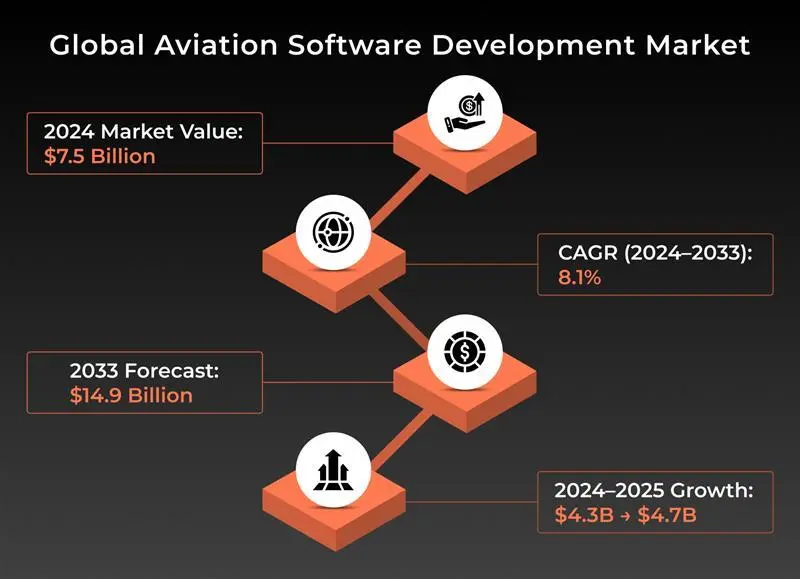
The global aviation software industry is growing quickly because of digital transformation, more people flying, and the need for businesses to run more smoothly. Important facts and figures include:
- In 2024, the aviation software market was worth around $7.5 billion. By 2033, it is expected to be worth $14.9 billion, with a compound annual growth rate (CAGR) of 8.1%.
- The market is estimated to grow from $4.3 billion in 2024 to $4.7 billion in 2025.
- Growth drivers include more people wanting automation and real-time data analytics, the use of AI, ML, and IoT for predictive maintenance and flight operations, the growth of drone and UAV markets, the speed of digital adoption after the pandemic, and strict regulatory requirements.
- Airline operations, air traffic management, maintenance, repair, and overhaul (MRO), and in-flight services are some of the primary areas that profit from aviation software development services.
This growth underscores the strategic importance of partnering with an experienced aviation software development company to stay ahead in a competitive market.
Types of Aviation Software Development Services
Aviation software development services include a wide range of solutions that are customized to meet the specific demands of airlines, airports, and drone operators. Some of the most popular types of services are:
1. Airplane Parking Reservation System Development
These systems automatically assign and reserve parking spaces for planes at airports. They use real-time data on arrivals, departures, and gate assignments to reduce congestion on the ground, speed up turnaround times, and make the most use of space. Custom aviation software development in this field makes it easier for ground crew and air traffic control to work together, which makes operations run more smoothly and increases the airport’s capacity.
2. Airline Reservation Software Development
Airline reservation systems are the backbone of ticket sales, seat management, and passenger check-in processes. Modern airline software development focuses on user-friendly interfaces, seamless integration with payment gateways, and real-time inventory updates. Advanced features include dynamic pricing, loyalty program management, and multi-channel booking capabilities, all designed to boost revenue and customer satisfaction.
3. Drone Mapping Software Development
With the rapid rise of UAVs, Drone Software Development has become a specialized niche. These applications enable aerial mapping, surveying, and data collection for agriculture, infrastructure, and emergency response. Key features include high-resolution imaging, automated flight planning, and real-time data transmission. Integration with GIS platforms and AI-driven analytics allows for actionable insights and regulatory compliance.
4. Crew Management Software Development
Crew management systems streamline the scheduling, rostering, and compliance tracking of pilots and cabin crew. These solutions consider factors such as duty time regulations, qualifications, and preferences to optimize crew assignments. Automated notifications, real-time updates, and mobile access improve workforce efficiency and reduce administrative overhead, supporting both airline operations and employee satisfaction.
5. Departure Control System Development
Departure control systems (DCS) take care of everything from checking in passengers to handling their bags to boarding them. DCS’s custom aviation software development focuses on the flow of data in real time between airlines, airports, and ground handlers. Modern DCS systems make sure that departures go smoothly and delays are kept to a minimum by allowing mobile check-in, biometric verification, and automated baggage tracking.
Step-by-Step Process for Aircraft Software Development
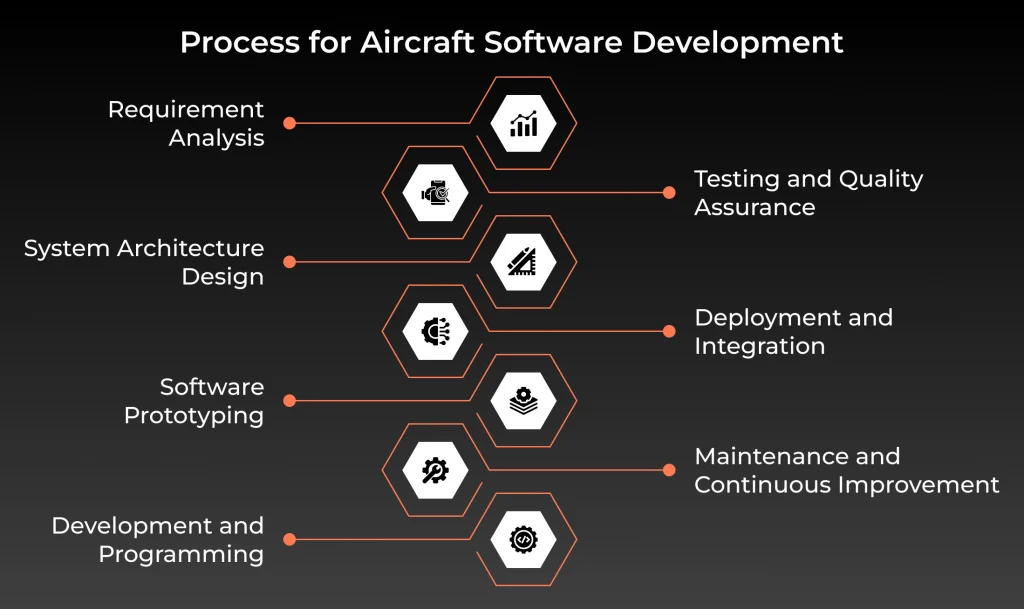
An organized, multi-stage strategy is needed to create aviation software that is both strong and compliant. Here’s a look at the steps that most top aviation software development businesses take:
1. Requirement Analysis
Departure control systems (DCS) take care of everything from checking in passengers to handling their bags to boarding them. DCS’s custom aviation software development focuses on the flow of data in real time between airlines, airports, and ground handlers. Modern DCS systems make sure that departures go smoothly and delays are kept to a minimum by allowing mobile check-in, biometric verification, and automated baggage tracking.
2. System Architecture Design
Next, engineers choose the right technologies, frameworks, and integration points to build the software’s structure. Priorities are security, scalability, and interoperability. The architecture needs to be able to handle real-time data processing, be highly available, and work well with current aviation systems.
3. Software Prototyping
Prototyping is making interactive mock-ups or minimal viable products (MVPs) to test ideas and get feedback from users. This iterative method lets stakeholders see how workflows work, find problems with usability, and improve requirements before full-scale production starts.
4. Development and Programming
During this phase, developers write code, implement features, and build interfaces according to the approved design. Agile methodologies are often employed, enabling incremental releases and continuous stakeholder engagement. Code quality, modularity, and documentation are emphasized for maintainability and compliance.
5. Testing and Quality Assurance
Rigorous testing is essential in aviation software development. Functional, performance, security, and compliance tests are conducted to ensure reliability and safety. Automated and manual testing methods are used to identify and resolve bugs, vulnerabilities, and integration issues before deployment.
6. Deployment and Integration
Once tested, the software is deployed in live environments and integrated with other aviation systems (e.g., reservation, maintenance, or air traffic control platforms). A phased rollout may be used to minimize disruptions. Data migration, user training, and change management are critical at this stage.
7. Maintenance and Continuous Improvement
After it is deployed, the program gets regular upgrades, bug repairs, and performance improvements. Continuous monitoring makes sure that new rules are followed and that new technologies may be used together. Feedback loops with end users lead to continuing upgrades and new features.

Advanced Technologies Powering Modern Aviation Software Development
Modern aviation software development uses a set of cutting-edge technologies to provide smart, safe, and scalable solutions:
1. Artificial Intelligence (AI) and Machine Learning (ML)
AI and ML algorithms are used for predictive maintenance, flight scheduling, and customer service automation. They analyze vast datasets to forecast equipment failures, optimize routes, and personalize passenger experiences, leading to increased efficiency and reduced costs.
2. Cloud Computing and Edge Computing
Cloud platforms provide scalable infrastructure for data storage, processing, and analytics. Edge computing, meanwhile, enables real-time data processing at the source (e.g., on aircraft or drones), reducing latency and supporting mission-critical applications even in connectivity-challenged environments.
3. Internet of Things (IoT) for Real-Time Tracking
IoT devices—such as sensors and beacons—enable real-time tracking of aircraft, baggage, and equipment. These devices transmit data to central systems for monitoring, predictive analytics, and automated alerts, enhancing situational awareness and operational control.
4. Big Data & Predictive Analytics
Big data platforms aggregate information from diverse sources (flight logs, maintenance records, passenger data) to uncover patterns and drive informed decision-making. Predictive analytics helps airlines anticipate demand, schedule maintenance, and optimize resource allocation.
5. Blockchain for Data Security and Transparency
Blockchain technology ensures secure, tamper-proof data sharing among stakeholders. It is used for digital identity management, maintenance record-keeping, and transaction validation, reducing fraud and improving regulatory compliance.
6. Beacon Technology
Beacons are used for indoor navigation, asset tracking, and personalized passenger services within airports. They enable location-based notifications, streamline passenger flows, and support efficient resource allocation.
7. Augmented Reality (AR) for Pilot Training
AR applications enhance pilot training by overlaying digital information onto real-world scenarios. This immersive approach accelerates learning, improves retention, and supports simulation-based assessments for both pilots and maintenance crews.
How Custom Aviation Software Enhances Airline Efficiency?
Custom aviation software development delivers measurable improvements in airline efficiency across multiple dimensions:
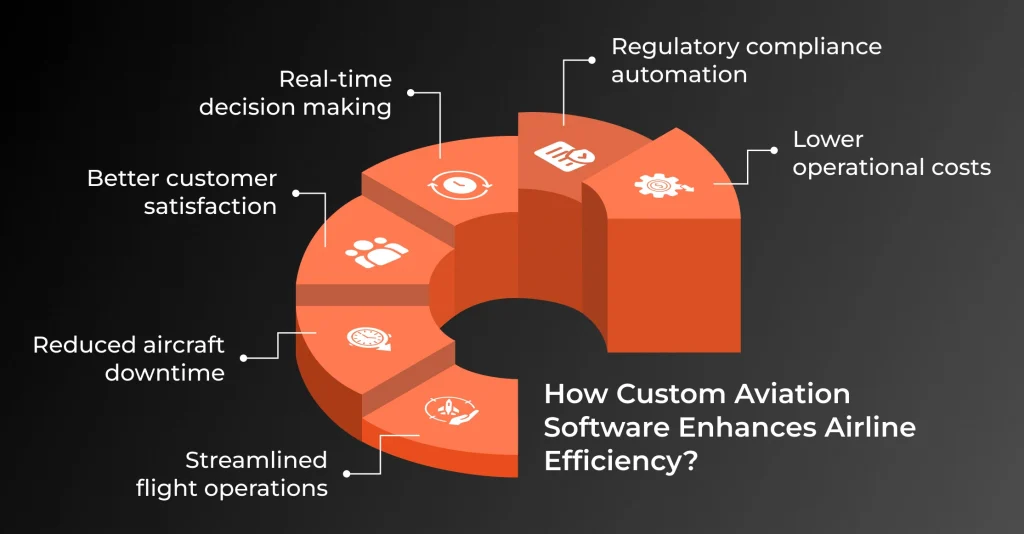
1. Streamlined Flight Operations
Automation of flight planning, crew scheduling, and operations control reduces manual workload and errors. Real-time data integration enables dynamic adjustments to schedules and routes, ensuring optimal resource utilization.
2. Reduced Aircraft Downtime
Predictive maintenance powered by AI and IoT minimizes unplanned outages. Maintenance teams receive timely alerts about potential issues, allowing for proactive repairs and faster turnaround times.
3. Better Customer Satisfaction
Personalized booking experiences, real-time flight updates, and self-service options enhance passenger satisfaction. Integrated customer feedback systems enable airlines to respond quickly to concerns and improve service quality.
4. Real-Time Decision Making
Airline managers can make better decisions about fleet deployment, personnel assignments, and handling disruptions when they have access to real-time operational data. This makes the airline more flexible and resilient.
5. Lower Operational Costs
Automation, predictive analytics, and better resource allocation all help cut down on fuel use, labor costs, and maintenance costs. These savings have a direct effect on how much money you make and how competitive you are.
6. Regulatory Compliance Automation
Compliance management that is based on software makes sure that aviation rules, safety standards, and reporting requirements are followed. Automated documentation and audit trails lower the chance of penalties and problems with operations.
Cost Breakdown: How Much Does Aviation Software Development Cost in 2025?
The price of making aviation software in 2025 will depend a lot on how big and complicated the project is and what technological stack it uses. Here is a full breakdown:
- Entry-level apps, such simple reservation systems, can cost anywhere from $8,000 to $25,000.
- Systems that are more complicated and have integrations, analytics, and mobile capabilities usually cost between $25,000 and $150,000.
- AI, IoT, and blockchain-enabled solutions for large-scale, mission-critical tasks may cost more than $200,000, especially when security and compliance with rules are top priorities.
Key Cost Factors
- The project’s level of difficulty and the features it has (such real-time analytics, AI, and mobile apps).
- Working with old systems and platforms from other companies.
- Requirements for following the rules, like getting DO-178C certification.
- How much customization and how much scalability you require.
- Ongoing support, maintenance, and updates.
Cost-Saving Strategies
- Focus on the most important features for the first release, and add more features over time.
- Use existing frameworks and cloud services to cut down on the cost of infrastructure.
- To prevent having to do a lot of extra work and make sure you’re following the rules from the start, work with a specialized aviation software development company.
Custom aviation software development saves money in the long run by making things more efficient, making fewer mistakes, and improving the customer experience.
Latest Trends in Aviation Software Development You Should Know
Aviation software development is rapidly evolving, with several trends shaping the future of the industry:
Digital Twins for Aircraft Simulation
Digital twin technology creates virtual replicas of aircraft and components, enabling real-time monitoring, predictive maintenance, and simulation-based training. This reduces downtime, improves safety, and supports data-driven decision-making.
Smart Airports Powered by AI
AI-driven systems manage passenger flows, optimize resource allocation, and enhance security at smart airports. Automated check-in, facial recognition, and predictive analytics streamline operations and improve passenger experiences.
Passenger Self-Service Kiosks and Mobile Apps
Self-service kiosks and mobile apps empower passengers to check in, select seats, and manage bookings independently. These solutions reduce queues, enhance convenience, and free up staff for higher-value tasks.
Real-Time Baggage Tracking
IoT-enabled baggage tracking systems provide real-time visibility into luggage location, reducing lost baggage incidents and improving customer trust. Passengers receive instant notifications about their baggage status via mobile apps.
Predictive Maintenance Using IoT Data
IoT sensors collect data from aircraft systems, enabling predictive maintenance and early fault detection. This minimizes unplanned maintenance, reduces costs, and increases fleet availability.
Cybersecurity-First Aviation Development
With increasing digitalization comes greater cybersecurity risk. Aviation software development companies now prioritize security by design, employing encryption, multi-factor authentication, and continuous monitoring to protect sensitive data and critical systems.

Top 5 Aviation Software Development Companies in 2025
Selecting the right aviation software development company is crucial for project success. Here are the top five companies leading the industry in 2025:
| Rank | Company Name | Overview |
| 1 | A3Logics | A3Logics is known for making custom aviation software from start to finish. They are also great at digital transformation, following the rules, and making AI-powered solutions. Global airlines trust their aviation software development consulting to make systems that can grow, are safe, and will last for a long time. |
| 2 | Dreamix | Offers innovative, scalable aviation software, leveraging AI, UI/UX, and compliance expertise. Strong in flight operations and planning optimization. |
| 3 | NAVBLUE | Specializes in flight management, navigation, and crew planning software, serving over 600 global customers. |
| 4 | CS Soft | Focuses on air traffic control systems and scalable solutions for airspace management and safety. |
| 5 | Lufthansa Systems | Provides a wide range of airline software development and IT services, with decades of experience and a strong client base. |
Why Choose A3Logics for Aviation Software Development Consultancy?
A3Logics is one of the best companies for developing aviation software. They offer a full range of aviation software development services that are customized to meet the needs of airlines, airports, and aviation authorities. Their extensive knowledge of the industry guarantees that every project satisfies strict safety, security, and compliance criteria, such as DO-178C certification.
A3Logics is a custom software development company that offers complete solutions, from analyzing requirements and designing systems to deploying them and providing continuous support. Their aviation software development consulting firm focuses on coming up with new ideas and using AI, IoT, and blockchain to make sure your business is ready for the future. A3Logics helps aviation companies achieve operational excellence, regulatory compliance, and great customer experiences by using a proven method and focusing on the needs of its clients.
Their Software Development Consulting Services give you strategic advice, help you figure out the risks, and make technological roadmaps. This makes sure that your investment in custom aviation software development gives you the most value and a competitive edge.
Final Thought
Hopefully you are clear about all the aspects related to aviation software development. It is important that you understand that investing in aviation software development will certainly be a big step towards digital transformation. Sg in aviation software development can help you with matching passenger expectations, regulatory complexities, and the push for sustainability.
So, this is why it is important that you invest in custom aviation software development and is essential for future-ready operations. All you need to do is to partner with a leading aviation software development company, A3logics. We are going to help your business remain agile, compliant, and competitive that can assist you get ahead in the competition. Good luck!