
What if you had to let go of your biggest B2B client, not because you had a bad price or service but because your competitors had a faster, smarter, self-service buying option?
This is the painful truth for many businesses at the moment as they are pushed by digital pressure to change every detail of business-to-business trade. New age consumers insist that they should get efficient access, knowledge, and seamless connection to services. This shift places robust B2B portal infrastructure at the forefront.
Through B2B Portal Development, corporations create efficient networks with customers, suppliers, and partners in a secure manner. A well-designed portal delivers role-based access, real-time data, and deep integration with enterprise systems.
In the blog, we will cover everything you need to know about B2B Portal Development. Let’s get started!
What is B2B Portal Development?
B2B Portal Development is the process of creating, constructing, and establishing an internet platform that assists digital interactions, transactions, and cooperation between companies. B2B web portals are not the same as regular online stores; there should be more than just buying and selling functions; the users ought to be able to manage the supply chain, inventory, customer interactions, etc., depending on the goals stated in the portal.
There are different kinds (as we will examine later), however, the main goal remains unchanged: to allow businesses to go digital, be responsive, and operate transparently.
Some distinctions you should know about:
- B2B Web Portal Development phrase centers on architecture and aspects of the web interface as basic things.
- B2B Customer Portal Development is when portals are established solely for the customer’s self-service.
- B2B Ecommerce Portal Development refers to the commerce transaction layer in a portal context.
B2B Market Insights: Statistics That Highlight the Need for B2B Portals
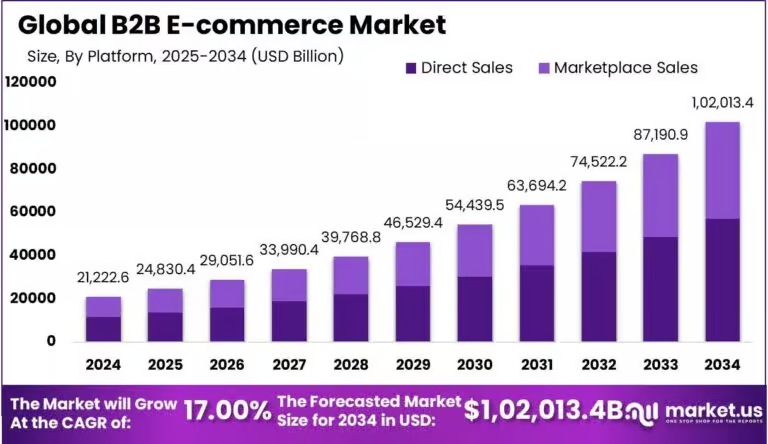
In terms of value, the global B2B e-commerce market is projected to reach $102.01 trillion by 2034, at a 17% CAGR.
- A survey conducted in 2025 confirmed that 85% of B2B companies have an e-commerce storefront or self-service portal, whereas 66% are demanding more investment in customer portals.
- The percentage of revenue from digital channels for B2B is projected to be 56% in 2025, an increase from the 2020 figure of 32%.
- Brand research indicates that millennials and Gen-Z buyers, who make up 73% of the B2B purchasers, expect to have a digitally rich purchasing experience.
As buyers’ expectations increase and their patience gets low, the idea of B2B Portal Development becomes clearer and more persuasive.
How a B2B Portal Streamlines Business Operations?
The strategic advantage of B2B Portal Development lies in its ability to streamline operations across multiple dimensions. Let’s take a look at the four key areas.
1. Automated Workflows
One of the most direct operational benefits of a B2B portal is automation. Traditional manual tasks can be automated through the portal workflows, thereby avoiding delays and mistakes. For example, a buyer logs in, places an order, then the approval is routed, an invoice is auto-generated, communication is established with the warehouse, and the buyer’s dashboard is updated. All that is done with little human intervention.
2. Centralized Data Management
Centralized data management is the greatest strength of portal platforms. The best integrative portal answers the problem of having multiple silos for product catalogs, pricing data, order history, inventory levels, and customer accounts by consolidating all relevant data into a unified system.
3. Collaboration Tools
The bulk of the B2B operations involve multiple and distributed players: internal account managers, external buyers, suppliers, and logistics partners. A portal bodes well in the collaboration department by supplying the users with tools that support messaging, file sharing, task tracking, and comment threads which are all connected to particular orders or accounts.
4. 24/7 Accessibility
One of the main characteristics of a digital portal is that it is always accessible. When the buyers or suppliers can get their portal access on any device, wherever they are, the traditional business hours limitations disappear. This is especially important in global operations or in the case of field personnel who need to act quickly.
Key Features to Include in B2B Portal Development
1. User Authentication and Role-Based Access Control
A key element in B2B Portal Development is user authentication plus role-based access control. This implies that the portal provides a possibility of secure logins (if necessary using multi-factor authentication) and, once inside, each user can view only the elements appropriate to his or her role.
For instance, the purchasing manager can see the workflows of the purchase orders and the pricing tiers; however, a finance user will only see the invoice history.
2. Product and Catalog Management
In a portal which is aimed at B2B commerce, especially (usually denoted as B2B Customer Portal Development when directed at end-customers), the product and catalog management module is a key element. It’s got to have:
- The provision for multiple product categories and attributes (specs, regulatory documentation, certifications)
- Customer-specific catalogs and pricing. It means when Buyer X logs in, they see only their negotiated SKUs and their pricing tiers.
- Updation in near real-time or real-time of availability, lead times and stock across various warehouses.
3. Order and Inventory Management
Order and inventory management features are the ones that set apart basic web ordering from enterprise-grade portals in B2B Ecommerce Portal Development. The major functions include:
- The possibility for buyers to place orders (or convert quotations) via the portal
- Order tracking and status updates in the portal (received > processing > shipped > delivered)
- Using stock levels or “availability messages” to show inventory systems integration and at the same time avoid overselling.
4. Integrated Payment Systems
To finalize the commerce workflow, the portal must include integrated payment systems. A number of B2B transactions allow flexible options: online payment, bank transfer, or execution on credit. The well structured B2B Web Portal Development project includes:
- Different payment methods across gateways (both credit/debit cards, ACH, and digital wallet)
- Dashboard updates flowing back and forth between invoicing and payment status
- Multicurrency and tax/region aware handling where applicable
5. CRM and ERP Integration
Integration with enterprise systems is a major part of superior B2B portal development services. More specific:
- CRM integration (noted by Salesforce, HubSpot) is an assurance that the portal user behavior and transactions are channeling into the sales/support ecosystem, and gives a consolidated view of the client interactions.
- ERP integration (such as SAP S/4HANA, Oracle) encompasses the orders that are being carried out in the portal are connected with backend fulfillment, inventory, and finance management.
6. Data Analytics and Reporting Dashboard
A popular and modern portal is equipped with strong analytics and dashboarding. These features allow both the enterprise and portal users to analyze data from usage, orders, and behavior. Among its features are:
- Personalized dashboards showing KPI’s such as total orders, average order value, user engagement, reorders, etc.
- Exportable reports (CSV/PDF) for buyers or internal teams
- Trend analysis to identify popular products, under-utilized features, or possible bottlenecks
7. Communication Tools
The ability to communicate has become a key factor for the success of enterprises. Within B2B customer portal development, the addition of features like live chat, private messaging, document discussion threads or user forums furthers collaboration. For example:
- Buyers can message account managers from within the portal interface
- Suppliers or partners can upload documents and comment within the context of orders or shipments
8. Multi-Language and Multi-Currency Support
If your company is a global one or if it operates in different geographies, you should look for multi-language and multi-currency support in your B2B Ecommerce Portal Development efforts. This implies:
- Portal interface translation/localization for users in different regions
- Catalog and pricing data in appropriate currencies, with correct conversions or price lists per region
9. Document Management System
As the B2B operations involve contracts, specifications, certifications, and other documents, the Document Management System (DMS) built into the B2B Portal Development is a must-have. The DMS should allow:
- Upload/download of documents tied to accounts, products or orders
- Version control and access restrictions per user role
- Search/filtering by metadata, document type, and date
10. Mobile-Friendly Interface
With the shift to mobile and remote usage, a portal built with a responsive design or mobile app is a necessity. B2B buyers are increasingly turning to smartphones/tablets to manage their purchase journey. Sources have shown that a mobile-friendly interface can uplift engagement and repeat sales.
Exploring the Main Types of B2B Portals in Modern Commerce
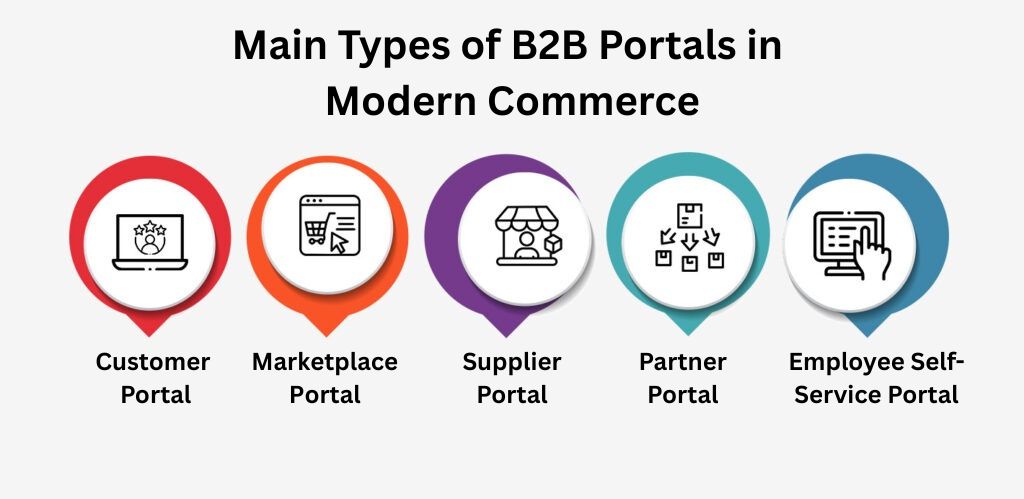
1. B2B Customer Portal Development
The customer portal allows you to manage customer ordering, shipment tracking, invoice access, and their account. It creates the front line of B2B commerce operations as this portal stands as the common user interface for digital self-service.
2. Supplier and Vendor Portal
The supplier/vendor portal is intended for organizations to collaborate with their suppliers to manage purchase orders, stock updates, delivery schedules, invoices, and compliance documentation. Among the B2B Web Portal Development types, it concerns less to external buyers and more with procurement and supply-chain flows.
3. Distributor and Partner Portal
A distributor/partner portal is offered in a networked economy so that retailers, dealers, or agents should be able to reach training resources, sales material, order placement, and so on. This kind of gateway portal aims to empower partners to sell, support & market their products.
4. B2B Marketplace Portal Development
A marketplace portal comprises multiple buyers and sellers simultaneously within the same framework. In the case of a B2B Marketplace Portal Development, this consists of creating a platform that accommodates different vendors, product listings by third-party suppliers, buyer filtering and comparative shopping, transactional workflows and often a commission or fee model.
5. Employee Self-Service Portal
The employee self-service portal is mainly for service workers (employees). Features often include HR services (leave requests, payroll access), internal documentation, training modules and IT support ticketing.
Benefits of B2B Portal Development for Enterprises
1. Operational Efficiency
B2B Portal Development is primarily beneficial for the organization’s productivity improvement. It helps in automating orders, self-service workflows, data centralization, and dashboards for internal teams that are accurate, all of which contribute to operational efficiency.
2. Customer Retention
A smooth, easy-to-use, self-service, transparent portal experience that is online manifests loyalty and retention. It has been reported that the majority of buyers find that the digital-first, self-service options and the positive mobile experience lead to repeat purchases in the long run.
3. Data-Driven Decisions
Portals can also help managers with detailed data regarding user activity, transactional flow, and the performance of the system. Through the built-in analytics, enterprises can recalibrate their product mix, set optimal prices, recognize bottlenecks and predict demand.
4. Reduced Costs
Operational efficiencies and self-service features are one of the main components in translating costs into savings. Manual order taking, phone support, invoice queries, and data re-entry have all been eliminated, thereby reducing cost-to-serve for each transaction proportionately.
5. Stronger Relationships
In addition to efficiency, portals can also be a means of building relationships with customers, suppliers and partners. Reliability is created through shared dashboards, self-service access, descriptions of orders, and messages integrated into the system, which in turn leads to the building of trust.
6. Scalability
A properly architected portal can be the one that scales without needing to proportionately expand cost or staff. Whereas companies grow through adding more users, transactions, or international operations, the portal provides the basis for accommodating this growth.
Step-by-Step B2B Portal Development Process
1. Requirement Analysis
This phase includes identifying the various user personas (buyers, suppliers, partners), dependencies on workflows, and integration necessities. The analysts have pointed out that “establishing the goals of the portal and the involvement of the stakeholders” comes first, before anything technical can be produced.
2. Wireframing and Design
The navigation layout, dashboard design, and interface hierarchy are defined in the wireframing stage of B2B Web Portal Development. Wireframes turn into the visual mock-up that will be solely for the use of responsive devices. Usability is a priority for designers whether it is desktop or mobile, so they set the accessibility guidelines (WCAG 2.1) and brand consistency.
3. Development Phase
The basic components of B2B Portal Development are the back-end and front-end coding. The most frequent tech stacks:
- Front-end: React, Angular, or Vue.js
- Back-end: Node.js, Laravel, Django, ASP.NET
- Database: MySQL, MongoDB, PostgreSQL
- Cloud Platforms: AWS, Microsoft Azure, Google Cloud
- Security Tools: SSL encryption, OAuth 2.0, multi-factor authentication
This combination guarantees quick performance, flexibility, and enhanced data protection.
4. Integration and Testing
At this point, the integrations have been configured and tested. Comprehensive QA evaluates compatibility issues with devices and browsers. The validation test cases include functionality checks, security audits, and user-acceptance. Automation frameworks such as Selenium or Cypress are usually utilized.
5. Deployment and Maintenance
After completing the stage validation, the portal is deployed to cloud environments including AWS, Azure, or Google Cloud. The process will include the continuous tracking of uptime, load performance, and feature enhancements as a direction for the maintenance of the portal.
B2B Portal Architecture and Technology Stack Overview
Choosing the right architecture and tech stack is key to building a scalable and secure B2B portal.
Front-End Technologies: React, Angular, Vue.js
Back-End Frameworks: Node.js, Laravel, Django, ASP.NET
Databases: MySQL, MongoDB, PostgreSQL
Cloud Platforms: AWS, Microsoft Azure, Google Cloud
Security Tools: SSL encryption, OAuth 2.0, multi-factor authentication
This combination ensures fast performance, flexibility, and enhanced data protection.
Essential Integration Capabilities for B2B Portals
1. CRM Systems (Salesforce, HubSpot)
The integration with CRM platforms is the fastest way to achieve a single customer view. When contracted with Salesforce or HubSpot, every interaction is automatically logged. This is a good means of improving sales forecasting and quicker service delivery.
2. ERP Software (SAP, Oracle)
ERP integration ensures synchronous inventory, as well as billing and procurement. Expert witnesses point out that the acute ERP data exchange being used in real-time cuts out redundancy and as a result, fulfillment time is reduced by as much as 30%.
3. Payment Gateways (Stripe, PayPal)
By secure payment gateway integration, B2B companies can add more modes of payment and at the same time, be PCI-DSS compliant. Automatic payment reconciliation, automatic invoicing, and refund automation are critical in B2B Ecommerce Portal Development.
4. Inventory and Logistics Platforms
Logistics systems integration allows for the connection of the shipment tracking, warehouse synchronization, and predictive restocking. This alignment drives transparency between suppliers and customers.
5. Marketing Automation Tools
This is mainly done by interlinking with platforms like Marketo or Pardot, which aid marketing teams in segmenting their email communications and allow them to track leads right from the portal environment. When combined with CRM, it completes the marketing and sales loop.
Cost Breakdown: How Much Does B2B Portal Development Cost in 2025?
B2B Portal Development costs are highly dependent on several factors like the functional integrations and the geographical region. The average development cost would be from $60,000 to $250,000 for mid to enterprise-grade portals. The main cost drivers would be as follows:
1. Project Complexity and Features
A standard order portal is much more economical than one that needs to support multiple vendors which naturally requires a contract of complexity.
2. Technology Stack Used
Licensing and hosting also have a considerable impact on the total cost. Stacks based on the cloud and using the microservices architecture are more expensive from the start, but will scale up more efficiently.
3. UI/UX Design Requirements
Customized UI themes, accessibility compliance, and adaptive layouts might account for 10 to 15% of the total cost but at the same time, it can result in a stronger adoption.
4. Integration Scope
A larger number of integrations (ERP, CRM, payment, and shipping) will usually result in a larger budget. It can be +25 to 40% over base cost.
5. Developer Expertise and Region
The average development cost in North America is $80-150/hour, in Eastern Europe it’s $45-75/hour, and in South Asia $25-55/hour. Hybrid engagement models help optimize the cost while maintaining the quality.
Approximate range:
- Basic customer portal → $60K–$100K
- Mid-complex ERP-linked portal → $120K – $180K
- Full marketplace or multi-tenant portal → $200K – $250K
Tips to Choose the Right B2B Portal Development Company
Your choice of a reliable B2B Portal Development Company impacts your long-term success. Here are some important factors to keep in mind:
- Domain Competence: Check previous projects in manufacturing, logistics, or technical sectors.
- Technical Stack Capability: Confirm if the vendor supports up-to-date model frameworks and DevOps pipelines.
- Integration Experience: The vendor’s history of integrating Salesforce, SAP, and payment APIs is crucial.
- Security Certifications: Compliance should be with ISO 27001 or SOC 2.
- Scalability & Support: Review SLA terms & conditions, scalability strategy, and support after product launch.
- Client References: Check case studies, testimonials, or Clutch ratings.
Future Trends in B2B Portal Development
1. AI and Predictive Analytics
The use of AI algorithms in B2B Portal Development is a revolutionary step. The engines of predictive analysis define the user’s behavior and make product suggestions, forecast demand, and provide automated support responses. AI-based chatbots quicken the response and personalize it more.
2. Blockchain
Blockchain refers to transaction records that cannot be altered, to safe smart contracts, and to audit transparent trails. This technology is applicable particularly to supply chain business cases.
3. Voice Search Integration
Voice interfaces combined with an enterprise catalog could bring in a huge effect for users to discover products faster, thus it would also help hands-free warehouse or field operations.
4. Augmented Reality (AR)
AR gives the opportunity for product visualization and remote equipment inspection. Portals utilizing AR technology enhance buyer confidence in industrial high-value products.
5. IoT and Automation
IoT-connected portals link assets, sensors, and logistics in real-time. The trends in 2025 of predictive maintenance and automated replenishment join the portal intelligence with the physical operations.

What Makes A3Logics a Leading B2B Portal Development Company?
A3Logics is an established and professional enterprise software development company that offers comprehensive B2B Portal Development Services. With software development, system integration, and digital commerce transformation being its primary focus, it has gained expertise in various technology fields.
The main factors that distinguish A3Logics:
- 20 years of experience across a variety of industries (manufacturing, logistics, retail, finance)
- Achieved specialization in B2B Marketplace Portal Development and complex ERP/CRM integrations
- Offer predictive insights through AI-driven analytics modules
- Global delivery with certified cloud, DevOps, and cybersecurity experts
- Custom solutions built with consistent compliance and governance
A3Logics understands that to be competitive in the future sphere, organizations need market-ready Ecommerce software solutions that are delivered end to end from the time of project discovery through to maintenance.
Final Thoughts
Strategic B2B Portal Development investment is an enabler of real growth for your organization. Businesses that leverage data and deploy AI-influenced portals will see tangible efficiency returns, stronger customer relationships, and a foundation for scalable innovation.
At A3Logics, we’ve seen how the right digital portal can completely change the way a business connects and grows. With our deep expertise in Software Development Services, we help you build solutions that truly support your teams, customers, and long-term vision.
If you’re thinking about what’s next for your B2B platform, let’s explore it together!
Contact A3Logics today!