Managing your office building and everything inside is not just about operations; it requires a key strategy. Whether it’s a campus, an international office, industrial plants, or public infrastructure, the need for centralized management has never been more important.
To address this need, companies are implementing facility management software solutions to streamline everything. Whether it is work orders and asset management to space planning and vendor coordination. FMS or Facility Management Software is basically a smart, centralized system that digitizes all building-related operations.
The global market for facilities management software is rising fast. It was valued at $2.37 billion in 2024 and will reach over $4 billion by 2030. The rise of IoT and AI is pushing more innovation in the FMS development landscape by enabling AI-powered analytics and smart sensors. The new technologies are reshaping how businesses manage their physical environments.
What is Facility Management Software?
Facility management software solutions help businesses take care of their buildings and everything inside them. It is a smart control center for your office or any building. Whether it’s about fixing air conditioning, tracking where a projector or fire extinguisher is, FMS puts it all in one place.
It empowers businesses to automate maintenance, manage physical assets, supervise space utilization, and ensure compliance with all regulatory standards.
Traditionally, these operations were managed on sheets or manually. But the modern FM system unifies everything from workflows to analytics, all into a real-time dashboard. Facilities management software helps IT, maintenance people, HR, and all other departments to collaborate and share information. This reduces delays, human errors, and operational failures.
Modern FM systems are designed to scale across buildings and departments. In sectors like education, manufacturing, and healthcare, the need for these tools is critical. They ensure safe environments, reduce downtime, and save energy.
Facility Management Software Solutions – Statistical Highlights
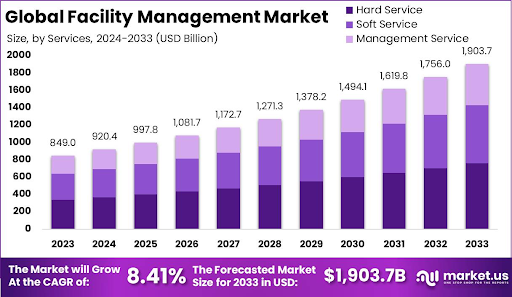
- Market Growth: The global market for facility management software solutions is growing with a CAGR of 13.3%. The rising digitization and increased mobile users are linked to the growth of FM systems across industries.
- Smart Building Integration: The major growth is coming from the IoT. More than 75 billion IoT devices are active in 2025, and most of them are embedded in facility systems like HVAC, security, and electricity meters. IoT sensors feed real-time data into FM systems, which is a great enabler to automation and advanced analysis.
- AI and Automation: Companies are investing heavily in AI. In 2025, the total AI spending is going to reach $158 billion. The modern facility systems are using LLMs and integrated automation tools to optimize energy and automate repetitive tasks.
- Geographic Distribution: North America has almost one-third of the global facility software market. There is a rapid adoption of facilities management software in areas such as Europe and the Middle East, especially after the pandemic.
Many organizations still use paper and legacy tools for facility management. This shows a greater need for awareness and adoption of modern FM systems. It also highlights the opportunity for building facility management software that is scalable and efficient.
Key Features of Facility Management Software Solutions in 2025
1. Work Order Management
The elementary feature of any FM software is the work order management. It enables teams to create, assign, and track maintenance activities across different locations. Technicians get real-time updates on mobile apps, and meanwhile, supervisors check response times and task details on a dashboard.
The main objective of this functionality is to ensure smooth coordination between planned and unplanned activities, improving overall accountability. This reduces delays and idle time for technicians, ensuring that maintenance resources are used efficiently.
2. Preventive Maintenance
FM systems integrate seamlessly with calendars. It allows companies to automate the regular servicing of assets like elevators, fire systems, or HVAC. The maintenance is scheduled in the interval of days or hours based on the sensor data and signal.
This function helps reduce unexpected repair needs. Moreover, it extends asset lifespan and keeps equipment well-maintained and efficient. As a result, safety and compliance are consistently ensured. Companies using facility management software for preventive maintenance also benefit from higher uptime and more predictable maintenance costs.
3. Asset Management
Modern FM systems have comprehensive details of all the assets in digital format. Each asset includes details such as location, asset condition, warranty, purchase history, and maintenance history.
There is also the use of QR/barcode tagging so that the field technicians can check and update the records in real time. This is a very crucial feature of any facility asset management software. It enables supervisors and managers to plan capital for future maintenance and resource allocation.
4. Space Management
Space management is a highly cost-effective feature of any FM software. Given the rising cost of real estate, efficient space utilization is more important than ever. In this context, FM systems provide floor plans and occupancy heatmaps to optimize physical layouts. Consequently, companies can reduce unused areas and achieve better ROI on their real estate investments.
When FM systems are integrated with BIM (Building Information Modeling), it enables the simulation of a 3D virtual environment before any physical changes are made.
5. Inventory Management
FM systems allow teams to track inventory levels and automate purchase orders based on past usage. This helps avoid stockouts and emergency procurement.
This feature of FM is very much aligned with the principles of Inventory Management Software Development. It supports just in time availability and reduces overhead with accurate forecasting and traceability.
6. Reporting and Analytics
Data-driven decisions are always crucial in any organization. Team leaders with modern FM systems can now see operational spends, failure rates, and other metrics to analyze and take strategic data-driven decisions. When integrated with AI, it can even provide real insights, helping you make better decisions in less time.
7. Energy Management
Organizations are prioritizing energy management more than ever. FM systems can now check electricity, gas, and water usage in real time. IoT and AI, when combined with FM software, can detect anomalies, optimize load, and automate reporting for ESG compliance.
The objective of this feature is mainly cost savings and sustainability. Any enterprise facility management software that has a proper energy management ability is a key element for achieving operational and environmental efficiency.
8. Compliance Management
When businesses scale, the complexity of regulatory compliance also increases. FM platforms allow documentation of safety inspections, fire system checks, and ADA compliance.
The feature of alerts and audit ensures that no task is left. All records like permits, training logs, and certificates are digitally stored and easily accessible. It also maintains safety and operational transparency.
9. Vendor Management
FM systems help manage third-party service providers like HVAC, plumbing, electrical, and janitorial. It includes contract forms, work orders, and performance reports.
By connecting vendors directly to tasks, teams have better coordination and improved accountability.
10. Communication and Collaboration
The core of any FM system is cross-functional. FM systems enable collaboration by messaging, tagging, and note-sharing features within the dashboards. Some platforms also offer portals for submitting requests or feedback. This centralized system ensures all the stakeholders from top to bottom are aligned and eliminates delays.
11. Mobile Access and Real-Time Updates
Most FM teams are on the field. They can collaborate and access FM systems through Android or iOS apps only. It allows technicians to receive work orders, scan tags, and capture photos – all from the field. FM systems also have offline capabilities, ensuring they work in low-connectivity areas like basements or remote warehouses.

Top Benefits of Facilities Management Software Solutions
1. Reduced Downtime and Repair Costs
Facility management software solutions automate service schedules and issue real-time alerts with the help of IoT sensors. It ensures systems like HVAC and elevators are fully repaired before any failure occurs.
This overall results in faster issue resolution, reduced costs of repair, and less overall expenses for companies. For example, a hospital avoids productivity slowdowns when maintenance teams are alerted on time before any asset breakdowns.
2. Improved Productivity and Workflow Efficiency
Facilities management software reduces manual and coordination errors by digitizing work orders. Technicians receive, update, and complete their tasks in the field, and everything is updated on a centralized system in real time. This reduces paperwork and admin work by up to 40%, increasing productivity and workflow efficiency.
3. Better Compliance and Risk Mitigation
When it comes to regulated industries like healthcare or finance, adhering to compliance is necessary. FMS solutions play a crucial role by keeping all regulatory documents organized in one secure system. These FM systems also send alerts for expired permits or missed safety checks, ensuring that nothing slips through the cracks.
4. Enhanced Occupant Safety and Satisfaction
From hotels to corporate campuses, keeping occupants safe is essential. Software for facility management plays a key role in spotting and fixing service issues like broken elevators, HVAC problems, and inadequate lighting before they affect users.
Many of these systems come with occupant portals, allowing employees, guests, or tenants to submit requests, track the progress of resolutions, or reserve facilities. These features promote quick responses and transparency, resulting in improved user experiences and a safer, healthier environment throughout the facility.
5. Enhanced Asset Lifespan
Facility management platforms fine-tune maintenance schedules based on real usage and the condition of assets like lab equipment or building systems. By leveraging data from facility asset management software, managers can keep an eye on lifecycle performance and spot depreciation trends. This strategy not only enhances capital budgeting but also extends the lifespan of equipment. This overall cuts down on long-term ownership costs and unexpected capital expenses.
6. Better Decision Making
Teams analyze past data to identify patterns and make decisions. This can include resource allocation, budgeting, and strategic planning. FM systems can do root cause analytics across:
- Work order number
- Utility consumption
- SLA compliance
- Downtime checks
- Vendor performance
- Utilization of space
Data-driven analytics with AI can even point out recurring failures and forecast maintenance costs.
7. Improved Communication and Collaboration
Software for facility management allows all teams to collaborate on maintenance, onboarding, and space planning. All of this occurs from a single platform.
For example, if you are onboarding a new team member, it has a whole new set of tasks. Tasks like desk setup, giving control, and all are tracked within the system. This level of cross-functionality helps the team to eliminate delays and ensure accountability among them.
8. Sustainability and Energy Savings
Many companies are committing to sustainable goals. FM systems are crucial for companies looking to cut down resource use. When it is integrated with IoT, it can provide real-time tracking of energy consumption, water, and HVAC loads. When these systems are running for too long, they get flagged for attention.
Advanced FMS features can shut these systems off automatically to avoid misuse. Businesses using FMS systems for conserving energy have seen a 10 to 20 % drop in utility costs.
Industrial Use Cases for Facility Management Software Solutions
1. Sports Facility Management Software
Managing stadiums, arenas, or large recreational venues requires careful orchestration of lighting systems, HVAC, audio-visual setups, and seating configurations. FM platforms support facilities teams in scheduling maintenance between events, responding quickly to equipment failures, and monitoring energy usage during peak and off-hours.
Integration with BIM and digital twin technologies allows teams to simulate crowd movement or adjust layouts virtually, improving safety, comfort, and operational readiness for large audiences.
2. Facilities Management Software For Schools
From K-12 to sprawling universities, educational institutions require reliable oversight of classrooms, labs, auditoriums, and student housing. Facility management software solutions automate janitorial schedules, track AV equipment, and manage inspection logs critical for accreditation.
Interactive floor maps and booking tools help optimize room usage, while mobile apps keep custodial and maintenance teams responsive to real-time service needs. Lifecycle asset tracking supports capital planning, particularly for high-use equipment and shared resources.
3. Hospital Facility Management Software
In hospital settings, the consequences of downtime can be life-threatening. FM platforms enable scheduled maintenance of medical devices, HVAC systems, and sterilization units. They also track biomedical assets and manage vendor SLAs for emergency servicing.
Compliance with fire safety, infection control, and clinical readiness is logged and monitored through digital inspection tools. When integrated with Hospital Management Software, FM systems contribute to a larger healthcare delivery ecosystem and infrastructure resilience.
4. Facility Management Software For Churches
Religious institutions like churches, temples, and mosques often operate as multi-purpose centers with sanctuaries, classrooms, kitchens, and event halls. FM software supports scheduling for cleanings, volunteer coordination, HVAC checks, and lighting maintenance.
With limited staffing and budgets, automation and digital tracking help prioritize tasks, reduce oversight gaps, and ensure facilities are safe and functional during high-traffic events like weddings or festivals.
5. Fitness Center Facilities Management Software
Gyms, recreation centers, and wellness clubs rely on FM tools to maintain high-touch equipment, ensure cleanliness, and monitor indoor air quality. These platforms track usage of treadmills, resistance machines, and pool filtration systems, scheduling preventive maintenance and sanitation.
Dynamic room booking for classes (e.g., yoga, spinning) and locker room maintenance scheduling can also be automated. Mobile capabilities support real-time issue reporting by staff or members, ensuring quick fixes and sustained customer satisfaction.
6. Healthcare Facilities Management Software
Beyond hospitals, healthcare campuses, outpatient centers, and labs require strict asset control and environmental safety. FM systems handle compliance logging, track specialized equipment like autoclaves or isolation room ventilation, and automate rounds-based inspections.
Real-time dashboards allow administrators to monitor multiple departments or satellite facilities. Preventive maintenance, vendor coordination, and emergency alerts are essential for protecting patients and staff across healthcare properties.
7. Hotel Facilities Management Software
Hotels and resorts operate on round-the-clock expectations for guest experience and facility uptime. FM software schedules maintenance for HVAC, elevators, kitchen appliances, and laundry systems, minimizing downtime and maintaining brand consistency.
Occupancy data can trigger automated adjustments to room lighting or climate control, increasing both energy efficiency and comfort. Housekeeping coordination, guest service requests, and vendor SLAs are managed through centralized dashboards, standardizing operations across chains or multi-property portfolios.
8. Manufacturing Facilities Management Software
In industrial plants and factories, uptime of heavy machinery and compliance with safety regulations are critical. FM platforms schedule maintenance, track machine health, manage spare part inventories, and oversee regulatory inspections.
IoT-enabled equipment integration allows predictive maintenance, using metrics like vibration or heat levels to preempt failures. With integrated Workforce Management Software Development, technician shifts, safety checklists, and workload balancing are optimized, ensuring lean operations with zero compromise on safety.
9. Retail Facilities Management Software
Retailers with regional stores or global chains use FM tools to maintain both customer-facing and back-end operations. This includes upkeep of point-of-sale systems, HVAC, lighting, signage, and restrooms.
The software not only enables real-time incident reporting, SLA tracking, and vendor accountability across hundreds of outlets, but also ensures seamless coordination. Furthermore, benchmarking dashboards allow managers to compare performance metrics store-by-store. As a result, they can easily identify underperforming locations and, in turn, make data-backed decisions to drive service improvements and reduce costs.
10. Facility Management Software For Workforce
Modern offices and corporate campuses now operate in hybrid and flexible formats. As a result, FM platforms play a crucial role in streamlining operations. They manage workspace bookings, while also monitoring real-time occupancy. In addition, they coordinate IT setup and support building access for both employees and contractors, ensuring a smooth and efficient work environment.
Integration with HR systems ensures seamless onboarding, from assigning desks to provisioning equipment and coordinating facility access. Energy dashboards and wellness metrics align with ESG and workforce wellbeing initiatives, helping enterprises manage both space and employee experience efficiently.

What is the Difference Between CMMS and CAFM Software?
Let’s take a look at some of the key differences between CMMS and CAFM software.
| Aspect | CMMS (Computerized Maintenance Management System) | CAFM (Computer-Aided Facility Management) |
| Primary Focus | Maintenance and repair workflows | Space, asset, and service management |
| Key Modules | Work order tracking, preventive maintenance, parts inventory | Room booking, space planning, lease tracking, real estate oversight |
| Data Orientation | Asset-centric | Facility- and occupancy-centric |
| Best for | Maintenance-heavy industries (e.g., manufacturing, utilities) | Multi-use campuses, office spaces, real estate firms |
| Example Tools | UpKeep, Hippo CMMS | ARCHIBUS, Planon, IBM TRIRIGA |
Best Facility Management Software to Watch in 2025
Here are five platforms that are leading the FMS landscape. They are:
1. IBM TRIRIGA

A robust IWMS platform, IBM TRIRIGA offers end-to-end automation for space, lease, maintenance, and sustainability management. It integrates with IoT sensors and AI engines like IBM Watson to drive predictive analytics across buildings and assets.
Enterprises use TRIRIGA for global facility portfolios, multi-site coordination, and capital project planning.
2. Planon

Planon (under the Eptura umbrella) stands out for its intuitive UI and strong emphasis on space utilization and smart building integration. With modules for preventive maintenance, energy monitoring, and workplace bookings, it supports hybrid work environments and post-pandemic office transitions.
3. FM: Systems (FMS: OpenBlue Workplace)
FM: Systems blends workplace analytics with core FM capabilities. Through real-time floor plans, occupancy sensors, and interactive dashboards, it helps enterprises visualize and optimize space usage, maintenance operations, and energy patterns.
FMS: OpenBlue Workplace is known for seamless HR, finance, and building systems integrations. It is a highly adaptable option for corporations modernizing their facility operations.
4. eFACiLiTY (SIERRA Solutions)

eFACiLiTY provides a unified CAFM solution with modules for space, maintenance, sustainability, and workplace wellness. Notable for its 360° facility dashboards, it’s gaining traction among global enterprises looking for flexible deployment models.
Its emphasis on automation and AI positioning makes it an ideal fit for firms building facility management software tailored for smart campuses or ESG mandates.
5. Accruent FAMIS 360
Accruent FAMIS 360 is a comprehensive facility management solution designed to streamline operations across various sectors, including higher education, public sector, and commercial real estate. It offers robust features for asset management, space planning, preventive maintenance, and compliance tracking.
6. Matterport
Matterport leads the facility management space with its 3D digital twin technology, transforming physical spaces into immersive, dimensionally accurate virtual models. Facility teams use it to document spaces, conduct remote inspections, and manage assets across multi-site portfolios.
Its seamless BIM and CAD integrations make it a natural fit for organizations modernizing their building infrastructure, while AI-powered spatial data capabilities support maintenance planning, capital projects, and long-term asset lifecycle management.
Breakdown of Facility Management Software Development Costs
If you are building facility management software in-house or via a partner, you must account for detailed cost structures. While exact figures vary by region and complexity, the breakdown typically follows this model:
1. Business Analysis and Requirements Gathering
- Estimated Cost: $5,000 – $15,000
- Percentage of Total Budget: 5% – 10%
- Description: This phase involves understanding the specific needs of the organization, defining the scope, and outlining the functional requirements. It sets the foundation for the entire project.
2. UI/UX Design
- Estimated Cost: $7,000 – $25,000
- Percentage of Total Budget: 10% – 15%
- Description: Designing an intuitive and user-friendly interface is crucial for user adoption. This includes creating wireframes, prototypes, and the overall visual design of the application.
3. Core Software Development
- Estimated Cost: $50,000 – $200,000
- Percentage of Total Budget: 50% – 60%
- Description: This is the most substantial part of the project, encompassing the actual coding and development of features such as work order management, asset tracking, preventive maintenance scheduling, and reporting tools.
4. Integration with Third-Party Systems
- Estimated Cost: $5,000 – $20,000
- Percentage of Total Budget: 5% – 10%
- Description: Integrating the FM software with existing systems like HMS or Inventory Management Software ensures seamless data flow and operational efficiency.
5. Quality Assurance and Testing
- Estimated Cost: $5,000 – $15,000
- Percentage of Total Budget: 5% – 10%
- Description: Rigorous testing is essential to identify and fix bugs, ensuring the software operates smoothly and meets all specified requirements.
6. Deployment and Implementation
- Estimated Cost: $3,000 – $10,000
- Percentage of Total Budget: 3% – 5%
- Description: This phase covers the actual rollout of the software into the production environment, including configuration and setup.
7. Training and Documentation
- Estimated Cost: $2,000 – $8,000
- Percentage of Total Budget: 2% – 5%
- Description: Providing training sessions and comprehensive documentation helps users understand and effectively utilize the software.
8. Maintenance and Support (Annual)
- Estimated Cost: $5,000 – $20,000 per year
- Percentage of Total Budget: Varies
- Description: Ongoing support ensures the software remains up-to-date, secure, and continues to meet evolving business needs.
Total Estimated Cost Range
- Basic FM Software Solution: $80,000 – $100,000
- Advanced FM Software Solution: $150,000 – $300,000+
Partnering with a Custom Software Development Company experienced in FM platforms ensures correct architectural decisions, seamless IoT connectivity, and long-term scalability.
AI, IoT, and the Future of Facility Management Software Development
1. IoT-Driven Smart Buildings
In 2025, over 75 billion IoT devices connect buildings to cloud platforms. FM software is evolving into real-time decision engines, leveraging sensors for temperature, motion, occupancy, humidity, and vibration to:
- Automate climate control
- Detect equipment anomalies
- Optimize room usage
- Enable condition-based maintenance
These smart capabilities are mission-critical in healthcare, hospitality, and manufacturing, where uptime and occupant safety are paramount.
2. AI and Predictive Maintenance
AI models trained on maintenance history, asset telemetry, and external data (e.g., weather or usage cycles) now forecast equipment failures and suggest optimized maintenance schedules.
Generative AI adds another layer: auto-creating reports, recommending fixes, or even summarizing incident logs. A growing number of FM tools now integrate with AI assistants, supporting voice or chatbot-based interactions for managers and technicians.
3. BIM and Digital Twins
FM platforms are integrating Building Information Modeling (BIM) and digital twin capabilities to visualize asset location, floorplan workflows, and emergency scenarios in 3D. These tools help:
- Simulate HVAC retrofits
- Model fire evacuation
- Replan office layouts for headcount changes
Digital twins backed by real-time data from sensors create continuous feedback loops for FM decision-makers.
4. Sustainability and ESG Automation
Sustainability tracking is no longer optional. FM tools are embedding energy consumption dashboards, carbon footprint estimators, and automated ESG compliance reports, allowing organizations to meet reporting mandates and internal KPIs.
It enables granular tracking of consumables, water use, and energy performance across zones and assets.

Why Should You Develop a Facility Management Software with A3Logics?
If you’re evaluating whether to buy or build, you are in the right place. A3Logics brings deep domain expertise in software for facility management. Here’s why enterprises trust A3Logics:
- 21+ Years of Experience in delivering scalable, enterprise-grade platforms for industries like healthcare, manufacturing, and education.
- Proven track record in Workforce Management Software Development, AI integration, IoT connectivity, and enterprise mobility.
- Full-stack capabilities covering business analysis, UI/UX, development, QA, DevOps, and long-term support.
- A consultative approach to Software Development Consulting Services, ensuring solutions align with regulatory requirements, IT policies, and organizational workflows.
From CMMS modules to ESG dashboards, from real-time IoT streaming to BIM-enabled space planning – A3Logics has built it all.
If you’re planning to digitize facilities across geographies, reduce O&M costs, and improve compliance, we at A3Logics can architect a solution that’s robust, extensible, and ready for what’s next.
Final Thoughts
Facility management is a strategic enabler of business performance, employee experience, and environmental compliance. As operations become more complex, digital, and decentralized, the case for investing in facility management software solutions is stronger than ever.
Leaders ready to digitize must choose carefully: adopt platforms that scale, evolve with technology, and integrate across the enterprise. And if your needs are unique, building with a capable, future-forward technology partner like A3Logics ensures your solution fits your business, not the other way around.