
Blog Summary
RPA, short for Robotic Process Automation, is a software technology that uses bots to automate repetitive processes, rule-based tasks that are performed by humans in offices and digital environments. However, for these bots to work reliably, they must be thoroughly tested. RPA testing ensures bots perform tasks accurately, handle unexpected situations, and integrate smoothly with other systems.
The Link Between RPA Testing and Automation Success
> Overview of Robotic Process Automation
RPA or Robotic Process Automation is a technology that uses software bots to perform simple, repetitive tasks. The aim of RPA bots is to replace computers or even people. The bots can mimic tasks that human do (and which are cumbersome and that take time) such as typing enormous amount of data, clicking buttons to perform actions, reading emails, opening files and moving information between systems.
An important question that may have popped into your mind is whether these bots are real?
The answer is – No! These bots are not real. Instead, they are software bots that work like a human on a screen. We have already covered a detailed blog how these software bots mimic human actions and how they simplify processes and boost efficiency.
> Importance of Testing in Ensuring Automation Reliability
RPA automation testing ensures bots perform accurately, consistently, and without failure. When RPA testers test every step of the bot’s actions, they can catch errors, prevent breakdowns, eliminate bottlenecks, and fix issues early. Testing also ensures that bots can handle unexpected data or system changes smoothly. In the absence of appropriate testing measures, bots may return incorrect results that can cause disruptions in the business’s workflow.
Market Trend of RPA Testing
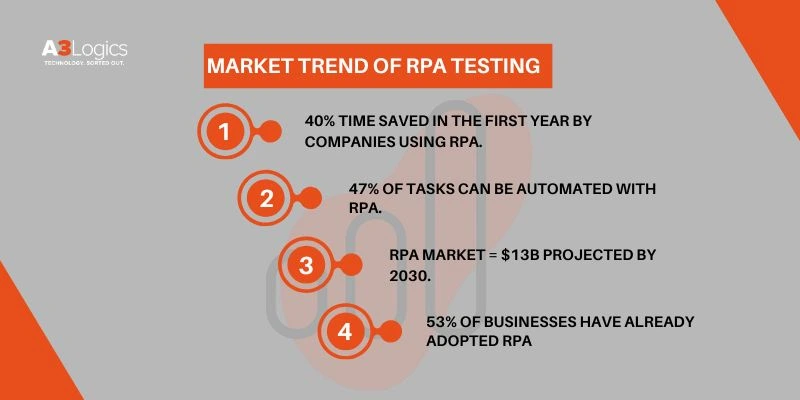
- Companies adopting RPA have reported 40% time savings in the first year.
- 47% of business-related tasks can be automated using RPA.
- The RPA market is projected to reach $13 billion by 2030.
- As per the global Robotic Process Automation survey by Deloitte, 53% of businesses have implemented RPA.
- Businesses adopting hyperautomation can lower their testing expenses by 20%-40%
Understanding RPA Testing
> What is RPA Testing?
Robotic Process Automation testing is the process of evaluating and validating the accuracy, efficiency, and reliability of RPA bots. Bots are software programs that copy the way humans do simple and repetitive tasks, such as copying data, reading emails, filling out forms, moving files between systems, etc.
Since these are software bots, before deploying them to actual use they need to be tested thoroughly and that’s why the process is also known as RPA software testing. The software bots help automate repetitive business-related tasks. The testing phase helps ensure that the bots perform as intended, meet business requirements, and produce desired outcomes.
> Types of RPA Testing
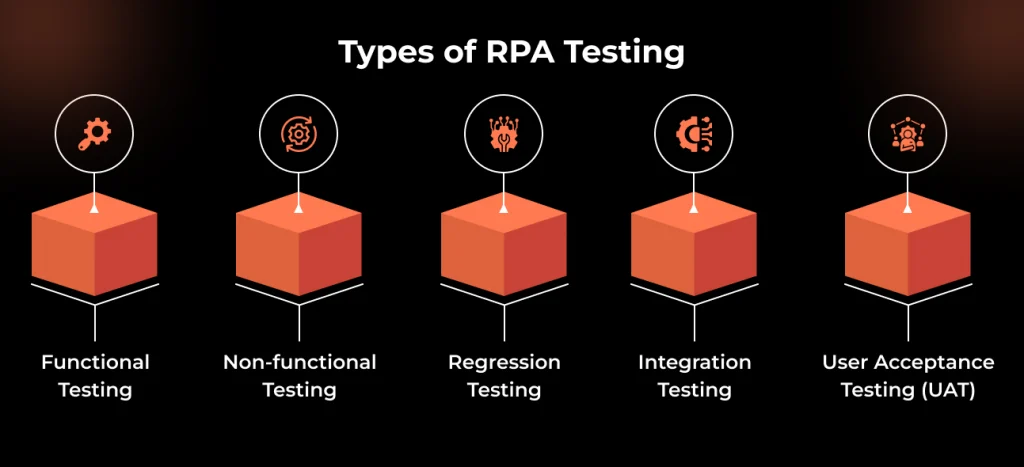
There are various approaches in RPA testing. Let’s discuss some of them below –
1. Functional Testing
It focuses on validating that the bot performs the tasks intended correctly and as per the design. RPA testers create real-world scenarios and test how the bot would interact with them.
2. Non-functional Testing
This focuses on aspects beyond the core functionality of the RPA bot. In simple terms, while the functional RPA software testing focuses on the “what” aspect, the non-functional RPA software testing focuses on the “how” aspect. It dives deeper into aspects like – performance, usability, security and scalability.
3. Regression Testing
Considering that the RPA software testing will go through several changes in the process and that the processes are interconnected, the regression testing involves rerunning previously executed test cases to validate that recent changes have not adversely affected the established workflows.
4. Integration Testing
Integration testing is a part of RPA software testing and ensures seamless interaction and data exchange between external systems and RPA bots. The phase tests the interoperability of the RPA bot with external systems, databases, and APIs. It also detects potential data transfer issues and communication glitches.
5. User Acceptance Testing (UAT)
UAT focuses on verifying the automation from the final users’ perspective. It ensures that the RPA solution meets the business’s needs and goals. Again, in this phase, RPA solutions or applications are tested using real-world scenarios to check if they can function as expected. This is also important, as it helps get stakeholders’ approval and ensures that the RPA solution can be incorporated easily.
Importance of RPA Testing in Automation Projects
1. Ensuring Accuracy and Reliability
In industries like healthcare, banking and finance, manufacturing, and others, a small mistake can cause a lot of damage. Testing in RPA helps check if the RPA bots are functioning as they are meant to—if they can accurately send emails, enter data, automate processes as per rules, move files, etc.
To ensure reliability and accuracy, RPA testing also ensures that the bots maintain accuracy even when the internet is down or slow. The test prepares bots so that in most situations, they won’t give wrong outputs, crash, or skip steps.
2. Enhancing Efficiency and Performance
The purpose of RPA software testing is to ensure that, in the future, they don’t slow down or render subpar performance, especially when something unexpected happens. Even in the toughest situations, the bots should work swiftly and smoothly.
Another great aspect of RPA testing is that, this step helps identify weak areas of RPA bots timely. You can easily find out if the bot is taking too long to complete a step or if it is consuming too many resources. Once identified, you can resolve the issue promptly and make it more efficient.
Developing a Robust RPA Testing Strategy
A robust RPA testing strategy is key to building reliable and error-free bots. The strategy ensures that automation runs smoothly across real-world scenarios and across different systems. Furthermore, a strong RPA testing strategy helps enhance bot performance, reduces risks, and ensures business processes are carried out quickly, accurately, and are fully compliant.
Let’s discuss some of the steps in developing a reliable RPA testing strategy –
1. Identifying Critical Processes for Automation
It starts by identifying repetitive tasks that have rules and can be automated. Next, prioritize processes based on factors like processing volume and potential savings. Lastly, consider the technical feasibility of automation, including data accessibility and system compatibility.
2. Defining Clear Testing Objectives and Scope
As a part of developing a robust RPA testing strategy, businesses need to determine specific goals of RPA testing, such as exception handling, functional accuracy, data integrity, and performance. The scope of testing should be defined. It outlines all those aspects of RPA that are to be tested.

Best Practices for Effective RPA Testing
1. Comprehensive Test Planning
Companies should identify key automation opportunities, define clear objectives, and set measurable KPIs to monitor progress.
First, align automation goals with business objectives such as reducing costs, improving test coverage, and accelerating release cycles. Next, evaluate existing QA processes, determine the level of automation, and identify gaps. Lastly, focus on high-impact areas like performance testing, regression, and data-driven testing in order to maximize ROI.
2. Scenario-Based Testing
Here, testers design cases that simulate realistic user interactions and business processes to ensure that the RPA bots function as expected in real-life scenarios. Instead of isolated code functions, in this form of testing in RPA, RPA testers consider how the bot will interact with the end-to-end process, with system responses, user interactions, data handling, etc.
The test cases take into account specific scenarios such as user initiating a specific action, data point being manipulated, etc. RPA for testing scenarios helps identify any potential defects.
3. Data Management in Testing
In RPA testing, data management holds a very important place. Choosing the right data is very important for validating the functionality and performance of RPA applications. Managing different versions of data and syncing them across various environments helps minimize errors as well as ensures data integrity during testing.
Common Challenges in RPA Testing
RPA testing is essential for ensuring reliable and accurate automation, however it can present several challenges. These may arise from frequent changes in user interfaces, system updates, or integration complexities. Addressing these challenges early is key to maintaining seamless bot performance and achieving long-term automation success. Let’s discuss some of the common challenges in RPA testing and possible ways to deal with them –
1. Dynamic User Interfaces
Business environments are dynamic, and RPA bots, on the other hand, are designed to operate in predictable and stable environments. Unpredictable and dynamic user interfaces can lead to inefficiencies and failures.
To tackle this, it is important that RPA bots are monitored continuously and are updated regularly. There should also be a robust change management process to ensure that bots can adapt to environmental changes.
2. Integration Complexities
When working with multiple systems, integration complexities may arise, especially when there are platforms, systems, or software that aren’t designed to communicate with each other. Secondly, businesses may encounter complexities when systems have different rules, formats, or security settings that may add to integration difficulties. These complexities may also lead to bottlenecks, such as firewalls blocking bots from reaching certain systems or if there are changes in the field names, or login process.
To overcome such a challenge, leveraging API, middleware, and other integration solutions can facilitate smoother interactions between systems.
3. Maintenance of Test Scripts
Maintenance of test scripts is a common challenge in RPA testing because RPA bots often work with applications and integrated systems that change over time. For example, an RPA bot may have to adjust itself according to a change in software interface or web page layout. When such changes happen, the test script also needs to be updated to match the new process.
If there are many bots, testers may find it challenging to review and rewrite test scripts to keep them up to date. Another issue is that if test scripts are poorly written, it may be hard to update them. To avoid such challenges, it is advisable to keep test scripts simple, organized, and updated, and follow version control.
4. Selecting the Right Tool
The effectiveness of RPA testing depends on the tools and technologies used. It is important that companies select the tools and technologies carefully. They should ensure that these tools integrate seamlessly with existing framework and also support AI driven robotic process automation.
Let’s discuss some key considerations when selecting a RPA testing tool –
RPA Testing Across Industries
RPA testing is used across industries to improve workflow. In banking and finance, it can be used to validate transactions, in healthcare, it helps manage patient data and likewise it is utilized in a variety of industries as demonstrated below –
1. Financial Services
RPA testing in financial services implies using RPA bots to automate and test various financial processes such as loan processing, account opening, and fraud detection. BY employing RPA bots, banks and financial institutions can accelerate operations, reduce manual errors, and improve overall customer service. To get a deeper outlook, you can check out this post, where we have discussed RPA use cases in banking.
2. Healthcare
RPA automation testing helps healthcare facilities streamline tasks like insurance checks, data entry, and claims processing. RPA testers ensure bots work reliably across EMRs and other systems. With RPA testing services, hospitals improve patient care, maintain smooth workflows, and ensure compliance with HIPAA, GDPR, and other healthcare data regulations.
3. Retail and E-commerce
In the retail and E-commerce domain, RPA software testing can help streamline operations. It can aid in tasks like order processing, inventory updates, and returns. With RPA automation testing, testers can validate if bots are syncing data across platforms, tracking shipments, and managing pricing. RPA for testing in the retail domain can help ensure accurate and real-time responses that can further help in smoother back-end logistics and improved customer experience.
4. Human Resources
Repetitive HR responsibilities can be cumbersome, and we have already established how RPA can help ease labor-intensive HR related tasks. With RPA automation testing, testers can make life easy for HR teams by automating tasks like employee onboarding, resume screening, and payroll processing which otherwise are time-consuming.
Future Trends in RPA Testing
1. Integration with AI and Machine Learning
Integrating AI and machine learning with RPA or even RPA testing tools enables intelligent mechanization. These tools can adapt to dynamic working environments, expediting the decision-making process.
2. Hyperautomation
Hyperautomation testing integrates next-gen technologies such as machine learning, AI, and RPA to optimize software testing. It helps minimize errors and automates repetitive QA tasks. It can help achieve better test coverage while ensuring constant monitoring and high-quality releases.
3. Shift-Left Testing Approach
This proactive approach integrates testing activities earlier in the development lifecycle, which aids in proactively identifying and fixing issues. You needn’t wait for an outcome; you can prevent possible errors from occurring.
Why Choose A3Logics for RPA Testing?
1. Looking for Robotic Process Automation Consulting Services?
A3Logics, is a name you can trust. We are a leading provider of robotic process automation services. We validate the functionality of RPA bots, ensure smooth performance, and address issues before deploying them to optimize automation and minimize risks.
2. Expertise in Testing Automation
At A3Logics, our testers have years of hands-on RPA testing experience and know robotic process automation inside out. They are deft at catching bugs before they cause issues and ensure that your bots run smoothly right from day one.
3. End-to-end RPA Solutions Tailored to Testing
For us, RPA testing isn’t just about testing the bots; we build a comprehensive strategy around it. We offer custom-built RPA applications that are tailored to meet your business objectives. Our bots are designed to work efficiently and accurately in real-life scenarios.
4. Proven Success Stories and Case Studies
Don’t just take our word for it – our results speak for themselves. We have helped companies across all domains boost their operations with automations using RPA testing solutions. You can check out our case studies that speak volumes about our quality, and performance.
5. Compliance-driven Approach
At A3Logics, adherence to compliance is non-negotiable. We strictly follow industry rules and data standards like GDPR, HIPAA and other regulations to keep you safe and fully compliant.

Conclusion: Making RPA Testing a Strategic Priority
It starts with this: If you wish your business to thrive in a technologically evolving world, you need to automate the various processes, something that can be made possible with RPA bots. Next, comes the part where you test the RPA bots with a carefully well-thought-out strategy – choosing the right tools, adhering to best practices and making every possible effort to ensure that the bots deliver accuracy and make your operations efficient.