
AI underwriting is the use of machine learning, natural language processing, computer vision, and automated decision engines to evaluate risk and approve insurance applications with more speed, accuracy, and consistency. This feature has become the industry’s turning point for the insurers going towards 2025-26.
The rising customer expectations, the request for instant decisions, and the increasing pressure on profitability have remodeled the way underwriting has to operate within the whole insurance value chain. In the past, underwriting was at the core of insurance operations, affecting customer acquisition, pricing, policy issuance, claims handling, and renewals. Insurance value chain transformation is the need of the hour and AI is broadening its scope, speeding up underwriting and changing every interaction across the value chain.
With almost 70-80% of insurers intending to increase AI and automation-related expenditures by 2026, and with AI already allowing to cut the underwriting time by 30-60% and the decision accuracy to be improved by 25-40%, the change is both timely and indispensable.
Understanding the Insurance Value Chain
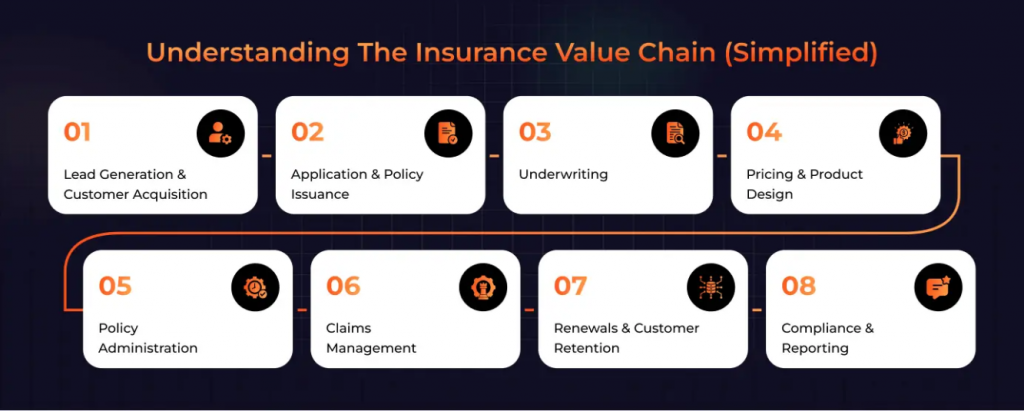
The insurance value chain transformation is a series of interrelated processes that describe how insurers attract and retain customers, assess risks, issue policies, handle claims, and build long-term relationships. It normally starts with lead generation and customer acquisition, where insurers find prospective customers and pair them with appropriate products. The process advances into application and policy issuance, where customer data is gathered, verified, and formatted for the underwriting department.
Underwriting is central to the value chain and is in charge of evaluating risks, making decisions on eligibility, and suggesting pricing or approval input. Pricing and product design depend on risk trends revealed by underwriting data to modify rates or launch new products.
Policy administration is responsible for the compliance, updates, and accuracy of all current policies. Claims management is the department that deals with customer losses, while renewals and customer retention concentrate on nurturing long-term relationships. At every stage of the insurance value chain transformation, compliance and reporting ensure that the company follows regulations, can be audited, and keeps its operational integrity.
Where Traditional Underwriting Falls Inefficient
Traditional underwriting has been heavily dependent on manual labor, document-based workflows, and isolated systems that have the effect of slowing down the whole insurance lifecycle. Underwriters are burdened with the task of data gathering, documents reviewing, and information reconciling from different sources. This dependency on manual work leads to inconsistency in risk evaluation and infuses the process with human errors, thus, the problem of underwriting leakage becomes more serious.
Delays in turnaround times have a negative effect on the customer experience, especially when modern consumers require real-time decisions as would be the case in digital banking or fintech interactions. Operational expenses rise because manual processes consume significant time and money. Moreover, scalability suffers during peak seasons. Additionally, sudden spikes in applications create further strain on operations.
These drawbacks are what make insurers decide to resort to insurance value chain transformation for the purpose of bringing the underwriting process up to date and simultaneously improving both the customer and internal teams’ experience.
How AI Underwriting Is Reshaping the Entire Insurance Value Chain?
1. Transforming Customer Acquisition
AI in underwriting is changing the first stage of the insurance value chain transformation journey when the insurers attract and qualify customers in a new way. With AI-supported risk pre-assessment, insurers can evaluate a prospect before even receiving a full application from him. This allows them to offer customer-specific products that fit each person’s risk profile. Instant eligibility verification helps ease the enrollment process and eliminate customer drop-offs.
Therefore customer acquisition gets more targeted, faster, and safer since it is in line with the insurer’s risk appetite. The lead-to-policy conversion rate gets much better when the prospects receive quick, predictive information about their potential coverage options.
2. Reinventing Application Processing
AI has revolutionized application processing, making it a much faster and accurate stage in the value chain. Present-day technologies like OCR and NLP are able to process various documents, e.g., PDFs, identity proofs, financial statements, medical reports, and lab results with almost human accuracy. What used to heavily involve hours, it is done now in a few seconds.
The easing of manual data entry work is often at a level of 70%, thus the policy issuance is sped up radically by the insurance employees. At the same time, insurance fraud detection automation detects fraudulent activities in applications by pointing to inconsistencies in data, unexpected document patterns, or illegal operations. Such a first stance against fraud gives the company a safe period before the underwriting review starts and lowers the chances of high-risk or fraudulent applications getting approved.
3. The Core: AI-Powered Underwriting Workflow
a. Automated Data Collection
Automated insurance underwriting starts with data collection from as many internal and external sources as possible. Examples of these would be public records, financial info, medical history, credit report, and telematics data that comes from IoT devices or a connected car. Besides, by external APIs, AI systems are also able to perform identity verification, KYC checks, and third-party risk assessments settings. Consequently, it compiles a comprehensive data profile on which the human underwriters can base an accurate estimation.
b. AI Risk Scoring Models
When the data is at hand, AI risk scoring models are there to analyze it and predict the chance of future claims. These models look at customer behaviors, use historical trends, and risk sources to divide applicants into groups according to the degree of danger. Differently from conventional risk assessment, AI is always consistent and explainable because it uses one single standard for scoring decisions. It results in less loss ratios and better quality of the portfolio.
c. GenAI-Assisted Decision Support
Generative AI is one of the ways through which the underwriting process can be improved in terms of decision-making complexity. It reads the long texts quickly, brings out the most important risk factors, and even gives suggestions to acceptance, rejection, or further review. The automated insurance underwriting also automatically completes the underwriters’ notes, thus shortens the documentation time while maintaining the accuracy level. Therefore the human underwriters get more time for the final decision and not for data review.
d. Automated Approval for Low-Risk Cases
In case of straightforward and low-risk situations, AI is used for straight-through processing which allows a case to be approved immediately without intervention by a human. The policy issuance gets thus sped up very much, the time staff underwriters who are free can use for complex cases or borderline ones which need deep analysis.
4. Impact on Pricing & Product Development
AI underwriting is a major contributor to pricing and product development. Insurers become aware of new possibilities that let them create more precise actuarial models once they start to analyze risk patterns and customer behaviors. With insurance value chain transformation the idea of a premium being real-time adjustable is not far from becoming reality as AI is on a continuous monitoring of risk-relevant data.
Micro-segmentation allows insurers to create highly customized products for specific customer groups. Moreover, predictive analytics reveals market trends and new product opportunities. As a result, insurers gain time to prepare for competition.
5. Enhancing Policy Administration
AI is a great helper in policy administration as well by ensuring they are always accurate and clean through the automatic updating of policies when customer risk profiles change. It finds the gaps, inconsistencies, and even outdated information in policy records and suggests the fixes. In that way, fewer administrative errors are made and policy data remain trustworthy all through the customer lifecycle. The use of AI lessens the workload of the administrative staff, thus the insurance companies can be more efficient in their operations.
6. Strengthening Claims Management
Underwriting insights are used in claims management, too, which means better fraud detection and overall claim accuracy. The risk data, which comes from the AI-powered underwriting stage, is very helpful for claims departments to do quick loss validations at the first notice of loss. Also, predictive models make reserves more accurate and allow claims forecasting. Therefore, insurers are usually able to have a 20–30% decrease in unaccounted claims, which is a double win, as it not only raises profits but also strengthens loss ratios.
7. Improving Renewals & Retention
AI is an aid to the renewal process in a sense that it helps to predict the churn risks as well as figuring out customers who may benefit from personalized retention strategies. With the help of underwriting insights, the premiums for the renewals get adjusted depending on the latest risk profiles. Providing the customers with customized recommendations and also giving them the option of buying other products that may interest them is a way companies can increase customer lifetime value and thus retention rates, too.
8. Compliance, Audit & Reporting
AI helps very much with compliance by making proper and traceable underwriting decisions. Every step of the AI-based process is able to be recorded in automated audit trails, which makes the regulatory reporting faster, and it is more accurate. Furthermore, by way of anomaly detection, AI also warns the organization about the first signs of non-compliance or deviations from underwriting guidelines, thus helping risk governance to be more effective throughout the company.

Real Use Cases of AI Underwriting in 2025-26
AI underwriting in the insurance value chain transformation is providing very visible and quantifiable benefits in various major sectors.
1. Life insurance
In the life insurance segment, automated examination of medical documents is a method by which the companies may instantly process health records and lab reports without the need of manual review that would have taken hours.
2. Health insurance
AI is also utilized by health insurers in detecting early fraudulent patterns and in making accurate predictions of claims risks.
3. Auto Insurance
Auto insurance companies are using real-time data from telematics to revise the rates of premiums depending on the actual on-the-road behavior, thus showing effectiveness in pricing the risk correctly.
4. Property and Casualty
Property and casualty lines are benefitting from the introduction of satellite images and computers’ vision tools that not only speed up the process but also increase the accuracy of evaluations of the properties’ conditions and levels of exposure thus do away with incomplete and outdated survey methods.
5. Commercial insurance
Commercial insurance now benefits from value chain transformation that speeds analysis of operations and financial stability. This transformation also accelerates reviews of historical risk data. Insurers make faster decisions with greater confidence and consistency.
Benefits for Insurers
1. Operational Benefits
Automated insurance underwriting provides an enterprise with the means of improving performance on the operational side which in turn leads to expanding the business and making a profit. Practices of underwriting which are time-consuming and monotonous will be automated by AI, consequently, most of the workers will no longer be required thereby underwriters’ costs will fall significantly.
2. Risk and Accuracy Benefits
Insurance value chain transformation increases policy issuance speed and boosts performance capacity without extra staff. Standardized AI models reduce human errors and remove subjective inconsistencies. These improvements enhance risk selection and help insurers achieve better combined ratios.
3. Customer experience benefits
The main benefit of insurance value chain transformation for consumers is the provision of an easy-to-use application process due to the combination of more rapid decisions and more uniform evaluations thus the return rates will be higher. In the long run, AI is the means by which insurance companies can handle a more significant number of applicants, achieve better risk selection, and provide their customers with prompt services.
Challenges & Considerations
1. Data privacy and governance
AI in underwriting can only be effective if the use of the technology comes along with the management of considerable challenges by the insurance companies. Due to the fact that the carriers manage highly sensitive personal information, data privacy and proper governance must be the main concerns.
2. Model Explanability and Bias Control
The AI decision models should be kept interpretable so that the reasoning behind decisions can be easily grasped and checked for fairness not only by regulators but also by the internal teams.
3. Integrating AI with Legacy Systems
One remaining step in the process of solving legacy system problems is still integration, which can be particularly difficult for networks that have older sets of platforms, which restrict automation.
4. Change management within underwriting teams
On the other hand, change management is just as crucial because support and training of the employees from the underwriting department in handling AI are necessary.
5. Regulatory Compliance
Adherence to the ever-changing regulations of various authorities such as IRDAI and NAIC is also facilitated by exhibiting robust controls, audit trails, and transparency in operations.

How A3Logics Helps Insurers Transform Underwriting?
A3Logics utilizes the power of AI by underwriting the transformation of traditional methods through automation, individualized workflow systems, and cutting edge risk modeling.
1. AI Underwriting Automation Solutions Development
The enterprise completes the construction of solutions gradually by first simplifying the physical document handling process, then by speeding up data extraction, and finally by paving the instant decision path for the less complicated risks.
2. Custom Underwriting Workflow Automation
Through the implementation of AI submittal followed by a progressive development of the policy and CRM systems, it completes harmonizing an exam process thus making full functionality usable without hassle.
3. Predictive Analytics & Risk Models
In identifying and planning for future pricing and risk decisions, A3Logics as a top AI development company employs the power of advanced analytics to build stronger risk assessment and determine pricing accuracy.
4. Integrations
Utilizing the knowledge of technology, industry, and integration, the company is able to provide insurers with the needed support to have a more rapid, efficient process in underwriting.
Conclusion
AI underwriting is changing rapidly and greatly offering insurance value chain transformation. They are changing the way insurers look at the risk, how they execute their applications and offer services to the clients. AI now completes tasks in minutes and delivers instant, accurate decisions. Insurers cut major operational costs through automation. Bottlenecks arise from data quality, governance gaps, and legacy systems. Insurers can solve these issues with the right strategy and technology partner.