IoT asset tracking is not just a buzzword – rather, it’s a powerful way to monitor the right assets in real time. The best part is that technology does not revolve around a single industry. IoT helps many businesses reap the utmost benefits from logistics to healthcare.
However, due to emergencies, complexities patients face, long waiting queues, and the need for remote observation, mostly large-scale healthcare facilities feel the need to increase the uptime of critical medical assets & improve care facilities. So, they focus on real-time hospital asset tracking and monitoring, allowing them to make instant and quick decisions.
Here, the IoT hospital asset tracking & monitoring system development allows the doctors and paramedics to monitor their condition and proper usage, along with optimized asset allocation. But they are often challenged to efficiently track & manage a massive number of medical equipment & resources, especially when they’re movable & scattered. This needs proper IoT integration.
So, let’s explore how hospital asset management using IoT technology can improve the pace, accuracy & efficacy of tracking & optimize asset use.
Stats and Facts of IoT in Healthcare, Management, and Asset Tracking
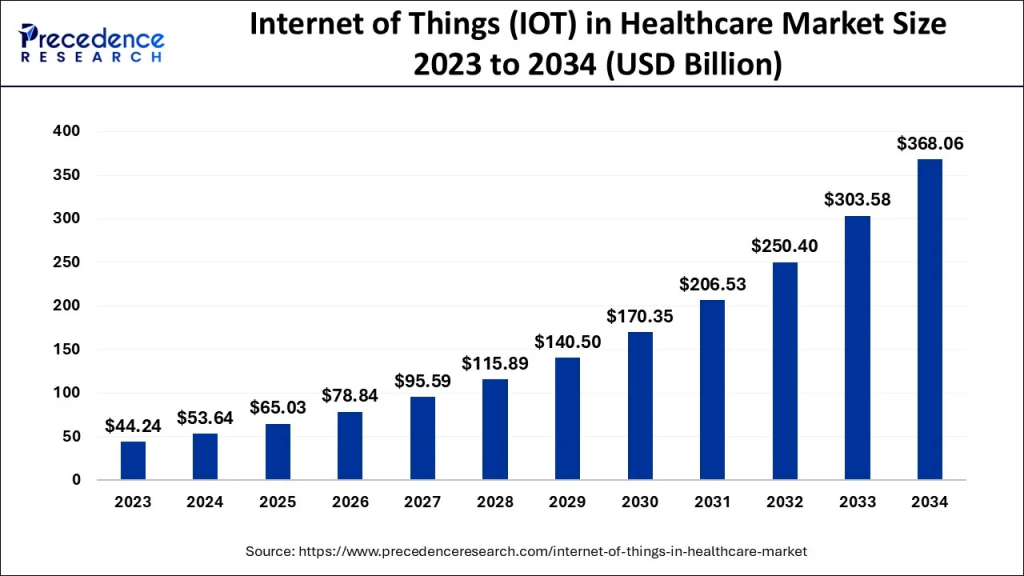
- The global IoT in the healthcare market was valued at USD 53.64 billion in 2024.
- IoT in Healthcare market is expected to reach USD 368.06 billion by 2034, expanding at a CAGR of 21.24%.
- IoT-enabled remote patient monitoring can reduce hospital readmissions by as much as 50%.
- 80% of healthcare executives see increased innovation as the primary advantage of IoT implementation.
- Approximately 50% of healthcare IoT is used for remote operations besides enhancing the overall operational efficiency.
- Remote patient monitoring has shown some promising results, reducing the hospital readmission rates by 45% for heart failure patients.
- Over 60% of hospitals worldwide have implemented IoT devices for various healthcare applications.
- About 75% of healthcare executives believe that IoT will significantly impact the overall patient outcomes and operational efficiency.
- IoT-powered wearables have seen a 55% increase in usage for tracking proper fitness and health-related metrics.
- IoT in healthcare has resulted in a 50% reduction in patient wait times.
- Healthcare facilities using the smart IoT technology report an average cost reduction of 26% in their operations.
- IoT-powered asset tracking has proven effective in reducing hospital equipment loss and theft by up to 35%.
How Does an IOT Hospital Asset Tracking & Monitoring System Work?
In a hospital, assets and critical equipment like ventilators, infusion pumps, MRI machines, wheelchairs, and different diagnostic tools are used. It also covers top-notch surgical instruments, consumables like syringes and gloves, and even large mobile assets such as ambulances. However, these resources are vital for proper patient care and must be properly monitored, and an IoT-powered Hospital asset tracking system development works here.
Current Pain Points
Hospitals these days often face some major challenges in asset management.
- Theft or misplacement – Theft or misplacement of high-value medical equipment, or data theft, often leads to financial losses and delayed treatment, which is not okay.
- Under-utilization is another problem — when devices are left unused due to poor visibility, many departments are experiencing shortages of that equipment.
- Time & Resource Mismanagement – Additionally, time wasted searching for tools or machines can directly affect patient outcomes and staff efficiency.
Here, the IoT-enabled hospital asset monitoring system development comes into action.
IoT-based Hospital Asset Tracking System Workflow

An IoT hospital asset monitoring system development using the sensors, RFID tags, Bluetooth Low Energy (BLE) beacons, or GPS devices continuously transmits the real-time data about the location, condition, and even the usage of each asset to a centralized hospital management platform.
The collected data is processed through the right IoT gateways and stored securely in modern cloud-based systems. Additionally, using some advanced analytics and dashboards, hospital staff can easily monitor the correct asset utilization rates, predict the genuine maintenance requirements, and quickly allocate resources where needed. Alerts can also be triggered in unauthorized movement, equipment malfunction, or low inventory.
For example, a ventilator with an IoT sensor sends signals quickly to receivers installed across hospital zones. Thus, it enables the administrators to instantly check where it is located and whether it is in use or unused.
Integration with an efficient IOT enabled hospital asset tracking system ensures correct scheduling, billing, and compliance align with correct asset usage.
Moreover, by automating the proper asset visibility, hospitals reduce different chances of losses, optimize usage, and even enhance overall patient safety. This proactive system not only eliminates the chances of correct manual tracking, lowers operational costs, but also ensures that the right equipment is always available at the right time.
Who Are The Key Users of the IoT Hospital Asset Tracking & Monitoring System
Many key users use the advanced IoT hospital asset tracking systems. When an IoT hospital asset monitoring system development is used, key users use the technology in different ways. So, let’s take a look at the detailed breakdown and learn the key roles –
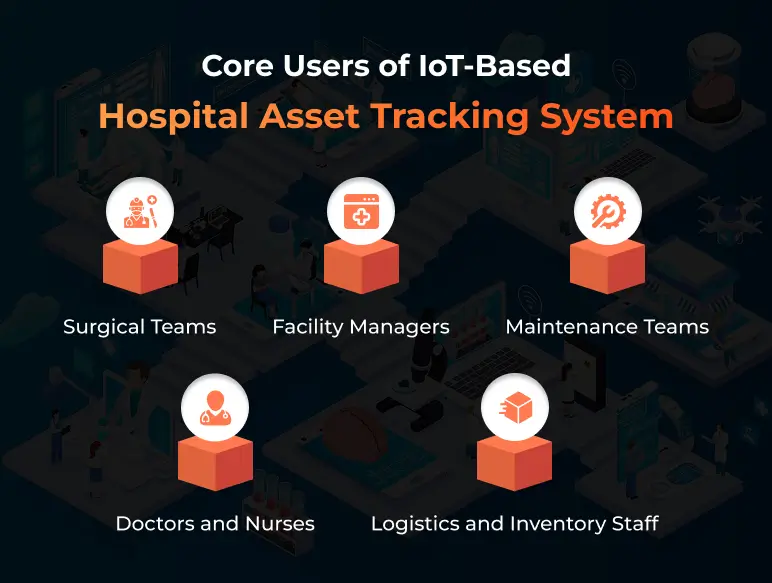
- Doctors and Nurses:
Doctors and nurses generally use the correct IoT system to locate the ideal equipment (like wheelchairs, ventilators, or monitors) quickly. This easily reduces the chances of patient wait times and ensures the immediate availability of using some necessary devices during critical situations.
- Surgical Teams:
Surgical teams can use the IoT hospital asset monitoring system development systems to confirm that some sterilized surgical instruments are available and in the right place before performing a procedure.
- Facility Managers:
Use the advanced and real time hospital asset tracking to monitor and manage some mobile assets, ensuring their availability and tracking proper maintenance schedules. Thus, they automate different processes for repairs and ordering.
- Logistics and Inventory Staff:
Track the real-time status and even accurate location of various assets, from checking the expensive medical machines to hospital beds, to prevent cases of loss and theft, and ensure optimal stock levels.
- Maintenance Teams:
Using real-time hospital asset tracking, maintenance teams can easily receive real-time alerts for low equipment inventory or upcoming maintenance needs. Thus, it allows for proper and predictive maintenance.

How Does IoT Asset Tracking Benefit Hospitals?
Hospital asset tracking and managing them is not just about using those properly— rather, it’s about unlocking superior performance across care, cost, and proper compliance.
1. Better Productivity and Higher Efficiency
Many hospitals often struggle with some misplaced or underutilized hospital equipment. Through proper asset tracking, the technology ensures quick detection of emergency devices. This ensures that less time is wasted searching for the essential tools. This eventually improves the overall workflow and also increases staff productivity.
2. Enhanced Patient Safety
Hospitals can not bring any risk or compromise patient care. So, missing or even malfunctioning the equipment may have some serious consequences. Here the hospital asset tracking saves the day by ensuring that all critical equipment is available on-time without causing any further delay.
3. Cost Reduction and Resource Optimization
When some hospital assets are misplaced, it often leads to repeat purchases. As a result, there are some unnecessary cost burdens and financial challenges. But, with the innovative IoT hospital asset tracking & monitoring system development solutions, hospitals can get the chance to make the best use of the assets, reducing different cases of theft and avoiding redundant expenses.
4. Proper Care and Preventive Maintenance
While using the IoT hospital asset tracking & monitoring system development, hospitals should follow the rules to ensure proper medical equipment maintenance and safety. Asset management in hospitals, in such cases, helps in automated maintenance and even schedules that ensure all the equipment works perfectly and meets safety standards.
5. Theft and Loss Prevention
Medical equipment often gets stolen, leading to some significant financial losses. No doubt, this has become a serious matter of concern. Here, the right hospital tracking solutions send on-time alerts to the management. That’s how it successfully prevents the issues of unauthorized access and the cases of tools loss.
Top Five IoT-Driven Hospital Asset Tracking & Monitoring Systems in the Market
Many key players are in the IoT-powered hospital asset tracking system development market. The best part is that all of the systems come with significant benefits. These are –
- ASCOM:
A global leader in modern healthcare communication. The tool offers exclusive solutions for a seamless workflow and workflow automation. Thus, it offers proper integration of asset tracking capabilities.
- CenTrak:
Specializing in real-time location services (RTLS) for the healthcare industry, this particular system helps track critical assets like wheelchairs and equipment.
- GE Healthcare:
A comprehensive IoT-powered hospital asset tracking system development with a healthcare technology provider with the latest solutions, including proper asset management and monitoring of some integrated into their medical equipment offerings.
- Honeywell International:
A major technology company usually provides various solutions, including IoT-enabled asset tracking. Therefore, it helps to improve visibility and control of different medical devices and equipment.
- Midmark Corporation:
It focuses on superior clinical workflow and equipment, with some IoT-enabled systems to monitor asset availability and manage top-quality equipment across hospital departments.
What Are the Capabilities of the Hospital Asset Tracking System?
IoT-enabled hospital asset monitoring system development has some significant capabilities. These systems use some superior technologies such as RFID, RTLS, and barcodes and also provide real-time data on location, status. Those even guide on proper equipment usage, supplies, and medication.
- Real-Time Location Tracking (RTLS)
Real-time hospital asset tracking uses the latest RTLS tools. These are ideal for real-time monitoring of different medical equipment, medicines, and even ambulances. This ensures quick access to the latest devices, reduces the chances of delays, and even ensures better operational efficiency.
Moreover, by providing some proper and accurate real-time data on the asset locations, staff can easily avoid time wastage in searching for some proper equipment, especially in critical care units. This enhances patient care, prevents duplication of equipment purchases, and ensures optimal use of hospital resources.
- Asset Utilization Analytics
The system analyzes when, how often, and where the medical equipment is used. Therefore, it helps hospitals maximize ROI. Also, the underused and overused assets can be easily identified and redeployed effectively.
On the other hand, analytics-driven insights also empower hospitals to cut costs, improve equipment distribution, and even avoid unnecessary purchases. Moreover, hospitals can make data-backed investment decisions and streamline asset allocation by understanding some of the latest usage trends and proper management.
- Predictive Maintenance & Alerts
IoT hospital asset monitoring system development helps to track the right equipment’s health, performance, and usage cycles. Therefore, send alerts before any breakdowns occur. This reduces the overall downtime and even extends asset lifespan.
Similarly, the accurate predictive maintenance prevents some unexpected equipment failures during the application of some critical treatments. So, by scheduling timely servicing and repairs, hospitals can also easily ensure continuity of care, maintain the proper compliance standards, and minimize costly emergency repairs or frequent replacements.
- Geofencing & Loss Prevention
Virtual boundaries (geofences) are ideal to prevent unauthorized movement of assets. It also alerts to serious triggers if equipment is removed from some designated areas.
Geofencing also strengthens the overall hospital security and minimizes the chances of asset theft and misuse. Furthermore, the IoT-enabled hospital asset monitoring system development helps to track proper asset movement across certain departments, ensuring greater accountability. This minimizes financial losses and guarantees equipment availability.
- Environmental Monitoring (Cold Chain, Pharmacy, ICU)
IoT hospital asset tracking & monitoring system development is basically development of some IoT sensors. These monitor the ideal temperature, humidity, and proper storage conditions for sensitive items like vaccines, medicines, and ICU equipment.
So, maintaining some environmental conditions ensures proper compliance with medical safety standards. Therefore, hospitals can prevent the issues of spoilage of costly drugs, vaccines, and even blood samples while ensuring patients receive safe treatments.
- Staff & Patient Safety (Integration with RTLS Badges)
RTLS badges and the real time hospital asset tracking can track staff and patients, improving the overall emergency response and ensuring safety in critical scenarios.
Furthermore, integration with proper asset tracking enhances the chances of security and ensures quick staff deployment. Thus, they support contact tracing. It also boosts patient safety by monitoring their movement in ICUs or even inside the isolation wards. Additionally, the badges also protect the staff against workplace hazards and emergencies.
Read Also: IoT in Healthcare
Types of Hardware and Sensors Required to Develop an IoT-powered Hospital Asset Tracking System
An IoT-powered hospital asset tracking system requires hardware and sensors that could fulfill specific tracking needs within the hospital environment. Let’s have a look –
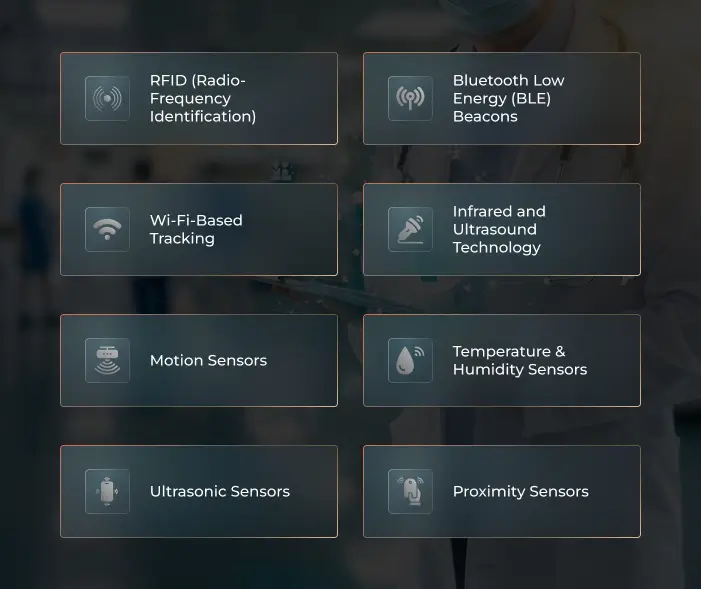
- RFID (Radio-Frequency Identification)
There are many medical equipment, materials, hospital beds, and other items with RFID tags attached to them. And the best part is that these can be easily detected with the RFID readers placed throughout the hospital. The readers are used because they can send real-time location data to a central system.
- Bluetooth Low Energy (BLE) Beacons
When it comes to IoT hospital asset tracking & monitoring system development, Bluetooth low energy or BLE Beacons are small yet power-efficient devices that send signals to some nearby Bluetooth receivers. However, when it comes to high accuracy and minimized power consumption, they help hospitals properly track assets. Also, those are perfect for locating wheelchairs, checking the location of patient transport carts, and some portable medical devices.
- Wi-Fi-Based Tracking
The Wi-Fi-based tracking seamlessly blends with the existing hospital Wi-Fi networks, and the equipment can efficiently track proper assets and people. Since it uses a hospital’s existing infrastructure, this technology is ideal for some cost-effective and precise asset tracking.
- Infrared and Ultrasound Technology
Hospitals use this infrared and ultrasound technology to track sterile surgical instruments and proper medication storage areas. When tags go through some specific locations, the infrared sensors can easily accurately detect them with room-level accuracy. Here the ultrasound waves help with proper and real-time tracking.
- Motion Sensors:
Hospital motion sensors help track movement asset usage and location changes. These are ideal for monitoring equipment in use, particularly those areas where it shouldn’t be.
- Temperature & Humidity Sensors:
Temperature and humidity sensors are ideal for monitoring the condition of sensitive medical equipment, and different medical supplies measure the environmental factors.
- Ultrasonic Sensors:
Ultrasonic sensors are used to detect the presence of assets or measure distances. However, these sensors are very helpful for tracking some surgical instruments and storage areas.
- Proximity Sensors:
Proximity sensors, on the other hand, help identify when two objects are near each other, a valuable feature for managing proper workflow and preventing collisions.
Implementation Challenges in an IoT hospital Asset Tracking system
Implementing real time hospital asset tracking is not possible without some challenges. Different factors are involved here. From the high infrastructure costs and network limitations, data security, sensor maintenance, and staff readiness, each of these factors requires careful planning. Also, hospitals must follow and balance some superior technology investments to ensure that the system delivers accurate, secure, and sustainable benefits that help them make the workflow smooth and secure.
- Infrastructure Costs & Deployment Complexity
Setting up the proper hospital asset tracking with IoT requires significant investment in sensors. There are gateways, cloud platforms, and integration with some proper hospital systems. Furthermore, large facilities may need extensive infrastructure upgrades, making the initial deployment complex and resource-heavy. Some high upfront costs and long implementation timelines may delay adoption, especially in budget-sensitive healthcare environments.
- Network Coverage & Accuracy Issues
When it comes to IoT-powered Hospital asset tracking system development, the IoT tracking systems always rely on some wireless networks. These include Wi-Fi, BLE, or RFID, and due to these, hospital management may face signal interference inside the hospitals due to the concrete walls, equipment, and multiple floors. On the other hand, some inaccurate location data can also impact the overall asset visibility. This as a result ensures consistent network coverage and precise indoor positioning needs optimization.
- Battery Life of Tags & Sensors
Most of the sensors and IoT asset tags are battery-powered. So, frequent replacements or recharging are time-consuming, and that also increases the maintenance costs. If a sensor battery fails, the asset becomes much untraceable, leading to serious disruptions. So, designing some superior and energy-efficient systems and adopting low-power communication technologies are vital to extend battery life and it ensures reliable asset tracking.
- Data Security, Privacy & Compliance (HIPAA/GDPR)
Since IoT-enabled hospital asset monitoring system development is superior for real-time data sharing, protecting patient and hospital information is necessary. Some systems must comply with proper healthcare regulations such as HIPAA (US) or GDPR (EU). Also, some security breaches can expose sensitive data. As a result, this leads to legal penalties and serious reputational damage.
- Change Management & Staff Training
Even the best IoT system may fail to work without proper user adoption. So, the best healthcare staff may resist some new technologies due to improper training or the fear of added workload. So, hospitals must invest in structured training and awareness programs and focus on change management strategies that ensure smooth adoption and maximum benefits.
Best Practices for Healthcare Asset Tracking
Healthcare organizations rely on smart equipment, tools, and other assets. Together, these help to provide quality healthcare to patients. And that includes more than just using simple equipment, but also relying on it to develop IoT-powered hospital asset tracking system development. These help to manage patient records, medical billing, and other processes that take place.
- Perform a Proper Inventory Audit
Categorizing different assets by type, documenting the correct asset value, considering the years in service, manufacturer information, and even other information about each asset makes it easy to manage. Also, the existing operational status of different assets should be properly documented.
Categorizing these assets based on the right type is also crucial during the initial inventory audit. Also, check the different types based on unique maintenance schedules and other distinct asset management procedures.
- Use the Proper Asset Tags
Healthcare assets should undergo proper sanitization procedures to mitigate other environmental hazards. So, selecting the real time hospital asset tracking and proper asset tags that can easily withstand the regular exposure is imperative. There are also asset tag solutions particularly designed for high-value equipment that is frequently lost or stolen.
Similarly, some destructible vinyl asset labels and tamper-evident barcode labels also leave clear evidence of tampering behind or even discourage theft issues.
- Apply an Inventory Management System
Many hospitals often over-invest in some assets and compensate for the difficulties in locating some essential assets quickly. Moreover, by implementing a hospital inventory management system, organizations can reduce the chances of redundant and unnecessary equipment purchases by optimizing proper equipment utilization.
Labeling assets and documenting excellent equipment locations in a central database makes it easy for staff. Thus, they can readily locate the tools, supplies, and proper equipment for efficient care delivery.
- Set Up a Simplified Asset Lifecycle Management System
Healthcare asset tracking, when combined with a proper IoT-powered Hospital asset tracking system, can manage the asset lifecycle for different types of assets. Also, using the correct method, healthcare organizations easily monitor the condition of different assets, manage proper maintenance schedules, and track the lifetime costs associated with some unique assets.
Organizations also opt for replacing some assets after they are fully depreciated to improve overall safety by taking some older assets out of service before accidents or permanent breakdowns occur. Furthermore, asset lifecycle management also provides some relevant and valuable data to different healthcare organizations that can help with future equipment investment.
- Practice Preventive Maintenance
Hospitals and other healthcare organizations must manage a large volume of high-value assets. IoT-enabled hospital asset monitoring system development can easily streamline the overall management of preventive maintenance programs. These can significantly reduce the overall frequency of unexpected breakdowns by identifying the potential equipment problems before they cause severe interruptions.
Additionally, some ongoing preventive maintenance typically extends the lifespan of those costly assets and keeps them in optimal working condition.
- Implement a Check-in/check-out system
When some unique identification numbers are used to tag the assets, healthcare organizations focus on implementing proper check-in/check-out systems. These can successfully record the real-time availability of the assets and consider the accurate location information. Additionally, with IoT hospital asset monitoring system development when data is collected over time, it assists with properly optimizing investments.
Moreover, setting up alerts for tasks such as expiring licenses, maintenance needs, or safety checks helps maintain proper compliance and proactively address different issues.
How A3logics Can Help You Develop a Smart IoT Hospital Asset Tracking System
When it comes to IoT hospital asset monitoring system development, A3Logics is at the forefront of driving superior innovation. By connecting healthcare through the seamless implementation of cutting-edge IoT technology, we know how to bring the best solutions for hospitals. Also, by developing advanced IoT solutions, we at A3Logics empower healthcare providers and patients with enhanced connectivity, real-time data access, and seamless communication. Here are some of the best methods they follow –
- IoT Healthcare Integration: A3Logics’ IoT Healthcare Solutions has the potential to seamlessly connect patient care, healthcare professionals, and the best quality medical equipment. Thus, it helps to create an excellent and unified care ecosystem.
- Real-Time Monitoring: With superior IoT technologies, A3Logics offers real-time patient monitoring, predictive analytics, and continuous data collection. Thus, it allows healthcare professionals to ideally monitor patients remotely from anywhere and at any time.
- Applications in Chronic and Geriatric Care: These IoT solutions are crucial for managing some chronic diseases, post-surgical recovery, and even ideal geriatric care. In these cases, continuous health monitoring is essential for proper patient survival.
- IoT-Enabled Medical Devices: Different devices include heart monitors, glucose meters, and even blood pressure cuffs. These advanced options help to analyze patient data, providing healthcare professionals with a real-time and comprehensive view of patient health.
- EHR/ EMR Integration: IoT-enabled hospital asset monitoring system development and Integration of the advanced Electronic Health Records guide a patient’s medical history. However, the correct data comes in real-time from IoT-enabled devices.
- Secure and compliant data management: Healthcare data is sensitive, which is why every patient’s data should be secured and safely stored. The platform also complies with HIPAA and should meet other standards to satisfy legal and regulatory requirements.
- Scalable and Customizable Solutions: IoT healthcare solutions can be significantly tailored to meet the unique needs of different healthcare providers. Whether a large hospital system or a small clinic, you can always get the best assistance on IoT-enabled hospital asset monitoring system development to fulfill your organization’s needs.

Conclusion
Hospital asset tracking is difficult, as they must tackle many things simultaneously. This creates several significant challenges if they decide to go for manual monitoring and management of hospital assets. So, opting for an IoT hospital asset tracking & monitoring system development can help reduce the cost of replacing the stolen equipment, but also help by accurately recording the performance data and asset usage.
All the solutions are here – the seamless integration of the excellent IoT technology and mixing that in line with your business model. As demonstrated above, an end-to-end solution for asset lifecycle management, remote asset tracking, and asset workflow automation brings the best outcome. It, as a result, increases productivity for your healthcare organization and enables you to save significant costs.
Only the right IoT development company can help you by bringing industry-leading technologies and opting for IoT hospital asset monitoring system development with superior and robust integrations. So, get an end-to-end solution, track assets remotely, help in better asset lifecycle management, and automate hospital workflows in the long run.