A multi-agent system is made up of numerous artificial intelligence (AI) agents that act independently yet collaborate to analyze user inputs, make decisions, and complete tasks to reach a common goal.
Multi-agent systems capabilities extend far beyond just automating operations, thanks in part to AI agents, which represent the next frontier of generative AI. AI agents will far outperform simple chatbots and push the boundaries of what AI copilots can do. Consider a single human acting alone. One person can only have so much expertise and, working alone, can only do so much.
The same is true for AI agents. Collaborating achieves far more than working alone. Multi-agent systems that autonomously collaborate to tackle more complicated workflows can boost an organization’s production and efficiency. Looking to find your perfect AI development service partner, get in touch with our experts today!
In this blog we are taking a look at what a multi-agent system is and how it works, its types, applications and multi-agent system benefits.
What is a multi-agent system?
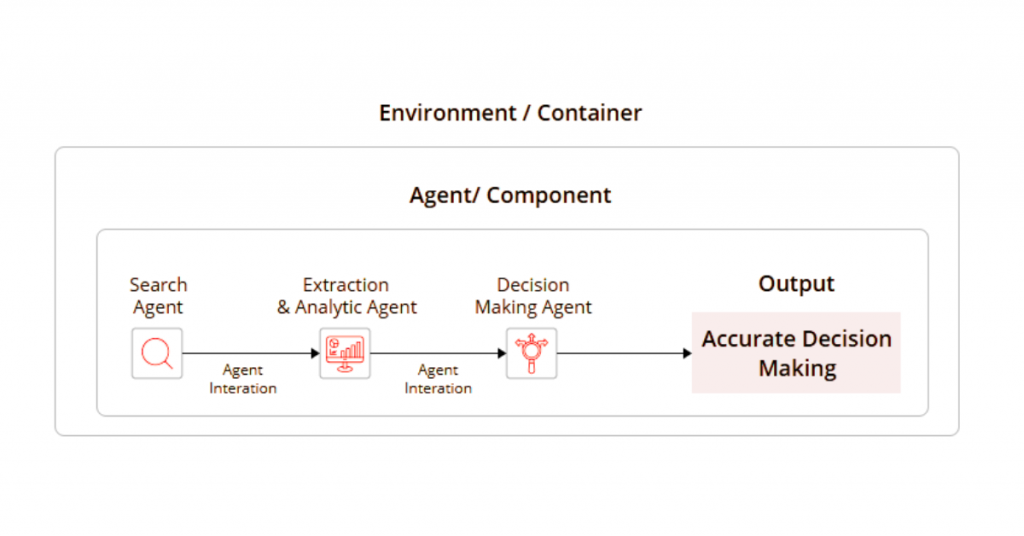
A multi-agent system or MAS uses many AI agents to do tasks for a user or system. Every MAS agent has unique qualities, but they work together to achieve global goals. Multi-agent systems help complete complicated tasks with hundreds or thousands of agents. Multi-agent system (MAS) is a rapidly growing market, projected to reach USD 184.8 billion by 2034 with a 45.5% CAGR.
This concept centers on AI agents. An AI agent is a system or program that designs its own workflow and uses tools to do tasks for a user or other system. Large language models underpin AI agents. LLMs’ superior natural language processing helps these intelligent agents understand and respond to user inputs. Agents solve problems step-by-step and use other tools when needed.
AI agents employ tools and can plan, unlike traditional LLMs. Agents can use external databases, online searches, and APIs. Like humans, AI agents can refresh their memory as they learn new facts. Information-sharing, tool use, and adaptive learning make AI agents more general-purpose than LLMs.
Wondering how to build a AI agent? Read our complete guide on building a AI agent.
Core Components of Multi-Agent Systems
1. Agents
Agents are a separate system entity. Each of the agents function on specific independent goals, knowledge and the decision-making process. These agents can be software programs, robots or anything else that operates and interacts with the system.
2. Interactions
Agents in a multi-agent system communicate and collaborate to achieve their objectives. Depending on the system’s nature, they can trade information, negotiate, collaborate, and even compete.
3. Coordination
In order for the agents to function successfully the actions performed must be in perfect coordination. They can work together via direct communication or explicitly or through shared communication or indirect communication.
4. Collaboration and competition
Agents can often collaborate with each other if they want to achieve a goal. However they can also compete against each other when their goals differ. Multi-agent systems are capable of simulating both kinds of actions.
5. Distributed issue solving
Multi-agent systems frequently address problems that are too complicated for a single agent or central controller. The system uses the dispersed nature of the agents to manage and address these challenges collectively.
A multi-agent system uses the aggregate behavior of numerous agents to achieve goals and solve problems that would be difficult for a single agent to address alone.
Key Characteristics of Multi-Agent Systems
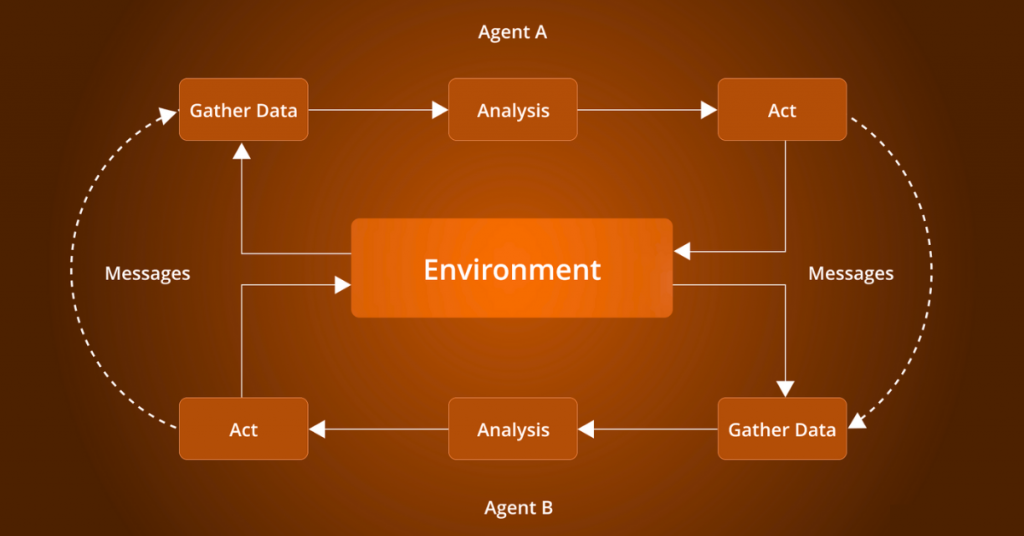
A multi-agent system (MAS) is a group of independent agents that work together to reach certain goals. There are a few things that are similar to all multi-agent systems:
1. Autonomy
One of the best things about multi-agent systems is that each agent is capable of working independently. They can make their own choices and take necessary actions without the need of a central controller.
2. Complexity
There is an involvement of various advanced processes making the interactions in the multi-agent systems pretty complicated. The processes include decision making, learning and reasoning. Mechanisms like these help the agents work properly and any change in the setting can cause more complications.
3. Adaptability
Agents are adaptable in the multi-agent system and they can adjust according to the environment changes. This means that the agents can change on the basis of any knowledge they gain and the changing conditions keeping the systems working even during the tough times.
4. Concurrency
A multi-agent system allows for parallel processing . Which means that several agents can work on various tasks at the same time. The system works better and responds faster since it can handle multiple jobs at once.
5. Communication
In a multi-agent system – agents talk to each other (inter-agent communication) and to themselves (intra-agent communication). This communication is necessary for agents to work together, coordinate, and share information in order to reach common goals.
6. Distribution
Multi-agent systems are generally spread out across many places or platforms – which means that agents function on different hosts over a network. This distribution lets the system use resources from many places – which makes it more powerful overall.
7. Mobility
Agents in multi-agent systems can switch and move between different – platforms and settings are required. The ability to switch is pretty important when it comes to doing things across different parts and places of the system.
7. Security and privacy
A multi-agent system must protect against possible security threats – such as illegal access or data breaches, this is because agents are in charge of their own data and actions.
8. Openness
Multi-agent systems are meant to be open, which means they can add or delete agents as needed. The system may change and grow since it is open, which makes it flexible and scalable.

Types of Multi-Agent Systems
1. Cooperative Agents
Cooperative Agents share knowledge and coordinate activities to achieve goals. Smart grids, where distributed energy resources balance loads, and autonomous transport systems, where V2V communication improves traffic safety, are using them more. Cooperative agents help hospitals schedule patients and allocate resources. They play a larger part in sustainable energy systems and multi-robot warehouse automation by 2025 – improving efficiency and lowering costs.
2. Adversarial Agents
Adversarial Agents compete in markets with competing goals. They are used in cybersecurity simulations, where attack and defensive agents test system resilience, and in financial markets, where algorithmic trading bots battle for arbitrage. Gaming and AI research relies on them to fuel reinforcement learning advances like adversarial training.
Adversarial MAS have grown in AI security testing and zero-trust environments in 2025, exposing weaknesses by replicating real-world threats.
3. Mixed-Agent Systems
Complex ecosystems benefit from Mixed-Agent Systems’ cooperation and competition. Suppliers in supply chain networks must collaborate for efficiency and compete for contracts. In smart city traffic systems, cooperation and rivalry for road space are balanced. E-commerce systems show buyer-seller-intermediary mixed-agent dynamics. These systems have become important in multi-stakeholder climate simulations and market-based energy trading platforms, where collaboration and competition coexist.
4. Hierarchical MAS
Hierarchical MAS have supervisory agents who oversee subordinates. In military simulations and industrial IoT systems, edge devices report to gateways before cloud-level agents receive data. With regional hubs coordinating delivery fleets, hierarchical logistics works. Hierarchical MAS enable – scalability, stability, and efficient decision-making across huge networks, making them essential for industrial automation and cloud-edge orchestration in 2025.
5. Heterogeneous MAS
Heterogeneous MAS involve agents with different designs, roles, and abilities pursuing common goals. UAVs, sensors, and emergency bots are used in disaster response systems and robotic ecosystems. Heterogeneous MAS integrate diagnostic AI, patient-monitoring IoT devices, and surgical robots in healthcare.
They are important to autonomous mobility ecosystems – linking automobiles, drones, and delivery bots—and federated AI networks. This is where agents with varied designs collaborate without central supervision by 2025.
Single-Agent vs. Multi-Agent Systems
Let’s make a quick comparison between single agent and multiple agent systems.
| Aspect | Single-Agent Systems (SAS) | Multi-Agent Systems (MAS) |
| Definition | Operates with a single intelligent agent handling all tasks independently. | Consists of multiple interacting agents, each with specific roles and objectives. |
| Complexity Handling | Limited in managing highly complex, distributed tasks. | Designed to handle complex, distributed, and dynamic environments. |
| Decision-Making | Centralized – decisions are made by one agent. | Decentralized – decisions are distributed among agents. |
| Scalability | Less scalable; performance drops as task complexity increases. | Highly scalable; additional agents can be introduced as needed. |
| Fault Tolerance | Vulnerable – failure of the agent causes system breakdown. | More resilient – if one agent fails, others can continue functioning. |
| Communication | Minimal or no inter-agent communication needed. | Requires inter-agent communication and coordination protocols. |
| Examples (2025) | Personal virtual assistants, single-robot navigation. | Smart grids, autonomous vehicle fleets, multi-robot warehouse systems, distributed cybersecurity. |
Building Blocks of Multi-Agent Systems
MAS works like a well-coordinated team; with each agent having a role and contributing to a common goal. Understanding the key components of these systems reveals their – complexity and efficacy.
> Large Language Models
LLMs are modern MAS’s intellectual core. Advanced AI systems can understand and generate human language – which is essential for parsing large datasets and interpreting complex requests. LLMs help agents understand and follow complex instructions, giving them the reasoning and decision-making skills to tackle complex jobs. They enable meaningful conversations and informed decision-making by translating human language into actionable insights.
> Agents
Autonomous agents make decisions, complete tasks, and collaborate to achieve goals. LLM-based reasoning gives each agent unique powers and obligations. Agent autonomy lets them adapt to changing conditions and interact dynamically. Their independence and collaboration – with other agents help the system tackle diverse jobs and problems.
> Tools
Tools are unique talents or functions agents use to perform tasks. These can range from API data retrieval to thorough analysis. Agents need tools to perform their duties. Selecting and integrating the right tools is essential for system optimization and success.
> Processes & Flows
A MAS’s processes or flows organize and execute tasks. They plan and coordinate operations to efficiently distribute work and meet goals. Inter-agent and intra-agent processes exist. These procedures manage dynamic interactions and ensure all system components work together, toward the goal.
How Do Multi-Agent Systems Work?
So, how exactly does a multi-agent system work? In this section we are going to
1. Agent functioning
A MAS relies on autonomous agents to sense, decide, and act. Agents are programmed with goals and tactics to achieve system goals. They can react to environmental changes or take deliberate action to attain goals. Each agent’s talents, aims, and system role determine its operation.
2. Inter-agent communication
Communication protocols like – message passing, negotiation – signaling help agents share information. This interaction lets them collaborate or compete. Communication streamlines task distribution, conflict resolution, and collective intelligence. Communication helps delivery drones adjust their routes without overlapping.
3. Interaction with the environment
In MAS, agents perceive, process, and act on changes. Physical environments include traffic systems and warehouses – whereas virtual environments include financial markets and simulations.
- Environment – Agents interact with their environment. It gives restrictions, opportunities, and data.
- Perception – Agents perceive via sensors, APIs, or data streams. Robots sense barriers with sensors; whereas trading bots sense market data.
- Brain or decision making – Each agent’s brain processes perceptions – applies rules, and picks the best action. For adaptable judgments – modern MAS use AI approaches like reinforcement learning.
- Actions: Agents move, update data, give alarms or trigger events based on decisions.
- Rules and algorithms – Game strategies and traffic protocols govern agents’ behavior – as do advanced techniques like – machine learning and optimization models. These regulate behavior to ensure reason and system goals.
Applications of Multi-Agent Systems
Multi-agent systems handle complicated challenges in several industries. This is done using their – decentralized and collaborative character. Examples of significant applications include.
1. Supply Chain Management
MAS facilitates autonomous agents – suppliers, manufacturers, distributors, and retailers, to work together wisely, revolutionizing operations. Agents can dynamically minimize stockouts and holding expenses by sharing real-time inventory data.
They estimate demand using – historical and current data to improve production planning and resource allocation. MAS reduces delivery times and costs by optimizing logistics routing and scheduling in real time. This improves supply chain transparency, agility, and collaboration, lowering costs and increasing efficiency.
2. Healthcare
Healthcare multi-agent systems enhance monitoring of patients, resource distribution, and customized treatment planning. The agents work together to track patient health in real time, assign medical staff and equipment. This helps to develop customized treatment plans from patient information. Patients and doctors can – communicate, decide, and utilize resources better using the system. MAS enhances – patient care and management of healthcare resources by combining data and synchronizing activities.
3. Finance & Banking
Multi-agent systems revolutionize finance by allowing autonomous agents to undertake complex tasks such as fraud detection, risk analysis, and financial surveillance. Each agent pursues its own objectives and exchanges and interprets data to identify fraud and financial risks. Real-time, MAS can identify inconsistencies and anomalies in data that might point to fraud. Market conditions and financial metrics are supported with the evaluation.
This collaboration promotes – transparency, decision-making, and institution adaptation to evolving threats. This is making financial systems stronger and more resilient.
4. Game Development & Simulations
Multi-agent systems are applied in many – games and simulations. It helps to create complex and interactive environments. Agents in games are characters or objects with specific action and objectives. Agents communicate and interact with one another and the environment – rendering gameplay dynamic and interactive. MAS mimics real-world situations where multiple things interact based on rules. It produces realistic and immersive – learning, entertainment, and research simulations.
5. E-commerce & Retail
Multi-agent systems enhance e-commerce consumer experiences. This is done by enabling – sophisticated customisation and dynamic management of interactions. Various agents evaluate browsing history, preferences, and buying behaviors in MAS. The bots exchange – concepts and study data to provide sound, personal product recommendations.
While agents scrutinize market trends and client behavior – MAS enables real-time offer and promotion adjustments. MAS streamlines these operations to create an extremely pertinent and customized buying experience on online platforms, boosting customer satisfaction and sales.
6. Manufacturing & Robotics
Multi-agent systems (MAS) allow for dynamic response to situations such as varying demand and equipment failures – enhancing factory planning and scheduling. A number of MAS agents track equipment, workstations, and inventory levels. The agents dynamically coordinate and reconfigure tasks to optimize the use of resources and reduce delays.
Agents will detect and resolve bottlenecks through – monitoring production metrics, assigning workloads, and realigning schedules. This cooperative approach balances production, increases efficiency, reduces downtime, and assists in meeting production goals.
7. IT & Cloud Systems
MAS streamline IT management functions like – network management, system monitoring, and incident handling. There are several agents in MAS that observe – system performance, recognize anomalies, and oversee network resources.
All the agents work together to – examine data, diagnose faults, and manage responses to maintain system stability and performance. MAS enhances IT operations, problem solving, and infrastructure robustness and security through sharing knowledge and responding to evolving situations. This proactive and cooperative approach monitors advanced IT environments and rectifies problems – before they can disrupt performance.
- Also Read: Use Cases of AI Agent in Customer Services
Benefits of Multi-Agent Systems
Multi-agent systems have several benefits in AI applications as they are decentralized and cooperative.
Following are the advantages of adopting a multi-agent system.
1. Scalability
Through the distribution of the workload among a number of agents, MAS is able to successfully manage difficulties that are of a vast size. Additionally, the system is able to be scaled up as we add more and more agents, and each agent is accountable for a certain portion of the work. In complex contexts, where a single agent might not be able to handle the entire problem space, this is especially helpful because it allows for more flexibility.
2. Robustness
The fundamental nature of MAS is robustness. In case there is a failure or problem in one agency, there are other agents that can operate on it and mark it as agent task failure. With this the system can function properly without causing a system failure.
3. Flexibility
The MAS was designed to be – versatile and flexible in order to accommodate dynamic and shifting circumstances. Agents are able to adapt their tactics, restructure their relationships, and adjust to new information or conditions in real time, which makes MAS suitable for situations that are unpredictable or that are constantly changing.
4. Efficiency
Another advantage the MAS offers is by allocating the tasks to multiple agents at once, their solution can be achieved faster. Wherein each of the agents is focused on a specific problem, the parallel one can be focused on other parts and quicker execution. This is handy when the application is time critical.
5. Parallelism
Parallel processing is inherently supported by MAS – in which several agents concurrently work on various aspects of a problem. Parallelism accelerates problem-solving and enables the system to handle more complicated tasks that would be too resource-hungry for one agent.
6. Modularity
MAS is modular in design, i.e., agents can be developed, tested, and implemented separately. The modularity makes the development easier since new agents can be incorporated into the system without affecting the already existing ones. It is also easier to upgrade or replace a single agent in case of requirements.
7. Specialization
In MAS – the agents can be created with specialized knowledge or expertise so that they are specialized in particular tasks where they are experts. Specialization results in more efficient problem-solving since each agent can use its strength in its specific domain. This makes the system successful as a whole.
8. Improved decision-making
MAS can enhance decision-making by getting insights from multiple agents. Also each of the agent comes with its perspective and expertise. Decisions that are better informed and more well-balanced are frequently the result of this collective intelligence. This because as different viewpoints and strategies are considered.
9. Increased cooperation
MAS allows agents to cooperate successfully; exchanging information, resources, and plans in order to reach a common objective. Cooperation is especially beneficial with complicated – multifaceted issues for which a single agent lacks all the information or abilities required to solve the problem independently.
10. Resilience to uncertainty
In highly uncertain or uncertain information environments – MAS may offer resilience by enabling agents to initiate independent decisions with local information. This type of decentralized system allows the system to adjust better to surprise changes or disturbances compared to a centralized system.
11. Real-time response
When it comes to applications that require real-time answers – MAS is an excellent choice. The fact that agents are able to function independently and simultaneously makes it possible for them to react rapidly to changes in their surroundings. This makes MAS a perfect solution for applications such as autonomous vehicles, financial trading, and emergency response systems.

Best Practices for Building Multi-Agent Systems
> Match the architecture to the problem
The correct architecture is important since MAS adds complexity in the form of coordination and communication. Specifically between agents that doesn’t exist in single-agent systems. A single-agent system can do in simple tasks, but a MAS can provide more flexibility and robustness for complex, dynamic environments.
> Begin small and scale up
Begin with a basic configuration with few agents. This allows for initial testing and validation of basic functionalities before scaling. Beginning small allows developers to identify and correct errors early. This is easier to manage as complexity rises with more agents.
> Allocate unique roles and responsibilities
Every agent plays a unique role in the system. They specialize in specific tasks. This division of work ensures that the agents perform tasks without the hassle of any extra responsibility that can cause conflicts and inefficiencies. This role definition helps the system to be more understanding.
> Provide flexible inter-agent communication
Communication is of utmost importance in MAS. The communication structure is simpler to maintain and debug with static structures. But it provides the ability to change in real time in response to changing situations with dynamic communication. This decision was made following consideration of the requirements of the system. Which include static for predictability and dynamic for flexibility in situations that are complicated.
> Balance autonomy and control
Obtaining the appropriate degree of autonomy for agents is pretty important. The responsiveness of the system can be stifled by an – excessive amount of control. While an excessive amount of liberty might lead to actions that are unpredictable. Adjustable autonomy – where the level of control can vary depending on the context, is a valuable approach to maintaining balance.
> Human-agent interface design
Because people frequently interact with MAS – intuitive interfaces and interaction schemes must be designed. Whether the system is represented as one unitary system or a group of discrete agents; the design must allow human users and agents to communicate easily and efficiently with each other so that the system functions optimally and user objectives are achieved.
> Ongoing monitoring and optimization
MAS is designed in a modular fashion – which means agents can be continuously analyzed and optimized individually. Through monitoring tools and evaluation agents – developers can continuously monitor system performance and make iterative refinements. The ongoing feedback loop is crucial to preserving and improving system efficiency.
> Proactively manage and prevent risks
MAS offers specific safety and security issues; especially because it is distributed in nature. Malfunctions or security vulnerabilities in one agent may propagate through the system with far-reaching consequences. To prevent such – risks, strict security controls like – encryption, anomaly detection, and secure execution environments should be ensured.
Endnote
Multi-agent systems make use of autonomous agents’ collective intelligence to solve complicated, ever-changing problems.They work in real-time environments where the agents have a defined role. This is where they have defined roles and the agents with skills interact, collaborate and make decisions.
MAS is really great at being adaptable. Agents collect input from their surroundings to alter their actions and plans – keeping the system flexible and adaptable. Traffic flow management and supply chain coordination demand real-time decision-making – therefore adaptability is crucial.
The decentralized structure of MAS improves scalability and robustness. MAS spreads workload among several agents. This helps in decreasing – system-wide failures and improving resource efficiency. MAS is predicted to drive automation and intelligent system innovation as technology improves. MAS is essential to future intelligent systems because they improve collaboration, optimize operations, and adapt to changing obstacles.
How A3Logics Can Help You Build Multi-Agent Systems?
A3Logics has the capability to create multi-agent systems. Our experts have more than 10 years of experience in building AI driven intelligent systems. Here is why you can hire us as your AI Agent development company.
- Leverage our expertise in AI & multi-agent System development
- Our experts create tailored solutions for businesses that are future-ready and scalable.
- End to end AI development services ranging from AI consulting services and to implementation support