LLMs are rapidly gaining popularity and almost everyone is familiar with the term. This is pretty visible from the fact that the global LLM market is forecasted to grow dramatically. From USD 6.4 billion in 2024 to USD 36.1 billion by 2030. This increase is projected at a compound annual growth rate (CAGR) of 33.2%. Most Large Language Models (LLMs), such as GPT-4, are trained on generic, frequently out-of-date datasets. While they thrive at answering generic questions, they struggle with questions regarding current events, fresh discoveries, and domain-specific topics.
In such instances, they may have hallucinations or deliver erroneous responses. Now you want a system that is updated with the latest information? You have two ways to do it. First, RAG or retrieval augmented generation second one fine tuning.
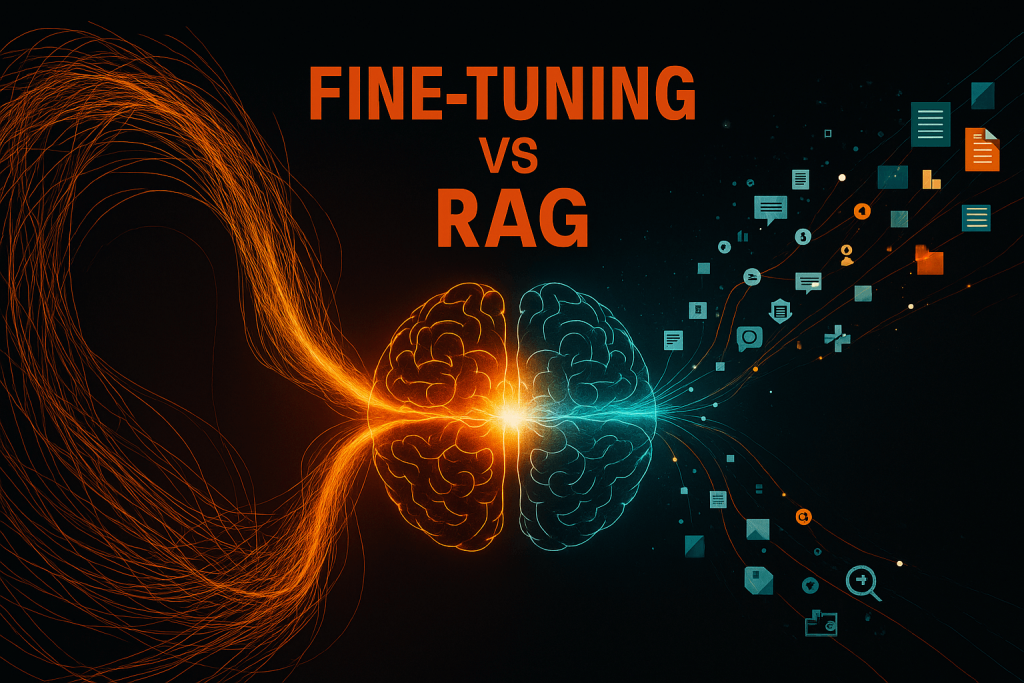
Take a deeper look at what are LLMs to understand why it is important to keep training them. Despite the introduction of higher-performing models such as Claude 3.5 Sonnet, we still need to apply model fine-tuning to generate tailored replies or Retrieval-Augmented Generation (RAG) systems to supply additional context to the basic model.
There is always the question of RAG vs Fine-Tuning, which one is better and which one to choose. In this article, we’ll look at RAG vs Fine-Tuning – two unique strategies for improving LLM answers. We will investigate their distinctions and apply theory to practice by analyzing the findings.
In addition, we’ll look at hybrid strategies that mix fine-tuned models with RAG systems to get the most of both. Understand how to choose amongst these two ways based on individual LLM use cases and requirements.
What is RAG (Retrieval-Augmented Generation)?
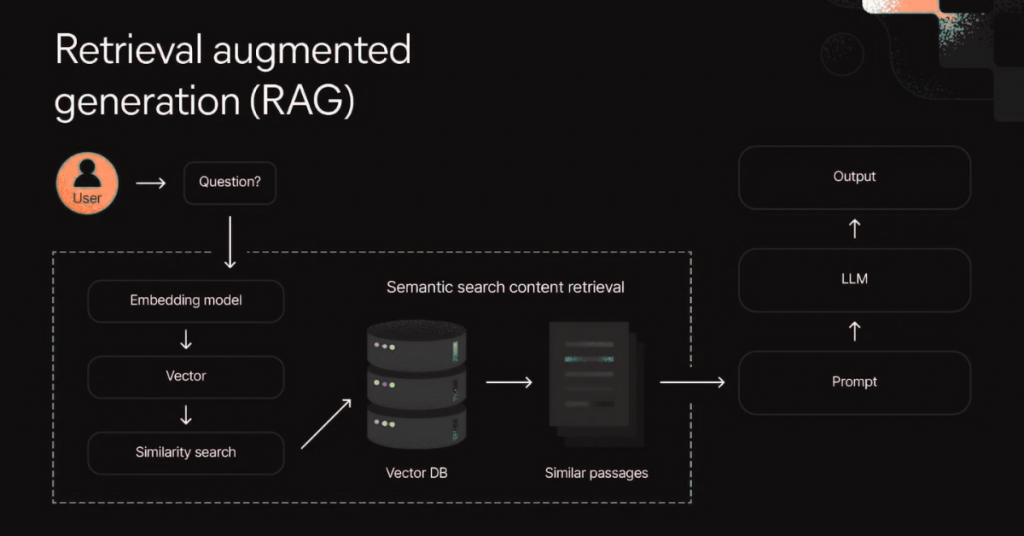
RAG is an advanced AI model architecture that combines two AI techniques – retrieval and generation. It responds to user inquiries with excellent accuracy and contextual relevance. The retrieval component initially searches a big knowledge store for relevant information. This data is then fed into a generative model like LLM – which produces a cohesive and exact response.
The RAG architecture is particularly useful in applications that require – precise and accurate data. This includes areas such as – customer service, research assistance, and technical documentation. RAG models are typically built to be customizable in order to cater to – certain knowledge bases or sectors.
How it works: When a question is asked the RAG will first look through the pre-existing knowledge based for the required and the relevant material. It will then send both the original question and the information gained to the LLM, telling it to respond based on the context. But before you do any of this take a quick look at our guide on how to build LLM.
What is Fine-Tuning?
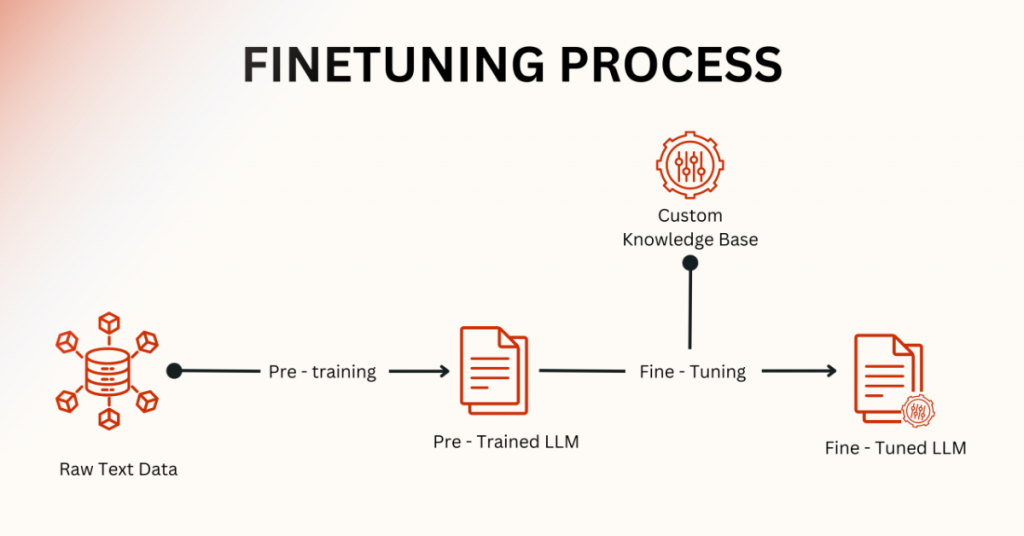
Now that we are familiar with what RAG is, let’s understand what is fine-tuning. Well, fine-tuning is the process by which we take a pretrained general purpose LLM and then train it on a small more handpicked data set that is custom to the given topic or activity. This process modifies the model’s internal parameters (“weights”), effectively teaching it a new skill, style, or specialized vocabulary. It adapts the model’s core behavior.
How it Works: The training process is continued using a dataset of high-quality examples (e.g., question-and-answer pairs for a certain industry). This specializes in the model and makes it an expert in that specific subject.
Benefits of RAG
Now that we have familiarized ourselves with what RAG is and how it works. Let’s take a look at what are the benefits of RAG.
1. Curated Database
RAG makes use of well-curated databases to procure information. For example, it makes use of external sources like vector databases for accuracy. This enables it to offer vast amounts of data to find latest and relevant information in response to the queries.
2. Secured Database Environment
Another benefit of RAG in LLMs is it ensures that sensitive data is protected and accessed only by authorized users. This helps in keeping the sensitive knowledge within the right systems.
3. Hypothetical Document Embeddings
RAG generates document embeddings based on semantic meaning, allowing the model to retrieve contextually rich information and identify relevant answers even in complex or confusing queries.
4. Up-to-Date Information
RAG helps models to retrieve and make use of the most recent data from various sources. This helps in getting knowledge that is up to date. This latest information helps in improving the relevance and accuracy of the generated responses making them more useful.
5. Semantic Relationships
RAG’s semantic relationships enable the model to comprehend and harness the links between concepts, allowing for more contextually relevant replies. Furthermore, improving the quality of generated content to gain deeper insights.
Benefits of Fine-Tuning
Fine tuning is gaining rapid popularity. Why? Here are some of the benefits that fine tuning LLM models offer.
1. Utilizes Pre-Trained Model
Fine tuning is built on a pre-trained model. This means the model already has a foundational understanding of the language. It is time saving and prevents resource wastage as it does not require training from scratch.
2. Adaptation to Task-Specific Dataset
With fine tuning the models can learn from a task-specific dataset. This makes it highly specialized and accurate for various particular applications including customer support, legal or medical tasks.
3. Prevents Overfitting
With fine tuning targeting adjustments rather than retraining on the extensive dataset overfitting can be prevented. With this it becomes easier to generalize new data within specialized domains.
4. Resource-Efficiency
Because fine tuning only refines the subset of a model’s parameter it becomes resource efficient. This is a pretty cost effective way to customize the model with the need of extra computational demands.
5. Enhanced Relevance and Performance
The responses delivered by fine tuned models are more accurate and relevant this is due to the fact the model is optimized for a particular dataset. Furthermore this improves the overall user experience and satisfaction in particular use cases.
Challenges of RAG
1. Contextual Integration
RAG systems need to integrate retrieved information smoothly into text that is being generated. Poor integration leads to responses that sound disjointed or incoherent, lowering confidence and clarity.
2. Complexity with Conversational Agents
In multiple-turn conversations, coherence is hard to maintain. The system needs to strike a balance between retrieved facts and conversational context, lest responses sound robotic or out of context.
3. Large Document Repositories
When databases are extremely large – retrieval can slow down response. Optimizing speed without sacrificing accuracy is a key challenge in production-grade RAG applications.
4. Processing Heterogeneous Document Classes
RAG needs to operate with varied sources—structured databases, PDFs, research papers, emails, or logs. Integrating these various types for efficient retrieval is technically challenging.
5. Memory-Backed Dialogue Constraints
Long dialogues tend to trouble conversational agents. RAG retrieval can complete some blanks, but models still have trade-offs in recalling short-term context and retrieving long-term knowledge properly.
6. Quality of Retrieved Information Guarantee
If retrieval sources are stale or extraneous, the response produced will be inaccurate. Ongoing curation of knowledge bases and rank algorithms is needed to ensure reliability.
Challenges of Fine-Tuning
Let’s take a look at some of the challenges we can face while fine tuning LLMs.
1. Computing Power
Fine-tuning LLMs requires powerful computational equipment. Without GPUs/TPUs, training is practically impossible, particularly for enterprise-level activities.
2. Time-Consuming Effort
One thing is that, data setup can frequently be more time consuming than tuning. The entire process of data cleansing, tagging and purifying calls for a lot more effort and this is important to get meaningful results.
3. Cost Efficiency
Multiple training epochs, hyperparameter searching, and storage of big checkpoints add up to very significant costs, making fine-tuning expensive for businesses.
4. Dataset Quality and Size
If the training data is noisy, biased, or insufficient, the model carries over these imperfections and produces inaccurate or unsafe outputs. Data quality would have a direct effect on tuning success.
5. AI Architecture Complexity
Not every model is fine-tuneable in the same manner. Some need parameter-efficient tuning (such as LoRA, adapters), whereas others might require full retraining, increasing complexity.
6. Streamlining Process for Conversational Agents
Even after being tuned, models need to be latency and responsiveness optimized in live chat or voice systems, which is not an easy engineering problem.

RAG vs Fine-Tuning: Technical Implementation
Now let’s take a look at RAG vs Fine-Tuning and compare their technical implementation.
RAG readies the data through creation of vector embeddings through external sources and connects through APIs to knowledge bases. It is pretty flexible and easy to update but it is dependent on retrieval pipelines and tends to have latency issues. Deployment is rather focused on caching and optimizing the retrieval speed.
Whereas fine tuning is dependent on curated, labeled datasets in order to retrain the models. They embed knowledge directly into the various parameters.
It helps in ensuring consistent, domain specific outputs and smoother API integration however it requires time, compute resources and a timely resource retraining to stay relevant.
| Aspect | RAG (Retrieval-Augmented Generation) | Fine-Tuning |
| Data Preparation | Create vector embeddings from external knowledge sources | Curate labeled, domain-specific datasets |
| API Configuration & Integration | Connect to knowledge bases and search engines | Integrate trained models via APIs |
| Model Deployment & Optimization | Optimize latency, caching, and retrieval pipelines | Monitor model drift and schedule retraining |
RAG vs Fine-Tuning – What To Choose?
When it comes to RAG vs Fine-Tuning both have respective strengths in different problem spaces. RAG in LLMs is tailored for environments where data is constantly changing and real-time updating is vital. For example, news reporting, financial reports, or customer support with constantly shifting product information. With the use of external knowledge bases and vector databases, it is easily scalable, and organizations are able to update knowledge without having to retrain the model.
This makes RAG in LLMs efficient in terms of resources and flexible – but at times may have a hard time sustaining fluency and coherence in lengthier conversations because answers rely on the relevance and quality of information retrieved.
Fine-Tuning LLMs, however, best suits stable and niche domains such as law, medicine, or compliance-based industries. There, knowledge does not evolve much, and accuracy, fluency, and domain specialization are more sought after than constant updates. Fine tuning also adds the knowledge straight into the model’s parameter.
This means a more natural sounding dialogue flow, tone consistency and trustable decision making. But trade-offs involve increased compute and data preparation costs, longer development timelines, and diminished agility when information changes. This is because the model might need to be retrained or updated every now and then.
In short? RAG offers flexibility, scalability and rapid adaptability. Fine tuning on the other hand gives precision, consistency and stability in the long haul. The decision between RAG vs Fine-Tuning is based on whether the need is to keep up with changing knowledge or to infuse in-depth expertise into the model.
Still confused between the two and looking to find the perfect fit for you? Here is a quick glance at RAG vs Fine-Tuning.
| Aspect | RAG (Retrieval-Augmented Generation) | Fine-Tuning |
| Need for Knowledge | Real-time, dynamic info (news, finance). | Domain-specific, stable fields (law, healthcare). |
| Resource Efficiency | Scales with external databases. | Reduces reliance on external sources. |
| Data Security | Sensitive data stays in databases. | Knowledge embedded directly into the model. |
| Conversational Consistency | Broad retrieval but less consistent flow. | Higher fluency and consistent dialogue. |
| Adaptability | Quickly adapts to evolving knowledge. | Long-term stability, durable expertise. |
Final Thoughts on Choosing the Right Approach on RAG vs Fine-Tuning
In conclusion both RAG vs fine-tuning hold a significant importance when it comes to its use cases across various industries and sectors. They are in a position to successfully address complex user queries and tailor responses to the context in which they are asked, as well as to the particular quirks of the domain in question. An RAG in LLMs is capable of providing users with replies that are both correct and comprehensive for the queries made.
This is achieved by the combination of the RAG’s ability to retrieve data in real time. This happens when there is an improved understanding of the language quirks of the situations of the large language model fine tuning offers.
Deployment of such an amalgamation can be highly effective as a means of delivering an improved user experience and robustly resolving industry-specific query complexity and specialized requirements. This solution enables overriding individual limitations of the corresponding models by domain-specific agents, providing expertise in cases requiring expansive retrieval of particular information or comprehension of expert terminology.
How A3Logics Can Help?
Our team consists of experts with more than 10 years of LLM development service experience. We have successfully created and deployed RAG pipelines and fine tuning solutions across industries. Our custom solutions enable business to create secure, scalable and high performance AI systems aligned with their requirements.
Enterprise-Grade RAG Systems – Our experts at A3Logics develop and implement sophisticated RAG architectures. Their integration consists of knowledge bases and vector databases which provide real time and contextually accurate answers for the dynamic industries.
Domain-Specific Fine-Tuning – Our fine-tuned LLMs are specialized for finance, healthcare, legal, and retail, providing fluent, accurate, and compliance-ready results. Get in touch with us for the perfect LLM agent development services today!
Secure AI Data Access – We ensure that all the databases are highly secure using encryption, access controls and compliance driven architectures. This helps to keep sensitive information safe and compliant while maximizing the usefulness of artificial intelligence.