Despite the growth of online shopping, brick-and-mortar stores are still going strong. The global brick-and-mortar retail segment generated $3.5 billion in revenue in 2024 and is expected to reach $7.3 billion by 2030.
Brick-and-mortar retail stores aren’t just about physical shelves. It’s wonderful how technology is redefining the working of these stores. Retailers are using software to create more engaging shopping experiences.
As retail software development evolves, various types of brick-and-mortar software now assist with everything – from managing inventory, backend operations, and employees to providing tailored recommendations.
What is a Brick-and-Mortar Store?
Traditional retail businesses that have physical storefronts (stores made of brick-and-mortar) and that allow customers to shop in person are called brick-and-mortar stores. In these stores, customers can interact directly with staff – inquire about products, make transactions, and do other things. Unlike online stores, customers can make purchases and take their purchases instantly.
Why are they important?
Brick-and-mortar stores remain essential as they help build real, personal customer connections. And, with the integration of brick-and-mortar retail software, they can further create experiences that online stores can’t match.
What are the features of brick-and-mortar retail software?
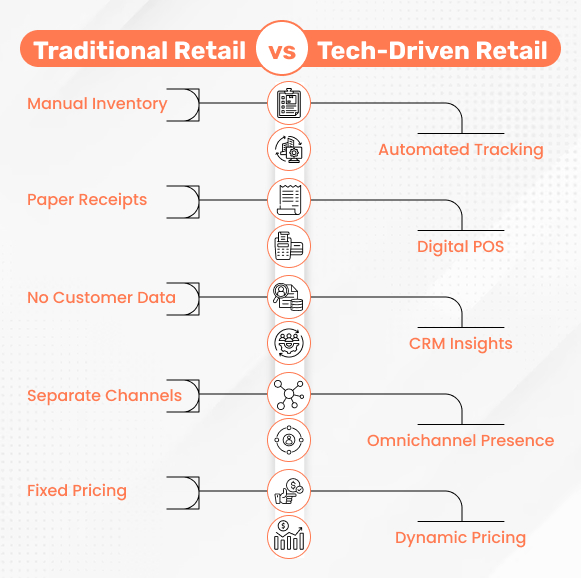
Brick-and-mortar retail software have features like – POS integration, inventory management, CRM, order processing, and many others. Below we have enlisted some of the important features of a retail brick-and-mortar operation software –
- Inventory management
This helps track stock information, manage product information, and automate ordering and restocking.
- Point of Sale (POS) integration
Point of Sale (POS) systems handle various aspects of in-store transactions, including payments, sales, and returns.
- Customer Relationship Management (CRM)
The integration of CRM systems helps streamline the process of taking and fulfilling orders, as well as building loyalty.
- Visual merchandising
To enhance the shopping experience, retailers can optimize store layouts and product displays.
- Employee management
This feature of a brick-and-mortar software helps manage key staff metrics, including payroll, employee schedules, and streamlining store operations.
- Reporting and analytics
Retailers can use the software to track inventory performance, analyze sales data, and gain important insights into customer behavior.
Top Brick and Mortar Retail Software for 2025
When considering retail technology for brick-and-mortar operations, it’s not just about one tool. It’s instead a mix of solutions or rather systems, that help manage inventory, sales, customer management, and staff. All helping to make daily operations smooth and drive growth for improved in-store experiences.
POS Systems
Brick-and-mortar software can significantly benefit from a POS (Point of Sale) system. They can manage sales transactions, inventory, and other key operations. Let’s discuss some of the popular POS systems that exhibit features like reporting capabilities, inventory management, payment processing, customer relationship management, and others.
-Square POS
It’s a user-friendly cloud-based system used by businesses of all sizes, primarily small and medium-sized businesses. It comes with features for employee management, inventory tracking, managing customer profiles, and even integrating online stores. It is popular among businesses for its low fees.
-Shopify POS
Shopify POS is a cloud-based point of sale (POS) system known for its seamless integration with online stores, making it an ideal choice for omnichannel retailers. It comes equipped with features such as mobile payments, easy customer profile management, and inventory synchronization between physical and online stores.
-Lightspeed Retail
It is an e-commerce and point-of-sale (POS) system designed to help brick-and-mortar retailers manage their online sales and retail stores from a single platform. It offers features like omnichannel capabilities, inventory management, and real-time reporting.
CRM system
When developing a brick-and-mortar software, integrating a CRM system is important. It stores customer details, manages loyalty programs, and tracks purchase history. It therefore allows businesses to send personalised offers, and follow up with customers. Here are some popular CRMs that can be integrated as a part of brick-and-mortar-software technologies –
– Hubspot
Hubspot is a leading CRM system that can be utilized when considering brick-and-mortar software development. It can help you visualize and manage every aspect of your sales pipeline while also facilitating customer interactions and tracking key sales and customer satisfaction metrics.
– Zoho CRM
Zoho CRM is yet another popular CRM platform that can prove to be a great asset as part of brick-and-mortar technologies. With it, you can monitor inventory levels and manage stock effectively, ensuring products are available when required.
Inventory management software
By integrating inventory management software into your brick-and-mortar software, you can avoid overstocking unsold items or running out of popular products. This ensures better cash flow, smooth operations, and more satisfied customers. Let’s have a look at some of the popular inventory management software –
– NetSuite ERP
The software provides a unified platform for enterprise resource planning (ERP). It manages core business processes, including inventory management, accounting, order management, and customer relationship management. The ERP module of the software is ideal for companies seeking to optimize their back-office operations.
– Zoho Inventory
It is a cloud-based platform designed for automated stock adjustments, for providing real-time inventory tracking, and multi-warehouse management. The software’s intuitive interface, automation, and reporting tools help businesses minimize manual tasks and streamline operations.
– Fishbowl Inventory
Fishbowl inventory is a robust inventory management software designed for retailers, wholesalers, and distributors. It offers features such as multi-location inventory racking, barcode scanning, and IoT tracking, and a single source to manage complex processes.
Brick and Mortar Analytics
Brick-and-mortar analytics tools track foot traffic, in-store behavior, and customer movement. These insights enable store owners to improve staffing, optimize store layouts, and make informed marketing decisions, ultimately increasing customer satisfaction and sales.
– WorkJam
The platform enables operations, HR, learning, and internal communications teams to connect directly with store employees. Through this platform, leaders can set milestones and identify dependencies, managers can schedule shifts, and employees can gain early access to wages earned.
– Shopify
Shopify offers a comprehensive suite of analytics features that are directly integrated with their e-commerce and POS platforms. These provide real-time insights across all sales channels.
– Microsoft Power BI
Power BI can help brick-and-mortar stores by providing data-driven insights to improve customer experiences, optimize operations, and make informed decisions. It can help with sales analysis, marketing strategies, and more. Check out the best Power BI dashboard examples here for inspiration.
Workforce management software
A workforce management software streamlines all aspects related to managing the workforce, including attendance tracking, employee scheduling, and payroll management. It ensures the right number of staff during peak hours, reduces operational costs, and improves employee productivity.
– Ripping
Rippling is an all-in-one platform for IT, HR, spend management, and payroll. It effortlessly manages the entire employee lifecycle, right from hiring to benefits administration. It provides real-time access to metrics such as dynamic spend policies, financial visibility, and software access, all from one dashboard.
– ADP Time & Attendance
ADP is a comprehensive global provider of cloud-based HCM, short for human capital management, solutions. These unite payroll, HR, tax, time, and benefits administration. Its deep insights, ADP’s own experience, and cutting-edge technology give it a strategic business advantage.
– Keka
Keka makes it easy for businesses to manage HR processes, including attendance, payroll, and employee management. It comes with a modern and intuitive interface that provides businesses with insight into HR data, allowing them to analyze business productivity and identify areas for improvement.
Automation solutions
For any business, including brick-and-mortar retailers, automation software handles repetitive tasks such as order processing, email campaigns, and appointment reminders. By reducing errors and saving time, it enables store owners to focus on growing their business and enhancing the customer experience.
– AR/VR solutions
AR/VR solution creates interactive in-store experiences. Customers can virtually try products before buying them. Not only do these technologies improve conversion rates, but they also make the shopping experience more engaging.
– Personalization software
A brick-and-mortar personalization software offers special discounts and provides recommendations based on customers’ past purchases. This helps in increasing repeat purchases and increasing customer loyalty.
Benefits of Implementing Retail Software in Brick-and-Mortar Stores
For today’s brick-and-mortar retailers, relying only on traditional operations is not sufficient. With customers expecting personalization, speed, and supreme service, modern brick-and-mortar personalization software bring a powerful combination of insight, efficiency, and growth. Here are some of the key benefits of implementing retail software in brick-and-mortar stores –
- Enhanced customer service
The various brick-and-mortar software, comprising systems like CRMs, ERPs, work management systems, and more, help build lasting relationships with customers.
- Increased operational efficiency
Retail brick-and-mortar personalization software streamline daily retail operations by scheduling workforce, automating billing, managing inventory, and streamlining supply chain.
- Data-driven decision making
Software loaded with brick-and-mortar technologies gives access to real-time analytics. Using these, retailers can monitor footfall, rack sales trends, and make strategic decisions backed by data.
- Staying ahead of the competition
Modern retail is dynamic; it conforms to the latest trends and uses the newest brick-and-mortar technologies, such as AR/VR, conversational AI, IoT-powered smart stores, and other innovations to gain an edge against online competitors.
- Cost control and revenue growth
Retail brick-and-mortar software is adept at reducing wastage, optimizing stock levels, and improving promotions through data insights. This way, they help control costs and boost sales, thereby increasing the profitability of the business.
Challenges and Considerations When Choosing Retail Software
When choosing the right retail software, there are various challenges involved. You need to understand specific business needs and evaluate solutions. Apart from that, there are some other challenges, some of which we’ll discuss below –
Cross-integration complexity
A retail brick-and-mortar operation software needs to be such that it can seamlessly integrate with other software, such as ERP, Retail CRM Software, and e-commerce platforms.
Scalability
Knowing that transactions are bound to increase or decrease, the brick-and-mortar software should be able to handle the scalability needs of the business.
Data migration
A brick-and-mortar software should be flexible and pave the way for seamlessly moving historical data to a new system, implying it should handle various fields and formats.
Choosing the right vendor
If you have entrusted the implementation and ongoing maintenance of the software to a third-party vendor, it is essential to choose one that is reliable.
Customization
One of the challenges of choosing a retail software is customization, where, for instance, you ascertain if the vendor can customize brick-and-mortar technologies as per your business needs.
Employee training
Getting accustomed to new brick-and-mortar software demands training. This ensures that the staff can effectively use the system and adapt to workflows.
Adherence to compliance
Retailers need to ensure that the brick-and-mortar software complies with industry standards and regulations for data privacy and governance.
Future Trends in Retail Technology for Brick and mortar operations
AI-driven Autonomous Stores
These are retail establishments where customers can shop without the need for traditional checkout processes or cashiers. As a part of brick-and-mortar personalization software, AI-driven autonomous stores leverage computer vision, AI, and various other brick-and-mortar technologies to manage inventory, track items, and process payments automatically.
Blockchain solutions for transparency
There are instances, such as industries like organic products and luxury goods, where buyers may want to verify the ethical sourcing and authenticity of products. Blockchain solutions do exactly that. It brings trust and transparency by securely recording supply chain activities, product origins, and transactions.
IoT-powered smart stores
The IoT connects devices such as sensors, shelves, and checkout counters to offer personalized offers, real-time inventory updates, and automated maintenance alerts. In the case of brick-and-mortar stores, this helps reduce errors as stock receives alerts in real-time. IoT also enhances the shopping experience with features like instant product availability notifications.
Conversational AI
In several ways, conversational AI is empowering brick-and-mortar retail software. It helps answer product queries, suggests items, guides shoppers, and even assists with checkouts. This not only reduces staff workload but also improves customer satisfaction, resulting in a more efficient and engaging in-store experience.
Real-time analytics and predictive AI
By leveraging real-time analytics and predictive AI, retailers can get an insight into customer behavior and predict trends. They can predict demand spikes, optimize product placements, and personalize promotions in real-time.
Face Recognition Technology
Brick-and-mortar retailers can utilize facial recognition technology to identify loyal or VIP customers and offer them personalized discounts, promotions, or recommendations based on their past purchasing history. It can also help alert staff if they suspect individuals with a history of shoplifting.
Hyper personalization
Hyper-personalization is a growing trend that helps cater to customer preferences by utilizing technologies such as AI and predictive analytics. It’s indeed special as it helps ascertain customer preferences much before they realize what they want. This way, customers feel valued, and it increases both loyalty and sales.
AR/VR shopping
These technologies enable virtual try-ons, in-store navigation, and interactive product demonstrations, ultimately leading to increased sales and more confident buying decisions. Customers can learn more about product features and functionalities, and try products before purchasing. Additionally, AR and VR can reduce the need for extensive physical inventory and storage space.
How A3Logics Can Help You in Designing Your Retail Software?
At A3Logics, we understand that every business has unique needs. Through our custom software development services, we deliver solutions tailored to your specific requirements. We help build tools such as advanced inventory systems, personalized CRM tools, and seamless POS software that meet your business expectations.
Ready to take your brick-and-mortar store to the next level? You can hire experienced software developers from A3Logics who specialize in creating robust and tailored retail solutions.
Conclusion
In the end, we’d like to conclude by saying that while online retail continues to grow, brick-and-mortar stores will thrive as well, provided they stay updated with emerging trends, leverage the right technologies, and overcome challenges.
In this post, we’ve aimed to give retail leaders, brick-and-mortar store owners, and others interested a clear view of how technology is shaping the future of retail. We have walked you through challenges, trends, opportunities and everything that can help you build future-ready retail spaces and make smarter decisions.