Insurance is a complex sector where underwriters and insurers have to frequently juggle multiple claims carefully. They have to assess claims, determine coverage, set premiums, and detect fraud while complying with necessary regulations. A slight error, and things can take a serious negative turn.
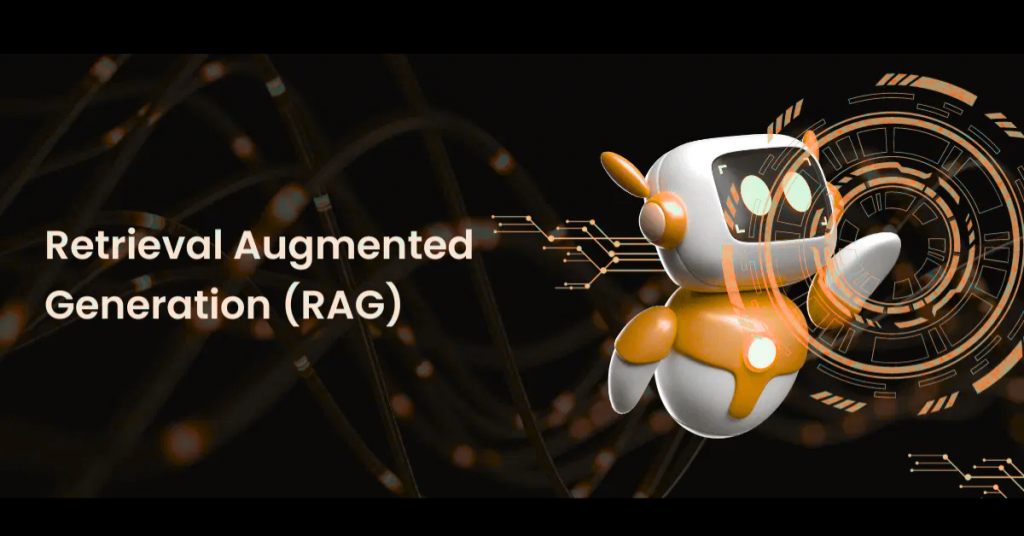
Something that can streamline the insurance industry is technology, and more specifically, Retrieval-Augmented Generation in Insurance. Before we discuss RAG-powered insurance services, let’s get to know a little about the technology from which it has branched out i.e., AI in insurance.
> Brief on the evolution of AI in insurance
No longer is AI all about automating repetitive tasks; it now enables insurers to operate with unmatched efficiency. It helps them predict risk and personalize experiences. At the helm of this innovation is Retrieval-Augmented Generation in Insurance. It combines real-time data retrieval with advanced generative AI.
- The growing importance of Retrieval-Augmented Generation (RAG)
Integrating RAG with LLMs improved answer accuracy to 91.4%. Retrieval-augmented generation is beneficial for the following reasons –
- RAG has access to information that may be fresher than the information used to train the LLM.
- RAG’s knowledge repository contains data that’s more contextual compared to a generalised LLM.
- Data in RAG’s knowledge repository can be continually updated without incurring significant costs.
- Since RAG’s vector database keeps track of its information sources, any inaccurate data can be easily located, corrected, or removed.
> Why insurers are exploring RAG for better decision-making
Insurers are exploring RAG for decision-making since RAG combines LLM generation with real-time retrieval of facts from trusted databases such as claim history, policy documents and external compliance sources. This ensures that answers are grounded in facts; this reduces hallucinations and improves compliance.
Understanding Retrieval-Augmented Generation (RAG)
> Definition and core concept
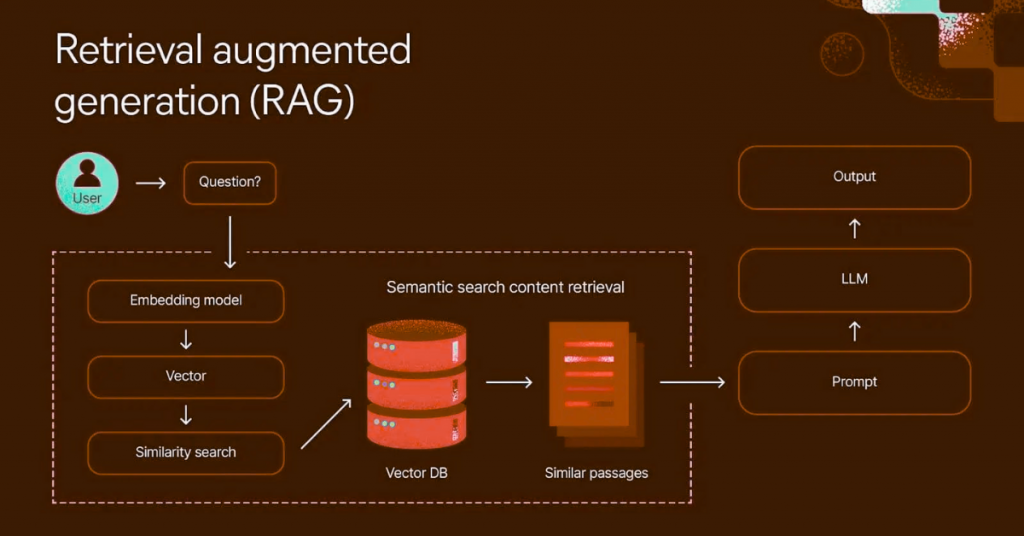
RAG is an AI framework that improves the responses of LLM-generated responses. It optimizes the output of LLM with targeted information. For this, it doesn’t modify the underlying model. It helps generative AI systems provide more contextually appropriate answers by basing their answers on extremely current data.
The RAG doesn’t rely on its training but also retrieves fresh, relevant information from an external knowledge base before answering. With the help of RAG, the data can be added to the system without retraining the AI.
> How RAG combines information retrieval + generative AI
When a user submits a prompt; RAG uses a retriever to fetch relevant data from a knowledge base. For instance, the retriever may search internal documents for relevant information that matches the user’s query. The information retrieved is used to enhance the user’s original prompt. After fetching the data; it feeds it to a generative AI model such as an LLM, short for large language model, to create a contextually rich, accurate, and up-to-date answer.
> Key components of RAG systems:
- Document Encoding
In RAG, document encoding refers to the process of transforming documents into a numerical format. It can either be in the form of vectors or embeddings. These can be efficiently searched and understood by large language models; Here, the numerical representation helps capture the semantic meaning of the text.
- Vector Databases
Vector databases in RAG use vector retrieval to locate relevant data for the Large Language Model. In this method, data is broken into small vector embeddings and a query is matched to the closest vector.
- Knowledge Graphs
Knowledge graphs in retrieval-augmented generation are structured networks of entities and relationships that help large language models retrieve context-rich, precise information. When it comes to RAG, it doesn’t rely on chunks of text, it can instead, query knowledge graphs to get information.
Advantages of RAG Over Traditional AI Models
> Improved accuracy with domain-specific knowledge
Using generative AI and pulling the right data from internal sources, Retrieval-Augmented Generation in insurance gives more trustworthy and precise insights than traditional AI. Old AI models depend only on limited datasets and general knowledge, while RAG uses real company data for smarter, context-aware answers.
> Context-aware and explainable responses
Retrieval-Augmented Generation in Insurance considers context in each insurance query and generates responses based on individual customer’s circumstances and needs; This leads to more personalized interactions that are meaningful.
> Faster and more efficient data retrieval
With the help of knowledge graphs and vector databases, Retrieval-Augmented Generation in Insurance retrieves relevant information from vast amounts of insurance data. This saves time and resources. It allows insurers to make informed decisions and respond quickly to customer queries.
> Scalability for large insurance datasets
RAG-powered insurance services can easily integrate with existing workflows and systems. These are designed to handle large-scale insurance datasets. RAG can scale seamlessly as the volume of data grows with no dips in performance.
Applications of RAG in Insurance
1. Enhancing Risk Assessment Accuracy
A RAG model for risk assessment can spot patterns, links, and risk factors that human underwriters might miss. It pulls relevant details from sources like claim histories, policy documents, and customer profiles, giving underwriters a clear and complete picture of the risks linked to each applicant.
2. Streamlining the Underwriting Process
The RAG model for risk assessment can help underwriters prioritize high-risk cases and allocate time and resources more effectively by providing data-driven insights. With RAG – underwriters can focus on the most critical points of each application by quickly identifying relevant data points.
3. Mitigating Bias in Underwriting Decisions
Retrieval-Augmented Generation in Insurance uses facts and clear data to reduce bias in underwriting, claims assessment, and policy recommendations. It applies AI models and analysis to make fair underwriting decisions. Instead of personal opinions, it depends on unbiased algorithms. It also creates a transparent record of data and insights that guide every decision made.

Real-World Use Cases Across Insurance Domains
1. Property & Casualty (P&C) Insurance
Retrieval-Augmented Generation in Insurance can accurately analyze the risks associated with insuring specific individuals. It analyzes historical claim data, in addition to risk factors, and property information. It further spots patterns that help insurers set the policy price more accurately and reduce fraudulent claims.
2. Life & Health Insurance
Using Retrieval-Augmented Generation in insurance, underwriters can analyze lifestyle factors, medical records, and data related to mortality; Using this data, they can predict future claims, identify potential risks, and help insurers offer coverage options that match individual risk profiles.
3. Commercial Insurance
In commercial insurance, RAG can help analyze industry trends, financial data, and historical claim patterns. Based on this data, it helps underwriters assess the risk associated with insuring specific individuals as well as businesses. Insurers can set the right pricing while defining coverage limits and building strategies to manage risk effectively.
RAG-Powered Chatbots & Customer Experience
> Handling complex insurance queries
RAG chatbots for insurance provide policyholders with accurate and detailed responses to their queries related to policy coverages and exclusions, in addition to claims process, premium calculations, etc. The chatbots offer quicker responses and enhance customer service by understanding the nuances and context of customer queries, even if they are in natural language.
> Personalizing policy recommendations
They retrieve customer-specific data such as age, historical health records, past claims, and financial goals. They match all of these with updated policy documents. The embedded AI capability generates personalized suggestions, making sure that the customer receives the most relevant coverage options.
> Integrating RAG chatbots with existing systems/workflows
RAG chatbots for insurance can be integrated seamlessly into an insurer’s existing systems. These chatbots can handle routine inquiries and provide instant support, letting human agents focus more on complex tasks; that require strategic thinking. They can escalate conversations to human agents; thereby providing them with relevant context.

Technical Aspects of RAG Implementation in Insurance
> Encoding and vectorizing insurance documents
RAG model for risk assessment tranforms unstructured insurance data – claims, policies, and customer notes into a format that the AI can comprehend. This process involves encoding and vectorizing the textual data. Encoding changes the text into numbers that capture relationships and meaning. Vectorization turns this into high-dimensional vectors, making it easy to compare and retrieve information.
> Leveraging vector databases and knowledge graphs
Using knowledge graphs and vector databases; RAG can conduct complex queries and retrieve relevant information from vast insurance data. The capability helps insurers provide contextually relevant and accurate responses to customer inquiries; Insurers are also able to generate personalized recommendations and support underwriting decisions.
> Deployment considerations: Cloud vs. On-premises
While implementing RAG in insurance, there are two deployment options that can be considered – Cloud and On-premise. The cloud-based RAG in insurance can scale up and down based on demand and ensures that the RAG can handle varying workloads. These solutions are easy to integrate as they provide APIs and connectors. However, cloud-based deployment raises concerns about data security and privacy.
On the other hand, on-premise deployment gives insurers complete control over their infrastructure and data. It is more secure when it comes to data security, and it also allows for smooth integration with on-premise systems.
> Security and compliance safeguards
RAG in Insurance consists of large volumes of confidential customer data. It is essential to ensure that all data, is encrypted using industry-standard protocols. Regularly auditing encryption practices can ensure compliance with security standards. Secondly, implementing RAG in insurance must be done in compliance with regulations to avoid legal risks.
Challenges and Considerations
> Ensuring data quality and completeness
To ensure the accuracy of RAG models, insurers must invest in data cleansing techniques, as insurance data originates from various sources. Without proper cleansing and standardization, the data may be incomplete, and outdated. In addition to data cleansing and standardization; insurers must establish robust data governance frameworks to maintain the security and integrity of customer information.
> Balancing transparency and explainability
In the financial industry, decisions can have significant financial and legal implications; as such, insurers must be able to interpret and understand the reasoning behind the decisions of RAG models. Furthermore, they should employ explainable AI techniques that provide clear insights into all those factors that are influencing the output of RAG models.
> Navigating regulatory compliance (GDPR, HIPAA, etc.)
There are stringent regulatory measures in insurance. When implementing RAG in insurance, it is critical to comply with regulatory standards such as HIPAA, GDPR, etc, to avoid any legal or reputational risks. To ensure this, the insurers must work in unison with compliance and legal teams. Furthermore, it is essential to implement governance frameworks, regular audits, and maintain a detailed documentation of algorithms and other essential data used to train RAG models.
> Maintaining the human-in-the-loop for critical decisions
When implementing agentic RAG-powered insurance services, it is recommended to maintain a human-in-the-loop approach. This implies allowing AI agents to request human approval during execution. Human and AI agents can make reliable and trustworthy systems that are error-free and that can make better decisions.
Real-World Case Studies
To demonstrate the benefits of RAG in the insurance industry, let’s have a look at a few real-world case studies –
Case Study 1: Improving claims processing efficiency
A health insurer struggled with claim settlements; faced delays due to scattered medical records, policy documents, and compliance rules. What further made the situation worse was that customers often complained of long processing times, inconsistent decisions, and frequent claims rejections for which no apparent reason was provided.
The company deployed Retrieval-Augmented Generation in Insurance. All claim policies, policy-related documents, medical guidelines, and past claims were encoded into a vector for quick retrieval. All medical codes, relationships between policy rules, and customer data were mapped.
Using the RAG chatbots for insurance, agents could query the system using natural language and retrieve the most relevant documents swiftly before generating AI-driven recommendations. By integrating RAG in their insurance workflow, the company saw a 40% drop in claim processing time, a 30% drop in errors, and, most importantly, customer satisfaction increased by nearly 35%.
Case Study 2: Enhancing risk assessment in life insurance
An insurance company was struggling with risk assessment since it relied on manual reviews and old reports; This often lead to errors, delays, and unfair pricing of policies. To resolve this issue; the company deployed RAG along with Generative AI in insurance.
The system took into consideration each applicant’s insurance history and past claims. It further checked current market trends and considered the latest regulations. The data was used to provide underwriters with actionable advice, including suggested premiums, coverage, and potential risk warnings for each policy.
This helped in faster and more accurate risk checks; the underwriting time dropped by 45%, errors were reduced by 30% and the company saw a 20% reduction in losses. Plus, it also saw a 25% increase in customer trust.
How A3Logics Can Help?
> Expertise in AI + RAG implementation
As an expert AI development company, our AI development services are inclusive of AI+RAG implementation, where we choose the best agents for your requirements. We pick up the right LLM and design scalable and high-performance solutions that boost accuracy, integrate seamlessly, and reduce hallucinations.
> Building custom insurance software development
We also have vast experience in custom insurance software development, where we create custom insurance data platforms that transform claims histories, raw documents, and regulatory information into actionable insights. We integrate these platforms seamlessly into your workflows, thereby empowering your teams to make smarter and faster decisions, further helping you automate processes.
> Developing RAG-powered chatbots & decision-support tools
We are skilled at developing RAG-powered chatbots and decision support tools that can help both insurers and customers comprehend complex insurance data. The tools provide meaningful insights and guide claims underwriters to make faster decisions.
Conclusion
In the insurance sector, errors in policy interpretation, claims evaluation, or regulatory compliance can lead to both reputational and financial consequences. Advanced technologies like RAG in insurance empower underwriters by delivering accurate and context-rich insights, letting them navigate complex regulations and make informed data-driven decisions. Predictive analytics in RAG can further identify high-risk claims and mitigate the chances of any potential fraud by analyzing patterns across current and historical data.