The past decade has witnessed considerable development in natural language processing (NLP). From machine translation, serving as a virtual language bridge, to chatbots answering in a manner close to the human reply.
The recent breakthrough in the creation of large (advanced) language models has reduced the technological and knowledge barriers to utilize NLP models in a broad range of use cases. In the U.S., almost 44% of insurers already have at least one generative AI solution in production (a jump of 57% over 2024). Another 38% expect to deploy GenAI within the next year.

Shift Technology assessed six LLMs specifically against insurance-domain tasks and highlighted that cost / performance tradeoffs and fine-tuning remain key determinants of which models insurers select. Insurers are quite familiar with processing structured information through statistical analysis or machine learning. Yet much of the data in an insurance company is not structured, and much of its core business involves textual information, such as client communication, claims processing or underwriting.
Large language models in insurance have provided us with the capabilities to process these data without creating sophisticated proprietary models and to automate even more procedures than ever before. In this we have taken an in-depth look at the role of Large Language Models in Insurance, what are the benefits and challenges of LLM in insurance, how insurance software development services can help you and how LLM claims processing works.
Key Opportunities of Large Language Models in Insurance
Did you know that in a recent study it was found that only about 7% of insurers globally have successfully scaled AI/LLM systems across their organizations. The majority remain in pilot or experimentation stages. This means that a lot of LLM potential in the insurance sector remains untapped.
Let’s understand what are the key opportunities of large language models in insurance.
> Operational Effectiveness and Automation
Policy management, claims handling, and compliance reporting are document-intensive back-office tasks that LLMs can automate. They can reliably extract, classify, and understand unstructured data from customer letters, contracts, and regulatory reports. This lowers routine processing – manual intervention, turnaround time, and operational faults. Instead of manually examining hundreds of claims papers – insurers can use LLM-driven workflows, to quickly evaluate legitimacy, identify abnormalities, and speed approvals.
> Personalized Customer Experience
Insurance customers today want rapid, personalized, and simple service. LLM in insurance provide natural language consumer engagement with chatbots, virtual assistants, and tailored advice tools. LLMs can recommend personalized policies, coverage changes, and risk-reduction measures based on policyholder history, preferences, and behavior. Personalization boosts satisfaction, confidence, and loyalty. AI-based policy assistants can clarify complex policy terminology and guide consumers through claims submission in real time.
> Cost Optimization
In light of increasing operational costs and competitive pressures on pricing – cost-effectiveness is essential for insurance companies. LLM-based automation minimizes administrative expense by eliminating the need for, manual labor and accelerating processes. They also streamline resource use by pinpointing areas of inefficiency in, claims, underwriting, and servicing.
Furthermore, better fraud detection and fewer claim mistakes lower financial leakage. The cost reductions can be reinvested in digital transformation and innovation projects over the long term – further enhancing insurers’ competitive advantage.
> Risk Management and Fraud Prevention
Symbiotic claims remain an ongoing problem for the insurance sector, racking up billions each year. LLMs, with predictive analytics, can identify suspicious patterns and irregularities in claims descriptions, customer interactions, and histories. Through the interpretation of subtle language patterns – they can distinguish between authentic claims and attempted fraud more accurately than conventional rule-based systems.
Furthermore, LLMs enable insurers to evaluate changing risks by regularly monitoring external information sources – like regulatory changes, climate reports, and market trends—to predict threats and modify policies in advance.
LLMs in Insurance: Market Insights and Value Considerations
The insurance market for generative AI was worth $761.36 million in 2022 and is expected to grow to $14.4 billion by 2032 at a CAGR of 34.4%. A subclass of the category of generative AI algorithms – large language models are quickly becoming popular among insurers across the globe because they can process time- and labor-intensive data processing tasks.
For insurance professionals, who devote as much as one-third of their time to gathering information together, the power of Large Language Models in Insurance to immediately pull together multi-source data and turn it into a form perceivable by human minds provides a solution to one of the largest operational challenges in insurance. MunichRe, the largest reinsurer in the world who is already committing to LLM pilots on life and disability lines, opines that with proper training, testing, and control, LLMs can deliver unparalleled value for underwriting and claims.
Deloitte emphasizes that insurance-specific emphasis on “vertical” applications (i.e., distinct functional domains calling for deep domain knowledge) can slow LLM uptake in the discipline. Optimizing general-purpose language models to apply them effectively across specialty insurance functions would involve calibrating them to the relevant discipline or training them on a particular discipline or developing special-purpose LLM algorithms.
How LLMs Work in Insurance?
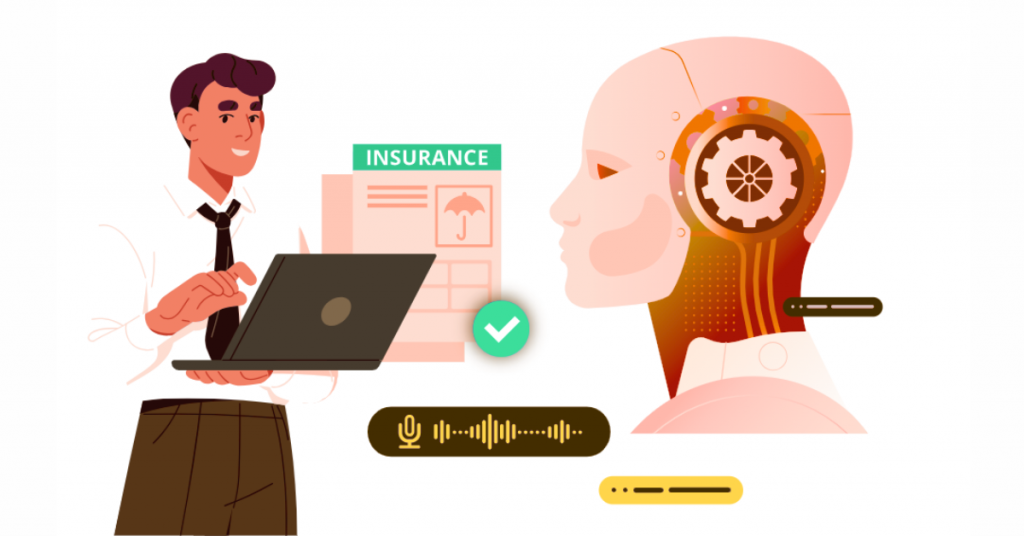
1. Customer onboarding
Large Language Models in Insurance can automatically extract customer information from text and voice-based applications and extract KYC-salient information from documents of insureds for quicker pre-qualification.
2. Underwriting
LLM in insurance can automatically consolidate risk information from customer documents and third-party data and present summaries of information on seeming and potential perils that could influence written premiums.
3. Claims processing
Large Language Models in Insurance can auto-capture claim insights from FNOLs, policies, and multi-format loss evidence documents and create claim summaries to guide settlement decisions.
4. Fraud detection
Large Language Models in Insurance can automatically detect insurance document inconsistencies that can signal customer or employee fraud and alert them for closer examination by human specialists.
5. Compliance
LLMs can automatically verify document compliance with an insurer’s internal policies and regulatory guidelines. They can also filter through regulatory updates (e.g., NAIC, NICB, IFRS, IA standards) and report new clauses.
6. Customer service and support
LLM-powered assistants are able to comprehend nuances of customer questions, provide appropriate real-time feedback, and summarize customer calls and conversations for human representatives.

Key Capabilities of LLMs for Insurance
Large Language Models in insurance handle – complicated, data-intensive, customer-facing tasks with great accuracy and efficiency – giving insurers new capabilities. AI development services speed up policy administration and fraud detection, reducing manual work and improving decision-making.
The most impactful LLM capabilities for insurance are:
> Prompt-based interaction
Insurers can use LLMs to create conversational interfaces where agents, brokers, and consumers can ask natural language inquiries and get context-aware answers. By searching“Show me all pending claims above $1 million”, agents can quickly access organized insights without navigating different systems or dashboards.
> Call transcription & voice synthesis
Insurance call centers serve many customers. Real-time LLMs can transcribe, summarize, and synthesize voice to automate customer interactions. Maintaining accurate, conversation logs and reducing misinterpretation increases service quality and regulatory compliance.
> Contextual data capture from insurer’s databases
Integration with policy admin, claims, and CRM systems lets LLMs pull contextual data during contacts. If a customer asks about their policy’s maturity benefits – the LLM can rapidly collect information from the insurer’s database, and provide a personalized response.
> Data extraction & analysis from documents
Insurance plans, claims papers, medical records, and regulatory filings are extensive. Insurance fraud detection automation development can evaluate unstructured documents, extract policy terms, claim amounts, and exclusions, and format them. Underwriting, claims, and compliance checks speed up.
> Insurance data summarization & export
Large Language Models in Insurance can simplify policy paperwork, claims history, and risk assessments into simple reports. These summaries can be exported for regulators, brokers, or internal teams. This helps communicate more accurately while saving time analyzing lengthy paperwork.
> Third-party data validation
Credit scores, KYC records, and medical databases, are often used by insurers. LLMs can verify this information against – supplied documents, identify discrepancies, and assure compliance. They can compare a proposal form customer’s income to credit bureau data.
> Insurance document review & comparison
Comparisons of insurance contracts, renewals, and endorsements can be laborious. LLMs can automatically compare two or more documents, flag hazards, and highlight coverage terms, rates, or exclusions. Underwriters and lawyers can make faster, more informed choices.
> Knowledge consolidation for decision-making
LLMs can combine regulatory circulars, claims data, customer information, and market insights into a decision-support layer. Underwriters, claims managers, and executives can make – data-driven decisions with less monitoring.

LLM in Insurance – Use Cases
Let’s take a look at some of the ways the LLM in insurance in making a difference.
Use Case 1 – LLM-Powered Chatbots for Customer Support
LLM-enabled chatbots can process customer questions in natural language, making support more intuitive and convenient. They can respond to policy questions, assist customers in filing claims, and give real-time feedback on application status. While regular chatbots struggle with complex questions, LLM-powered bots get complex queries, learn from past interactions, and return customized answers, enhancing customer satisfaction and saving call center expenses.
Use Case 2 – LLM-Powered Bot Assistant for Sales Agents
Sales agents may have to deal with huge volumes of – product information, customer information, and regulatory requirements. An LLM-based assistant can act as a knowledge buddy, accessing product information in real time, creating customized policy suggestions, and even writing sales pitches customized to customer profiles. This helps agents close deals quicker, cuts down on paperwork, and provides customers with correct advice at the right moment.
Use Case 3 – Claims Processing Automation with LLMs
Claims handling tends to be document-intensive, time-consuming, and error-prone. LLMs have the ability to automate claim-taking by pulling information. Specifically from stored forms, doctor’s reports, or descriptions of accidents. They can highlight – missing data, summarize documentation, and even identify inconsistencies – that can signal potential fraud. This saves processing time, enhances accuracy, and improves customer transparency, leaving human adjusters, free to work on intricate claims.
- Also Read: AI Claims Management Software Development in Insurance: Use Cases, Benefits, and Challenges
Use Case 4 – Underwriting Automation and Risk Assessment with LLMs
Underwriting entails risk evaluation based on examining enormous amounts of structured and unstructured data—from financial documents to health reports. LLMs can process these datasets at scale, integrate insights, and aid underwriters in, making quicker, data-based decisions. They can also offer risk scoring, identify anomalies, and maintain regulatory compliance by – cross-referencing rules with up-to-date guidelines. This not only speeds up underwriting but also improves the accuracy of risks, lowering the chances of losses.

How Insurance Market Leaders Benefit From LLM Solutions
> Allianz – Insurance Copilot & Enterprise Knowledge Assistant (EKA)
Allianz has rolled out a generative AI-based application named Insurance Copilot (released for automobile claims in Austria) that leverages LLMs to automate claims processes. It performs – document analysis, summarizing policy information of key importance and assisting adjusters in identifying relevant clauses or agreements quickly. This helps in speeding up and improving accuracy of settlement claims.
Also, with its “Enterprise Knowledge Assistant” (EKA), Allianz leverages AI to assist customer care agents in extracting pertinent information and documents, responding to customer inquiries quicker, and enhancing first-contact resolution. This minimizes delays, enhances customer satisfaction, and maximizes agent productivity.
> Indico Data – Underwriting Automation for Large Insurance Carriers
Indico has an underwriting solution that greatly accelerates the underwriting process. For instance, one of the Top-10 global insurance companies utilizing Indico reduced submission processing time by 80%. Another result cited: a Fortune 500 specialty insurer increased quarterly Gross Written Premium (GWP) with quicker underwriting facilitated by automated data extraction from Loss Runs & Statements of Values (SOVs) within less than 30 seconds for some types of documents.
> Allianz UK – “Incognito” Fraud Detection Tool
Allianz UK developed a machine-learning-based tool, Incognito, to detect potentially fraudulent claims. Although never openly referred to as an “LLM”, the tool employs sophisticated AI / ML / NLP methods to identify claim submission irregularities (motor, casualty, property, etc.). It has saved the company millions in fraudulent claims payouts.
> Aviva – Improved Liability Assessment & Routing Accuracy
Aviva used AI (including NLP and associated technologies) in claims handling to enhance performance in challenging cases. Notable outcomes include determining liability in challenging cases approximately 23 days more quickly than previously, in addition to enhancing routing accuracy by around 30%—which gets cases into the correct teams more quickly.
> Fortune 500 Property & Casualty Insurer – LLM Search & Underwriting Efficiency (through Skan)
A major U.S. Fortune 500 insurance company employed Skan to pilot several LLMs on internal search applications. Rather than keyword / database searching, underwriters were able to search internal and external information with natural-language queries powered by LLMs. They cut the time spent by underwriters in searching by ~55% compared to earlier search utilities. For more complicated cases, the time savings was even greater.
Challenges of LLMs in Insurance and How to Tackle Them
1. Risks of inherited inaccuracy
Prejudiced inferences, misinformation, and toxicity created by pretrained LLMs can spread to insurance LLM solutions and result in incorrect responses, unforeseen discrimination, and potential violations of ethical servicing guidelines.
How to Tackle:
- Enforce human-in-the-loop review for sensitive processes.
- Employ fine-tuned models trained on insurance-specific datasets.
- Create confidence scoring mechanisms to mark uncertain responses.
- Regularly retrain the model with validated – updated insurance information.
2. Lack of control over data security
Leveraging sensitive insurance information with LLM providers, increases the risk of data security. Subjecting it to potential hazards of unauthorized use, public disclosure of data, and contravening sectoral data protection laws. Such as HIPAA, CCPA, NYDFS, GDPR, the IA’s guidelines.
How to Approach:
- Use LLMs within secure, private cloud or on-premise environments.
- Enforce end-to-end encryption for data transmission and storage.
- Implement role-based access controls (RBAC) to limit sensitive data usage.
- Compliance with ISO 27001, HIPAA, and GDPR standards for data processing.
3. Regulatory and Compliance Risks
The insurance sector is highly regulated. Utilizing LLMs in the absence of compliance guardrails can result in HIPAA, GDPR, or state insurance law violations, subjecting insurers to fines.
How to Tackle:
- Periodically perform – compliance reviews of LLM output.
- Incorporate regulatory rules directly, into model prompts and workflows.
- Collaborate with legal and compliance departments at LLM deployment.
- Employ explainable AI methods to provide transparency to decision-making.
4. Complexity of Integration
It can be complex, expensive, and time-consuming to integrate LLMs with – current policy administration systems, claim platforms, CRM, and external data sources.
How to address:
- Apply API-based integration frameworks to have seamless connectivity.
- Begin with pilot implementations through modular architecture before scaling-up enterprise-wide.
- Collaborate with seasoned AI/insurance solution vendors for easier adoption.
- Enforce strong change management and staff training programs.
Insurance LLM Consulting and Implementation by A3Logics
Here is how A3Logics can simplify the LLM implementation journey, for those who make life journey a little simpler.
Insurance LLM Consulting (strategy & roadmap) – We review the suitability of LLMs for your business requirements. Recommend the cost-efficient path to LLM implementation – and offer security and compliance guidance.
Insurance LLM Implementation (custom solutions & integration) – Our organization works on the project end-to-end, i.e., from the integration of pretrained models to LLM application design and development. We implement secure LLM orchestration procedures, increase the model’s insurance awareness through RAG and PEFT – and retrain an LLM in complicated situations. You receive an MVP of your insurance LLM solution in 1–4 months.
LLM Development Services (fine-tuned models for insurers): When you choose A3Logics you get the best feature set, architecture, and tech stack for your LLM solution along with the comprehensive project plan with an estimate of cost and time.
Conclusion
Insurers that don’t adopt LLM-driven solutions risk being left on the sidelines of an industry that’s rapidly data- and AI-driven. The possibilities are immense with these models, but it’s all about incorporating them into your current processes thoughtfully — in compliance, security, and a smooth customer experience.
So, what’s next for you? If you haven’t done so already, it’s time to begin learning how LLMs and generative AI can integrate into your organization. Whether your goal is reducing operational expenses, enhancing customer satisfaction, or better defending against risk, these technologies offer a way forward. The insurance business is changing, and those who innovate now will establish an advantage that’s difficult to overcome.
It is time to act. Discover, test, and apply these tools to future-proof your insurance company and lead the way in an innovative market that requires it.