
Traditional reporting procedures, starting from spreadsheets and manual data gathering, are error-prone and cause compliance problems with challenges like expense management, purchase orders, and so on. Based on a recent Business school study at the University of Baltimore, financial reporting errors mushroomed to an amount of a whopping $7.8 billion in the United States alone.
AI extends automation to offer higher analytical capabilities. AI in finance automates reporting and offers richer financial data analysis for improved decision-making using machine learning and advanced algorithms.
Also, strategic AI-based financial reporting software could enhance competitiveness. AI-based businesses can respond more quickly to changes in the market, discover concealed financial patterns, and better manage resource allocation. This forward-thinking action enhances operating efficiency and innovation, enabling organizations to grasp new opportunities in a dynamic market.
In this blog, we have discussed in detail the role of AI in financial reporting, how it functions, the different advantages of AI for financial reporting and how an AI development services provider like A3Logics can assist you in implementing the right AI-based financial solution.
What is Financial Reporting?
Financial reporting is the process of making statements that reveal an organization’s financial condition to the government, investors, and management. Financial reports are important in offering stakeholders the knowledge they require to make informed decisions. The fundamental objective of financial reporting is to ensure transparency and accountability, with all financial transactions being recorded correctly.
It entails preparing standardized reports such as the – balance sheet, income statement, and cash flow statement that present a clear image of the financial health of the company over a period of time. It is necessary to prepare such statements to make sound business decisions and to meet legal, tax, and regulatory compliance requirements.

Key Components of Financial Reporting
> Balance Sheet
A balance sheet offers a complete overview of what are the company’s assets, liabilities, and the shareholder equity at the present time.
> Income Statement
An account of a company’s revenues, expenses, and profits during a period stated.
> Cash Flow Statement
The cash flow statement is a record of the cash that is generated and used by the company for operations, investments, and other financial activities during a particular period.
> Statement of Changes in Equity
This statement consists of an account of the changes the owners and shareholders interest during a period of time.
An Overview of AI in Financial Reporting

Artificial Intelligence is revolutionizing financial reporting by – enabling automatic data collection, analysis, and interpretation to provide faster and more accurate insights. Manual financial reporting processes are liable to human errors and delays. Organizations can automate report generation, remain compliant, and achieve predictive analysis for improved financial planning using AI.
With AI applications coming into play it becomes easier to analyze large datasets from various systems, classify transactions, identify anomalies, and create real-time financial reports with no to minimal human interference. Machine learning algos help with revenue trend identification, expenses and cashflows. Natural language processing helps with facilitating automatic report generation and narrative discussion.
Also, AI in financial reporting improves the decision making process with predictive analytics that enable CFOs and other finance professionals to better forecast trends, risk evaluation and forecast business scenarios. Additionally, it improves audit accuracy and compliance through early detection of inconsistencies or fraud.
In brief, AI introduces velocity, accuracy, and intelligence into financial reporting, enabling companies to transition from reactive accounting to proactive financial planning.
How Does AI for Financial Reporting Work?
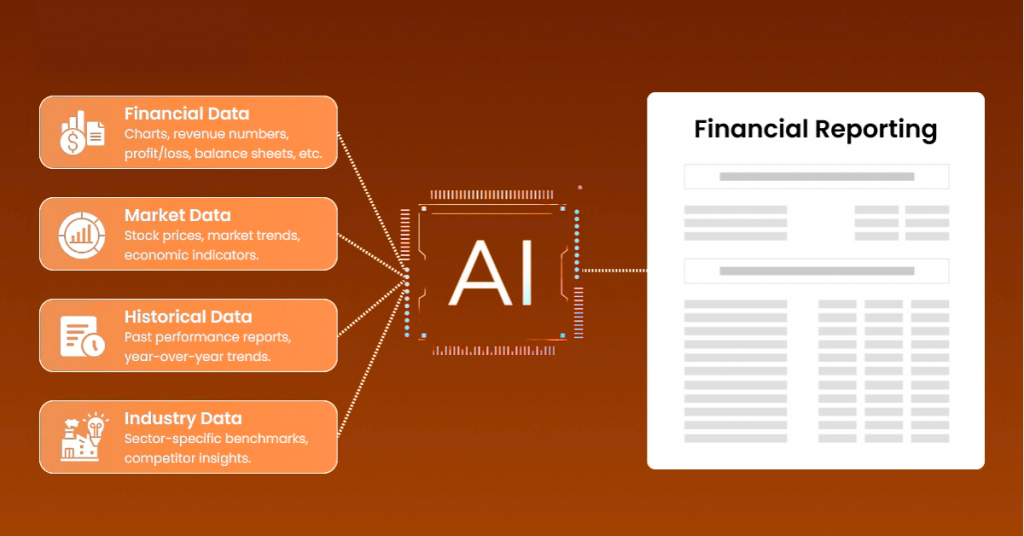
AI for financial reporting functions by mechanizing and streamlining each phase of the reporting process. It starts with collecting and consolidating data, where AI systems collect and consolidate financial information from various sources like ERP systems, CRMs, and spreadsheets, making it consistent and accurate.
After this by making use of AI-driven processing and analysis; machine learning algorithms will detect various patterns, identify anomalies while automating tedious tasks like reconciliations and categorizing transactions.
Lastly, during the report generation and visualization stage – AI solutions apply natural language generation (NLG) and sophisticated visualization processes to generate real-time financial reports and dashboards, displaying intricate data in lucid, actionable insights for better business decision-making.
Use Cases and Applications of AI in Financial Reporting
Whether it is automating monotonous processes or improving insights into the financial data, the role of AI in financial reporting is pretty significant. Here are some of the major use cases of AI in financial reporting.
1. Automating Repetitive Financial Processes
Artificial intelligence automates routine financial processes like – data entry, reconciliations, and journal postings, lowering manual labor and the chances of human errors. Automation means faster report generation, uniform accuracy, and improved efficiency in month-end or year-end closing processes. By taking care of these routine processes, AI helps the finance teams to spend more time on higher-value analysis, strategic planning, and decision-making instead of time-consuming administrative activities.
2. Improving Data Analysis and Insights
AI enables finance professionals to examine large sets of data with high accuracy and agility. Machine learning models identify patterns, outliers, and underlying relationships within financial data, providing profound insights into performance and profitability. Such insights enable companies to identify opportunities for – growth, align resources, and predict outcomes more effectively, turning data into actionable intelligence to make better strategic and operating decisions.
3. Enhancing Compliance and Risk Management
AI facilitates compliance by monitoring transactions and financial activities constantly against regulatory requirements and internal policies. Automated systems detect non-compliant or suspicious entries, enabling organizations to remain transparent and evade penalties. AI-based risk models also forecast future financial or operational risks, enabling companies to take preventive measures and fortify governance frameworks, thereby ensuring increased accountability and regulatory compliance.
4. Simplification of Audit Processes
AI transforms auditing by submitting evidence gathering, transaction verification, and outlier detection to automation. It allows auditors to process enormous amounts of financial information rapidly and with increased precision. Smart audit software can detect discrepancies or abnormal patterns that can potentially point to fraud or mistakes, greatly enhancing the efficiency and credibility of audits. This not only speeds up audit schedules but also fosters trust and compliance.
5. Optimizing Financial Planning & Analysis (FP&A)
Using AI-based FP&A solutions enables organizations to – forecast revenues, costs, and cash flows with greater precision. They are able to learn from historical trends and market experience to create scenario-driven models that are responsive and improve the precision of budgets and also responsiveness. Financial teams can compare strategies in real-time, this means quicker decision-making and more reactive financial management according to changing business circumstances.
6. Enhancing Financial Statement Accuracy
With AI financial reporting solutions there is greater accuracy in the reports. This is achieved through automated reconciliations between the data from various systems and identifying differences. It reduces human mistakes while consolidating, adjusting and classifying financial data. This means the balance sheets and income statements are more accurate. Through consistency and data integrity AI powered financial reporting software. This helps to ensure adherence to accounting standards such as GAAP and IFRS.
7. Real-Time Financial Reporting and Monitoring
With artificial intelligence in financial reporting the reports are changing from static and periodic to dynamic with real-time tracking. With smart dashboards monitoring transactions, giving performance indicators and analysing cash flows in real time decision makers are getting current insights into financial wellbeing. This makes it easier for the organizations to spot problems, shift strategies and react quickly to market changes or operational issues.
8. Advanced Financial Forecasting
AI enhances forecasting capabilities by employing predictive analysis that helps making predictions based on past and external sources of data. The data sources often include customer behavior, market conditions, and macroeconomic conditions. Machine learning algorithms improve and learn over time with changing conditions – hence making predictions more accurate with time. This allows organizations to predict revenue fluctuations, maximize the deployment of capital – and support long-term development strategic financial planning.
Benefits of AI in Financial Reporting
From improved accuracy in less time, boosted capabilities to substantial cost saving – here are some of the benefits of AI in financial reporting.
1. Greater Accuracy and Reliability
AI in financial reporting lowers the risk of manual errors by working on complicated data processing and validation activities. With machine learning you can identify inconsistencies, missing records and uneven data patterns in ledgers and financial statements. This provides more reliability in reporting and enhances audit readiness. Financial organizations can rely on the integrity of their figures – which in turn enhances investor trust and regulatory compliance.
2. Efficiency and Substantial Time Savings
Manual financial reporting takes hours to collect data, reconcile, and produce reports. AI eliminates these mundane workflows, significantly cutting turnaround time. Natural language generation (NLG) technology can even generate draft financial summaries automatically, freeing up finance teams hundreds of hours. Organizations are then able to devote this time to high-value activities like, strategic analysis and performance optimization instead of administrative tasks.
3. Better Analytical and Forecasting Capabilities
AI doesn’t so much automate as amplify insights. Machine learning-driven predictive analytics assist finance leaders in – anticipating trends, recognizing opportunities, and avoiding financial risks. Cash flow forecasting, expense optimization, and even tax planning – AI models can model multiple economic scenarios, enabling CFOs and business leaders to make strategic choices with greater assurance.
4. Scalability and Flexibility in Reporting
As companies grow across geographies and markets, the financial reporting grows more complex. AI facilitates scalable, adaptable reporting that can seamlessly accommodate multi-currency operations, regional regulatory requirements, and heterogeneous data sources. Cloud-based AI platforms facilitate effortless access and real-time collaboration among teams irrespective of scale or geography.
5. Manual Process Cost Reduction
By streamlining data entry, reconciliation, and report generation AI reduces operational expenses. Eliminating manual intervention means reduced labor costs and fewer error or delay-related costs. Moreover, since AI can continuous learning it supports increasing process efficiency over time – guaranteeing long-term ROI and continued cost savings.
6. Improved Decision-Making
AI converts financial information into actionable insights. By collecting data from multiple systems, using analytics, and displaying key performance indicators (KPIs) in real time, AI enables decision-makers to move more quickly and decisively. Executives have an accurate, 360° picture of financial health — facilitating nimble decision-making in rapidly changing market conditions.
7. Enhanced Collaboration and Transparency
AI-based platforms ensure data transparency with the help of centralized dashboards that are available to various stakeholders — finance and operations, innovation, management, and investors. It brings all these stakeholders together in collaboration, responsibility, and mutual awareness across departments. Additionally, AI-driven document management systems have version control and audit history so everyone is working from the most correct and current financial information.
AI Technologies Used in Financial Reporting
1. Machine Learning & Deep Learning
Machine learning programs allow systems to – recognize patterns, spot anomalies, and make inferences based on past financial data. Deep learning models improve the ability to predict – allowing companies to anticipate revenue, recognize fraudulent activity, and automate reconciliations. These technologies bring about ongoing improvement in financial accuracy and efficiency.
2. Natural Language Processing (NLP)
NLP enables AI systems to read and write human language, making finance communication more natural. Finance teams can use NLP- driven chatbots or assistants to ask sophisticated financial information with simple language. NLP tools can also generate narrative for financial reports, automatically – translating raw data into readable insights for stakeholders.
3. Robotic Process Automation (RPA)
RPA performs regular, rule-based accounting work like invoice processing, data mining, and compliance testing. RPA integrates perfectly with the existing accounting software and ERP solutions, performing repetitive tasks with accuracy and efficiency. With AI, RPA transforms into intelligent automation, able to make decisions, detect anomalies, and evolve workflows.
4. Predictive Analytics and Business Intelligence Tools
Predictive analytics solutions leverage historical information and statistical algorithms to predict – financial patterns and business results. When combined with BI dashboards, predictive analytics solutions offer visual, data-based insights to enable businesses to make anticipatory financial decisions. Combined, predictive analytics and BI enable finance leaders to spot nascent opportunities and avoid potential risks before they effect the bottom line.

Challenges in Adopting AI for Financial Reporting
> Data Privacy and Security Issues
Financial data is among the most sensitive data particularly within an organization. Being involved with AI increases the possibility of data privacy, unauthorized access, and data protection legislations like GDPR. Companies must have robust encryption, access control, and cybersecurity frameworks to safeguard financial data against, data breaches or unauthorized application.
> Integration with Legacy Systems
Almost all of the legacy organizations run on outdated accounting and ERP systems that do not conform to newer AI software. Integrating these systems proves challenging – requiring a great deal of effort to enable seamless data exchange. However, through the right middleware and API platforms, AI is able to be properly layered onto existing infrastructures without suspending business.
> Requirement of a Talented Workforce
Implementing AI requires a skilled workforce in – data science, analytics, and financial modeling. Not enough expertise can become a barrier to implementation. Companies need to invest in up-skilling finance professionals and combine the expertise of both – financial experts and data scientists to make the most of AI.
> The Need For Strong Governance Policies
AI finance modeling needs a clearly defined governance policies this ensures ethical usage, accuracy, and accountability. Without proper regulation there are chances that the AI models give biased or unpredictable results. Clear governance frameworks must be put in place by companies that define ownership, data integrity expectations, and audit processes for AI-driven financial reporting.
> Continuous Monitoring and Oversight
AI is not a point solution, it must be regularly monitored to stay accurate and relevant. Machine learning models must periodically be retrained to learn the evolving data patterns, regulatory changes, and market conditions. Constant monitoring guarantees AI systems provide consistent and predictable financial results.
Best Practices for Successful AI Adoption in Financial Reporting
1. Clear Strategy and Roadmap
A successful AI deployment starts with a clear strategy linked to organizational objectives. Companies need to determine precise pain points within their financial reporting process and create a roadmap that defines AI use cases, timelines, and forecasted ROI. Piloting projects first enables controlled experimentation prior to enterprise-scale adoption.
2. Effective Change Management
Adoption of AI can spur resistance within an organization because of – fear of job loss or process interruption. Successful change management requires – open communication, training initiatives, and stakeholder engagement. Instilling a culture of innovation enables teams to adopt AI as an enabler that supports human skills.
3. Collaboration Between Finance and Tech Teams
AI’s success in financial reporting depends on how finance experts and technology professionals work together. Teams can work together to design models that understand both financial logic and technical architecture. This will help in ensusring that AI tools give business-relevant, accurate, and actionable outputs.
4. Regular Evaluation and Optimization
Continuous evaluation is the secret to maintaining AI performance. Businesses must continually check for; accuracy, compliance, and ROI for AI tools. Constant updates, model retraining, and incorporation of fresh data streams ensure – peak system efficiency and reliability.
How A3Logics Can Assist?
As a leading technology partner with decades of experience in AI, data analytics, and enterprise software development, A3Logics helps organizations revamp their financial reporting infrastructure using cutting-edge AI solutions.
> End to end AI Development and Integration
A3Logics offers AI development services for financial reporting ranging from – strategy and model development to deployment and integration. Our experts ensure seamless automation and syncing of data across platforms – to enhance visibility and decision-making.
> Custom AI Agent Development
We develop AI agent in finance industry that perform routine finance functions such as – data verification, risk determination, reconciliation, and forecasting. The agents can run automatically report generation, anomaly detection, and compliance monitoring, maximizing human workload with increased speed and accuracy.
> Custom Finance Software Development
A3Logics is a leading provider of AI solutions – not only that but we provide best in class custom finance software solutions. Our services include cloud financial dashboards, predictive analytics solutions and automated reporting solutions. Every solution designed by us is customized to support your business objective ensuring scalability, security and adherence financial regulations.
Final Thoughts
Not only is AI revolutionizing financial reporting – but it’s also revolutionizing the whole finance industry. By automating sophisticated workflows, simplifying compliance, and revealing predictive insights – AI drives organizations to make – quicker, wiser, and more strategic financial decisions. However, successful adoption depends on the right combination of technology, expertise, and governance.
With A3Logics as your technology partner, you are sure to leverage AI’s potential to bring more accuracy and efficiency in financial reporting and business acumen to lead the way toward a responsive data-driven future.