The world of finances never stops for anyone, and one major part of this is the stock market. In the core of the stock market lies trading. Everyone wants to step into the world of trading; however, it is not easy. Watching the market for constant fluctuations, scrolling through thousands of stock market analyses is not possible. That is exactly why we need AI trading. Are you aware that around 70% of total trading volume in markets like the US is driven by algorithms? So, what exactly is AI trading, and what role of AI trading bots play in it? Before we delve into the intricacies of AI trading bots, let’s understand what AI trading is.
AI trading merges Artificial Intelligence functionalities into algorithmic trading mechanisms. AI trading robots possess the ability to process a tremendous amount of technical and fundamental market information in real time, pertaining to a broad range of financial markets such as stocks, commodities, bonds, indices, forex, and crypto.
These can execute a vast majority of activities ranging from historical price and volume study, assessment of risk, signal generation, entry and exit recommendation, strategy backtesting and trade execution. In this blo,g we have taken a look at the step by step process of how to build an AI trading bot, the benefits of AI in trading and what are the features that can make your AI trading bot stand out from the rest.
AI in Trading: Key Market Insights
The global AI in trading market is expanding rapidly, with forecasts projecting growth from $4.1 billion in 2023 to nearly $20 billion by 2030 with a CAGR 25%. The reason for this surge is driven by the need for faster trade execution, predictive analytics, risk management, and algorithmic decision-making. Individuals are now looking for trading solutions that are quicker to analyze and are more accurate when compared to the human counterparts.
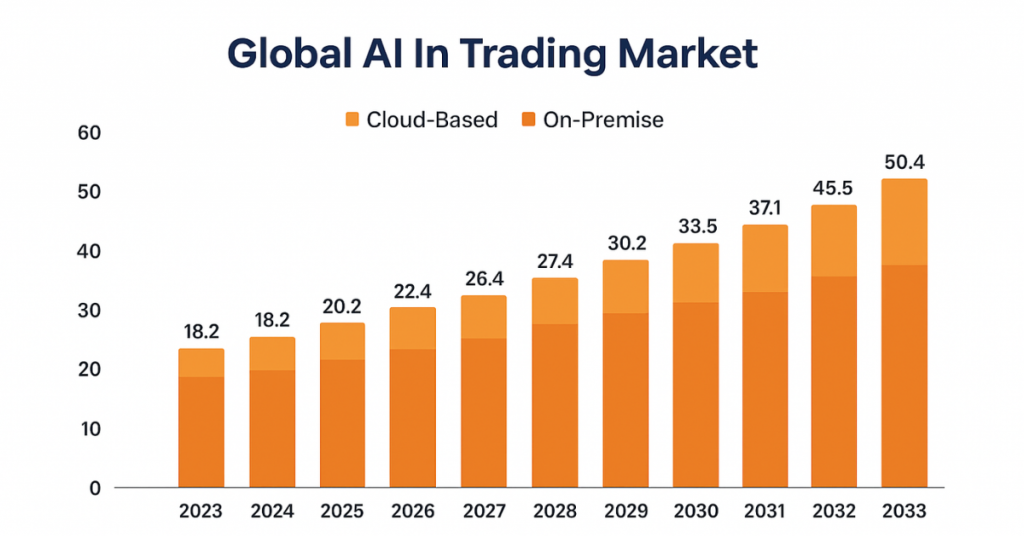
Both retail and institutional traders are embracing AI to gain competitive advantages. The retail investors leverage AI-powered trading apps and robo-advisors. Institutional firms depend on high-frequency trading, fraud detection, and advanced portfolio optimization. AI is changing the way we trade by enhancing efficiency, accuracy, and profitability.
AI trading bots are reshaping the trading by providing enhanced ROI, reduced costs and improved and agile cost management. Major financial bodies like Morgan Stanley and Bank of America are implementing AI tools for better productivity. JP Morgan was able to save a whooping $1.5 Billion and saw a 20% increase in wealth and asset management sales through AI efficiency.
Why AI Trading Bots Are Gaining Popularity
With people looking for better trading solutions, and AI rapidly taking over various industries the trading sector is not going to be left behind. With improved and accurate analysis AI trading bot are quickly gaining popularity. And here’s the reason for it.
1. 24/7 trading without human fatigue
There is no doubt that humans are very capable of making good trading decisions. And they have been doing it for years. However, there is a limit to human intellect and can get tired and make mistakes. AI does not get tired and with AI in trading playing a key role in decision making trading can continue 24/7 without getting tired.
2. Data-driven decision-making
Trading is a matter of timing and accuracy, and AI lives and breathes on data. AI trading robots have the ability to process enormous amounts of historical and real-time market data much quicker than any human being. This guarantees decisions are based on facts, trends, and predictive analysis instead of guesswork.
3. Less emotional bias in trades
Humans are generally emotional and the emotions determine the direction of our decisions. Controlling emotions is one of the most significant challenges in trading, fear, greed, or panic usually lead to expensive errors. AI trading robots eradicate this factor as they make decisions strictly based on logic and ensure disciplined and consistent trading patterns.
4. Scalability for various markets
Whether stocks, forex, crypto, or commodities, trading bots can easily scale and work in a variety of markets. This ability to scale offers traders the liberty to diversify and look at more possibilities without overcommitting themselves.
Core Features of an AI Trading Bot
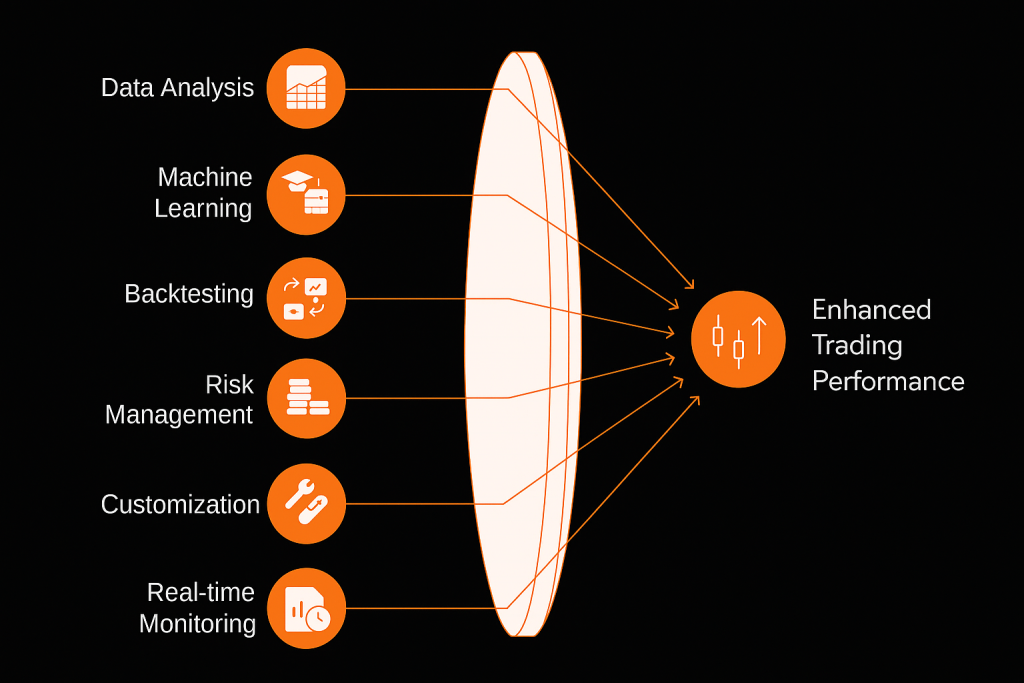
Trading bots are turning out to be a significant part of the trading industry. Any AI trading bot is incomplete without it’s features. Here is a list of core features that are a must have for any AI trading bot.
1. Data Analysis and Processing
AI trading robots are perfectly suited to coexist alongside massive amounts of – market data, digging deep into past trends and current data to execute well-informed trading orders. For instance, applications like DeepSeek utilize sophisticated AI models to browse financial data that enables improved strategy formulation and lower costs for the clients.
2. Machine Learning Algorithms
Machine learning enables AI trading robots to dynamically adjust strategy based on – prior performance and present market conditions. Products such as Altreva’s Adaptive Modeler employ agent-based modeling to reproduce market behavior so that dynamic realignment of strategies becomes straightforward.
3. Backtesting Capabilities
AI robots provide backtesting facilities that replicate strategies using historical data. The facility allows traders to test the performance of strategies in different market conditions before using them in live trading, thus providing improved risk management and precision.
4. Risk Management Tools
Sophisticated risk management capabilities enable AI robots to control exposure and contain losses. Stop-loss orders, position size, and risk alert notifications protect investment. DeepSeek’s AI solutions, for example, run around the clock for risk cues and provide instant analysis to protect the traders.
5. Customization Options
Trading robots for AI are configurable parameters and strategy, risk, and trade execution parameters can be adjusted by traders. The flexibility presents seasoned and new traders with the ability to make the bot behave in a manner that is acceptable to risk tolerance and goals.
6. Real-time Monitoring and Execution
AI trading robots monitor markets around the clock and execute trades immediately when specific conditions are met. The 24/7 operational mode is especially valuable on high-volatility markets like cryptocurrency, where opportunities exist all the time.
7. Sentiment Analysis
Some AI bots incorporate sentiment analysis through – monitoring news, social media, and popular mood to predict trends in the market. DeepSeek, for instance, combines sentiment insight with financial data to maximize trade choices.
8. Multistream Market Coverage
The multistream trading robots are able to trade several asset classes, i.e., stocks, forex, commodities, and cryptocurrencies. Multi-market coverage provides room for diversification of strategy and optimization of opportunity.
9. Automated Reporting and Analysis
AI trading robots also provide detailed reporting of performance, which informs traders regarding profitable trades, margins, and exposures. Software such as Altreva’s Adaptive Modeler provides end-to-end analysis to allow traders to prepare for enhancement.
10. API Integration
Cutting-edge artificial intelligence trading bots utilize cutting-edge trade platforms – through APIs to deliver seamless connectivity with brokerage accounts. The connectivity makes it easy to execute trades and keeps information in sync to make proper decisions.
Step-by-Step AI Trading Bot Development Process
In this section we have listed out the essential steps for creating an AI trading bot.
1. Consult Industry & AI Experts
Before creating the AI Trading Bot, the first and most important step is to confer with a respectable business like Ideausher. Before creating this product and joining the AI trading market, you can get appropriate guidance from their market researchers and developers. They may help you develop the ideal AI trading bot to introduce to the market by providing you with – market trends, competitor analysis, possible obstacles, and their solution.
2. Choose a Programming Language
Choosing the appropriate programming language is essential when developing an AI trading bot. Python is the most popular option because of its robust libraries, such as scikit-learn for machine learning, NumPy for numerical calculations, and Pandas for data manipulation. Additionally, deep learning-based prediction models can be created using PyTorch and TensorFlow. Java is used to create enterprise-level bots, whereas C++ is used for high-frequency trading.
3. Select a Trading Platform & Asset Class
Platforms that offer API access – such as Binance, Coinbase, Alpaca, and others, can improve the functionality of the bot and aid in identifying the asset class. For forex trading, MetaTrader (MT4/MT5) is a popular tool. Whether it’s stocks, forex, or cryptocurrency, asset selection dictates the data sources and technical indicators your bot will employ. Real-time market data retrieval and order execution depend heavily on RESTful and WebSocket APIs.
4. Set Up Development Environment
Use cloud platforms like – AWS, Google Cloud, and others to enhance the, scalability, storage, and security of your AI trading bot. Version control and code management are options both on GitHub and GitLab. Developers can utilize Docker for efficient distribution across multiple platforms. Finally – Jupyter Notebook is an excellent application for data analysis and model testing.
5. Define Trading Strategy
Strategies such as arbitrage, mean reversion, and momentum trading are instrumental in developing the perfect AI trading bot. Backtrader and QuantConnect are both great libraries for developing strategies for the purpose. For enhancing predictive analysis and training machine learning models; you can utilize historical data from Quandl, Yahoo Finance, and Alpha Vantage.
6. Implement Risk Management
Risk management limits losses and offers controlled exposure. Furthermore some strategies such as – portfolio diversification, position sizing, and stop-loss orders must be employed. AI-based risk assessment can utilize Monte Carlo simulations or Bayesian optimization. Cloud monitoring tools such as Prometheus and Grafana help monitor threats in real time.
7. Backtest & Optimize Strategy
Utilizing historical market data, backtesting helps one to compare the performance of a strategy. Some systems that can be used to do so include – QuantConnect, Zipline, and Backtrader. This process allows one to feed historical market data, prompts one to execute trades, and performs significant performance metrics like maximum drawdown and Sharpe ratio.
8. Deploy & Monitor in Live Markets
Make use of Jenkins or GitHub Action to deploy the AI trading bot on the live trading environment after the testing and verification. The bot is running in real time on the cloud server. Utilize Logstash and Kibana to monitor bot performance and monitor tools to – detect anomalies or function accurately in the face of market changes. AI and ML models can be retaught to enhance the performance of the models during live trading and adapt to shifting markets.
Cost of Developing an AI Trading Bot
There are various factors that can affect the cost to build a AI trading trading bot. Before you invest in one let’s understand the factors affecting the cost to build a AI trading bot.
- Feature Complexity – Predictive analytics and sentiment engines cost more than static rule logic.
- Exchange Integrations – Multi-exchange support offers specialized API processing.
- AI architecture requires more time to design and modify reinforcement learning models, whereas UI/UX interfaces include dashboards, user controls, and notifications.
- Security & Compliance – Mandatory encryption, KYC/AML layers, and logging.
- Ongoing Optimization – Costs associated with training updates, performance tuning, and support.
If you’re dealing with an experienced provider of AI Development Services, these factors are given out early in the scoping process.
AI Bot Development Cost
| Type of Bot | Ideal For | Estimated Cost |
| Starter Bot | Individual traders or early-stage startups | $10,000 – $20,000 |
| AI-Enabled Bot | Scaling teams or fintech firms | $20,000 – $40,000 |
| Enterprise Bot | Institutions, hedge funds | $60,000 – $150,000+ |
Emerging Trends in AI Trading Bots
1. Broader Take-Up by Retail Investors
There has been a boom in the use of trading platforms that specialize in AI algorithms such as DeepSeek, which Chinese retail investors use. It leverages AI in analyzing financial information, thereby enabling traders to make improved market strategies. This technology innovation brought about by DeepSeek is revolutionizing the game in China’s $700 billion hedge fund sector.
2. Use of Open-Source AI Platforms
The use of open-source AI platforms is coming on strong. DeepSeek is accompanied by the advantages of open-sourced AI tools, which have recently become popular among traders. The ease with which the tools can be accessed helps more traders deploy AI technology since they are more affordable and stimulate innovation. The limitation lies in the fact that these tools need to undergo major customization and solutions that fit the rules and regulations of the given country.
3. Enhanced Efficiency with Enhanced Volatility Risks
Though AI and its devices can enhance the level of liquidity in the market, there is a drawback to its hyper efficiency. When AI sifts through vast volumes of information, it raises the risk of competition in the market, leading to more marked volatility and liquidity risks. Investors and regulators must make sure that they are fulfilling these changing requirements.
4. Adoption by Major Financial Institutions
JPMorgan and Goldman Sachs have started utilizing AI to automate procedures, and they have demonstrated a boost in productivity. This is evidence of how these companies have been attempting to incorporate AI into their operations, thereby indicating that using advanced technology to trade is not an option anymore.
Popular AI Trading Bots in the Market
There are various AI trading bot available in the market, before we go ahead creating our own trading bot it is important to understand what makes the popular ones stand out.
1. Cryptohopper
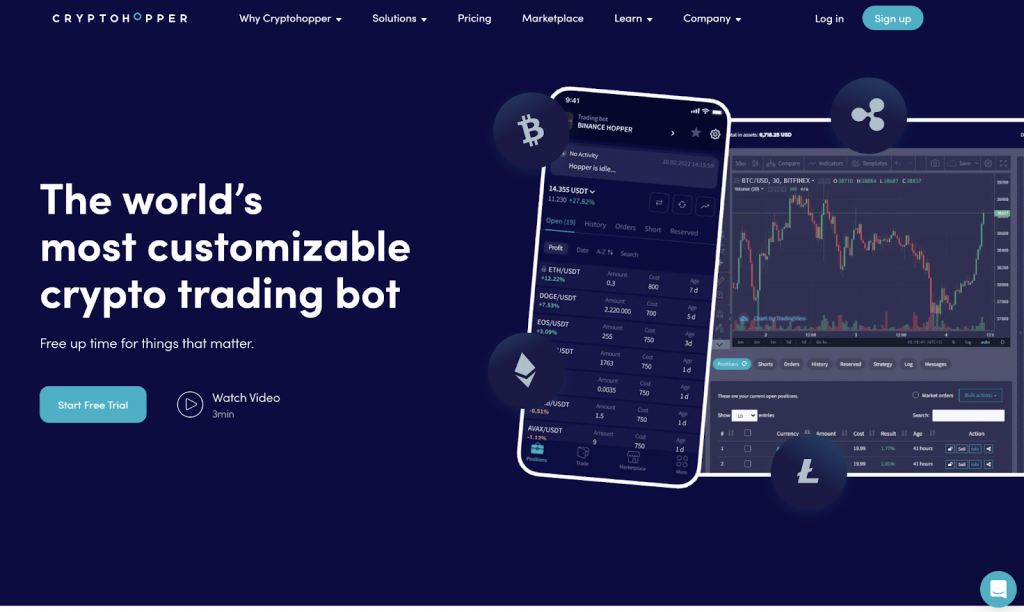
Cryptohopper is a web-based trading platform where one can automate cryptocurrency trading strategies. It incorporates algorithmic intelligence, copy trading, and strategy designer, and one can create and backtest their own trading strategies. Cryptohopper supports multiple exchanges and has beginner and pro trader tools.
2. 3Commas
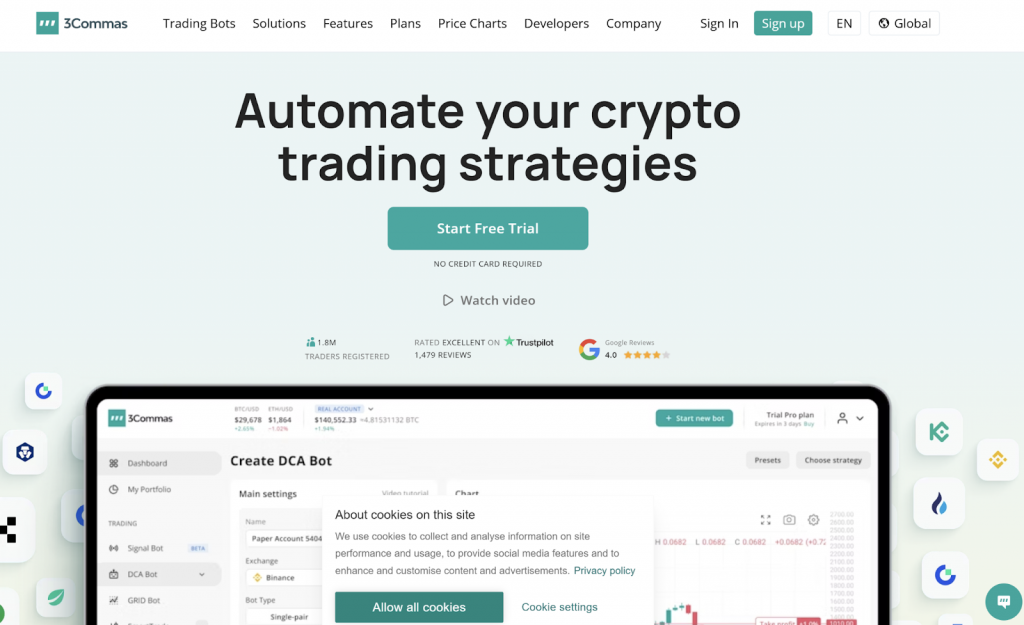
3Commas is designed to make trading processes simpler and reduce risk through the introduction of features like DCA bots (Dollar-Cost Averaging), grid bots, and option bots. It also introduces functionality by enabling users to include multiple varied cryptocurrency exchanges so users can trade and manage portfolios in a single platform. It also introduces functionalities like SmartTrade for individual manual trading with advanced-level options and a marketplace to trade on signals.
3. Tickeron
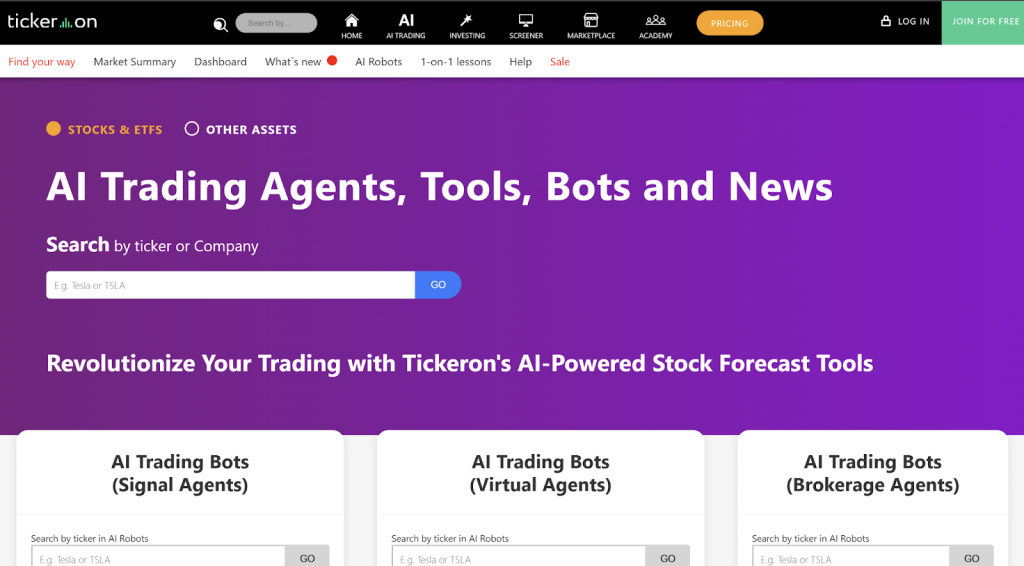
Tickeron offers artificial intelligence-based pattern detection and trend forecasting in multiple markets including stocks and cryptocurrencies. It offers real-time trade ideas, backtesting, and social sharing features focused towards traders and investors searching for data-driven strategies.
4. TrendSpider
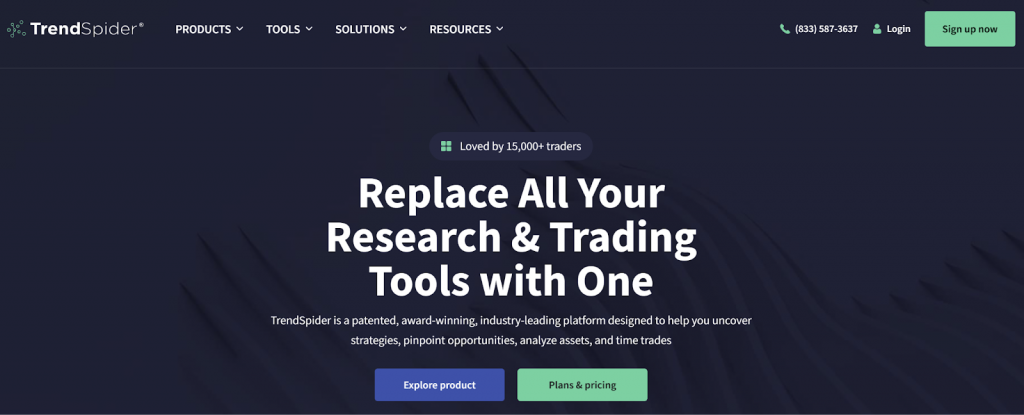
TrendSpider provides sophisticated technical analysis capabilities driven by AI – to help traders spot trends, patterns, and levels. It provides automated charting, dynamic price alerts, and multi-timeframe analysis, which is beneficial for traders who are extremely dependent on technical analysis in their strategy.
5. Pionex
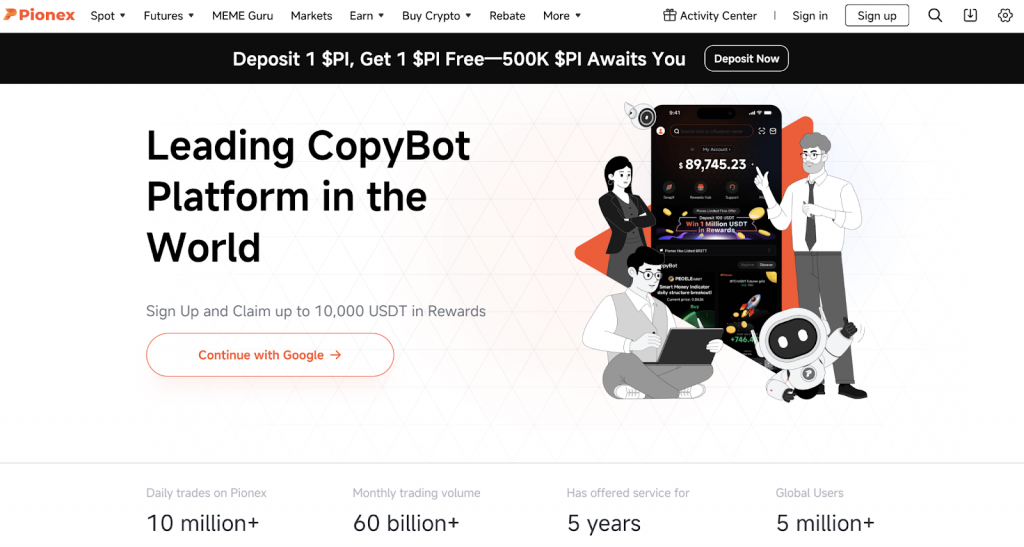
Pionex is unique in that it offers free, built-in trading bots for automated trading without an extra fee. It offers 16 types of trading bots, ranging from grid trading and DCA bots, depending on the market condition. As an exchange with built-in bots, Pionex makes trading easier for someone who requires automation of their trades.
Why Choose A3Logics for AI Trading Bot Development?
Let’s get real here — not every development partner is prepared for the volatility of code and markets. We don’t merely build bots at A3Logics. We engineer smart trading ecosystems for your strategy, data flow, and regulatory context. Here’s why decision-makers in fintech and capital markets trust us.
Expertise in AI Development Services & FinTech solutions – Our experts at A3Logics have more than two decades of experience in building solutions that are specifically tailored to the finance industry.
Secure, scalable development – We offer secure and scalable solutions that are feature rich and technology driven to ensure that your app is valid today and ready for the future.
End-to-end support from concept to deployment – Our job doesn’t just stop at building the app. Our team of dedicated experts provide continuous supports throughout the entire process and even after the launch.
Conclusion
One thing is fairly evident – the future of trading isn’t going to be manual, it will be intelligent, autonomous, and designed for speed. AI Trading Bot is no longer merely a competitive advantage — it’s rapidly on its way to becoming the new norm for platforms that wish to scale effectively and make more informed trades in real-time.
With the best team behind you, you can create an AI system that learns from the market, adjusts to risk, and doesn’t sleep. Whether you’re looking to bolt it on an existing exchange or starting a new platform, ensure that you’re working with a successful Trading software development firms like A3Logics who understands both AI architecture and the behavior of the market.
Need to scale quickly? Most of our partners prefer to staff chatbot developers who have expertise in AI in stock trading applications — not simple chatty scripts. And of course, there are seamless AI integration services that see your trading logic does not exist in a vacuum but is connected to live feeds, dashboards, compliance systems, and real-time alerts.